
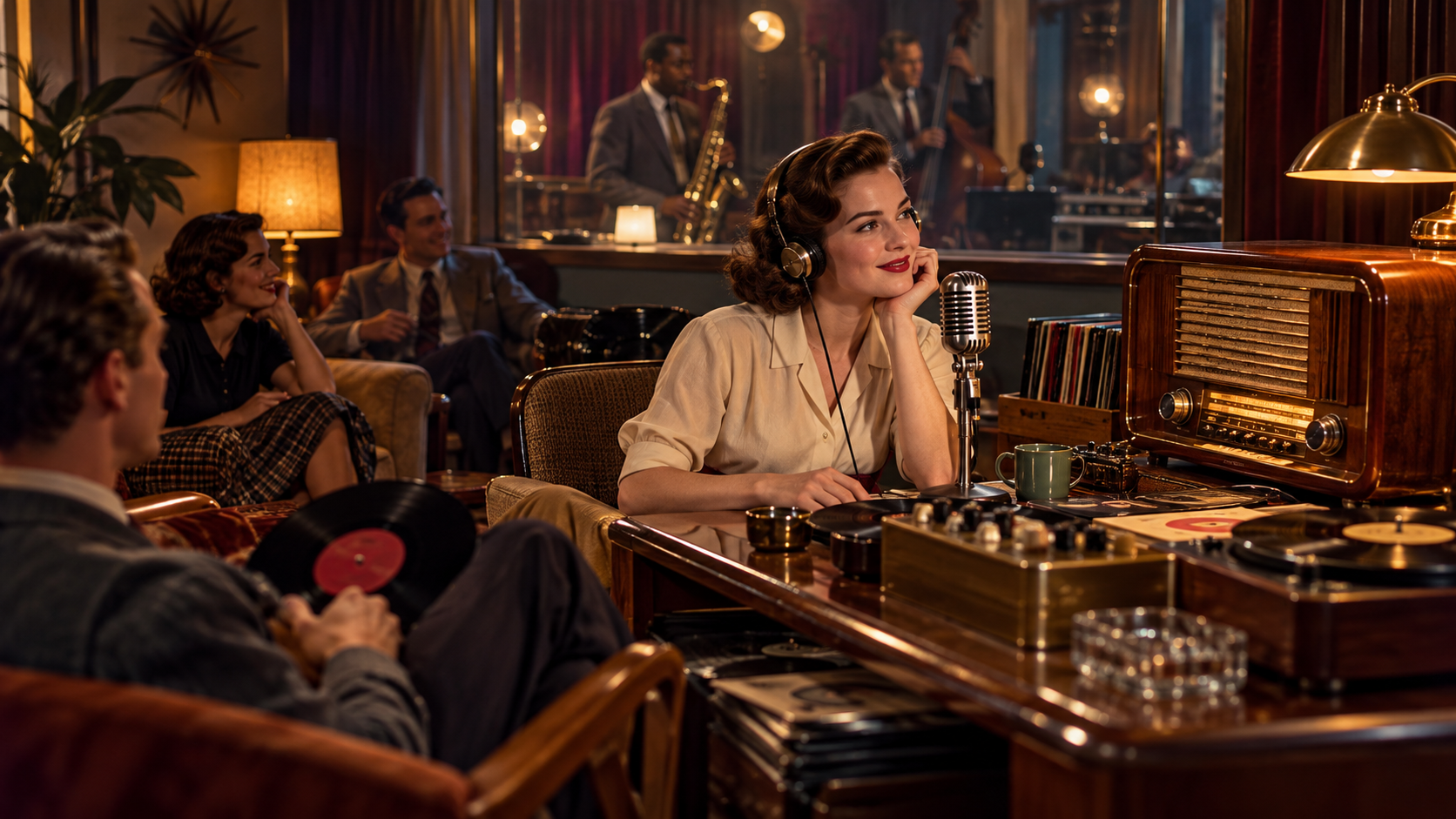
Imagine turning on an old radio in the middle of a quiet afternoon. A warm voice fills the room, backed by a piano, a soft rhythm section, and a melody that seems instantly familiar. A few minutes later, the mood changes. An electric guitar kicks in, the drums become louder, and suddenly the music feels made for dancing.
That contrast is part of what makes 1950s radio so enjoyable.
The decade is often remembered as the moment rock and roll captured the attention of young listeners. But the musical story of the 1950s is much bigger than one genre. It includes jazz musicians exploring new ideas, vocal groups creating unforgettable harmonies, country artists reaching new audiences, and rhythm and blues performers laying the foundations for sounds that would shape popular music for generations.
Listening to a 50s radio station today is like opening a window into that changing world. You hear familiar classics, but you can also discover songs that deserve another chance to be heard.
What Made 1950s Music So Different?
The 1950s were a period of change in popular music, particularly in the United States.
After World War II, new recording technologies, changing consumer habits, and the growing importance of teenage audiences helped reshape the music business.
The 45-rpm single became an important format for popular recordings. Radio stations could introduce new songs to large audiences, while jukeboxes brought music into diners, cafés, and other public spaces.
At the same time, musical styles that had developed over many years began reaching wider audiences.
Rhythm and blues, gospel, country, and earlier popular traditions influenced the emerging sound of rock and roll.
But older styles didn't disappear overnight.
A single radio playlist from the decade might move between traditional pop, jazz, country, doo-wop, and energetic rock and roll.
That's one reason 1950s music is so rewarding to explore. The decade contains several musical worlds living side by side.
Rock and Roll: The Sound That Changed Popular Radio
When people think of the 1950s, rock and roll is often the first thing that comes to mind.
The genre didn't appear suddenly. It grew from earlier musical traditions, particularly African American rhythm and blues, gospel, and blues, alongside country and other influences.
Artists such as Chuck Berry, Little Richard, Fats Domino, and Bo Diddley played major roles in shaping its sound and popularity.
Chuck Berry's guitar-driven songs combined memorable riffs with vivid storytelling. Little Richard brought explosive energy and a distinctive vocal style. Fats Domino blended rhythm and blues with an approachable, melodic sound.
Elvis Presley also became one of the decade's biggest popular-music figures, helping bring rock and roll to an enormous mainstream audience.
Why early rock and roll still feels exciting
Many classic rock and roll recordings are built around relatively simple arrangements.
A guitar riff, a strong rhythm, and an unforgettable chorus can be enough to carry an entire song.
But simple doesn't mean uninteresting.
Listen closely to the rhythm section. Notice how the piano, guitar, bass, and drums interact.
The energy often comes from the musicians playing together rather than from elaborate studio effects.
That directness is part of the music's lasting appeal.
Doo-Wop: When Vocal Harmony Took Center Stage
Not every memorable 1950s recording needed a loud guitar or a driving beat.
Doo-wop became known for its rich vocal harmonies, romantic themes, and memorable melodies.
The style developed largely within African American vocal-group traditions and became especially prominent during the 1950s.
Groups such as The Platters, The Drifters, and The Five Satins recorded songs that remain closely associated with the era.
Doo-wop arrangements often feature a lead singer supported by other voices singing harmonies and rhythmic syllables.
Sometimes the backing vocals almost become instruments themselves.
The beauty of a simple vocal arrangement
Listen to a classic doo-wop recording with headphones.
Try focusing on the voices behind the lead singer.
You may hear a bass vocal providing rhythmic support, higher harmonies filling out the melody, and carefully arranged phrases that make the chorus feel complete.
The production might be modest compared with modern pop recordings, but the musical detail can be remarkable.
For anyone who enjoys romantic ballads and expressive singing, doo-wop is one of the most rewarding parts of 1950s radio.
Jazz in the 1950s: A Decade of Extraordinary Creativity
While rock and roll was attracting new audiences, jazz musicians were continuing to explore increasingly sophisticated musical ideas.
The 1950s were an important period for cool jazz, hard bop, and other approaches to improvisation.
Miles Davis, John Coltrane, Thelonious Monk, and Art Blakey were among the influential musicians active during the decade.
Jazz recordings from this period can sound dramatically different from one another.
Some feature relaxed tempos and spacious arrangements. Others are intense, rhythmically complex, and full of improvisational energy.
A different way to listen
If you're used to pop songs built around verses and choruses, jazz may require a slightly different approach.
Instead of waiting for the main hook, follow the musicians' interaction.
Notice how a saxophone solo develops, how the pianist responds, or how the drummer changes the energy of a performance.
You don't need technical knowledge to appreciate it.
A little patience can reveal musical conversations that become more interesting with repeated listening.
The Romantic Ballads That Defined an Era
The 1950s also produced many popular songs built around expressive vocals and memorable melodies.
Artists such as Nat King Cole, Frank Sinatra, and Perry Como continued traditions of sophisticated vocal performance.
These recordings often featured orchestral arrangements, gentle rhythms, and lyrics about love, longing, or everyday emotion.
Some songs feel elegant and carefully polished. Others have an intimacy that makes them sound surprisingly personal.
This side of the decade is easy to overlook when rock and roll dominates the conversation.
But for listeners who enjoy classic love songs, 1950s radio offers an enormous amount to discover.
A station playing traditional pop and ballads can create a completely different atmosphere from one focused on early rock.
Both represent important parts of the decade.
Rhythm and Blues: The Foundation Behind Many Familiar Sounds
To understand 1950s popular music, it's essential to explore rhythm and blues.
R&B developed from earlier African American musical traditions and played a central role in the emergence of rock and roll.
Artists such as Ruth Brown, Big Joe Turner, and Ray Charles contributed to the genre's development and popularity.
Their recordings featured different combinations of blues feeling, gospel influence, energetic rhythms, and expressive vocals.
Some were designed for dancing. Others focused on emotional storytelling.
The influence of these musicians can be heard across later rock, soul, and pop recordings.
Learning about this history also helps correct a common misconception: rock and roll wasn't created by one performer or one community.
It emerged through a complex musical history in which Black artists played foundational roles.
Country Music and the Rise of Rockabilly
Country music was another important part of the 1950s musical landscape.
Artists such as Hank Williams, Patsy Cline, and Johnny Cash helped shape different aspects of the genre's sound and identity.
Rockabilly developed through a combination of country influences and rhythm and blues, becoming associated with energetic guitar playing and distinctive vocal styles.
Carl Perkins and Jerry Lee Lewis were among the performers connected with this sound.
Rockabilly recordings often have a lively, spontaneous quality.
The arrangements can be relatively simple, but the performances are full of character.
If you enjoy early rock and roll, exploring rockabilly is a natural next step.
What Did a 1950s Radio Sound Like?
When listening to original recordings from the decade, you may notice differences from modern music.
Many tracks were released in mono, meaning the sound was presented through a single audio channel rather than a modern stereo mix.
Recording methods and studio equipment also influenced the balance between instruments and vocals.
Some recordings place the singer prominently in front of the band. Others emphasize the rhythm section or create a fuller ensemble sound.
A remastered version may sound cleaner than an older transfer, but both can offer interesting listening experiences.
The important thing is not to judge every historical recording by modern production standards.
Instead, listen to how musicians used the technology available to them.
A strong performance can still feel immediate, even when the recording is decades old.
Why 1950s Radio Still Feels Special Today
Part of the appeal is nostalgia.
For some listeners, these songs bring back memories of family gatherings, old records, or music their parents and grandparents enjoyed.
For younger listeners, the attraction may be completely different.
The music can feel fresh precisely because it comes from another era.
A 1950s radio station also offers variety that a narrowly focused playlist might miss.
You could hear an energetic Chuck Berry recording, followed by a gentle Nat King Cole ballad, then a jazz performance that takes the music in an entirely different direction.
Those changes in mood are part of the pleasure.
And because radio introduces songs you haven't necessarily chosen yourself, it can lead to unexpected discoveries.
How to Find the Best 1950s Radio Stations Online
Not every station labeled 50s radio plays the same music.
Some focus on rock and roll, while others combine traditional pop, doo-wop, jazz, country, and rhythm and blues.
If you're looking for a particular sound, try searching more specifically.
Your musical taste Radio style to explore Energetic guitar music 1950s rock and roll Romantic vocal harmonies Doo-wop and oldies Instrumental improvisation 1950s jazz Classic love songs Traditional pop and vocal standards Blues-influenced music Vintage R&B Country and early rock RockabillyYou can begin browsing different musical styles through the 1LiveRadio online radio directory.
If you're interested in hearing how these sounds developed across earlier and later periods, the site's broader music discovery collection is another starting point.
Take your time with each station.
A single song doesn't always represent the broadcaster's full playlist.
The Artists Behind the Music Deserve Attention
One of the pleasures of exploring old radio recordings is discovering the people behind the songs.
You might recognize a famous chorus without knowing who wrote it or which musician played the memorable guitar solo.
A little research can reveal surprising connections.
For example, artists who influenced early rock and roll sometimes received less mainstream recognition than performers who later popularized related sounds.
Understanding those histories adds depth to the music.
The Rock & Roll Hall of Fame provides information about influential artists and the development of rock and popular music.
When a song catches your attention, try learning about its performers, songwriters, and recording history.
The more you explore, the more connections you'll begin to hear.
A Simple 1950s Listening Challenge
If you want to experience the decade's variety, try setting aside an hour for five different styles.
Spend the first ten minutes with early rock and roll.
Move into doo-wop and romantic vocal groups for another ten minutes.
Then explore jazz recordings from the decade.
After that, listen to rhythm and blues and notice how it connects with the rock recordings you heard earlier.
Finish with country or rockabilly.
Don't worry about choosing the most famous songs.
If you discover something unfamiliar, follow it.
You may find that your favorite part of 1950s music isn't the genre you expected.
Frequently Asked Questions
What is 50s radio?
50s radio refers to stations or programs featuring music from the 1950s. Depending on the station, playlists may include rock and roll, doo-wop, jazz, country, traditional pop, and rhythm and blues.
What music was popular in the 1950s?
Rock and roll became increasingly prominent, while traditional pop, jazz, country, R&B, and vocal-group music remained important.
Who were some famous 1950s musicians?
Chuck Berry, Little Richard, Fats Domino, Elvis Presley, Miles Davis, Ray Charles, and Nat King Cole were among the many influential performers active during the decade.
What is the difference between 1950s music and 1960s music?
The decades overlap musically, but the 1960s saw further developments in soul, rock, folk, pop, and studio experimentation. Many of those changes built on foundations established earlier.
Can I listen to 1950s radio online?
Yes. Many internet radio stations specialize in 1950s hits, vintage rock and roll, jazz, and other styles associated with the decade.
Why does 1950s music sound different from modern recordings?
Recording technology, studio techniques, instruments, and production practices have changed considerably. Many recordings from the 1950s were originally released in mono.
Is 1950s radio only for older listeners?
Not at all. Anyone interested in music history, classic melodies, or discovering influential artists can enjoy recordings from the 1950s.
Final Thoughts: The 1950s Still Have Plenty to Offer
The 1950s were not defined by a single sound.
They were years of musical change, when older traditions continued to develop and new styles reached increasingly large audiences.
Rock and roll brought excitement, doo-wop offered unforgettable harmonies, jazz musicians explored new ideas, and singers across several genres created recordings that remain moving today.
That's what makes 1950s radio worth exploring.
You can return to the songs you already know, but you don't have to stop there.
Give unfamiliar recordings a chance.
Listen to the rhythm, the voices, and the little details that make each performance different.
You might discover that a song recorded seventy years ago feels surprisingly close to home.
Reader comments
No comments yet. Start the conversation.
Leave a comment
Your email stays private. Comments appear after approval.