
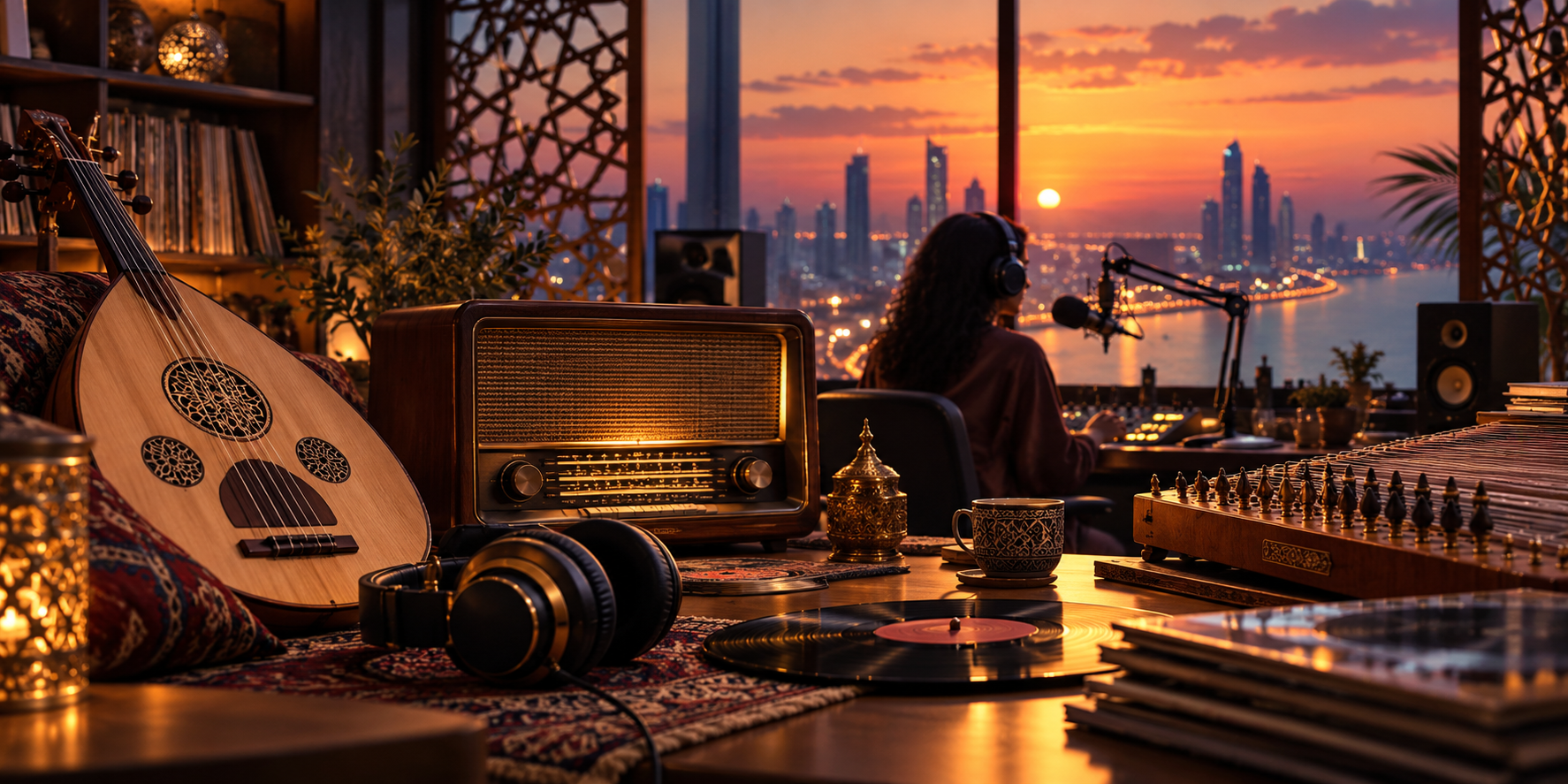
One moment, a singer holds a note so beautifully that the entire arrangement seems to pause around it. A few minutes later, the station moves to an energetic dance track with electronic percussion and a chorus that stays in your head.
Then comes a recording built around the oud, followed by a song featuring bright keyboards, a driving rhythm, and a completely different vocal style.
All of them might appear on Arabic music radio.
But they don't necessarily belong to the same genre.
Arabic-language music encompasses a remarkable variety of regional traditions, popular styles, historical recordings, and contemporary sounds. From the orchestral performances associated with classic Egyptian music to Algerian raï, Moroccan chaabi, Lebanese pop, and Khaleeji songs from the Gulf, there's no single arrangement that defines the entire category.
That's what makes exploring Arabic radio so rewarding.
You can discover familiar melodies, hear legendary performers, and encounter musical traditions you might never have searched for on your own.
Whether you understand Arabic or simply enjoy expressive singing and distinctive rhythms, there's plenty to explore.
What Is Arabic Music Radio?
Arabic music radio generally refers to stations that feature music performed in Arabic or associated with Arabic-speaking musical cultures.
However, the label can cover many different formats.
Some stations specialize in classic recordings.
Others focus on contemporary pop, regional folk traditions, romantic ballads, dance music, or a mixture of styles.
A broadcaster in Cairo may have a very different musical identity from one in Casablanca, Beirut, Riyadh, or Tunis.
Even stations within the same country can vary considerably.
One might emphasize nostalgic songs from earlier decades.
Another may play current chart releases and emerging artists.
The language provides a connection between many recordings, but it doesn't determine their instrumentation, rhythm, or artistic character.
For listeners, that diversity is an opportunity.
Instead of expecting one recognizable Arabic sound, approach each station as a doorway into a particular musical world.
The Rich History Behind Arabic Music
Arabic musical traditions have developed across centuries through cultural exchange, regional performance practices, and changing social environments.
Musicians have worked with different systems of melody, rhythm, poetry, and instrumental performance.
The oud, qanun, ney, and various percussion instruments have played important roles in many traditions.
But Arabic music has never been limited to one group of instruments.
Orchestral arrangements, electric guitars, synthesizers, drum machines, and digital production are also part of its modern history.
During the twentieth century, recording technology, cinema, and radio broadcasting transformed how music circulated.
Performers could reach audiences far beyond their home cities.
Songs became associated with films, national broadcasting networks, and shared cultural memories.
Later, cassette recordings, satellite television, and digital platforms created additional ways for music to cross borders.
Today's Arabic radio landscape reflects that long history of musical movement and change.
Egyptian Music: The Enduring Appeal of Classic Tarab
Egypt has played a major role in the history of Arabic popular music.
Cairo became an influential center for recording, cinema, broadcasting, and musical performance during the twentieth century.
Artists such as Umm Kulthum, Abdel Halim Hafez, and Mohamed Abdel Wahab became widely recognized across Arabic-speaking audiences.
Their recordings remain central to many classic Arabic radio formats.
Umm Kulthum and the art of musical expression
Umm Kulthum's performances are famous for their expressive vocal delivery and extended musical development.
A song may unfold gradually, with repeated melodic phrases taking on different emotional qualities.
Rather than simply repeating a line, the singer may change its timing, ornamentation, or intensity.
For listeners unfamiliar with this approach, the experience can be extraordinary.
The same phrase may return several times without feeling identical.
The details of the performance become part of the music's emotional power.
Abdel Halim Hafez and romantic songwriting
Abdel Halim Hafez became closely associated with romantic songs and Egyptian popular music.
His recordings demonstrate a different approach to vocal expression, often combining memorable melodies with carefully developed orchestral arrangements.
Listening to his work alongside Umm Kulthum reveals the variety within classic Egyptian music.
Both artists became major cultural figures, but their musical identities were distinct.
What Does Tarab Mean?
The term tarab is often associated with the emotional experience of music and the expressive interaction between performers and listeners.
It isn't simply a synonym for every old Arabic song.
Tarab can describe a powerful state of musical engagement, especially in traditions that emphasize melodic interpretation, improvisation, and expressive singing.
Listeners may respond strongly to a particular phrase or ornament.
A performer may repeat and develop a melodic idea, building emotional intensity through subtle variation.
Listen for the returning phrase
Choose a classic vocal recording and follow one melodic line.
Notice how it sounds the first time.
When it returns, pay attention to changes in rhythm, ornamentation, and vocal intensity.
The phrase may contain almost the same notes, yet communicate a different feeling.
This is one reason some classic Arabic performances reward uninterrupted listening.
Their emotional development can't always be captured in a short excerpt.
The Oud, Qanun and Other Instruments of Arabic Music
Traditional instruments remain important in many Arabic musical styles.
Each contributes a distinctive sound and performance technique.
Oud
The oud is a short-necked, fretless string instrument with a warm, resonant tone.
It can provide accompaniment, melodic introductions, and solo performances.
Its sound is closely associated with many Middle Eastern and North African musical traditions.
Qanun
The qanun is a plucked zither used in several regional musical traditions.
Its bright tone and expressive possibilities make it particularly effective in melodic passages.
Ney
The ney is an end-blown flute known for its breathy, expressive sound.
It appears in various musical traditions across the region.
Percussion
Instruments such as the darbuka and riq contribute rhythmic movement to many ensembles.
Their patterns can support delicate vocal passages or energetic performances.
Modern instruments
Arabic popular music also makes extensive use of violins, electric guitars, keyboards, synthesizers, bass guitars, and electronic percussion.
The presence of modern instruments doesn't make a recording less connected to Arabic musical culture.
Musicians continually adapt their sounds to new artistic possibilities.
Lebanese Music: From Fairuz to Contemporary Pop
Lebanon has contributed influential artists and recordings to Arabic popular music.
Fairuz remains one of the most recognizable voices in the region.
Her work with the Rahbani brothers helped create a distinctive musical catalog associated with poetic lyrics, memorable melodies, and carefully arranged performances.
Many listeners associate her recordings with mornings, nostalgia, and particular places or memories.
But Lebanese music extends far beyond one singer or period.
Artists such as Nancy Ajram, Elissa, and Wael Kfoury represent different approaches within contemporary Arabic popular music.
Listen to the contrast
Try moving from a classic Fairuz recording to a contemporary Lebanese pop song.
Notice how the production changes.
The older recording may emphasize acoustic instruments and orchestral textures.
The newer song may feature electronic percussion, polished vocal production, and a compact pop structure.
Both can be melodically expressive.
The differences reveal how musical tastes and recording techniques have evolved.
Algerian Raï: A Distinctive North African Sound
Raï developed in Algeria, particularly through musical activity associated with Oran and its surrounding region.
Its history involves social expression, regional performance traditions, and changing popular-music influences.
Over time, raï incorporated electric instruments, synthesizers, and modern studio production.
Artists such as Khaled, Cheb Mami, and Rachid Taha became important figures in bringing different forms of Algerian popular music to international audiences.
Their individual musical approaches shouldn't be treated as identical, but each offers an interesting listening path.
What makes raï memorable?
Many raï recordings combine expressive vocals with strong rhythmic accompaniment.
The melodies may be direct and emotionally charged.
Other tracks emphasize danceable grooves and energetic production.
Language can also be varied, with recordings reflecting the multilingual cultural environment of Algeria.
Raï demonstrates why Arabic music radio shouldn't be limited to one regional sound.
A classic Egyptian orchestral recording and an Algerian raï track may share some broad cultural connections while offering completely different listening experiences.
Moroccan Chaabi and the Sounds of the Maghreb
Morocco has a diverse musical landscape shaped by multiple languages, regions, and traditions.
Chaabi is an important part of Moroccan popular music, particularly in social celebrations and festive settings.
Depending on the artist and performance, it may feature expressive vocals, rhythmic accompaniment, and instruments associated with local musical practices.
Artists such as Abdelaziz Stati and Hajib are associated with well-known Moroccan chaabi repertoires.
Moroccan music also includes Gnawa, Andalusi traditions, Amazigh musical styles, and contemporary pop and hip-hop.
These traditions are not all Arabic-language music, and they shouldn't be reduced to a single category.
A useful listening comparison
Try listening to a Moroccan chaabi performance after an Algerian raï recording.
Pay attention to the rhythm, instrumentation, and vocal phrasing.
Both may be energetic, but their musical structures and performance traditions can differ substantially.
Exploring those contrasts makes regional radio especially interesting.
Khaleeji Music: Discovering the Sounds of the Gulf
Khaleeji is a broad term commonly used for popular music associated with the Arabian Gulf.
The category includes different local traditions and contemporary styles.
Artists such as Mohammed Abdu, Abdul Majeed Abdullah, and Ahlam are prominent names within Gulf popular music.
Khaleeji recordings often feature distinctive rhythmic approaches and vocal styles.
Some songs emphasize traditional poetic and melodic elements.
Others incorporate contemporary orchestration and electronic production.
Listen to the rhythm
When exploring Khaleeji music, pay attention to the percussion.
The rhythmic patterns may differ noticeably from those common in Egyptian or Levantine pop.
Also notice the vocal phrasing and the relationship between the melody and the lyrics.
These details help distinguish individual styles within the broader Gulf musical landscape.
Arabic Pop: A Sound That Keeps Changing
Contemporary Arabic pop includes artists working across many countries and musical influences.
Modern recordings may combine Arabic melodic approaches with electronic dance music, hip-hop, R&B, and international pop production.
Amr Diab is one of the most influential figures in modern Egyptian pop.
His recordings helped popularize combinations of Arabic melodies and contemporary pop arrangements.
Other artists have developed their own approaches, incorporating regional rhythms and changing production techniques.
What to listen for in modern Arabic pop
Start with the arrangement.
Is the rhythm built around electronic percussion?
Does the song use traditional instruments alongside synthesizers?
How does the singer approach the chorus?
Some recordings emphasize familiar pop structures.
Others retain longer instrumental introductions or more elaborate melodic phrasing.
The range is wider than a single genre label suggests.
Arabic Music Beyond the Mainstream
Popular hits are only one part of the Arabic-language music landscape.
Independent musicians, experimental artists, and regional performers continue exploring different approaches.
Some combine traditional instruments with electronic production.
Others draw on rock, jazz, hip-hop, or alternative music.
Local radio and specialist programming can introduce listeners to recordings that don't receive widespread international promotion.
This is one of the most valuable aspects of exploring music by station rather than relying only on familiar playlists.
You may discover an artist whose work doesn't fit neatly into a major commercial category.
And that discovery can lead you toward an entirely new musical scene.
Arabic Music and the Importance of Language
Arabic is spoken in many regional varieties, and musical performances reflect that diversity.
A song performed in Moroccan Darija can sound linguistically different from one in Egyptian Arabic, Lebanese Arabic, or a Gulf dialect.
Some artists use Modern Standard Arabic or more literary forms of expression.
Others combine Arabic with additional languages.
These choices affect vocal phrasing, lyrical style, and the listener's relationship with the song.
But language alone doesn't determine the genre.
Two songs performed in the same dialect may use completely different musical arrangements.
And two recordings from different countries may share musical influences.
What if you don't understand Arabic?
You can still appreciate the melody, rhythm, instrumentation, and vocal expression.
Try listening first without searching for a translation.
Notice how the singer shapes the phrases.
Then explore the lyrics if the song interests you.
Understanding the words may reveal additional layers of meaning, particularly in recordings built around poetry or storytelling.
How to Spend One Hour With Arabic Music Radio
If you're new to Arabic music, try a listening session that moves between different regions and styles.
Time Music to explore What to notice 0–10 minutes Classic Egyptian music Vocal expression and orchestration 10–20 minutes Lebanese classics Melody and poetic phrasing 20–30 minutes Algerian raï Rhythm and vocal energy 30–40 minutes Moroccan chaabi Percussion and festive arrangements 40–50 minutes Khaleeji music Regional rhythmic patterns 50–60 minutes Contemporary Arabic pop Production and modern influencesThis is only an introduction.
You could spend an entire hour exploring the recordings of Umm Kulthum or discovering one local musical scene.
The goal isn't to hear everything.
It's to find a sound that encourages you to listen further.
How to Find Arabic Radio Stations Online
When choosing an Arabic music station, think about the listening experience you want.
If you enjoy classic vocal performances, search for stations featuring old Arabic songs or tarab.
For contemporary music, explore Arabic pop and current-hits formats.
If you're interested in regional styles, look for stations specializing in Moroccan, Algerian, Egyptian, Lebanese, or Gulf music.
You can browse international radio options through the 1LiveRadio online radio directory.
For more guides to music genres and listening traditions, visit the 1LiveRadio music blog.
Different stations may use the same broad category while playing very different music.
Give each one time before deciding whether it suits your taste.
Why Radio Still Matters for Arabic Music
Radio has played a major role in the development and circulation of Arabic popular music.
During the twentieth century, broadcasting helped performers reach audiences across national borders.
Classic singers became familiar to listeners who might never have attended their concerts.
Radio also contributed to shared musical memories.
A particular song could become associated with a time of day, a family gathering, or an important personal experience.
Today, internet radio continues that tradition in a different form.
Listeners can explore stations from other countries without needing to live nearby.
For people living away from their home regions, familiar music can provide a meaningful connection with language and cultural memory.
For new listeners, the same stations offer opportunities for discovery.
Preserving Musical Traditions While Welcoming New Sounds
Arabic music continues to change.
New generations reinterpret older songs, experiment with production, and develop their own artistic identities.
At the same time, many performers and cultural organizations work to preserve important musical practices.
The relationship between tradition and innovation isn't always simple.
A modern recording may incorporate an older melodic approach without reproducing its original performance setting.
A traditional ensemble may use contemporary recording technology while maintaining established musical practices.
Both can contribute to a living musical culture.
For readers interested in the cultural significance of regional musical traditions, the UNESCO Intangible Cultural Heritage website offers information about recognized practices and the communities associated with them.
Learning about the histories behind particular musical forms can deepen the listening experience.
The Small Details That Make Arabic Music Memorable
The most memorable part of a song isn't always the chorus.
Sometimes it's the introduction.
An oud begins a melodic phrase.
A violin answers it.
The singer enters softly, then gradually adds intensity.
In another recording, a percussion pattern creates energy before the main melody arrives.
These details are worth noticing.
Try listening to one unfamiliar Arabic song twice.
On the first listen, enjoy the overall performance.
On the second, focus on a single element.
Follow the rhythm.
Listen to the instrumental responses.
Notice how the singer changes the melody from one phrase to the next.
You may discover that a recording becomes more interesting each time.
Frequently Asked Questions
What is Arabic music radio?
Arabic music radio refers to stations featuring Arabic-language music and related regional styles, including classic songs, contemporary pop, tarab, raï, chaabi, and Khaleeji music.
Is Arabic music one genre?
No. Arabic music includes many different musical traditions and popular styles. Language alone doesn't define the arrangement, rhythm, or artistic approach.
Who are some famous Arabic singers?
Umm Kulthum, Abdel Halim Hafez, Fairuz, Mohammed Abdu, Amr Diab, Khaled, and many others are influential performers associated with different regional musical traditions.
What is tarab in Arabic music?
Tarab refers to an intense emotional experience of musical performance and listening, often associated with expressive singing and melodic interpretation.
What is the difference between raï and chaabi?
Raï is strongly associated with Algerian musical history, particularly Oran. Chaabi is a term used for popular musical traditions in different North African contexts, including Morocco. Their histories and musical characteristics vary.
What instruments are common in Arabic music?
Depending on the tradition, instruments may include oud, qanun, ney, violin, darbuka, riq, keyboards, electric guitars, and other acoustic or electronic instruments.
Can I listen to Arabic radio online?
Yes. Internet radio directories and broadcasters provide access to Arabic music stations featuring different countries, genres, and generations of artists.
Is Arabic music the same as Turkish Arabesk?
No. Turkish Arabesk is a distinct popular-music tradition with its own history, although it has developed through various regional musical influences.
Final Thoughts: Follow the Music Beyond the Label
Arabic music radio is worth exploring because it refuses to fit into one simple description.
A classic Egyptian performance can unfold slowly through expressive singing and orchestral detail.
A Moroccan chaabi recording may create a festive atmosphere through rhythm and collective energy.
An Algerian raï track can combine emotionally direct vocals with dance-oriented production.
And a contemporary Arabic pop song may bring familiar melodic ideas into a completely modern arrangement.
Each deserves to be heard on its own terms.
Start with the artists you recognize, but leave room for unfamiliar voices.
Explore different regions, musical periods, and radio formats.
Pay attention to the melodies, instruments, rhythms, and small performance choices that give each recording its identity.
The next song may come from a country you've never visited or a musical tradition you've never explored.
Give it a chance.
You might discover a new favorite.
Reader comments
No comments yet. Start the conversation.
Leave a comment
Your email stays private. Comments appear after approval.