
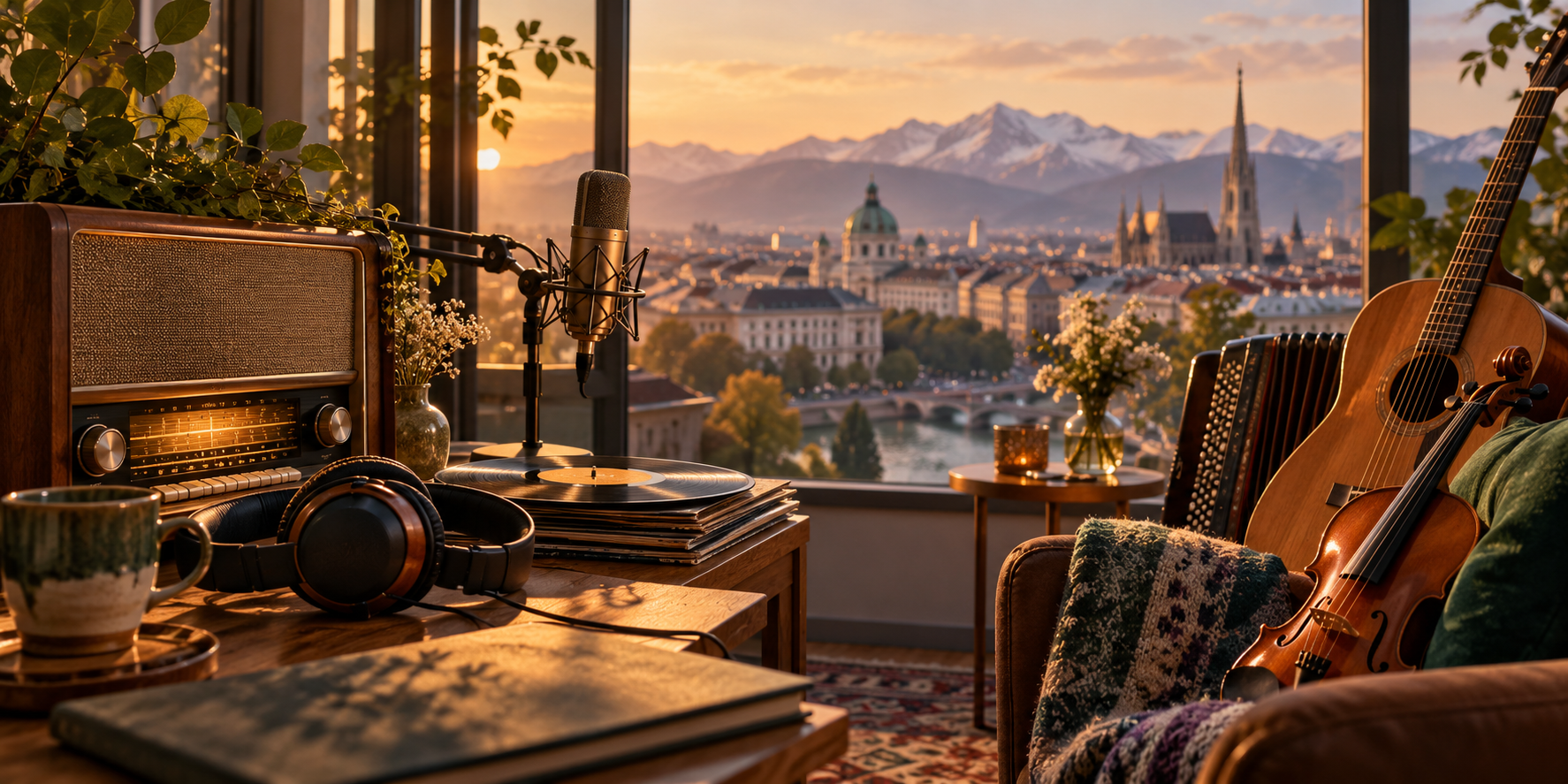
A song comes on the radio with a familiar rock arrangement, but the singer's phrasing sounds different from what you usually hear on international stations. The lyrics are in German, perhaps colored by an unmistakably Austrian accent. The next track is electronic, followed by an older recording that sounds like a conversation set to music.
The station is labeled Austro.
What exactly does that mean?
Unlike clearly defined genres such as jazz or reggae, Austro music radio is not a universally standardized musical category. Depending on the broadcaster, the label may refer to Austrian artists, German-language music from Austria, classic Austropop, or a broader collection of locally associated sounds.
That flexibility makes the category interesting.
Austria has produced internationally recognized pop musicians, influential singer-songwriters, alternative rock bands, electronic producers, and performers working within regional traditions.
Some artists are strongly associated with Austrian identity and dialect. Others create music intended for international audiences.
The best way to explore Austro radio is to listen to the specific songs being played, then follow the artists and styles that catch your attention.
What Does Austro Mean in Music?
The prefix Austro- generally refers to Austria or something Austrian.
In music discussions, it often appears in the term Austropop, a broad label associated with Austrian popular music, particularly German-language pop and rock.
But Austro and Austropop aren't automatically interchangeable.
A radio station labeled Austro might focus on classic Austrian-language hits. Another might feature contemporary Austrian artists across several genres.
A third could mix Austropop with Schlager, folk-related styles, or international recordings by Austrian musicians.
Because the category is flexible, its meaning depends on the station's programming.
Start with what you actually hear
Before deciding what kind of music a station plays, listen for a few basic details.
Is the singing in German, English, or another language?
Do the songs emphasize acoustic instruments, rock guitars, electronic production, or dance rhythms?
Are the recordings mostly older hits or contemporary releases?
Those observations will tell you more about the station than the category name alone.
Austropop: The Sound Most Closely Associated With Austro
Austropop is one of the most recognizable terms in Austrian popular-music history.
The label became especially prominent during the 1970s, when musicians developed pop and rock songs with strong connections to Austrian language, culture, and everyday experience.
Rather than simply copying international English-language rock, many artists used Austrian German and regional expressions.
Their lyrics often explored relationships, social observations, humor, identity, and ordinary life.
Musically, Austropop was never completely uniform.
Some recordings leaned toward folk-influenced songwriting.
Others embraced rock, pop, blues, or later electronic influences.
Why language mattered
Using Austrian German and local expressions gave many songs a distinctive character.
Listeners could recognize places, attitudes, and ways of speaking associated with their own environment.
The result wasn't necessarily traditional music.
It was contemporary popular music that reflected a particular cultural setting.
That connection remains an important part of Austropop's appeal.
Wolfgang Ambros and the Early Austropop Sound
Wolfgang Ambros is one of the major figures associated with Austropop.
His early recordings helped establish the possibilities of popular songwriting in Austrian German.
Songs such as Da Hofa became important within the development of the genre.
Ambros's music often combines direct storytelling with memorable melodies and rock-oriented arrangements.
What to listen for
Begin with the vocal delivery.
Rather than treating the words as interchangeable pop lyrics, notice how the singer's phrasing contributes to the song's personality.
The rhythm of the language becomes part of the music.
Then listen to the accompaniment.
Acoustic instruments, guitars, and a relatively direct arrangement can allow the storytelling to remain central.
For listeners who understand German, the lyrics add another dimension.
For those who don't, the performance still offers plenty to appreciate.
Georg Danzer: Storytelling and Musical Personality
Georg Danzer was another important Austrian singer-songwriter associated with the Austropop tradition.
His recordings often emphasized storytelling, social observation, and distinctive lyrical perspectives.
Danzer's musical identity was different from that of Wolfgang Ambros, even though both are commonly discussed within Austropop.
That contrast is useful for new listeners.
A genre label can connect artists historically without making their songs sound identical.
Listen to the narrative
Some singer-songwriters build their music around the progression of a story.
The instrumental arrangement supports the words rather than competing with them.
Even without understanding every lyric, you can notice how the singer changes tone, pacing, and intensity.
If a recording interests you, looking up a translation can reveal details that aren't immediately obvious from the melody alone.
Rainhard Fendrich and the Popular Side of Austropop
Rainhard Fendrich became one of Austria's best-known popular musicians.
His work includes songs that combine accessible melodies with lyrics connected to Austrian cultural life.
I Am from Austria became particularly well known and is strongly associated with expressions of Austrian identity.
But Fendrich's catalog contains a wider range of musical moods and subjects.
Some recordings are reflective.
Others are humorous, energetic, or more directly pop-oriented.
Why familiar songs remain important
For listeners who grew up hearing these recordings, Austropop can carry strong personal associations.
A song might recall a particular decade, family gathering, or place.
For international listeners, the same music can offer a new perspective on Austrian popular culture.
Both experiences are valid.
The music works as entertainment, but it can also provide a window into the social environment in which it became popular.
Falco: Austria's International Pop Icon
Falco is one of the most internationally recognizable Austrian musicians.
His recordings combined pop, rock, electronic production, and a distinctive vocal approach that often moved between singing and rhythmic speech.
Rock Me Amadeus became an international hit and reached number one on the US Billboard Hot 100 in 1986.
The song introduced many listeners outside Austria to Falco's unusual style.
But his musical identity extends beyond that one recording.
What makes Falco distinctive?
Falco's performances frequently rely on rhythmically precise vocal phrasing.
The relationship between language and beat is especially important.
He moved between German and English in ways that became part of his recognizable sound.
His arrangements also reflected changing developments in pop and electronic music.
Listen to the production as well as the voice.
Synthesizers, percussion, basslines, and studio effects contribute to the atmosphere.
Falco demonstrates how an Austrian artist could develop a distinctive identity while participating in international popular music.
Austria Beyond Classic Austropop
Austrian music didn't stop developing after the major Austropop artists established their reputations.
New generations have explored alternative rock, indie pop, hip-hop, electronic music, and experimental styles.
Some artists continue to use Austrian German or dialect.
Others sing in English or create instrumental music.
That variety matters when choosing an Austro radio station.
A broadcaster dedicated to nostalgic Austropop may sound very different from one featuring contemporary Austrian releases.
Both can offer worthwhile listening experiences.
Austrian Indie and Alternative Music
Austria has an active independent and alternative music landscape.
Bands such as Bilderbuch and Wanda have attracted attention through distinctive approaches to songwriting and performance.
Bilderbuch's music has incorporated elements of indie rock, pop, funk, and electronic production.
Wanda became known for guitar-driven songs and an expressive performance style.
The bands don't sound alike, but both illustrate how Austrian popular music continued developing beyond earlier Austropop conventions.
Listen for the differences
Choose a contemporary Austrian indie recording and compare it with a classic Austropop song.
Notice the production.
Are the guitars more prominent?
Does the song rely on electronic textures?
How does the singer use language?
You may hear connections to earlier Austrian songwriting traditions, but also clear differences in musical style.
Austrian Electronic Music and the Vienna Connection
Austria has also contributed important artists to electronic music.
Vienna became associated with influential electronic production during the 1990s and beyond.
Kruder & Dorfmeister are particularly well known for their work involving downtempo, remix culture, and electronic music.
Their recordings and mixes helped shape an internationally recognized atmospheric sound.
Other Austrian producers have explored techno, house, experimental electronics, and related styles.
Austro doesn't always mean German-language vocals
Electronic music provides a useful reminder that national musical categories don't necessarily depend on language.
An instrumental recording by an Austrian producer may belong to the country's musical landscape even without lyrics.
A station featuring Austrian electronic artists could therefore sound completely different from one dedicated to classic Austropop.
The category describes a connection to Austria, not one fixed musical arrangement.
Austrian Folk Traditions and Popular Music
Austria has diverse regional musical traditions.
These include different forms of folk music, dance music, and performances associated with particular communities and occasions.
Instruments such as the accordion, zither, and various brass instruments appear in different musical settings.
However, Austrian folk music shouldn't be treated as identical to Austropop.
The two can influence one another, but they have distinct histories and performance contexts.
What about Schlager?
Schlager is a broad German-language popular-music category associated with accessible melodies and familiar song structures.
It has a significant audience in Austria and neighboring countries.
Some Austrian radio stations may mix Schlager with Austropop and other popular styles.
But not every Schlager recording is Austropop, and not every Austropop song belongs to Schlager.
When browsing stations, checking the actual playlist is more useful than relying entirely on overlapping genre labels.
The Role of Austrian German and Dialect
Language is one of the most interesting features of Austrian popular music.
Standard German and regional Austrian varieties can sound different in pronunciation, vocabulary, and rhythm.
Some singers deliberately emphasize local speech patterns.
Others use a more internationally accessible vocal style.
These choices can shape the musical identity of a recording.
You don't need to understand every word
If you don't speak German, begin with the melody and rhythm.
Notice how the singer emphasizes particular syllables.
Listen to the way the vocal line fits around the instruments.
If the song catches your attention, look for a reliable translation.
The lyrics may reveal humor, local references, or social observations that weren't obvious on the first listen.
But even without a translation, the musical performance can be engaging.
Austropop Versus Austrian Pop: What's the Difference?
These terms are related, but they don't always mean exactly the same thing.
Category General meaning Typical listening focus Austropop A broad tradition of Austrian popular music, especially associated with German-language pop and rock Lyrics, melody, cultural identity Austrian pop Contemporary or historical pop music by Austrian artists Songwriting and production Austrian indie rock Independent and alternative guitar-oriented music from Austria Guitars, vocals, arrangements Austrian electronic music Electronic recordings by Austrian producers and artists Rhythm, texture, production Austrian folk music Diverse regional musical traditions Instruments and performance practices Austrian Schlager Austrian artists working within broader Schlager styles Melodic hooks and accessible arrangementsThese categories can overlap.
An artist may move between styles during a career.
A radio station may also combine several formats.
That's why it's worth listening before deciding what a category means in practice.
Five Austrian Artists Worth Exploring
If you're new to Austrian popular music, these artists provide contrasting starting points.
1. Wolfgang Ambros
Explore his early Austropop recordings for direct songwriting and a distinctive Austrian vocal character.
2. Georg Danzer
Listen for storytelling, lyrical personality, and carefully shaped performances.
3. Rainhard Fendrich
A useful introduction to melodic Austropop and songs associated with Austrian popular culture.
4. Falco
Discover a distinctive combination of pop, electronic production, and rhythmically expressive vocals.
5. Bilderbuch
Explore a more contemporary approach to Austrian pop and alternative music, with varied influences and production choices.
These artists aren't a complete history of Austrian music.
They're a starting point for discovering different generations and approaches.
How to Spend One Hour With Austro Music Radio
An hour of Austrian music can move from classic songwriting to contemporary production.
Here's one possible listening journey.
Time What to explore What to notice 0–10 minutes Early Austropop Austrian German and storytelling 10–20 minutes Georg Danzer or Wolfgang Ambros Vocal personality and arrangements 20–30 minutes Rainhard Fendrich Melody and accessible pop songwriting 30–40 minutes Falco Rhythmic vocals and electronic production 40–50 minutes Contemporary Austrian indie Guitars and changing musical influences 50–60 minutes Austrian electronic or regional music Instrumental textures and stylistic contrastsYou don't need to follow the timetable exactly.
If a particular artist catches your attention, explore more of their recordings.
The purpose is to discover which musical styles you enjoy.
How to Find Austro Radio Stations Online
If you're looking for Austro music, try searching with more specific terms.
Austropop may help you find stations emphasizing classic Austrian popular music.
Austrian pop or Österreichische Musik may lead toward broader programming.
If you enjoy older recordings, look for nostalgic Austrian hits.
For contemporary music, explore stations featuring Austrian indie, rock, or electronic artists.
You can begin browsing international broadcasters through the 1LiveRadio online radio directory.
For more genre guides and listening ideas, explore the 1LiveRadio music blog.
Because Austro isn't a universally fixed radio format, the station's description and playlist are especially important.
Why Local Radio Matters for Austrian Music
International music platforms often emphasize artists with the broadest commercial reach.
Local radio can offer a different perspective.
An Austrian broadcaster may feature regional performers, local-language recordings, and artists who are less familiar to international audiences.
Some stations focus on well-known classics.
Others introduce contemporary musicians and new releases.
This can help listeners discover music beyond the most internationally recognized names.
Radio also provides a sense of musical context.
Hearing several Austrian artists together can reveal shared influences, differences between generations, and changing production styles.
The result is often more interesting than listening to one isolated hit.
The Cultural Importance of Austropop
Austropop became meaningful partly because it reflected Austrian language and everyday experience within contemporary popular music.
The movement demonstrated that artists could create distinctive songs without abandoning local cultural references.
That connection helped some recordings become closely associated with particular generations.
It also created opportunities for musicians to explore social themes, humor, and personal storytelling.
For readers interested in Austria's wider musical and cultural background, the Austria National Tourist Office offers general information about Austrian culture, destinations, and musical heritage.
Understanding the environment surrounding a musical tradition can make individual recordings more meaningful.
The Small Details That Make Austro Music Memorable
Austrian popular music can be rewarding for reasons that have little to do with genre labels.
A singer delivers a line with unmistakable personality.
A guitar arrangement supports a story without overwhelming it.
A pop recording uses an unexpected rhythmic phrase.
Or an electronic track creates an atmosphere that feels completely different from the previous song.
These details are what make individual recordings memorable.
Try listening to an unfamiliar Austrian song twice.
On the first listen, focus on the overall mood.
On the second, pay attention to the arrangement.
Notice the voice, instruments, and production choices.
You may discover that the song becomes more interesting when you stop worrying about whether it fits a particular label.
Frequently Asked Questions
What is Austro music?
Austro is an ambiguous musical label that generally suggests a connection with Austria. On radio, it may refer to Austropop, Austrian artists, or a broader selection of Austrian music.
What is Austropop?
Austropop is a broad term associated with Austrian popular music, particularly German-language pop and rock that developed prominently during the 1970s.
Who are famous Austropop artists?
Wolfgang Ambros, Georg Danzer, Rainhard Fendrich, and Falco are among the influential figures associated with Austrian popular music.
Is Falco considered Austropop?
Falco is frequently discussed within the wider history of Austrian popular music and Austropop, although his distinctive international pop style differs from earlier singer-songwriter traditions.
Is Austro music always sung in German?
No. Austrian artists perform in German, English, and other languages. Some Austrian music is entirely instrumental.
What is the difference between Austropop and Schlager?
Austropop is associated with Austrian popular-music traditions, while Schlager is a broader German-language popular-music category. They can overlap, but they aren't identical.
Can I listen to Austro radio online?
Yes. Online radio directories and broadcasters may feature Austropop, Austrian pop, nostalgic hits, and other Austrian music formats.
How can I discover modern Austrian artists?
Try stations featuring Austrian indie, alternative rock, electronic music, and contemporary local releases.
Final Thoughts: Follow the Austrian Sound That Interests You
Austro music radio doesn't need one rigid definition to be enjoyable.
One station may introduce you to classic Austropop songwriting.
Another might play Falco, contemporary indie bands, or electronic music from Vienna.
The recordings may differ considerably, but each offers a perspective on Austria's musical landscape.
Start with the familiar names, then explore the artists you haven't heard before.
Listen to the language, instruments, rhythm, and production.
Pay attention to the small choices that give each recording its character.
And if a station labeled Austro plays something unexpected, don't assume it doesn't belong.
Take a moment to listen.
You may discover a new favorite sound from Austria.
Reader comments
No comments yet. Start the conversation.
Leave a comment
Your email stays private. Comments appear after approval.