
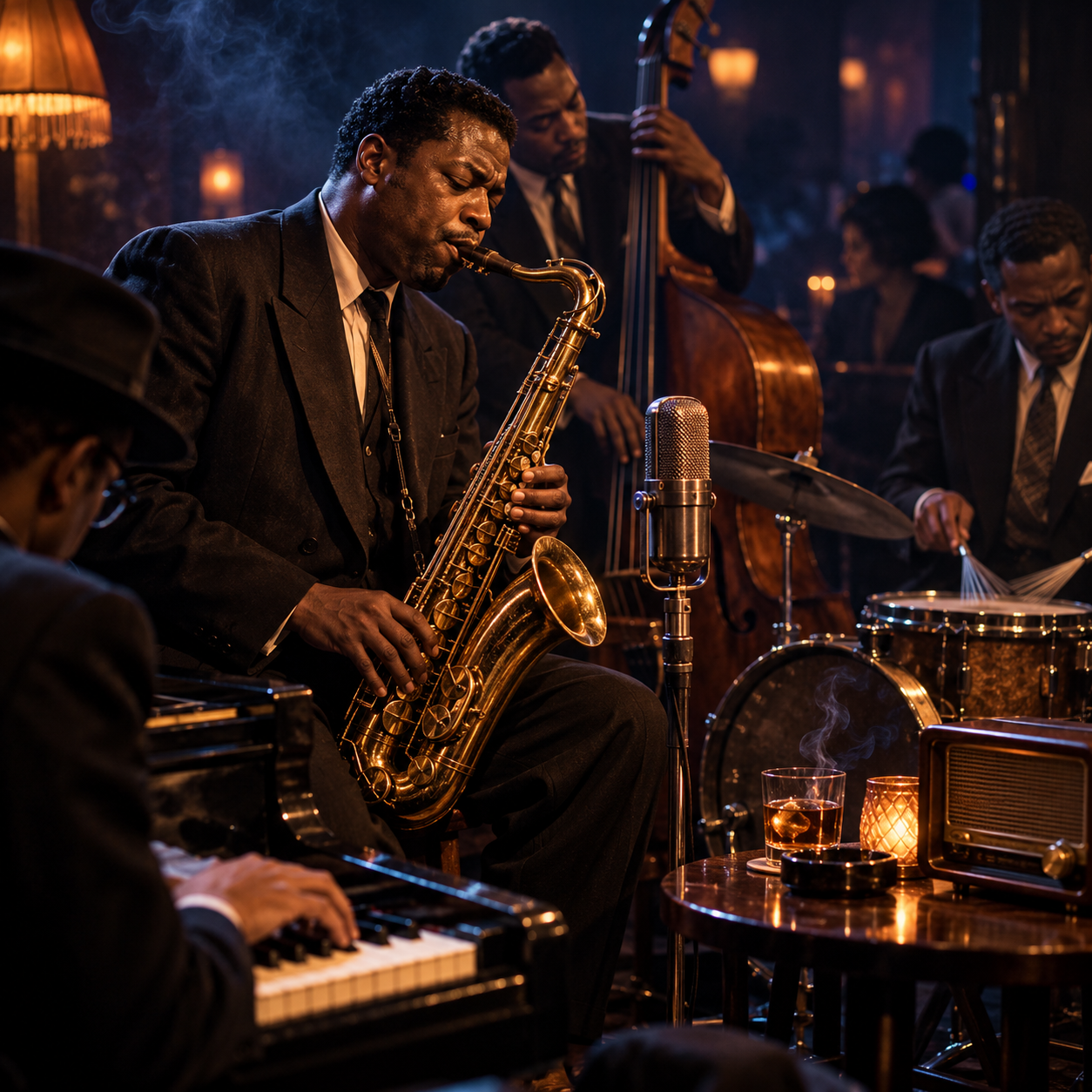
A saxophone races through a twisting melody. The pianist answers with a sharp chord. Behind them, the drummer shifts the accents while the double bass continues walking steadily through the harmony.
For a moment, the music seems to be moving in several directions at once.
Then the musicians meet on a familiar phrase, and everything falls into place.
This is one of the great pleasures of bebop jazz radio.
Bebop can sound complicated when you first encounter it. The melodies are often fast, the harmonies move quickly, and the soloists rarely settle for the most obvious musical idea.
But beneath that apparent complexity lies something deeply engaging: musicians listening, responding, and creating together.
Developed during the 1940s, bebop transformed jazz by placing greater emphasis on instrumental virtuosity, harmonic exploration, and improvisation within small ensembles.
Its leading figures included Charlie Parker, Dizzy Gillespie, Thelonious Monk, Bud Powell, and Kenny Clarke.
Their work influenced generations of jazz musicians and helped establish approaches to improvisation that remain important today.
You don't need to understand advanced music theory to enjoy bebop.
You only need to know where to listen.
What Is Bebop Jazz?
Bebop is a style of jazz that emerged during the early and mid-1940s, especially through the work of musicians in New York City.
It is associated with fast tempos, intricate melodies, sophisticated harmony, and inventive improvisation.
Bebop performances often feature small groups rather than the large orchestras commonly associated with the swing era.
A typical ensemble might include saxophone, trumpet, piano, double bass, and drums.
The musicians usually begin by playing a composed melody, often called the head.
Individual players then improvise over the tune's harmonic structure.
The performance may end with a return to the original melody.
This framework provides both freedom and organization.
The soloist can explore unexpected ideas while the rhythm section maintains a recognizable musical foundation.
Why is it called bebop?
The word bebop is associated with syllables used to imitate the sound of jazz phrases, particularly in scat singing and musical conversation.
The precise history of the term is not entirely straightforward.
What matters most is the musical tradition it came to describe.
Bebop was not simply swing played faster.
It introduced distinctive approaches to melody, harmony, rhythm, and ensemble interaction.
How Bebop Changed Jazz
During the 1930s, swing music became a major form of popular entertainment.
Large jazz orchestras performed dance-oriented arrangements, and bandleaders such as Duke Ellington, Count Basie, and Benny Goodman became widely recognized.
But jazz musicians were also exploring ideas that went beyond the requirements of commercial dance music.
Some wanted greater opportunities for improvisation.
Others were interested in more complex harmonic relationships and melodic possibilities.
Informal jam sessions provided spaces for experimentation.
Musicians could challenge one another, develop new approaches, and test ideas outside the restrictions of a typical dance-band performance.
The importance of New York jam sessions
New York venues, including Minton's Playhouse in Harlem, became associated with the development of modern jazz.
Musicians gathered to experiment with harmony, rhythm, and improvisational technique.
These sessions were part of a wider network of musical activity rather than the work of one venue or individual.
Bebop emerged through collaboration among musicians with different backgrounds and experiences.
Its development was closely connected to African American musical innovation and the changing professional circumstances of jazz performers.
By the mid-1940s, recordings and performances were bringing the new style to broader attention.
Charlie Parker: The Saxophonist Who Redefined Jazz
Charlie Parker, often known as Bird, is one of the central figures in bebop history.
His alto saxophone playing combined remarkable technical control with rhythmic imagination and sophisticated melodic invention.
Parker could move rapidly through changing harmonies while making his phrases sound purposeful rather than random.
His influence on later jazz improvisation was enormous.
What makes Charlie Parker's playing distinctive?
Listen to the shape of his melodic lines.
A phrase may begin in an unexpected place, move through a rapid series of notes, and resolve with remarkable precision.
He frequently uses rhythmic accents that create tension against the underlying beat.
The result can feel spontaneous and carefully organized at the same time.
Essential Charlie Parker recordings
Start with these compositions and recordings associated with Parker:
-
Ko-Ko
-
Now's the Time
-
Ornithology
-
Confirmation
-
Billie's Bounce
Each provides a different perspective on his musical language.
Now's the Time is particularly approachable because its blues foundation gives new listeners a recognizable structure.
Ko-Ko offers a more intense introduction to bebop's speed and complexity.
A listening exercise
Choose a Parker recording and listen only to the first few seconds of each phrase.
Notice where he begins.
Does the melody enter directly on the beat?
Does it start slightly before or after an expected accent?
Then listen to where the phrase ends.
These small rhythmic choices are part of what makes his improvisation so compelling.
Dizzy Gillespie: Trumpet, Rhythm and Musical Innovation
Dizzy Gillespie was another major architect of bebop.
His trumpet playing combined extraordinary technical ability with rhythmic precision and harmonic creativity.
He also played an important role in developing and popularizing Afro-Cuban jazz.
His musical contributions extended beyond instrumental performance into composition, arranging, and bandleading.
The sound of Dizzy Gillespie
Gillespie's trumpet lines can be fast, brilliant, and rhythmically adventurous.
But speed is only one part of his style.
Listen to his use of accents and contrasting phrase lengths.
A long melodic passage may suddenly give way to a short, sharply articulated figure.
These contrasts create energy and surprise.
Recordings worth exploring
Important Gillespie-associated pieces include:
-
A Night in Tunisia
-
Groovin' High
-
Salt Peanuts
-
Dizzy Atmosphere
A Night in Tunisia is especially interesting because of its rhythmic character and the way it brings together different musical ideas.
Gillespie's collaborations with Charlie Parker are essential listening for anyone interested in early bebop.
Their musical interaction reveals how two distinctive improvisers could develop ideas within the same performance.
Thelonious Monk: The Art of the Unexpected
Thelonious Monk occupies a distinctive position in the history of modern jazz.
He was a pianist and composer whose music featured unusual melodic shapes, striking harmonies, rhythmic displacement, and carefully placed silences.
Although closely associated with the bebop era and its musicians, Monk developed a highly individual style that does not fit neatly into every conventional description of bebop.
Why Monk sounds different
Some pianists emphasize flowing melodic lines.
Monk often creates interest through unexpected intervals, angular phrases, and surprising rhythmic placement.
His compositions can sound playful, mysterious, or deliberately unsettled.
Silence is also an important part of his musical language.
He may leave a space where another pianist would fill it with notes.
That pause changes the listener's expectations.
Essential Monk compositions
Explore:
-
'Round Midnight
-
Straight, No Chaser
-
Blue Monk
-
Epistrophy
-
Well, You Needn't
Blue Monk provides an accessible starting point through its blues-based structure.
'Round Midnight reveals a different side of his compositional imagination.
Listen for the spaces
When hearing Monk, don't focus only on the notes he plays.
Notice what happens immediately afterward.
How does the rhythm section respond?
Does the pause create tension?
Does the next phrase arrive where you expected?
These details help explain his enduring influence.
Bud Powell: A New Language for Jazz Piano
Bud Powell was one of the most influential pianists associated with bebop.
His playing helped establish a modern jazz piano approach in which the right hand performs rapid, horn-like melodic lines while the left hand supplies carefully placed harmonic support.
This represented an important development in jazz piano technique.
The piano as a melodic voice
Powell's improvisations often move with the speed and fluidity associated with bebop horn players.
Rather than filling every moment with dense chords, he could use the left hand selectively.
That approach creates space for melodic invention.
His recordings demonstrate how bebop ideas could be translated effectively to the piano.
What to listen for
Pay attention to the relationship between the two hands.
The right hand may produce an extended melodic line.
The left hand adds chords at particular moments.
Those chords support the harmony without overwhelming the improvisation.
This balance became highly influential in later jazz piano performance.
Kenny Clarke and the Bebop Drumming Revolution
Bebop wasn't only a revolution in melody and harmony.
The rhythm section changed as well.
Drummer Kenny Clarke was a major figure in developing the rhythmic approach associated with modern jazz.
Earlier swing drumming often placed a strong timekeeping role on the bass drum.
Bebop drummers increasingly emphasized the ride cymbal as a central source of rhythmic continuity.
The bass drum and snare could then provide more varied accents.
Listen to the ride cymbal
The ride cymbal often maintains a flowing rhythmic pattern.
Meanwhile, the snare and bass drum contribute accents that interact with the soloist.
This creates a sense of movement without requiring every instrument to emphasize the same beat.
The drummer becomes an active participant in the musical conversation.
For new listeners, following the ride cymbal can make a fast bebop performance easier to understand.
The Role of the Double Bass
The double bass provides an important foundation in many bebop ensembles.
A walking bassline commonly moves through quarter notes, outlining the harmony while maintaining a steady pulse.
This helps listeners stay oriented even when the soloist plays rhythmically unpredictable phrases.
Follow the bass before the solo
Try listening to a bebop recording while concentrating on the bass.
Notice how consistently it moves.
Then shift your attention to the saxophone or trumpet.
The soloist may seem to float around the beat, but the bass provides a reference point.
This relationship between stability and freedom is central to the style.
Bebop Harmony: Why the Music Sounds So Inventive
Bebop musicians developed sophisticated approaches to chord progressions.
Their improvisations often involve rapid harmonic movement, chromatic notes, and melodic lines that connect chord tones in unexpected ways.
Some compositions use familiar popular-song harmonic frameworks.
Others are based on the blues.
Musicians may create new melodies over existing chord progressions, a practice associated with contrafacts.
What is a contrafact?
A contrafact is a new composition built around the harmonic structure of an existing piece.
Bebop musicians frequently used familiar chord progressions as a foundation for new melodic ideas.
For example, Ornithology is associated with the chord changes of How High the Moon.
This practice allowed musicians to explore new melodic possibilities while working with established harmonic patterns.
Do you need music theory?
Not necessarily.
If you're a musician, studying chord progressions can deepen your appreciation.
But casual listeners can enjoy the music by following tension and resolution.
Notice when a phrase sounds unsettled.
Then listen for the moment it arrives somewhere more stable.
That movement is part of the musical drama.
Bebop Versus Swing: What's the Difference?
Bebop developed from the musical environment of the swing era, but the two styles often emphasize different aspects of jazz performance.
Feature Swing Bebop Major period of prominence 1930s and early 1940s 1940s onward Common ensemble Big bands and smaller groups Frequently small combos Musical emphasis Dance-oriented arrangements and swing feel Improvisation and harmonic exploration Melodies Often arranged for ensemble sections Frequently intricate and angular Rhythm section Strong dance pulse Flexible accents and interactive timekeeping Typical listening experience Energetic, often danceable Often concentrated and improvisation-focusedThese are broad tendencies rather than absolute rules.
Swing musicians were capable of remarkable harmonic sophistication and improvisational creativity.
Bebop musicians could also play at relaxed tempos and create highly melodic performances.
The styles overlap historically and musically.
Listening to them side by side reveals both continuity and change.
Bebop Versus Hard Bop
Hard bop developed prominently during the 1950s.
It built on bebop's musical language while incorporating strong influences from blues, gospel, and rhythm and blues.
Musicians such as Art Blakey, Horace Silver, and Clifford Brown became important figures in hard bop.
The style often emphasizes earthy rhythmic energy and memorable melodic themes.
How can you hear the difference?
Start with the compositions.
A bebop tune may feature a fast, intricate melody.
A hard bop recording might emphasize a blues-based riff or a groove with a particularly strong rhythmic identity.
But there is considerable overlap.
Many musicians performed across stylistic boundaries.
The distinction is useful for understanding jazz history, not for separating every recording into rigid categories.
Bebop Is Not Always Fast
Speed is one of bebop's most recognizable characteristics.
But it doesn't define every performance.
Bebop musicians also played ballads, medium-tempo blues, and more relaxed pieces.
Their harmonic ideas and phrasing could remain distinctive even when the tempo slowed.
This matters for beginners.
If extremely fast recordings feel overwhelming, start with a blues or a medium-tempo performance.
You may find it easier to recognize the musical conversation.
Then return to the faster pieces.
The same principles will become easier to hear.
How to Listen to Bebop Without Feeling Overwhelmed
A first encounter with bebop can feel like trying to follow several conversations at once.
Instead of attempting to hear every detail, choose one element.
First listen: follow the melody
Concentrate on the opening theme.
Notice its rhythm and shape.
When it returns at the end, you'll recognize how the performance has come full circle.
Second listen: follow the bass
Ignore the soloist for a moment.
Listen to the walking bassline.
Its steady movement can help you understand the structure.
Third listen: follow the drums
Pay attention to the ride cymbal and accents.
Notice how the drummer interacts with the soloist.
Fourth listen: follow one solo
Choose the saxophone, trumpet, or piano.
Listen for recurring melodic ideas.
Don't worry about identifying every note.
Try to recognize the phrases and how they develop.
Fifth listen: hear the whole group
Return to the recording with a broader perspective.
The performance may now feel less chaotic.
Instead of separate sounds competing for attention, you may hear a coordinated musical conversation.
Essential Bebop Recordings for Beginners
If you're building a listening list, these recordings and compositions provide useful starting points.
Charlie Parker — Now's the Time
A blues-based composition that offers a recognizable foundation for Parker's improvisational style.
Charlie Parker — Ko-Ko
A landmark early bebop recording known for its intensity and rapid melodic invention.
Dizzy Gillespie — Groovin' High
An important example of Gillespie's approach to modern jazz phrasing and harmony.
Dizzy Gillespie — A Night in Tunisia
A composition with distinctive rhythmic and melodic characteristics.
Thelonious Monk — Blue Monk
A blues-based piece that introduces Monk's unmistakable musical personality.
Bud Powell — Un Poco Loco
A recording that demonstrates Powell's rhythmic imagination and modern jazz piano language.
These are starting points, not a definitive ranking.
Bebop contains many remarkable recordings beyond the most familiar names.
How to Spend One Hour With Bebop Jazz
A carefully chosen listening session can help you become comfortable with the style.
Time Listening focus What to notice 0–10 minutes Medium-tempo bebop blues Walking bass and basic structure 10–20 minutes Charlie Parker Melodic phrasing and rhythmic invention 20–30 minutes Dizzy Gillespie Trumpet articulation and accents 30–40 minutes Bud Powell Piano lines and harmonic movement 40–50 minutes Thelonious Monk Space, rhythm, and unusual melodies 50–60 minutes Small-group bebop session Interaction between all musiciansYou don't need to follow this schedule exactly.
If one recording catches your attention, listen to it again.
Repeated listening is particularly valuable with bebop because the music contains so many interacting details.
How to Find Bebop Jazz Radio Online
Bebop stations may appear under several related categories.
Some specialize in bebop.
Others combine it with hard bop, classic jazz, or broader modern jazz programming.
A station featuring Charlie Parker, Dizzy Gillespie, Bud Powell, and early modern jazz recordings may be a good starting point.
If you prefer a wider range, explore jazz stations that include swing, bebop, hard bop, and cool jazz.
You can browse international stations through the 1LiveRadio online radio directory.
For more listening guides and music history, visit the 1LiveRadio music blog.
As always, the station's actual playlist matters more than the category name alone.
Why Radio Is an Excellent Way to Discover Bebop
Bebop rewards curiosity.
You may begin listening because you recognize Charlie Parker's name.
But a radio station can introduce you to lesser-known recordings, sidemen, and unexpected collaborations.
A familiar composition may appear in several different versions.
Each performance can reveal new choices.
One soloist emphasizes rhythm.
Another develops longer melodic lines.
A drummer changes the feel of the ensemble.
Radio makes these contrasts easy to encounter without requiring you to plan every track.
It also encourages you to listen beyond the most famous recordings.
That's especially valuable in a style built around improvisation.
The Lasting Influence of Bebop
Bebop changed the direction of jazz.
Its approaches to harmony, improvisation, and rhythm became central to many later styles.
Hard bop, cool jazz, and other modern jazz developments emerged in a musical world deeply influenced by bebop.
Its language also shaped jazz education.
Musicians continue studying bebop melodies, chord progressions, and recordings to develop their improvisational skills.
But bebop isn't only a historical subject.
Its recordings remain exciting because they capture real musical decisions.
A soloist responds to an unexpected accent.
A pianist introduces a new harmonic color.
A drummer changes the energy without disrupting the pulse.
Those moments still feel alive.
For further historical background, explore the Encyclopaedia Britannica article on bebop.
The Small Details That Make Bebop Memorable
The most impressive part of a bebop performance isn't necessarily the fastest passage.
Sometimes it's a short phrase.
A saxophonist plays three notes and leaves a space.
The pianist answers with a chord.
The drummer adds an accent.
Then the soloist continues in a new direction.
That exchange reveals the collaborative nature of the music.
Try listening to a recording twice.
On the first listen, follow the soloist.
On the second, pay attention to the rhythm section.
You may discover that the accompaniment is just as inventive as the lead performance.
Bebop becomes more rewarding when you hear the musicians as participants in one conversation.
Frequently Asked Questions
What is bebop jazz?
Bebop is a style of jazz that developed during the 1940s, characterized by intricate melodies, sophisticated harmony, rhythmic flexibility, and inventive improvisation.
Who invented bebop?
Bebop emerged through the contributions of several musicians rather than one inventor. Charlie Parker, Dizzy Gillespie, Thelonious Monk, Bud Powell, and Kenny Clarke were among its major innovators.
Why is bebop so fast?
Many bebop performances use fast tempos to explore rhythmic and technical possibilities, but the style also includes medium-tempo and slower recordings.
What instruments are common in bebop?
Typical bebop ensembles feature saxophone, trumpet, piano, double bass, and drums, although instrumentation varies.
What is the difference between bebop and swing?
Swing is often associated with dance-oriented big-band arrangements, while bebop places particular emphasis on small-group improvisation and harmonic exploration. Both are important parts of jazz history.
Is bebop difficult to listen to?
It can feel complex at first, but following one instrument or a recurring melody makes the music easier to appreciate.
What is the difference between bebop and hard bop?
Hard bop developed later and incorporated strong influences from blues, gospel, and rhythm and blues while building on bebop's improvisational language.
Who are the most famous bebop musicians?
Charlie Parker, Dizzy Gillespie, Bud Powell, Thelonious Monk, and Kenny Clarke are among the best-known figures.
Can I listen to bebop jazz online?
Yes. Internet radio stations featuring classic jazz, modern jazz, and bebop provide access to recordings from different musicians and periods.
Final Thoughts: Listen for the Conversation
Bebop jazz is sometimes described as difficult, fast, or highly technical.
Those descriptions capture only part of its character.
At its heart, bebop is about musical imagination.
A saxophonist discovers a new melodic direction.
A pianist responds with an unexpected chord.
The bass maintains a steady foundation while the drummer adds rhythmic surprises.
Each musician contributes to something that exists only in that particular performance.
When you listen to bebop radio, don't worry about understanding every note.
Start with the rhythm.
Follow one phrase.
Notice how the instruments respond to one another.
Then listen again.
What first sounded complicated may begin to feel playful, expressive, and full of personality.
And once you hear that conversation, bebop becomes much easier to love.
Reader comments
No comments yet. Start the conversation.
Leave a comment
Your email stays private. Comments appear after approval.