
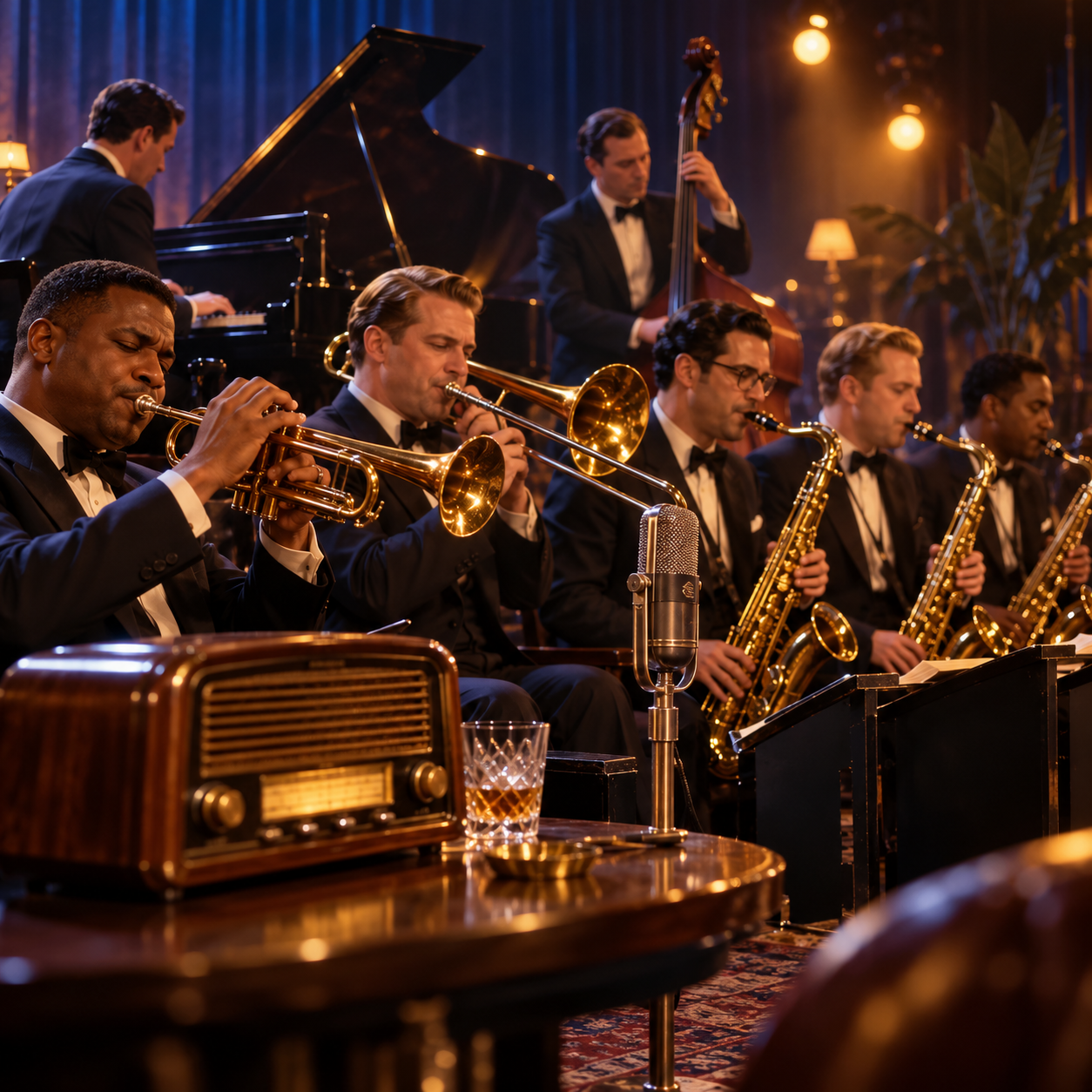
The drummer establishes a steady rhythm. A double bass begins walking through the harmony, and the piano adds a few carefully placed chords.
Then the saxophones enter together.
A moment later, the trumpets answer with a bright, powerful phrase. The trombones join, and the arrangement expands into a sound that seems to fill the entire room.
Just when the orchestra reaches its peak, the instruments fall back and leave space for a single soloist.
This is the excitement of big band music radio.
Big band jazz combines the power of a large ensemble with the individuality of improvising musicians. Its sound can be elegant, energetic, romantic, playful, or dramatically intense.
Although many listeners associate big bands with the swing era of the 1930s and 1940s, the tradition is much broader.
Big band music has evolved through different periods of jazz history, from dance orchestras and innovative composers to contemporary ensembles exploring new harmonies and arrangements.
Whether you enjoy classic swing, sophisticated orchestration, or the sound of brass and saxophones working together, big band radio offers a rich musical experience.
The secret is learning to hear how the different parts of the orchestra interact.
What Is Big Band Music?
Big band music is generally associated with jazz ensembles that are larger than the small groups commonly heard in styles such as bebop.
A traditional big band often includes approximately 15 to 20 musicians, although the exact number varies.
The ensemble is usually organized into several instrumental sections.
These commonly include:
-
Saxophones and other reed instruments
-
Trumpets
-
Trombones
-
A rhythm section featuring piano, bass, drums, and sometimes guitar
The musicians perform arrangements that coordinate these sections.
Unlike a small jazz group, where much of the performance may center on individual improvisation, a big band often relies on carefully written ensemble passages.
But improvisation remains important.
A saxophonist, trumpeter, trombonist, or pianist may step forward for a solo while the orchestra provides accompaniment.
The relationship between written arrangements and individual expression is one of the defining pleasures of big band jazz.
How the Big Band Sound Works
The most recognizable feature of big band music is the interaction between instrumental sections.
Rather than having every musician play the same melody, an arranger can divide musical ideas among different groups.
The saxophones may introduce a theme.
The trumpets answer.
The trombones add a contrasting harmony.
Then the full ensemble comes together.
Section playing
When several instruments perform a coordinated passage, they create a powerful collective sound.
A saxophone section can produce smooth harmonies or energetic rhythmic figures.
Trumpets often add brightness and intensity.
Trombones contribute a rich lower-brass sound.
Solos
A soloist temporarily becomes the center of attention.
The surrounding instruments may play short background figures or leave space.
This creates a contrast between the full orchestra and the individual performer.
Dynamics
Big bands can move quickly between soft and loud passages.
A quiet introduction may develop into a powerful ensemble climax.
These changes help shape the emotional direction of the arrangement.
Learning to recognize them makes big band music much easier to follow.
The Swing Era: When Big Bands Ruled Popular Music
The swing era is commonly associated with the 1930s and early 1940s, when large jazz orchestras became a major part of American popular entertainment.
Big bands performed in ballrooms, theaters, hotels, and radio broadcasts.
Their recordings reached audiences across the United States and internationally.
Swing music became closely connected with social dancing.
Its rhythmic energy encouraged movement, while memorable melodies made recordings accessible to a wide audience.
Music for dancing and listening
Many swing-era arrangements were designed with dancers in mind.
A steady pulse helped maintain the groove.
But the music was never limited to functional dance accompaniment.
Band leaders and arrangers developed sophisticated approaches to harmony, orchestration, and improvisation.
Some performances emphasized relaxed rhythmic movement.
Others featured dramatic contrasts, elaborate ensemble passages, or adventurous solos.
The swing era helped establish big band jazz as both popular entertainment and an important form of musical expression.
Duke Ellington: The Orchestra as a Creative Instrument
Duke Ellington is one of the most influential figures in jazz history.
As a pianist, composer, and bandleader, he developed a distinctive orchestral language that extended far beyond conventional dance-band arrangements.
Ellington worked with remarkable musicians whose individual sounds became essential to his compositions.
Rather than treating the orchestra as a collection of interchangeable instruments, he often wrote with specific performers in mind.
Why Ellington's arrangements stand out
Ellington explored unusual instrumental combinations and expressive tonal colors.
A muted trumpet might create a particular mood.
A clarinet or saxophone could introduce a distinctive melodic character.
The trombones might add warmth, tension, or dramatic contrast.
These choices made his orchestra sound unmistakably individual.
Essential Duke Ellington recordings
Start with:
-
Take the "A" Train — composed by Billy Strayhorn and famously associated with the Ellington orchestra
-
Mood Indigo
-
It Don't Mean a Thing (If It Ain't Got That Swing)
-
Sophisticated Lady
-
Cotton Tail
These recordings demonstrate different sides of Ellington's musical world.
Some emphasize rhythmic energy.
Others reveal his interest in atmosphere, melody, and orchestral color.
A listening exercise
Choose Mood Indigo and concentrate on the instrumental textures.
Notice how the combination of instruments contributes to the mood.
Then compare it with the rhythmic drive of Cotton Tail.
Both belong to the Ellington tradition, yet they offer very different experiences.
Count Basie: The Power of Rhythm and Simplicity
Count Basie became famous for leading orchestras with a distinctive rhythmic character.
His music often emphasizes a relaxed but powerful swing feel.
The rhythm section plays a central role.
Bass, drums, guitar, and piano work together to create a groove that feels effortless even when the arrangement is carefully organized.
What makes the Basie sound distinctive?
Basie's piano style often uses economical phrases rather than constant activity.
He understood the value of space.
A short piano figure can have more impact when surrounded by a strong rhythm section.
The orchestra also became associated with memorable riffs and energetic ensemble passages.
Essential Count Basie recordings
Explore:
-
One O'Clock Jump
-
Jumpin' at the Woodside
-
April in Paris
-
Shiny Stockings
One O'Clock Jump offers a useful introduction to riff-based swing.
April in Paris demonstrates how a big band can turn a familiar composition into a distinctive orchestral performance.
Listen to the rhythm section
Try following the bass and drums rather than the horns.
Notice how consistently they maintain the pulse.
Then listen to how the brass and reeds build excitement above that foundation.
The relationship between rhythmic stability and ensemble energy is central to Basie's appeal.
Glenn Miller: Melodies That Defined an Era
Glenn Miller became one of the most commercially successful bandleaders of the swing era.
His orchestra developed a recognizable sound associated with smooth reed-section arrangements and memorable melodies.
Miller's recordings remain familiar to listeners who enjoy classic big band music.
The Glenn Miller sound
One of Miller's signature arranging approaches involved the clarinet carrying a melody above saxophone harmonies.
This produced a smooth, blended reed-section texture.
The result was different from the more rhythmically aggressive or improvisation-focused approaches of some other jazz orchestras.
Essential Glenn Miller recordings
Start with:
-
In the Mood
-
Moonlight Serenade
-
Chattanooga Choo Choo
-
Pennsylvania 6-5000
-
A String of Pearls
In the Mood is particularly recognizable for its repeating riff and energetic arrangement.
Moonlight Serenade offers a more romantic and restrained listening experience.
Why Miller remains popular
His recordings combine clear melodies with carefully organized orchestration.
They can be enjoyed casually, but closer listening reveals the skill involved in balancing instrumental sections.
Benny Goodman: The King of Swing
Benny Goodman was a clarinetist and bandleader who played a major role in popularizing swing music.
His orchestra became widely recognized during the 1930s.
Goodman also performed in smaller jazz groups, demonstrating his versatility as an improviser.
The importance of the clarinet
The clarinet has a distinctive sound that can move between warm lower notes and bright, agile upper-register phrases.
Goodman's playing combined technical precision with rhythmic energy.
His solos remain an important part of swing-era jazz history.
Essential Benny Goodman recordings
Explore:
-
Sing, Sing, Sing
-
Let's Dance
-
Stompin' at the Savoy
-
Don't Be That Way
Sing, Sing, Sing is especially famous for its driving percussion and energetic ensemble performance.
The recording demonstrates how a big band can create excitement through repeated rhythmic ideas and dramatic instrumental interaction.
The Role of the Arranger in Big Band Jazz
In a small jazz group, musicians may rely heavily on shared harmonic structures and spontaneous interaction.
A big band usually requires more detailed coordination.
This is where the arranger becomes especially important.
An arranger decides how musical material will be distributed among the instruments.
The arrangement may specify harmonies, rhythmic figures, background passages, introductions, transitions, and endings.
Writing for instrumental sections
A melody can sound completely different depending on which instruments perform it.
Saxophones may create a warm, blended texture.
Trumpets can make the same phrase sound brilliant and assertive.
Trombones may add weight or a more rounded character.
Combining sections creates additional possibilities.
Creating contrast
An arranger might begin with a small instrumental group.
Then introduce the saxophones.
Next, the brass enters with a contrasting figure.
Finally, the entire orchestra performs together.
This gradual development gives the music a sense of direction.
Leaving room for improvisation
A strong arrangement doesn't need to control every musical detail.
Solo sections allow musicians to introduce their own ideas.
The surrounding orchestra can respond through written background figures or flexible accompaniment.
The balance between structure and spontaneity is one of big band jazz's defining qualities.
The Instruments of a Big Band Orchestra
A traditional jazz big band is often organized into three main areas.
Saxophone and reed section
A typical section may include alto saxophones, tenor saxophones, and baritone saxophone.
Some musicians also double on clarinet or flute.
This section can produce smooth harmonies, intricate melodic passages, and powerful rhythmic figures.
Trumpet section
Trumpets contribute brightness and intensity.
They can perform lyrical melodies, sharp rhythmic accents, and high-energy ensemble passages.
Different mutes can change the instrument's tone considerably.
Trombone section
Trombones provide a rich lower-brass sound.
Their ability to produce both smooth melodic lines and forceful accents makes them essential to the orchestra's range of textures.
Rhythm section
The rhythm section commonly includes piano, double bass or electric bass, drums, and sometimes guitar.
Its role is more than simply keeping time.
The musicians support the harmony, establish the groove, and interact with soloists.
When these sections work together, the orchestra can produce a remarkable variety of sounds.
Big Band Versus Bebop: What's the Difference?
Big band and bebop are related parts of jazz history, but they describe different aspects of musical practice.
Big band primarily refers to an ensemble format.
Bebop is a jazz style associated with particular approaches to melody, harmony, rhythm, and improvisation.
That distinction is important.
A big band can perform swing, bebop-influenced arrangements, Latin jazz, contemporary jazz, and other styles.
Bebop is frequently associated with smaller ensembles, but its musical language can also be arranged for larger groups.
Feature Big Band Jazz Bebop Main definition Large jazz ensemble format Jazz style Typical ensemble Often 15–20 musicians Frequently small combos Musical focus Orchestration and ensemble interaction Improvisation and harmonic invention Common historical association Swing era and later orchestral jazz 1940s modern jazz Arrangement Often extensively written Frequently head-solos-head formats Improvisation Important, within ensemble structures Central to many performancesThe categories can overlap.
Exploring both helps listeners understand how jazz musicians balance composition, arrangement, and improvisation.
Big Band Jazz Beyond the Swing Era
Although the swing era remains central to big band history, large jazz ensembles continued evolving after the 1940s.
Musicians and composers explored new harmonic ideas, rhythmic approaches, and orchestral techniques.
Some ensembles incorporated bebop influences.
Others developed more experimental forms of jazz composition.
Stan Kenton
Stan Kenton's orchestras became associated with ambitious arrangements and a powerful brass sound.
His work explored different approaches to large-ensemble jazz.
Thad Jones and Mel Lewis
The Thad Jones/Mel Lewis Orchestra became an important force in modern big band jazz.
Its performances combined sophisticated arrangements with strong improvisational contributions.
Maria Schneider
Composer and bandleader Maria Schneider has developed a distinctive contemporary orchestral jazz language.
Her work demonstrates how large ensembles can create detailed musical textures and expressive compositions beyond traditional swing formats.
These artists show that big band music is a continuing creative tradition rather than a style confined to one historical period.
Modern Big Band Music: A Living Tradition
Contemporary big bands perform in concert halls, jazz clubs, educational institutions, and recording studios.
Some specialize in recreating historical arrangements.
Others commission new compositions and experiment with modern musical influences.
Today's large ensembles may incorporate elements of contemporary jazz, Latin rhythms, funk, or experimental music.
The instrumentation can also vary.
Some groups add vocalists, percussion, or instruments outside the conventional big band format.
Why modern big bands matter
Large-ensemble jazz provides composers with a wide range of musical possibilities.
Different instrumental colors can be combined in complex ways.
A small solo passage can expand into a full orchestral statement.
Rhythmic patterns can move between sections.
Modern big bands demonstrate that these possibilities remain relevant to contemporary music.
The Relationship Between Big Band Music and Dance
Big band music became closely associated with social dancing during the swing era.
Dance styles such as Lindy Hop developed within broader African American cultural and musical environments.
Swing music's rhythmic feel encouraged dancers to respond creatively.
The relationship between musicians and dancers helped shape the energy of performances.
What makes a rhythm swing?
Swing involves a combination of rhythmic phrasing, accent placement, and ensemble interaction.
It isn't simply a matter of playing every pair of notes unevenly.
The feel can vary between performers, tempos, and musical contexts.
A relaxed rhythm section may create a strong sense of forward movement without sounding rushed.
Listen for the pulse
Choose a Count Basie recording and follow the bassline.
Notice how the drummer supports the beat.
Then listen to how the horns place their phrases around that rhythmic foundation.
You may begin to feel why the music was so closely connected to dancing.
Big Band Ballads: The Softer Side of the Orchestra
Big bands aren't always loud or fast.
Many orchestras have recorded expressive ballads with carefully shaped arrangements.
A solo trumpet or saxophone may carry the melody.
The brass and reed sections provide warm harmonies.
The rhythm section supports the performance with restraint.
The power of orchestral color
A quiet big band arrangement can be as sophisticated as an energetic swing performance.
The arranger must decide how much space to leave.
A single sustained chord can change the emotional character of a phrase.
An unexpected instrumental combination may create a memorable atmosphere.
If you enjoy romantic jazz, big band ballads are worth exploring.
How to Spend One Hour With Big Band Music Radio
An hour of listening can introduce several sides of the tradition.
Time Listening focus What to notice 0–10 minutes Count Basie Swing rhythm and ensemble riffs 10–20 minutes Duke Ellington Orchestral colors and composition 20–30 minutes Glenn Miller Reed-section sound and melodies 30–40 minutes Benny Goodman Clarinet and rhythmic energy 40–50 minutes Big band ballads Soft dynamics and instrumental balance 50–60 minutes Modern big band jazz Contemporary arrangements and improvisationYou don't need to follow this schedule exactly.
If a recording catches your attention, listen to another performance by the same orchestra.
Comparing different arrangements can reveal how much the bandleader and musicians contribute to the sound.
How to Find Big Band Radio Stations Online
Big band music may appear under several radio categories.
Some stations specialize in swing-era recordings.
Others feature traditional jazz, classic standards, or orchestral jazz.
You may also find big band performances on broader jazz stations.
If you enjoy dancing, look for swing-focused programming.
For more adventurous arrangements, explore contemporary big band jazz.
You can begin browsing international stations through the 1LiveRadio online radio directory.
For more genre guides and jazz listening ideas, visit the 1LiveRadio music blog.
Checking a station's playlist can help you identify whether it emphasizes nostalgic hits, instrumental jazz, or modern orchestral performances.
Why Big Band Music Works So Well on Radio
Big band radio offers a listening experience built around contrast.
One recording may feature an energetic brass arrangement.
The next could be a quiet ballad with a lyrical saxophone solo.
A familiar swing classic might be followed by an ambitious contemporary composition.
These changes keep the listening experience interesting.
Radio can also introduce lesser-known bandleaders, arrangers, and soloists.
Many musicians contributed to the big band tradition without becoming household names.
Their recordings remain worth discovering.
Listen beyond the famous bandleader
When you hear a performance you enjoy, explore the musicians involved.
Who arranged the piece?
Which soloist is featured?
How does the rhythm section contribute?
These questions can lead to a deeper appreciation of the music.
The Cultural Importance of Big Band Jazz
Big band jazz played a major role in twentieth-century popular culture.
It was connected to radio broadcasting, dance halls, recording industries, and the development of American jazz.
African American musicians, composers, and bandleaders were central to its artistic foundations.
The music also developed within a society shaped by racial segregation and unequal professional opportunities.
Understanding that history is important.
Big band jazz wasn't simply entertainment from a nostalgic period.
It was a major form of musical innovation, cultural expression, and professional collaboration.
For additional historical context, explore the Encyclopaedia Britannica article on big band music.
The Small Details That Make Big Band Music Memorable
A powerful ensemble passage may be the first thing you notice in a big band recording.
But the smaller details often make the performance special.
A saxophone section answers the trumpets.
The trombones enter with a contrasting harmony.
A drummer adds a subtle accent.
A soloist changes the direction of the arrangement.
Then the full orchestra returns.
These moments reveal the skill involved in coordinating a large group of musicians.
Try listening to a recording twice.
On the first listen, enjoy the overall sound.
On the second, choose one instrumental section.
Follow the saxophones, trumpets, or trombones.
Notice when they enter, when they stop, and how they interact with the rest of the orchestra.
You may discover that a familiar recording contains far more musical detail than you originally heard.
Frequently Asked Questions
What is big band music?
Big band music is generally associated with large jazz ensembles featuring brass, reed, and rhythm sections. The music often combines written arrangements with improvised solos.
How many musicians are in a big band?
A traditional jazz big band often includes approximately 15 to 20 musicians, although the number can vary.
Who are famous big band leaders?
Duke Ellington, Count Basie, Glenn Miller, Benny Goodman, and Stan Kenton are among the best-known figures.
Is big band music the same as swing?
No. Swing is a musical style and rhythmic approach, while big band refers primarily to a large ensemble format. Many swing recordings feature big bands, but big bands can perform other styles.
What instruments are used in a big band?
A traditional big band commonly includes saxophones, trumpets, trombones, piano, bass, drums, and sometimes guitar.
Is big band jazz always fast?
No. Big bands perform energetic swing pieces, medium-tempo compositions, and slow ballads.
What is the difference between big band and bebop?
Big band refers to an ensemble format, while bebop is a jazz style. Bebop is often performed by small groups, but its musical ideas can also be arranged for big bands.
Are there modern big bands?
Yes. Contemporary large jazz ensembles continue performing historical arrangements and creating new compositions.
Can I listen to big band music online?
Yes. Internet radio stations featuring swing, classic jazz, and orchestral jazz provide access to big band recordings from different periods.
Final Thoughts: Hear the Orchestra as One Conversation
Big band music is often remembered for its powerful brass sections, elegant melodies, and infectious swing rhythms.
But its real beauty lies in the relationships between the musicians.
The saxophones introduce an idea.
The trumpets respond.
The trombones add depth.
The rhythm section keeps everything moving.
Then a soloist steps forward and gives the music a personal voice.
When you listen to big band radio, don't focus only on the loudest moments.
Pay attention to the transitions.
Notice how the instrumental sections answer one another.
Listen to the rhythm section and the way it supports the entire orchestra.
The more closely you listen, the more you discover.
And a recording that first sounded like one large wall of sound may become a fascinating conversation between individual musical voices.
Reader comments
No comments yet. Start the conversation.
Leave a comment
Your email stays private. Comments appear after approval.