
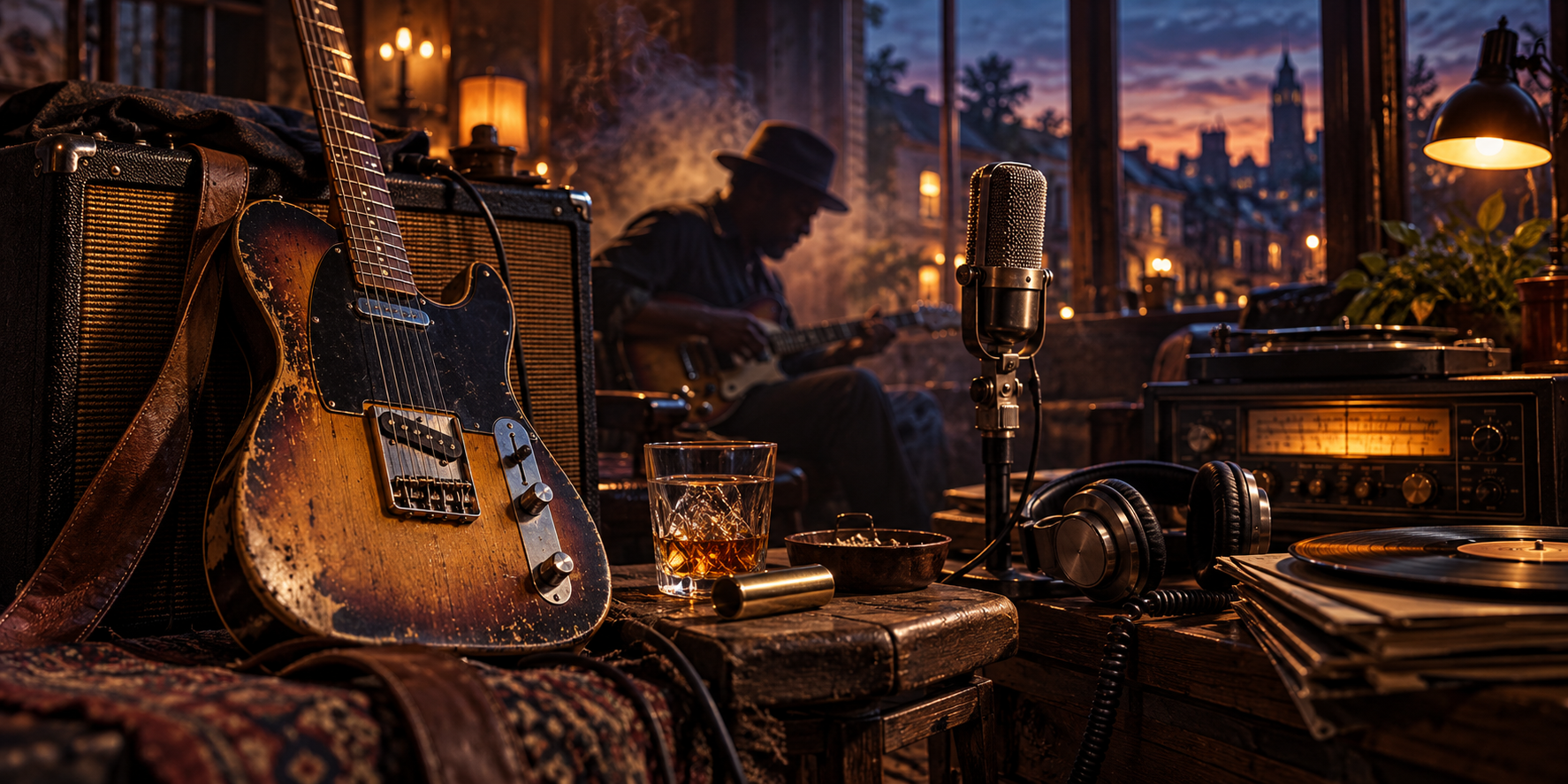
A guitar plays a short phrase, bending the final note until it almost sounds like a human voice.
The singer answers with a line about love, disappointment, or a difficult day.
The guitar responds again.
Behind them, the bass and drums maintain a steady rhythm, giving the music room to breathe.
Nothing about the performance needs to be complicated to feel powerful.
This is one of the pleasures of blues music radio.
Blues is often described as sad music, but that description misses much of its character. Blues can express humor, resilience, confidence, frustration, celebration, and joy. It can be quiet and reflective or loud enough to fill a crowded club.
Its identity comes from more than a particular mood.
Blues is a musical language built around expressive phrasing, distinctive tonal inflections, rhythmic flexibility, and the relationship between performers.
A singer may repeat a line with a different emphasis.
A guitarist may answer with only three notes.
A pianist can introduce a rhythmic figure that changes the energy of the entire recording.
Those details are what make blues so memorable.
From early acoustic performances in the American South to amplified Chicago bands and contemporary blues festivals, the genre has developed through many generations.
Whether you're discovering it for the first time or returning to familiar favorites, understanding its history and listening closely to its musical details can make every blues radio session more rewarding.
What Is Blues Music?
Blues is a musical tradition that developed within African American communities in the United States, especially in the South, around the late nineteenth and early twentieth centuries.
Its development drew on several interconnected musical practices, including work songs, spirituals, field hollers, and other forms of African American expression.
Blues eventually became a recognizable foundation for many styles of American popular music.
But it is also a diverse tradition in its own right.
What makes blues recognizable?
Several features frequently appear in blues performances:
-
Expressive vocal and instrumental phrasing
-
Bent notes and other tonal inflections
-
Repeated lyrical lines and call-and-response patterns
-
Distinctive chord progressions
-
Rhythmic grooves ranging from relaxed shuffles to driving beats
-
Improvisation and individual interpretation
Not every blues song uses all these characteristics.
A solo acoustic performance can sound very different from an electric blues band.
The connection often lies in the way musicians shape phrases, rhythms, and emotional expression.
The African American Roots of the Blues
Understanding blues means recognizing its African American origins.
The genre developed in a social environment shaped by the experiences of Black communities in the United States, including the legacy of slavery, racial segregation, labor, migration, and cultural creativity.
Blues emerged through musical exchange and individual innovation rather than from one inventor or single event.
Early performers developed expressive approaches to singing and instrumental accompaniment.
Songs could address personal relationships, difficult working conditions, travel, humor, and everyday life.
Blues as expression
Blues music gave performers a way to communicate experiences through direct language and distinctive musical phrasing.
A repeated lyric could become more meaningful when delivered differently the second time.
A short instrumental response might express something that words alone couldn't capture.
This relationship between lyrical and musical expression remains central to the genre.
From local performance to recordings
During the early twentieth century, blues reached wider audiences through commercial recordings and live performances.
The popularity of blues recordings helped bring regional styles into contact with listeners beyond their original communities.
Artists such as Mamie Smith, Bessie Smith, and Ma Rainey played important roles in the early recording era.
Their work helped establish blues as a major part of American popular music.
The 12-Bar Blues: A Familiar Musical Foundation
One of the best-known structures in blues is the 12-bar blues.
This form organizes a repeating harmonic pattern across twelve measures.
It commonly uses three primary chords, often described in music theory as the I, IV, and V chords.
The structure gives musicians a shared foundation for singing, accompaniment, and improvisation.
Why repetition matters
A repeating chord progression allows performers to introduce variation while maintaining a recognizable musical framework.
A guitarist may play a different phrase each time the pattern returns.
A singer may change the emotional emphasis of a repeated lyric.
The rhythm section can adjust its intensity.
The listener recognizes the underlying structure even as the performance changes.
Not all blues follows 12 bars
Blues also includes eight-bar forms, sixteen-bar forms, one-chord grooves, and many other structures.
Some performances use flexible timing or unconventional arrangements.
The 12-bar pattern is an important listening tool, not a definition that every blues recording must follow.
Call and Response: The Conversation at the Heart of Blues
One of the most recognizable features of blues is call and response.
A singer introduces a musical idea.
An instrument answers.
Or one instrumentalist plays a phrase that another musician develops.
This creates a conversational quality.
Listen to the guitar after the singer
In many blues recordings, the guitar plays a short fill between vocal lines.
That fill may repeat the emotional character of the lyric or introduce a contrasting idea.
The exchange can feel remarkably natural.
The singer expresses something.
The guitar responds.
Then the next verse begins.
A simple listening exercise
Choose a blues recording with vocals and guitar.
During the first verse, listen only to the singer.
During the second, focus on the guitar phrases between the words.
On the third, listen to both together.
You'll begin to hear how the two parts create one larger musical statement.
Delta Blues: Acoustic Roots and Expressive Storytelling
Delta blues is associated with the Mississippi Delta region and its surrounding musical environment.
It became one of the most influential regional styles in early blues history.
Recordings often feature a singer accompanying themselves on acoustic guitar, although the tradition includes different performance formats.
Delta blues is known for expressive vocals, rhythmic guitar playing, and flexible phrasing.
Robert Johnson
Robert Johnson became one of the most influential figures associated with Delta blues.
His recordings include:
-
Cross Road Blues
-
Sweet Home Chicago
-
Love in Vain
-
Hellhound on My Trail
Johnson's guitar playing combines rhythmic accompaniment with melodic responses.
His recordings have influenced generations of blues and rock musicians.
Son House
Son House was another major figure associated with Delta blues.
His performances often feature intense vocal expression and powerful slide guitar.
Songs such as Death Letter demonstrate the dramatic possibilities of a relatively sparse arrangement.
Charley Patton
Charley Patton was an important early Delta blues performer.
His recordings reveal a distinctive combination of rhythmic guitar playing, vocal personality, and expressive performance.
What to listen for
Delta blues can sound intimate and direct.
Follow the relationship between the singer's phrasing and the guitar rhythm.
Notice how the performer may stretch a phrase or shift the timing.
The music often feels flexible without losing its underlying pulse.
Chicago Blues: When the Blues Became Electric
During the twentieth century, many African Americans moved from the rural South to northern cities as part of the Great Migration.
Chicago became an important center of blues development.
Musicians brought southern musical traditions into a new urban environment.
As electric instruments and amplified performance became more common, blues bands developed a louder, more forceful sound.
The Chicago blues ensemble
A typical electric Chicago blues group might include:
-
Electric guitar
-
Harmonica
-
Piano
-
Electric or upright bass
-
Drums
-
Vocals
The exact instrumentation varies.
The amplified ensemble created new possibilities for rhythmic drive, instrumental solos, and group interaction.
Muddy Waters: The Sound of Electric Chicago Blues
Muddy Waters is one of the central figures in electric Chicago blues.
Born in Mississippi, he brought musical influences from the South into the urban blues environment of Chicago.
His recordings helped define the sound of amplified blues bands.
Essential Muddy Waters recordings
Explore:
-
Hoochie Coochie Man
-
Mannish Boy
-
I Just Want to Make Love to You
-
Got My Mojo Working
These recordings feature memorable riffs, expressive vocals, and strong ensemble performances.
What makes Muddy Waters distinctive?
His vocal delivery often communicates authority and personality.
The instrumental arrangements support that character.
A repeated guitar or harmonica riff may establish the identity of an entire song.
The band creates energy through repetition, timing, and subtle variation.
Listen to the riff
Choose Mannish Boy and concentrate on the repeated musical figure.
Notice how the singer interacts with it.
The power of the recording comes partly from the relationship between a simple riff and a commanding performance.
Howlin' Wolf: A Voice You Never Forget
Howlin' Wolf was another major figure in Chicago blues.
His powerful, rough-edged vocal style became one of the most recognizable sounds in the genre.
His recordings often combine intense singing with memorable instrumental arrangements.
Essential recordings
Start with:
-
Smokestack Lightning
-
Spoonful
-
Back Door Man
-
Killing Floor
These songs demonstrate different aspects of his musical personality.
The importance of vocal texture
Not every blues singer aims for a smooth or polished sound.
Howlin' Wolf's voice communicates intensity through its texture, phrasing, and delivery.
His performances demonstrate how vocal character can become as important as melody.
B.B. King: The Art of Making a Guitar Sing
B.B. King is one of the most internationally recognized blues musicians.
His electric guitar style is celebrated for expressive phrasing, vibrato, and carefully placed notes.
King demonstrated that a memorable solo doesn't require constant speed.
Sometimes one sustained note communicates more than a long passage.
The sound of Lucille
King famously called his guitars Lucille.
His playing became associated with a distinctive singing quality.
He frequently used string bends and vibrato to shape individual notes.
Essential B.B. King recordings
Explore:
-
The Thrill Is Gone
-
Every Day I Have the Blues
-
Sweet Little Angel
-
Paying the Cost to Be the Boss
What to listen for
Choose The Thrill Is Gone.
Listen to the spaces between the guitar phrases.
Notice how King allows notes to sustain.
Then pay attention to the way he shapes their pitch and intensity.
His phrasing demonstrates the expressive power of restraint.
Etta James: Blues, Soul and Vocal Expression
Etta James was a remarkable singer whose career crossed blues, R&B, soul, and other popular styles.
Her performances combine vocal strength with emotional interpretation.
She could deliver a quiet phrase with intimacy and then move toward a much more powerful sound.
Essential recordings
Explore:
-
I'd Rather Go Blind
-
Something's Got a Hold on Me
-
At Last
These recordings represent different aspects of her broader musical identity.
Not every song belongs strictly to the same blues subgenre.
That variety makes her an interesting artist for listeners exploring the connections between blues and soul.
Listen to the phrasing
Focus on how James shapes the ends of her lines.
A note may begin softly and grow in intensity.
A pause may create tension before the next phrase.
These decisions help make her performances emotionally convincing.
John Lee Hooker and the Power of the Groove
John Lee Hooker developed a highly distinctive blues style.
His recordings often emphasize repeating rhythmic figures and expressive vocal phrasing.
Some performances rely on relatively simple harmonic structures.
But simplicity doesn't mean a lack of musical depth.
Essential recordings
Start with:
-
Boogie Chillen'
-
Boom Boom
-
One Bourbon, One Scotch, One Beer
The boogie rhythm
Hooker's music frequently features a driving, repeated rhythmic pattern.
The groove creates momentum while leaving room for the singer's phrasing.
Listen to how the rhythm continues beneath the vocal.
Small variations can make the performance feel alive.
Texas Blues: Guitar Energy and Regional Identity
Texas has a rich blues history that includes different musical approaches.
Artists associated with Texas blues have explored acoustic traditions, electric guitar, jazz-influenced phrasing, and energetic blues-rock.
T-Bone Walker
T-Bone Walker was an influential electric blues guitarist and singer.
His playing helped shape later approaches to electric blues guitar.
He combined melodic sophistication with expressive phrasing.
Stevie Ray Vaughan
Stevie Ray Vaughan became one of the most prominent blues-rock guitarists of the 1980s.
His recordings combine blues traditions with a powerful electric guitar sound.
Songs such as Pride and Joy and Texas Flood demonstrate different aspects of his style.
What to listen for
Compare T-Bone Walker with Stevie Ray Vaughan.
Notice differences in guitar tone, rhythmic approach, and production.
Both are connected to blues history, but their recordings reflect different musical periods and artistic priorities.
Blues Rock: The Connection Between Blues and Rock Music
Blues had a major influence on the development of rock music.
Many rock musicians adopted blues-based chord progressions, guitar techniques, vocal approaches, and rhythmic ideas.
Blues rock became a recognizable style that combined blues influences with the energy and instrumentation of rock.
Artists worth exploring
Important names associated with blues rock include:
-
Eric Clapton
-
The Allman Brothers Band
-
Stevie Ray Vaughan
-
Gary Clark Jr.
Their recordings vary considerably.
Some emphasize traditional blues structures.
Others incorporate extended guitar solos, rock arrangements, or additional musical influences.
Blues and rock aren't identical
Although rock music developed partly through blues influences, the two genres have distinct histories and musical practices.
A rock song may use blues-based guitar phrases without belonging primarily to the blues tradition.
Listening closely to the arrangement and rhythmic approach can help reveal the difference.
Acoustic Blues Versus Electric Blues
Acoustic and electric blues offer different listening experiences.
Feature Acoustic Blues Electric Blues Common instrumentation Acoustic guitar, vocals, sometimes harmonica Electric guitar, harmonica, bass, drums, piano Performance setting Solo performers or small groups Often amplified bands Musical texture Frequently sparse and intimate Often fuller and more forceful Rhythmic approach Can be flexible and conversational Frequently emphasizes ensemble groove Listening focus Voice and instrumental phrasing Riffs, solos, and group interactionThese are general tendencies.
Some acoustic blues performances are extremely energetic.
Some electric blues recordings are quiet and restrained.
The distinction describes instrumentation more than emotional intensity.
Blues Versus Jazz: What's the Difference?
Blues and jazz share important historical connections.
Both developed through African American musical innovation.
Jazz musicians have frequently used blues forms, phrasing, and harmonic ideas.
Blues musicians have also incorporated jazz influences.
But the traditions aren't identical.
Jazz includes a broad range of improvisational approaches, ensemble formats, and harmonic practices.
Blues is associated with its own musical conventions, performance traditions, and historical development.
Where they overlap
A jazz musician may improvise over a 12-bar blues progression.
A blues guitarist may use jazz-influenced chords.
A singer may perform a song that draws from both traditions.
These connections make blues and jazz rewarding to explore together.
The Blues Shuffle: Rhythm That Makes You Move
Many blues recordings use a shuffle rhythm.
A shuffle creates a distinctive sense of movement through uneven subdivisions of the beat.
The exact feel can vary considerably.
Some shuffles are relaxed.
Others are fast and energetic.
Listen to the drums
In a blues shuffle, the drummer helps establish the rhythmic character.
The bass and guitar contribute patterns that reinforce the groove.
The resulting rhythm can feel rolling or bouncing.
Try a simple exercise
Choose a medium-tempo blues shuffle.
Follow the drums for one verse.
Then shift to the bass.
Finally, listen to the guitar.
Notice how the instruments cooperate to create the rhythmic feel.
Why Blues Guitar Sounds So Expressive
Blues guitarists use several techniques to shape individual notes.
String bending
A guitarist pushes or pulls a string to raise its pitch.
This can create a vocal-like quality.
Vibrato
Small pitch variations add movement and expression to a sustained note.
Slides
Moving between notes creates a smooth transition.
Slide guitar is especially important in several blues traditions.
Phrasing
The placement of notes and pauses can be as important as the notes themselves.
A guitarist may play a short phrase and leave space for the singer.
Tone
Amplification, guitar choice, playing technique, and recording methods all affect the sound.
A clean guitar tone may feel intimate.
A more distorted tone can add intensity.
These techniques are not exclusive to blues, but they are central to many recognizable blues performances.
Blues Lyrics: More Than Sadness
Blues lyrics often address difficult experiences, but the genre includes a much wider emotional range.
Songs may explore:
-
Love and relationships
-
Humor and irony
-
Travel and movement
-
Work and everyday life
-
Confidence and independence
-
Celebration and resilience
-
Frustration and social experience
A blues singer may express sadness in one verse and humor in the next.
The performance itself can also change the emotional meaning of the words.
Listen to the repeated line
In many blues songs, a lyrical line is repeated.
But the second delivery may not sound exactly like the first.
The singer might change the timing or intensity.
That variation can reveal a different emotional perspective.
How to Spend One Hour With Blues Music Radio
A balanced listening session can introduce several important blues traditions.
Time Listening focus What to notice 0–10 minutes Early acoustic and Delta blues Voice and guitar interaction 10–20 minutes Robert Johnson and Son House Slide guitar and expressive phrasing 20–30 minutes Chicago blues Amplified ensembles and strong riffs 30–40 minutes Muddy Waters and Howlin' Wolf Vocal character and rhythmic drive 40–50 minutes B.B. King and Etta James Guitar expression and vocal interpretation 50–60 minutes Texas blues and contemporary artists Electric guitar and modern influencesYou can adjust the order to match your interests.
If you prefer acoustic recordings, spend more time with early blues.
If you enjoy electric guitar, explore Chicago and Texas styles.
The goal is to hear how different musicians interpret the blues language.
How to Find Blues Radio Stations Online
Blues radio stations may focus on different periods and styles.
Some specialize in classic blues recordings.
Others emphasize electric blues, blues rock, or contemporary performers.
You may also find blues music on broader jazz, soul, or roots music stations.
If you enjoy Robert Johnson and Son House, look for acoustic or Delta blues programming.
For Muddy Waters and Howlin' Wolf, explore Chicago blues stations.
If you prefer B.B. King, Stevie Ray Vaughan, or contemporary electric guitar, broader electric blues formats may suit you.
You can begin browsing international broadcasters through the 1LiveRadio online radio directory.
For more music guides and listening ideas, visit the 1LiveRadio music blog.
The station's actual playlist is the best guide to its musical focus.
Why Blues Works So Well on Radio
Blues radio creates opportunities to hear different generations of musicians in conversation.
An early acoustic recording may be followed by a Chicago electric blues performance.
A classic B.B. King track might lead into a contemporary guitarist influenced by his style.
These transitions reveal musical connections that aren't always obvious when listening to individual songs.
Radio also introduces performers beyond the most familiar names.
You may discover a lesser-known singer whose phrasing immediately catches your attention.
Or hear a new interpretation of a familiar blues standard.
Compare different versions of one song
Blues musicians frequently reinterpret existing material.
Listening to multiple versions can reveal how much individual performance matters.
One artist may emphasize the rhythm.
Another changes the tempo.
A guitarist introduces a new melodic response.
A singer transforms the emotional character of the lyrics.
The composition may remain recognizable, but the performance becomes something new.
The Cultural Importance of Blues Music
Blues is one of the most influential musical traditions in American history.
Its development within African American communities shaped the evolution of jazz, rhythm and blues, rock and roll, soul, and other genres.
The blues also provides insight into changing social environments and the experiences of musicians and audiences.
Its history is not limited to one region or decade.
As performers moved between communities and cities, they developed new approaches to instrumentation, songwriting, and performance.
For additional historical context, explore the Encyclopaedia Britannica article on blues music.
Understanding the genre's origins makes its musical innovations even more meaningful.
The Small Details That Make Blues Memorable
The most memorable moment in a blues performance may last only a second.
A singer pauses before repeating a line.
A guitarist bends a note and lets it fade.
A harmonica player answers with a short phrase.
The drummer adds a subtle accent.
The bass continues moving beneath it all.
These details give blues its expressive character.
Try listening to a familiar recording twice.
On the first listen, follow the overall mood.
On the second, focus on the spaces between vocal lines.
Notice what the instruments do when the singer stops.
You may discover that the emotional center of the recording lies in those brief exchanges.
Frequently Asked Questions
What is blues music?
Blues is a musical tradition that developed within African American communities in the United States. It is known for expressive phrasing, distinctive tonal inflections, rhythmic patterns, and improvisation.
Where did blues music originate?
Blues developed in the American South around the late nineteenth and early twentieth centuries through several interconnected African American musical practices.
Who are the most famous blues artists?
Important figures include Bessie Smith, Robert Johnson, Son House, Muddy Waters, Howlin' Wolf, B.B. King, Etta James, and John Lee Hooker.
What is the 12-bar blues?
The 12-bar blues is a common harmonic structure that organizes a repeating chord progression across twelve measures.
Is blues music always sad?
No. Blues can express sadness, humor, joy, confidence, frustration, resilience, and many other emotions.
What is the difference between Delta blues and Chicago blues?
Delta blues is associated with early acoustic traditions of the Mississippi Delta region. Chicago blues developed within an urban environment and became strongly associated with amplified ensembles.
What instruments are used in blues?
Common instruments include guitar, harmonica, piano, bass, drums, and vocals. Instrumentation varies by style and period.
What is blues rock?
Blues rock combines elements of blues musical language with rock instrumentation, energy, and production approaches.
Can I listen to blues radio online?
Yes. Internet radio stations feature classic blues, Delta blues, Chicago blues, electric blues, blues rock, and contemporary performers.
Final Thoughts: Listen to How the Music Speaks
Blues has remained powerful for generations because it allows musicians to communicate through both words and sound.
A simple melody can become unforgettable through expressive phrasing.
A repeated chord progression can support endless variation.
A guitar can answer a singer with only a few notes.
And a rhythm section can transform a quiet performance into something full of movement.
When you listen to blues radio, don't focus only on the most famous songs or the fastest guitar solos.
Pay attention to the pauses.
Listen to how a phrase changes when it is repeated.
Notice the conversation between the voice and instruments.
The more closely you listen, the more the music reveals.
And sometimes, the smallest musical detail is the one that stays with you longest.
Reader comments
No comments yet. Start the conversation.
Leave a comment
Your email stays private. Comments appear after approval.