
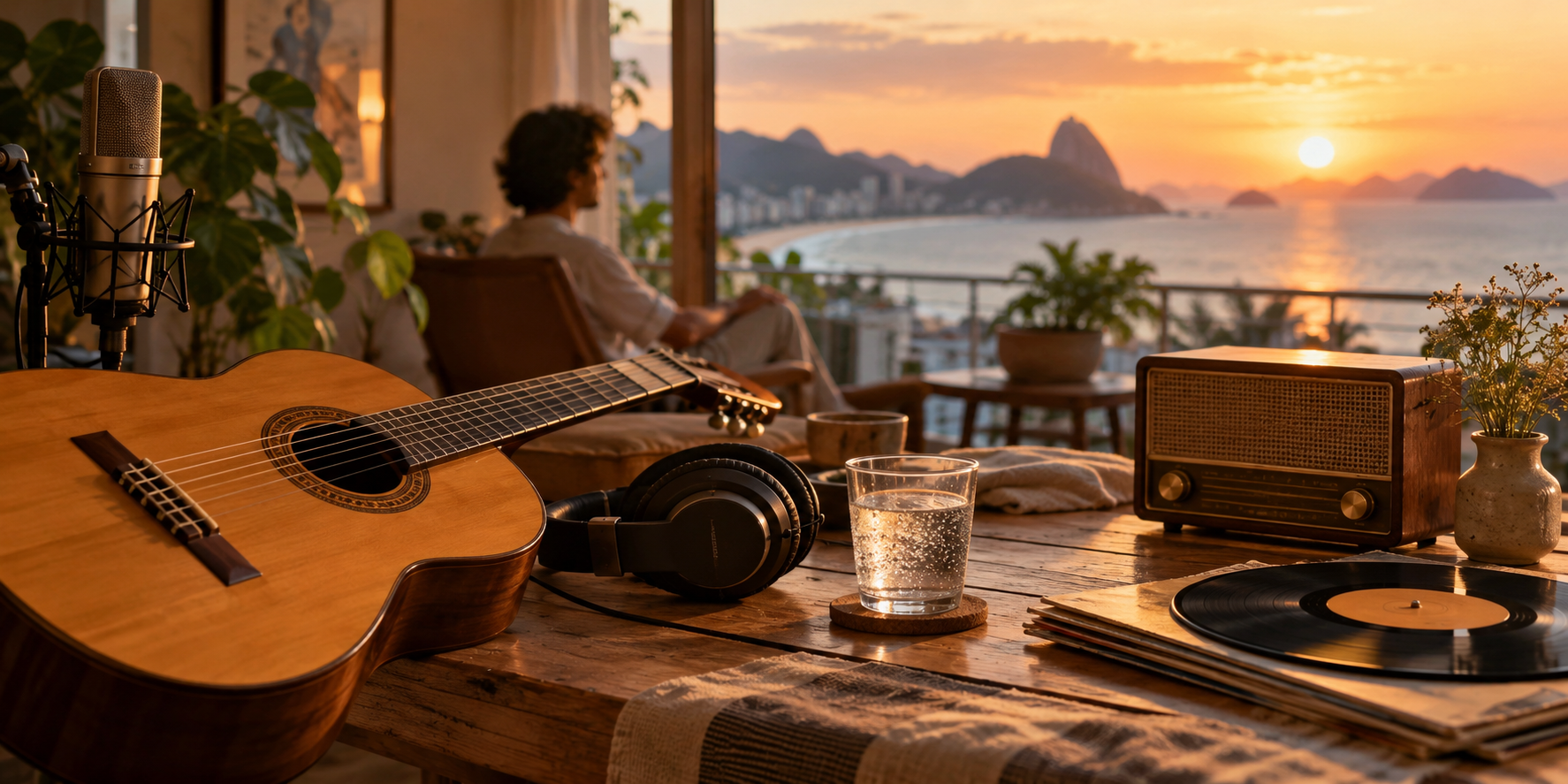
A soft acoustic guitar begins playing a gently syncopated rhythm. The chords sound warm and sophisticated, but the pulse remains relaxed.
Then a singer enters almost conversationally.
There is no need for dramatic vocal projection. No rush toward a powerful chorus. The voice seems to float around the guitar's rhythm, occasionally arriving just before or after the beat.
The result feels effortless.
Yet beneath that quiet surface lies a remarkable amount of musical detail.
This is the distinctive appeal of bossa nova music radio.
Bossa nova developed in Brazil during the late 1950s and became one of the country's most internationally recognized musical movements. Its sound brought together Brazilian samba traditions, intimate vocal delivery, refined guitar playing, and harmonic ideas associated with modern popular music and jazz.
The style became famous through recordings by João Gilberto, Antônio Carlos Jobim, Astrud Gilberto, and other influential musicians.
Songs such as Chega de Saudade, Desafinado, and The Girl from Ipanema helped introduce bossa nova to listeners around the world.
But bossa nova is much more than pleasant background music.
Its rhythms reward close attention. Its melodies often contain subtle surprises. And its arrangements demonstrate how expressive music can emerge from restraint rather than volume.
Whether you're discovering Brazilian music for the first time or searching for relaxing radio stations, understanding bossa nova can make every listening session more rewarding.
What Is Bossa Nova Music?
Bossa nova is a Brazilian musical style that emerged in Rio de Janeiro during the late 1950s.
The Portuguese phrase bossa nova is commonly understood as something like "new style" or "new way."
The music developed through the transformation of existing Brazilian popular traditions, especially samba.
It became associated with understated singing, distinctive guitar rhythms, and sophisticated harmonies.
What makes bossa nova recognizable?
Several musical characteristics frequently appear:
-
Soft, intimate vocal delivery
-
Syncopated acoustic guitar accompaniment
-
Harmonically rich chord progressions
-
Melodies that move flexibly around the beat
-
Restrained arrangements
-
A close relationship with Brazilian samba rhythms
Not every bossa nova recording sounds identical.
Some performances feature only voice and guitar.
Others include piano, bass, percussion, flute, saxophone, or orchestral strings.
The style can be intimate, playful, reflective, or rhythmically energetic.
Its defining qualities come from how the musical elements interact.
The Origins of Bossa Nova in Brazil
Bossa nova emerged within the musical and cultural environment of Rio de Janeiro in the late 1950s.
Brazilian popular music already included rich traditions of samba, choro, and other styles.
Musicians were also listening to international popular music and jazz.
A generation of performers and composers began developing a more intimate approach to song interpretation.
Rather than relying on large vocal gestures, they experimented with quieter delivery and refined rhythmic placement.
The guitar became especially important.
Rio de Janeiro and the new sound
Bossa nova is often associated with Rio's South Zone neighborhoods and the social environments in which musicians gathered to exchange ideas.
But its musical foundations extended beyond any one neighborhood or social circle.
The style developed through Brazilian musical traditions and the work of performers, composers, lyricists, and instrumentalists with different experiences.
A turning point in Brazilian popular music
The late 1950s brought recordings that helped establish bossa nova's identity.
Among the most influential was João Gilberto's interpretation of Chega de Saudade.
The song was composed by Antônio Carlos Jobim, with lyrics by Vinícius de Moraes.
Gilberto's 1958 recording became a landmark in the emergence of bossa nova.
His rhythmic guitar playing and understated singing offered a new approach to familiar Brazilian musical materials.
João Gilberto: The Sound That Defined Bossa Nova
João Gilberto is one of the most important figures in bossa nova history.
His guitar technique and vocal phrasing became central to the style's identity.
He developed a distinctive approach to accompanying songs, combining steady bass movement with syncopated chords.
His singing was quiet, controlled, and rhythmically flexible.
The João Gilberto guitar rhythm
Gilberto's accompaniment is often described through the relationship between the bass notes and upper guitar chords.
The thumb establishes a rhythmic foundation.
The fingers add syncopated chord patterns.
The result can suggest elements of samba percussion within a single guitar performance.
This creates a remarkable sense of movement without requiring a large ensemble.
Why his singing sounds different
Gilberto often sings with extraordinary restraint.
Instead of emphasizing every beat, he allows the melody to move naturally around the accompaniment.
The voice and guitar remain closely connected, but they do not always place accents in the same positions.
That subtle rhythmic independence is one of bossa nova's most recognizable characteristics.
Essential João Gilberto recordings
Start with:
-
Chega de Saudade
-
Desafinado
-
Corcovado
-
Samba de Uma Nota Só
-
O Pato
These recordings offer an excellent introduction to his musical approach.
A listening exercise
Choose Chega de Saudade.
Listen once to the guitar alone.
Try to follow the bass notes.
Then listen again and focus on the upper chord accents.
Finally, follow Gilberto's voice.
Notice how the vocal phrasing moves across the guitar rhythm.
The music may sound simple at first, but its internal coordination is remarkably sophisticated.
Antônio Carlos Jobim: The Composer Behind Timeless Melodies
Antônio Carlos Jobim, often known internationally as Tom Jobim, was one of bossa nova's most influential composers.
His work combined memorable melodies with rich harmonic structures.
Jobim drew on Brazilian musical traditions while developing a distinctive compositional voice.
His songs became essential parts of the bossa nova repertoire and later entered the international jazz-standard tradition.
What makes Jobim's compositions distinctive?
Jobim's melodies often feel natural and lyrical.
Yet the harmonies beneath them can move in unexpected directions.
A chord may introduce a subtle change in emotional color.
A melody may rise gently before resolving into a quieter phrase.
These choices give the music both accessibility and depth.
Essential Antônio Carlos Jobim compositions
Explore:
-
Garota de Ipanema (The Girl from Ipanema)
-
Corcovado (Quiet Nights of Quiet Stars)
-
Wave
-
Desafinado
-
Águas de Março (Waters of March)
-
Samba de Uma Nota Só (One Note Samba)
These compositions reveal different aspects of Jobim's musical imagination.
Listen to the harmony
Choose Corcovado and concentrate on the chord changes.
You don't need to identify every chord.
Simply notice how the harmonic colors shift beneath the melody.
Then listen to Wave.
Its melodic movement and harmonic development create a different atmosphere while remaining connected to Jobim's recognizable style.
Vinícius de Moraes: Poetry and Songwriting
Vinícius de Moraes was a Brazilian poet, lyricist, and diplomat who played a central role in the development of bossa nova.
His collaborations with Jobim produced some of the movement's most famous songs.
De Moraes brought poetic sensitivity to lyrics that explored love, longing, beauty, and the passage of time.
The importance of Portuguese lyrics
Bossa nova's international popularity sometimes leads listeners to focus primarily on instrumental arrangements or English-language versions.
But the original Portuguese lyrics are an important part of the music's identity.
Their rhythm, imagery, and sound contribute to the songs' expressive character.
Listen to the words as music
Even if you don't understand Portuguese, pay attention to the syllables.
Notice how the singer places words against the guitar rhythm.
The language itself becomes part of the musical texture.
Reading a reliable translation afterward can reveal additional meaning without replacing the experience of hearing the original performance.
Astrud Gilberto and the Global Success of Bossa Nova
Astrud Gilberto became internationally famous through her performance of The Girl from Ipanema.
Her understated vocal style became closely associated with the song's international popularity.
The recording appeared on the album Getz/Gilberto, released in 1964.
The album featured saxophonist Stan Getz, João Gilberto, and Antônio Carlos Jobim, among other musicians.
Why The Girl from Ipanema became so famous
The song combines an unforgettable melody with a relaxed rhythmic feel.
Its arrangement leaves room for the vocals and saxophone.
The performance demonstrates how bossa nova can feel intimate even within a studio ensemble.
Listen to the contrast
Pay attention to the different vocal approaches on the recording.
João Gilberto sings in Portuguese.
Astrud Gilberto sings in English.
Their performances have distinct characters.
Then listen to Stan Getz's saxophone.
Its lyrical tone adds another expressive voice to the arrangement.
Stan Getz and the Connection Between Bossa Nova and Jazz
American saxophonist Stan Getz played an important role in bringing bossa nova to international jazz audiences.
His collaboration with Brazilian musicians helped introduce the style to many listeners outside Brazil.
But it is important to remember that bossa nova was already a developed Brazilian musical movement.
Its international recognition did not begin with American jazz musicians.
Jazz influences and musical exchange
Bossa nova and jazz share certain harmonic and improvisational possibilities.
Jazz musicians were attracted to bossa nova's rhythmic character and sophisticated compositions.
Brazilian musicians also engaged with international musical ideas.
The resulting collaborations created new interpretations.
Essential listening
The album Getz/Gilberto is a useful starting point.
It includes:
-
The Girl from Ipanema
-
Desafinado
-
Corcovado
-
Só Danço Samba
The album demonstrates how Brazilian musical approaches and jazz performance practices could interact.
Bossa Nova Versus Samba: What's the Difference?
Bossa nova developed from Brazilian samba traditions, but the two are not identical.
Samba is a broad family of Brazilian musical and dance traditions with diverse regional and historical forms.
Bossa nova is a particular musical movement associated with the late 1950s.
Rhythm and instrumentation
Many samba styles feature prominent percussion and a strong rhythmic presence.
Bossa nova often translates aspects of samba's rhythmic character into a quieter guitar-based setting.
Vocal delivery
Bossa nova is frequently associated with restrained singing.
Samba encompasses a much wider range of vocal approaches.
Musical context
Samba has deep connections to Brazilian community traditions, social gatherings, and carnival cultures.
Bossa nova developed in a different mid-twentieth-century urban musical environment while remaining connected to Brazilian popular music.
Feature Bossa Nova Samba Historical identity Emerged in the late 1950s Older, broad Brazilian tradition Common sound Understated guitar, vocals and refined arrangements Wide range of percussion and ensemble formats Vocal approach Often intimate and restrained Highly varied Rhythm Gentle, syncopated samba-derived patterns Many distinctive samba rhythms Musical range Recognizable movement and style Broad family of stylesThese are general distinctions.
Some samba performances are quiet and intimate.
Some bossa nova recordings feature larger ensembles and energetic arrangements.
The traditions overlap through shared musical history.
Bossa Nova Versus Jazz
Bossa nova is often described internationally as Brazilian jazz.
That phrase can be useful for introducing the sound, but it can also oversimplify the music's origins.
Bossa nova is fundamentally a Brazilian musical development with strong connections to samba.
Jazz influenced certain harmonic and performance approaches, and jazz musicians later adopted bossa nova compositions.
Where they overlap
Both traditions can feature sophisticated harmony, expressive phrasing, and instrumental improvisation.
Many bossa nova songs became jazz standards.
Jazz musicians have performed them in different arrangements, from small combos to large ensembles.
Where they differ
A jazz interpretation of The Girl from Ipanema may emphasize improvisation.
A João Gilberto recording may focus more closely on the relationship between voice, guitar, and the song's original rhythmic character.
Neither approach is inherently better.
They reveal different musical priorities.
The Bossa Nova Guitar: A Rhythm You Can Feel
The acoustic guitar is central to many classic bossa nova recordings.
Its accompaniment often combines bass notes with syncopated chords.
The pattern can create a steady flow without sounding rigid.
The thumb and fingers
In a common approach, the thumb plays lower strings while the fingers articulate upper chord tones.
The bass establishes a foundation.
The chords create rhythmic accents.
Together, they suggest a small ensemble within one instrument.
Why timing matters
Bossa nova guitar isn't simply about playing softly.
The placement of accents creates the groove.
A chord played slightly earlier or later can change the feel.
Listen for repetition and variation
Choose a guitar-led recording.
Follow the accompaniment through several verses.
The pattern may sound repetitive, but small changes keep it alive.
Notice how the player responds to the singer.
The guitar and voice form a continuous musical conversation.
Bossa Nova Vocals: The Beauty of Restraint
Many classic bossa nova singers use a relatively intimate vocal approach.
The performance may sound conversational rather than theatrical.
This allows subtle changes in phrasing to become especially meaningful.
The voice doesn't need to dominate
In some musical styles, the singer is clearly separated from the accompaniment.
In bossa nova, the voice often feels integrated into the instrumental texture.
The singer may phrase around the guitar rather than directly following every accent.
Listen to the spaces
A brief pause can create anticipation.
A softly sustained note may change the emotional character of a phrase.
These details are easier to hear when the arrangement is restrained.
The Role of Piano, Bass and Percussion
Although guitar and voice are central to many classic recordings, bossa nova ensembles can include several other instruments.
Piano
The piano can provide harmonic color and melodic responses.
Its chords may reinforce or expand the guitar's harmony.
Bass
The bass supports the rhythmic foundation.
Its movement helps connect the harmony and maintain the pulse.
Percussion
Light percussion can add rhythmic detail.
Depending on the arrangement, musicians may use drums, shakers, or other percussion instruments.
Flute and saxophone
Wind instruments can introduce lyrical melodies and improvisational passages.
Their sound can complement the soft vocal and guitar textures.
Strings
Orchestral strings sometimes appear in more elaborate bossa nova arrangements.
They can add warmth or a cinematic atmosphere.
The key is how these instruments are balanced.
Bossa nova often benefits from allowing individual parts to remain clear.
Essential Bossa Nova Songs for Beginners
If you're building a listening list, start with these influential recordings and compositions.
Chega de Saudade — João Gilberto
A foundational recording that introduces Gilberto's guitar rhythm and understated vocal approach.
The Girl from Ipanema — Stan Getz and João Gilberto, featuring Astrud Gilberto
One of the most internationally recognized bossa nova recordings.
Desafinado — João Gilberto
A classic example of the movement's melodic and harmonic character.
Corcovado — Antônio Carlos Jobim composition
A gentle, lyrical piece that has been recorded by many performers.
Wave — Antônio Carlos Jobim
A composition known for its flowing melody and rich harmony.
Samba de Uma Nota Só — João Gilberto and other interpreters
A playful composition built around a memorable melodic idea.
Águas de Março — Antônio Carlos Jobim and Elis Regina
A celebrated Brazilian duet recording that demonstrates Jobim's songwriting and the expressive possibilities of vocal interaction. It is often discussed within the broader Brazilian popular music tradition, rather than as a straightforward example of early bossa nova.
These songs offer different entry points.
Some emphasize intimate guitar and voice.
Others feature larger arrangements or jazz-influenced performances.
Bossa Nova Beyond the Classic Era
Bossa nova's international success helped establish Brazilian music within global popular culture.
Its influence continued beyond the late 1950s and 1960s.
Brazilian musicians developed new musical movements and approaches, including the broad tradition known as Música Popular Brasileira, or MPB.
Bossa nova remained an important reference point, but Brazilian popular music continued changing.
Contemporary interpretations
Modern artists may combine bossa nova-inspired rhythms with pop, electronic production, jazz, or other styles.
Some remain close to the traditional acoustic sound.
Others use bossa nova elements within entirely different musical settings.
Recognizing influence without confusing genres
A modern song with soft vocals and syncopated guitar may be influenced by bossa nova.
That doesn't automatically make it a traditional bossa nova recording.
The distinction helps listeners appreciate both the original movement and its continuing influence.
Why Bossa Nova Is Popular for Relaxing Listening
Bossa nova is frequently associated with cafés, quiet evenings, reading, and relaxed social environments.
Its gentle rhythmic feel makes it suitable for background listening.
But the music also rewards concentration.
A calm surface with musical depth
The guitar maintains a flowing pulse.
The harmony changes subtly.
The singer phrases around the rhythm.
These details create movement without demanding constant attention.
Background music or active listening?
Both approaches can be enjoyable.
At a comfortable volume, bossa nova can accompany everyday activities.
For a more attentive session, listen closely to one instrument.
The same recording can provide a different experience depending on how you approach it.
How to Spend One Hour With Bossa Nova Music
A one-hour session can introduce several important aspects of the tradition.
Time Listening focus What to notice 0–10 minutes João Gilberto Guitar rhythm and vocal phrasing 10–20 minutes Antônio Carlos Jobim compositions Melody and harmonic movement 20–30 minutes Astrud Gilberto Understated vocals and arrangement 30–40 minutes Getz/Gilberto recordings Saxophone and Brazilian rhythmic interaction 40–50 minutes Instrumental bossa nova Piano, guitar and ensemble textures 50–60 minutes Later Brazilian interpretations Evolution of the soundYou don't need to follow this schedule exactly.
If a recording catches your attention, listen again.
Bossa nova often reveals new details through repetition.
How to Find Bossa Nova Radio Stations Online
Bossa nova music may appear under several radio categories.
Some stations focus specifically on classic bossa nova.
Others combine it with Brazilian jazz, samba, MPB, or international lounge music.
A station featuring João Gilberto, Antônio Carlos Jobim, Astrud Gilberto, and related Brazilian artists may be a good starting point.
If you prefer instrumental music, look for jazz stations featuring bossa nova standards.
For a wider experience, explore Brazilian music stations that include both classic and contemporary recordings.
You can browse international stations through the 1LiveRadio online radio directory.
For more genre guides and listening ideas, visit the 1LiveRadio music blog.
Checking the station's playlist is the best way to understand its musical focus.
Why Bossa Nova Works So Well on Radio
Bossa nova radio offers a listening experience built around subtle variation.
A familiar Jobim composition may appear in several different interpretations.
One recording features only voice and guitar.
Another includes piano, bass, and percussion.
A jazz version may introduce an extended saxophone solo.
These differences reveal how flexible the repertoire can be.
Radio also introduces listeners to artists beyond the most internationally famous names.
You may discover a lesser-known Brazilian singer whose phrasing immediately catches your attention.
Or hear an instrumental interpretation that changes how you understand a familiar melody.
Compare different versions
Choose Corcovado or Desafinado.
Listen to two or three recordings by different performers.
Notice changes in tempo, instrumentation, and vocal delivery.
The composition remains recognizable, but the musical experience changes.
This is one of the most rewarding ways to explore bossa nova.
The Cultural Importance of Bossa Nova
Bossa nova is an important part of Brazilian musical history.
It reflects a period of artistic experimentation and changing approaches to popular song.
Its international success helped bring Brazilian composers and performers to new audiences.
But the movement should not be separated from the broader Brazilian musical traditions that shaped it.
Samba, in particular, provided an essential rhythmic foundation.
Understanding these connections makes bossa nova more meaningful than a simple label for relaxing music.
For further historical background, explore the Encyclopaedia Britannica article on bossa nova.
The Small Details That Make Bossa Nova Memorable
The most memorable moment in a bossa nova recording may be almost invisible on a first listen.
A guitar chord arrives slightly earlier than expected.
The singer delays one word.
A bass note changes the harmonic direction.
A flute enters with a brief melodic response.
Then the arrangement returns to its gentle pulse.
These details are part of the style's beauty.
Try listening to a familiar recording twice.
On the first listen, enjoy the overall atmosphere.
On the second, follow the guitar rhythm.
Notice how the singer moves around it.
Then listen for the harmonic changes beneath the melody.
You may discover that music you once considered simple background listening contains remarkable musical sophistication.
Frequently Asked Questions
What is bossa nova music?
Bossa nova is a Brazilian musical style that emerged in the late 1950s. It is associated with syncopated guitar rhythms, intimate vocals, sophisticated harmonies, and strong connections to samba.
Where did bossa nova originate?
Bossa nova developed in Rio de Janeiro, Brazil, during the late 1950s.
Who invented bossa nova?
Bossa nova emerged through the contributions of several musicians. João Gilberto, Antônio Carlos Jobim, and Vinícius de Moraes were among its central figures.
What does bossa nova mean?
The Portuguese phrase is commonly understood as "new style" or "new way."
Is bossa nova the same as samba?
No. Bossa nova developed from Brazilian samba traditions but established its own recognizable approach to rhythm, singing, and arrangement.
Is bossa nova a type of jazz?
Bossa nova is fundamentally a Brazilian musical style. It shares certain harmonic and improvisational connections with jazz, and many bossa nova compositions became jazz standards.
Who are famous bossa nova artists?
Important names include João Gilberto, Antônio Carlos Jobim, Astrud Gilberto, Vinícius de Moraes, and musicians associated with the movement.
What is the most famous bossa nova song?
The Girl from Ipanema is among the most internationally recognized bossa nova songs.
What instruments are used in bossa nova?
Common instruments include acoustic guitar, piano, bass, light percussion, flute, saxophone, and vocals.
Can I listen to bossa nova radio online?
Yes. Internet radio stations feature classic bossa nova, Brazilian jazz, instrumental interpretations, and related Brazilian popular music.
Final Thoughts: Let the Rhythm Breathe
Bossa nova has a remarkable ability to create movement without sounding hurried.
The guitar maintains a gentle pulse.
The singer moves naturally around the rhythm.
The harmony introduces subtle changes.
And the arrangement allows each detail to remain clear.
When you listen to bossa nova radio, don't focus only on the familiar melody.
Pay attention to the timing.
Notice the guitar's rhythmic accents.
Listen to how the voice enters and leaves each phrase.
Follow the harmony as it changes beneath the song.
The more closely you listen, the more the music reveals.
And sometimes, the quietest recording is the one that stays with you the longest.
Reader comments
No comments yet. Start the conversation.
Leave a comment
Your email stays private. Comments appear after approval.