
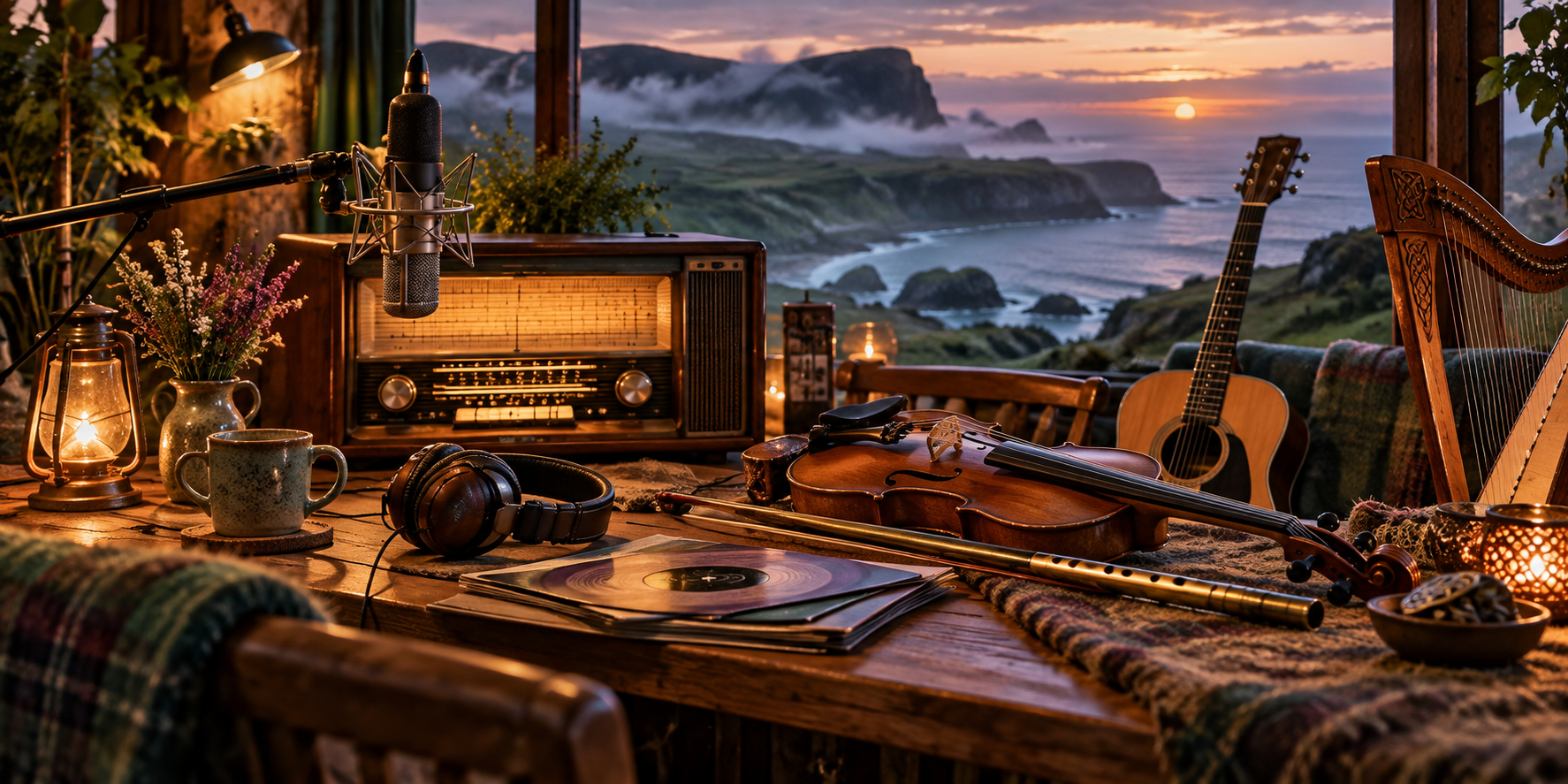
Celtic music brings together a remarkable range of traditional and contemporary sounds, from the lively fiddle tunes of Ireland to the powerful bagpipes of Scotland, the expressive songs of Wales, and the distinctive dance traditions of Brittany.
For listeners discovering these styles for the first time, Celtic music radio offers an accessible introduction to musical traditions shaped by centuries of storytelling, community gatherings, dance, and cultural exchange.
But Celtic music is not one uniform genre. The term covers several related yet distinct musical cultures, each with its own instruments, rhythms, languages, and performance practices.
This guide explores the origins of Celtic music, its most important regional traditions, popular instruments, influential musicians, and practical ways to discover authentic recordings through online radio.
What Is Celtic Music?
Celtic music is a broad term commonly used to describe traditional and contemporary music associated with regions that have historical Celtic languages and cultural identities.
These include:
-
Ireland.
-
Scotland.
-
Wales.
-
Brittany in northwestern France.
-
The Isle of Man.
-
Cornwall in southwestern England.
Galicia and Asturias in northern Spain also have musical traditions frequently featured at Celtic music festivals, although their linguistic and cultural histories should not simply be treated as identical to those of the Celtic-language regions.
There is no single rhythm, instrument, or melody that defines every Celtic musical tradition.
Instead, the label connects different musical cultures through historical relationships, shared performance practices in some regions, and modern artistic exchanges.
The best way to understand Celtic music is to listen to its regional traditions individually before exploring how contemporary musicians combine them.
A Brief History of Celtic Music
The history of Celtic music is closely connected to oral tradition.
For generations, communities passed songs and instrumental melodies from one musician to another, often without written notation.
Music played important roles in:
-
Weddings and celebrations.
-
Seasonal festivals.
-
Social dancing.
-
Storytelling.
-
Religious and ceremonial occasions.
-
Community gatherings.
-
Expressions of cultural identity.
Traditional melodies were often adapted as they traveled between communities.
As a result, one tune might exist in several versions, with different titles, ornaments, or arrangements.
During the nineteenth and twentieth centuries, collectors, musicians, and cultural organizations documented many traditional songs and tunes.
Later, radio broadcasting, sound recording, festivals, and international touring introduced these traditions to wider audiences.
The folk revivals of the twentieth century were particularly influential in bringing Irish, Scottish, and other traditional music into modern concert halls and recording studios.
Today, Celtic music continues to develop through both traditional performance and contemporary experimentation.
The Main Celtic Music Traditions
1. Irish Traditional Music
Irish traditional music is one of the most internationally recognized traditions associated with Celtic music.
It is especially known for its dance tunes, expressive ornamentation, and strong community-based performance culture.
Common instrumental forms include:
-
Reels.
-
Jigs.
-
Hornpipes.
-
Polkas.
-
Slides.
Irish traditional music frequently features fiddle, flute, tin whistle, uilleann pipes, accordion, concertina, and bodhrán.
Musicians may perform individually or gather for informal sessions, where several players share familiar tunes.
What makes Irish traditional music distinctive?
One important characteristic is melodic ornamentation.
Players use techniques such as rolls, cuts, and other decorative figures to shape a tune without changing its underlying identity.
Rhythmic phrasing also matters. Two musicians can play the same melody but give it noticeably different energy through timing and articulation.
Artists and groups to explore:
-
The Chieftains.
-
Planxty.
-
The Bothy Band.
-
Martin Hayes.
-
Altan.
These musicians represent different approaches to Irish traditional music, from ensemble arrangements to highly expressive fiddle playing.
2. Scottish Traditional Music
Scottish traditional music includes a wide variety of instrumental and vocal traditions.
The Great Highland bagpipe is internationally famous, but Scottish music extends far beyond bagpipe performances.
Fiddle traditions, Gaelic songs, Lowland ballads, accordion music, and dance tunes all contribute to Scotland's musical heritage.
Common forms include reels, jigs, strathspeys, and marches.
The strathspey
The strathspey is a Scottish dance-tune form particularly associated with distinctive rhythmic patterns and the use of the so-called Scotch snap, a short note followed by a longer one.
Its rhythmic character makes it different from many other traditional dance forms.
Scottish Gaelic singing
Scottish Gaelic vocal traditions include storytelling songs, laments, and work songs.
Waulking songs, historically associated with the communal process of finishing cloth, are one example of music closely connected with social activity.
Artists and groups to explore:
-
Capercaillie.
-
Julie Fowlis.
-
Aly Bain.
-
Battlefield Band.
-
Phil Cunningham.
For beginners, comparing a Scottish fiddle recording with a Highland bagpipe performance is an excellent way to hear the diversity of the tradition.
3. Welsh Traditional Music
Wales has a rich musical heritage encompassing traditional songs, instrumental music, harp traditions, and choral performance.
The Welsh harp has a particularly important cultural association, although Welsh musical history includes many other instruments and performance styles.
Welsh-language songs remain a significant part of the country's musical identity.
Traditional repertoire includes dance tunes, ballads, and songs reflecting local history and everyday life.
Artists and groups to explore:
-
Calan.
-
Ar Log.
-
Cerys Matthews.
-
Siân James.
Welsh traditional music is worth exploring for its expressive singing, distinctive repertoire, and connections between language and cultural heritage.
4. Breton Music from France
Brittany, or Bretagne, is a region in northwestern France with a strong Breton cultural identity and musical traditions.
Breton music is particularly associated with communal dancing and instrumental ensembles.
Two notable instruments are:
-
Bombarde: A powerful double-reed instrument.
-
Biniou: A type of Breton bagpipe.
These instruments are often performed together, creating a distinctive sound.
The fest-noz, a traditional Breton night festival centered on communal dancing, is an important setting for Breton musical performance.
UNESCO recognizes the fest-noz as an element of intangible cultural heritage.
Artists and groups to explore:
-
Alan Stivell.
-
Tri Yann.
-
Dan Ar Braz.
-
Denez Prigent.
Breton music is particularly interesting for listeners who enjoy strong dance rhythms, distinctive wind instruments, and the interaction between traditional and modern arrangements.
5. Manx and Cornish Musical Traditions
The Isle of Man and Cornwall also have musical traditions connected to their regional identities and histories.
Manx music includes songs and dance melodies associated with the island's cultural heritage.
Cornish music includes traditional songs, dance tunes, and modern efforts to maintain and develop regional musical practices.
These traditions may receive less international radio exposure than Irish or Scottish music, but they are important parts of the wider musical landscape.
Exploring them can reveal how smaller communities preserve and reinterpret their musical heritage.
Celtic Music Instruments Explained
One of the easiest ways to recognize different Celtic music traditions is to listen carefully to the instruments.
Fiddle
The fiddle is physically the same basic instrument as the violin, but the term often refers to its use in traditional music.
Fiddle players may use ornaments, rhythmic bowing, and stylistic phrasing associated with particular regional traditions.
The fiddle is especially prominent in Irish and Scottish traditional music.
Tin Whistle
The tin whistle is a simple six-hole wind instrument widely used in Irish traditional music.
Its clear, bright sound makes it particularly recognizable in melodic performances.
It is also a popular instrument for beginners.
Uilleann Pipes
Uilleann pipes are a type of Irish bagpipe operated using bellows rather than by blowing directly into a bag.
They are known for their expressive sound and melodic flexibility.
They should not be confused with Scottish Highland bagpipes, which differ in construction, playing technique, and musical use.
Great Highland Bagpipe
The Great Highland bagpipe is one of Scotland's most recognizable musical instruments.
It is associated with ceremonial performances, pipe bands, marches, and traditional repertoire.
Its powerful, sustained sound is especially distinctive.
Celtic Harp
The harp has important historical and cultural associations with Ireland, Wales, and other regions.
Modern harp performances may include traditional melodies, contemporary compositions, and arrangements inspired by folk traditions.
Bodhrán
The bodhrán is an Irish frame drum commonly played with a short stick or tipper.
It provides rhythmic accompaniment in many contemporary traditional-music ensembles.
However, not every traditional Irish performance includes a bodhrán.
Accordion and Concertina
Free-reed instruments such as accordions and concertinas play significant roles in several traditional dance-music cultures.
They provide melodic lines and rhythmic energy, especially in ensemble performances.
Flute
Wooden flutes are prominent in Irish traditional music.
Players often use ornamentation and rhythmic articulation to create distinctive interpretations of familiar melodies.
Bombarde and Biniou
These Breton instruments are especially associated with dance music in Brittany.
Their strong, penetrating tones create an energetic ensemble sound.
Celtic Music Instruments at a Glance
Instrument Common Association Sound or Role Fiddle Ireland and Scotland Expressive melodies and dance tunes Tin whistle Ireland Bright, clear melodic lines Uilleann pipes Ireland Expressive reed melodies Highland bagpipes Scotland Powerful sustained tones Harp Ireland and Wales Plucked melodies and accompaniment Bodhrán Ireland Rhythmic accompaniment Accordion Several traditions Dance melodies and rhythmic support Wooden flute Ireland Flowing melodies and ornamentation Bombarde Brittany Strong double-reed sound Biniou Brittany Bagpipe accompaniment and dance musicThese associations are not exclusive. Instruments and musical techniques frequently cross regional boundaries.
Understanding Celtic Dance Rhythms
Traditional dance music is an important part of many Celtic-associated musical cultures.
Understanding a few common tune forms can make listening more rewarding.
Reels
Reels are commonly played in simple or duple meter, often notated in 4/4 or 2/2.
They tend to have a flowing, energetic rhythmic character.
Listen for a steady pulse supporting continuous melodic movement.
Jigs
Jigs are commonly associated with compound meter.
A double jig is typically notated in 6/8, while slip jigs are commonly in 9/8.
The grouping of beats gives jigs a distinctive rhythmic movement.
Hornpipes
Hornpipes are another important traditional dance-tune form.
They are frequently performed with a more measured or swinging rhythmic feel, although playing styles vary.
Strathspeys
Strathspeys are especially associated with Scottish fiddle and dance traditions.
Their characteristic rhythmic patterns distinguish them from reels and jigs.
Polkas and Slides
Polkas and slides have important places in particular Irish regional traditions, including the music of Sliabh Luachra.
They offer useful examples of how regional dance practices shape musical repertoire.
Listening tip: Rather than memorizing every tune category immediately, begin by tapping the underlying beat. Then notice how the melody fits around it.
Famous Celtic Music Artists and Bands
The Chieftains
The Chieftains are among the most influential ensembles in the international popularization of Irish traditional music.
Their recordings and collaborations introduced traditional Irish instruments and repertoire to audiences around the world.
Their album The Long Black Veil is one accessible example of their cross-genre collaborations.
Clannad
Clannad is an Irish group known for combining traditional influences with atmospheric arrangements and contemporary production.
Their music helped introduce Irish-language singing and Celtic-inspired sounds to international audiences.
Enya
Enya is an Irish singer and composer whose layered vocal arrangements and atmospheric recordings are often associated with Celtic-inspired and new-age music.
Her work is not a direct substitute for traditional Irish session music, but it represents an influential contemporary approach.
Start with Orinoco Flow or Caribbean Blue.
Loreena McKennitt
Loreena McKennitt is a Canadian singer, songwriter, and instrumentalist known for music influenced by Celtic traditions and other cultural sources.
Her recordings often combine harp, voice, and richly arranged instrumentation.
Start with The Mummers' Dance.
Capercaillie
Capercaillie is a Scottish group known for blending traditional Gaelic songs and instrumental music with contemporary influences.
Their recordings offer an accessible introduction to modern Scottish folk arrangements.
Alan Stivell
Alan Stivell is a Breton musician whose work helped popularize the Celtic harp and modern Breton music.
His recordings are an important starting point for exploring Brittany's place within contemporary Celtic music.
Altan
Altan is an Irish traditional music group associated with the musical heritage of County Donegal.
Their performances combine instrumental dance tunes with traditional singing.
Julie Fowlis
Julie Fowlis is a Scottish Gaelic singer known for her expressive interpretations of Gaelic songs.
Her work offers a valuable introduction to the continuing vitality of Scottish Gaelic musical traditions.
Essential Celtic Music Recordings for Beginners
These selections introduce different musical approaches rather than representing a definitive ranking.
Artist or Group Suggested Recording What to Explore The Chieftains The Long Black Veil Irish traditional instruments and collaborations Clannad Theme from Harry's Game Irish-language vocals and atmospheric arrangement Enya Orinoco Flow Layered contemporary Celtic-inspired sound Loreena McKennitt The Mummers' Dance Folk influences and richly arranged instrumentation Alan Stivell Renaissance of the Celtic Harp Breton harp and modern revival Altan Harvest Storm Irish instrumental and vocal traditions Capercaillie Delirium Scottish Gaelic music and contemporary arrangements The Bothy Band The Bothy Band (1975) Energetic Irish traditional ensemble playingThese are listening recommendations, not claims about what any particular radio station currently broadcasts.
Traditional Celtic Music vs. Modern Celtic-Inspired Music
The term Celtic music appears in several different contexts.
Traditional music generally refers to repertoire and performance practices connected with particular communities and historical traditions.
Modern Celtic-inspired music may borrow instruments, melodies, or stylistic elements while incorporating contemporary production, orchestration, electronic sounds, or influences from other genres.
Feature Traditional Celtic-Associated Music Modern Celtic-Inspired Music Main focus Regional repertoire and performance practices Contemporary compositions and stylistic fusion Instruments Often acoustic and tradition-specific Acoustic, orchestral, and electronic combinations Performance Sessions, dances, concerts, community settings Concerts, studio recordings, soundtracks Examples Irish reels, Scottish strathspeys, Breton dance tunes Celtic-inspired ambient, folk-rock, cinematic musicNeither category is inherently superior.
Traditional recordings offer direct insight into regional musical practices, while contemporary artists can introduce new listeners to related sounds.
Celtic Music and Storytelling
Music has long played an important role in preserving stories and cultural memory.
Traditional songs may explore:
-
Love and separation.
-
Migration and travel.
-
Historical events.
-
Community life.
-
Local landscapes.
-
Work and everyday experiences.
-
Personal loss and remembrance.
Songs in Irish, Scottish Gaelic, Welsh, Breton, and other languages can carry meanings closely connected to their communities.
Translations can help listeners understand the lyrics, but the musical expression itself also communicates emotion through melody, phrasing, and vocal delivery.
Listening to songs in their original languages is a valuable way to appreciate this cultural dimension.
How to Find Celtic Music Radio Online
Online radio provides an opportunity to explore Celtic-associated musical traditions without needing to build a playlist manually.
Step 1: Search by Musical Tradition
Instead of searching only for the broad phrase "Celtic music," try more specific terms such as:
-
Irish traditional music radio.
-
Scottish folk radio.
-
Celtic harp music.
-
Breton folk music.
-
Gaelic songs.
-
Irish fiddle music.
These searches can help distinguish traditional repertoire from atmospheric or contemporary Celtic-inspired music.
Step 2: Explore Radio Directories
Visit the 1LiveRadio online radio directory to explore available stations and music categories.
Station availability, programming, and stream reliability may change, so check the current listing before listening.
Step 3: Listen for Instruments
When a recording catches your attention, identify the leading instrument.
A fiddle, tin whistle, harp, accordion, or bagpipe may suggest useful directions for further exploration.
Step 4: Learn the Regional Context
Once you discover an artist or tune, learn where the tradition comes from.
Regional context helps explain differences in rhythm, ornamentation, language, and performance.
Step 5: Explore Related Genres
Traditional Celtic music connects naturally with folk music, acoustic music, instrumental music, and certain contemporary fusion styles.
Browse the 1LiveRadio music blog for more guides to musical traditions and listening experiences.
Celtic Music for Different Listening Moods
Celtic music includes enough variety to suit many listening preferences.
For energetic listening: Explore Irish reels, jigs, and lively Scottish fiddle performances.
For quiet moments: Try solo harp recordings, slow airs, and gentle traditional songs.
For instrumental discovery: Listen to uilleann pipes, wooden flute, fiddle, or Breton instrumental ensembles.
For vocal music: Explore Irish-language songs, Scottish Gaelic singing, and Welsh folk traditions.
For atmospheric arrangements: Try contemporary Celtic-inspired artists who combine folk influences with modern studio production.
The mood of a performance depends on the individual recording, not simply its genre label.
A One-Hour Celtic Music Listening Journey
Use this suggested listening plan to discover several musical traditions in one session.
Time Music Style Listening Goal 0–10 minutes Irish reels and jigs Recognize dance rhythms and melodic ornamentation 10–20 minutes Scottish fiddle Hear bowing styles and rhythmic phrasing 20–30 minutes Irish or Welsh harp Explore plucked-string melodies 30–40 minutes Scottish Gaelic or Welsh songs Focus on language and vocal expression 40–50 minutes Breton dance music Identify bombarde and biniou textures 50–60 minutes Contemporary Celtic-inspired music Compare traditional elements with modern arrangementsThis is a personal listening guide rather than an actual radio broadcast schedule.
Why Celtic Music Remains Popular
Celtic music continues to attract audiences for several reasons.
Memorable Melodies
Traditional tunes often have distinctive melodic shapes that invite repeated listening.
Strong Cultural Connections
Many performances preserve relationships between music, language, dance, and regional identity.
Instrumental Variety
Fiddles, flutes, harps, pipes, and other instruments create a wide range of sounds.
Living Traditions
Traditional music is not simply historical material. Musicians continue to learn, perform, adapt, and create within these traditions.
International Exchange
Festivals, collaborations, and online broadcasting help audiences discover regional music beyond its place of origin.
Common Mistakes When Exploring Celtic Music
Assuming Celtic Music Is One Genre
Irish, Scottish, Welsh, Breton, Manx, and Cornish traditions have important differences.
The broad label should not erase those distinctions.
Thinking All Celtic Music Uses Bagpipes
Bagpipes are important in some traditions, but many performances feature fiddle, flute, harp, singing, or other instruments.
Confusing Atmospheric Music with Traditional Folk
Celtic-inspired ambient music can be enjoyable, but it should not automatically be presented as an example of traditional regional performance.
Ignoring Language
Traditional songs often carry cultural meanings connected to their original languages.
Assuming Every Tune Has One Correct Version
Oral transmission and regional performance practices mean that traditional melodies may exist in several legitimate versions.
Frequently Asked Questions About Celtic Music
What is Celtic music?
Celtic music is a broad label used for traditional and contemporary music associated with Celtic-language regions and related cultural traditions, including Ireland, Scotland, Wales, Brittany, Cornwall, and the Isle of Man.
Is Celtic music the same as Irish music?
No. Irish traditional music is an important part of the wider Celtic music category, but the label also includes distinct traditions from Scotland, Wales, Brittany, and other regions.
What instruments are used in Celtic music?
Common instruments include fiddle, tin whistle, flute, harp, bagpipes, accordion, concertina, and various percussion instruments. The instruments used depend on the regional tradition.
What is the difference between Irish and Scottish traditional music?
Irish and Scottish traditions share some tune forms and instruments, but they also have distinct regional styles, repertoire, ornamentation, dance practices, and vocal traditions.
What is the difference between a jig and a reel?
A reel is generally associated with simple or duple meter, while many jigs use compound meter, such as 6/8. Their rhythmic groupings create noticeably different musical movement.
Is Enya traditional Celtic music?
Enya is best described as a contemporary artist whose music incorporates Celtic-related influences alongside new-age and atmospheric studio production. Her recordings are not representative of every traditional Celtic musical practice.
Where can I listen to Celtic music radio?
You can explore online broadcasters and music directories offering traditional folk and Celtic-inspired programming. Visit 1LiveRadio to browse currently available radio options.
Is Celtic music always relaxing?
No. Some recordings are slow and reflective, while reels, jigs, marches, and dance tunes can be energetic and fast-paced.
What is the best Celtic music for beginners?
Irish fiddle music, Scottish folk songs, harp recordings, and accessible ensembles such as The Chieftains or Altan are useful starting points. Exploring different regional traditions provides a more complete introduction.
Explore More Traditional Music on 1LiveRadio
Celtic music offers a rewarding introduction to the connections between melody, rhythm, language, and cultural heritage.
If you enjoy traditional instrumental music, explore other folk traditions and acoustic genres.
If you prefer contemporary arrangements, listen for artists who combine traditional melodies with modern production.
You can discover additional listening guides on the 1LiveRadio music blog and explore available stations through the 1LiveRadio radio directory.
For further information about traditional Irish music and its cultural significance, consult the Irish Traditional Music Archive.
Conclusion: Discover the Many Sounds of Celtic Music
Celtic music is best understood as a family of diverse musical traditions rather than one fixed sound.
Irish dance tunes, Scottish fiddle performances, Welsh songs, Breton instrumental ensembles, and contemporary Celtic-inspired recordings each offer something different.
By listening to the instruments, rhythms, languages, and regional contexts behind the music, you can develop a deeper appreciation for these traditions.
Start with a familiar melody, explore a new instrument, and follow the sounds that capture your attention.
Celtic music radio can turn a simple listening session into a journey through living musical traditions.
Reader comments
No comments yet. Start the conversation.
Leave a comment
Your email stays private. Comments appear after approval.