
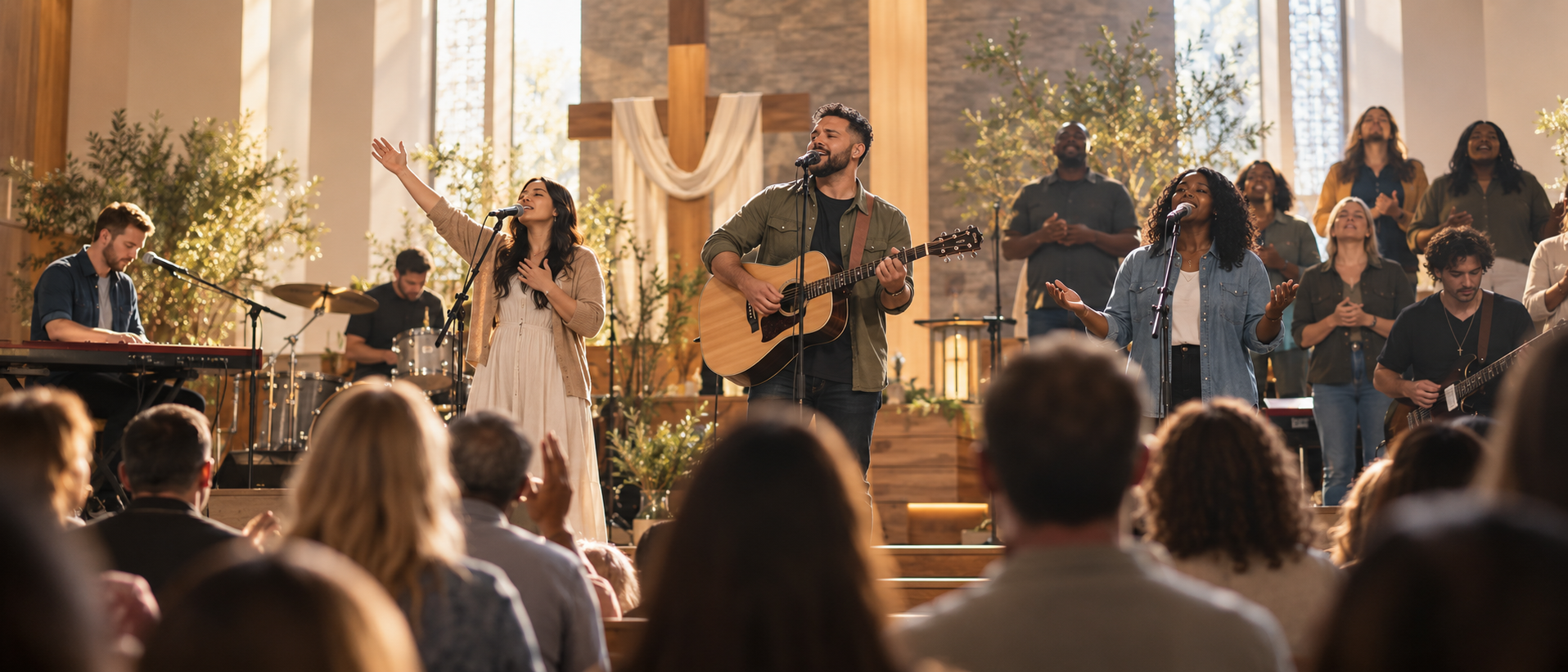
Christian music is one of the world's most diverse traditions of faith-related musical expression. It includes centuries-old sacred chants, traditional hymns, powerful gospel performances, choral compositions, contemporary worship songs, and modern Christian pop and rock.
For listeners exploring Christian music radio, this variety creates opportunities to discover different musical cultures, historical traditions, and approaches to religious expression.
Some recordings feature a single voice singing a simple melody. Others bring together large choirs, organs, orchestras, acoustic guitars, or modern electronic production.
Although these styles can sound very different, they are connected through their relationship with Christian belief, worship, scripture, or spiritual experience.
This guide explains the major types of Christian music, their historical backgrounds, influential performers, essential recordings, and practical ways to discover Christian radio online.
What Is Christian Music?
Christian music is music created, performed, or used to express Christian faith, worship, teachings, experiences, or spiritual themes.
It is a broad category rather than one musical genre.
Christian music can be performed in churches, concert halls, homes, community gatherings, or recording studios.
It can serve different purposes, including:
-
Congregational worship.
-
Personal prayer and reflection.
-
Religious celebrations.
-
Storytelling and spiritual encouragement.
-
Artistic expression.
-
Community participation.
-
Concert and radio listening.
The musical form depends on the tradition, period, culture, and intended setting.
A Gregorian chant, an African American gospel recording, and a contemporary Christian pop song may all belong to the wider category of Christian music, but their histories and musical characteristics are distinct.
The best way to understand Christian music is to explore its major traditions individually rather than assume that every recording follows one style.
A Brief History of Christian Music
Christian music has developed over many centuries across different regions and religious communities.
Early Christian Singing
Singing was part of Christian communal and religious life from the early centuries of the faith.
Early Christian musical practices developed within the cultural environments of the Mediterranean and neighboring regions.
Over time, different communities established their own forms of liturgical singing.
Medieval Sacred Chant
During the medieval period, Western Christian traditions developed bodies of liturgical chant.
Gregorian chant became particularly associated with the Roman Catholic liturgical tradition.
It is commonly characterized by unaccompanied vocal melodies and texts connected to worship.
However, Christian chant is not limited to Gregorian chant. Eastern Christian churches developed their own distinct liturgical musical traditions.
Renaissance Sacred Polyphony
During the Renaissance, composers created increasingly elaborate sacred music for multiple vocal parts.
Composers such as Giovanni Pierluigi da Palestrina became influential in the development of Western sacred choral music.
Polyphonic writing allowed several independent vocal lines to combine into complex musical textures.
Baroque Sacred Music
The Baroque period produced major works of Christian sacred music.
Johann Sebastian Bach composed cantatas, passions, and other works connected with Lutheran worship and religious themes.
George Frideric Handel's Messiah became one of the most widely recognized English-language sacred concert works.
Hymns and Congregational Singing
Hymns developed through many Christian traditions and became central to congregational worship.
Different denominations established distinct repertoires and approaches to hymn singing.
Some hymns were transmitted through written collections, while others developed through oral and community traditions.
Gospel Music
African American gospel music developed through the interaction of Black religious traditions, spirituals, blues-related musical influences, and church performance practices.
During the twentieth century, gospel singers, choirs, and composers helped establish a distinctive and influential musical tradition.
Modern Christian Popular Music
During the second half of the twentieth century, Christian musicians increasingly incorporated contemporary popular styles.
This development contributed to the growth of contemporary Christian music, Christian rock, modern worship, and other related genres.
Today, Christian music continues to evolve through regional traditions, international collaborations, and changing musical technologies.
The Main Types of Christian Music
1. Gospel Music
Gospel music is one of the most influential traditions associated with Christian musical expression.
In the United States, gospel developed through several interconnected traditions, including African American church music and different forms of Protestant religious song.
Gospel is known for expressive singing, powerful vocal harmonies, rhythmic energy, and strong connections with community worship.
Common musical features may include:
-
Lead vocals supported by a choir.
-
Call-and-response patterns.
-
Expressive improvisation.
-
Piano or organ accompaniment.
-
Rhythmic handclapping and percussion.
-
Emotionally intense performances.
Gospel is not one uniform style. Traditional Black gospel, Southern gospel, contemporary gospel, and other traditions have different musical histories.
Artists to explore:
-
Mahalia Jackson.
-
Thomas A. Dorsey.
-
Sister Rosetta Tharpe.
-
The Clark Sisters.
-
Kirk Franklin.
Gospel has also influenced soul, rhythm and blues, rock, and other popular music traditions.
2. Traditional Christian Hymns
Hymns are songs associated with Christian worship and religious expression.
They are especially important in many Protestant and other Christian congregational traditions.
Traditional hymns often feature memorable melodies and texts intended for group singing.
Some are performed with organ accompaniment, while others use piano, guitar, choir, or unaccompanied voices.
Well-known hymns include:
-
Amazing Grace.
-
How Great Thou Art.
-
Holy, Holy, Holy! Lord God Almighty!.
-
Be Thou My Vision.
-
Abide with Me.
The origins and transmission histories of these hymns differ, and individual works may exist in multiple arrangements and translations.
Listening tip: Compare a simple congregational performance with a choral or orchestral arrangement of the same hymn.
3. Sacred Choral Music
Sacred choral music includes compositions written for vocal ensembles in religious or concert settings.
The tradition covers a wide range of periods, languages, and musical approaches.
Western sacred choral repertoire includes works by composers such as:
-
Giovanni Pierluigi da Palestrina.
-
Johann Sebastian Bach.
-
Wolfgang Amadeus Mozart.
-
Gabriel Fauré.
-
Anton Bruckner.
Choral works may feature unaccompanied voices, organ, orchestra, or combinations of instruments.
Some are intended for liturgical use, while others are frequently performed in concerts.
4. Gregorian Chant
Gregorian chant is a form of Western Christian liturgical plainchant associated with the Roman Catholic tradition.
It typically features a single melodic line without instrumental accompaniment.
The rhythm is shaped by the liturgical text rather than by the regular drum-based patterns common in popular music.
Gregorian chant is particularly distinctive for its vocal texture and historical connection to worship.
However, it should not be treated as representative of all early Christian or Eastern Christian music.
5. Contemporary Worship Music
Contemporary worship music uses modern popular musical styles in songs often intended for worship gatherings.
Many recordings feature:
-
Acoustic and electric guitars.
-
Piano and keyboards.
-
Drum kits.
-
Group vocals.
-
Repeated choruses.
-
Gradually developing arrangements.
Artists and groups to explore:
-
Chris Tomlin.
-
Matt Redman.
-
Hillsong Worship.
-
Elevation Worship.
-
Passion.
Contemporary worship overlaps with contemporary Christian music, but its emphasis on congregational singing gives it a particular function.
6. Contemporary Christian Music (CCM)
Contemporary Christian music, commonly abbreviated as CCM, is a broad category of modern popular music with Christian themes.
It includes Christian pop, rock, acoustic songwriting, and other contemporary styles.
Influential artists include:
-
Amy Grant.
-
Michael W. Smith.
-
Steven Curtis Chapman.
-
MercyMe.
-
Casting Crowns.
-
Lauren Daigle.
-
TobyMac.
CCM developed a substantial recording and radio industry, particularly in the United States.
For a detailed exploration of its history, artists, and subgenres, see our dedicated guide to contemporary Christian music in the 1LiveRadio music blog.
7. Christian Rock
Christian rock combines rock instrumentation and musical approaches with Christian-related lyrics or artistic contexts.
Its sound may range from melodic pop-rock to alternative and heavier rock styles.
Artists and bands to explore:
-
Petra.
-
Third Day.
-
Skillet.
-
Switchfoot.
-
Jars of Clay.
Christian rock overlaps with CCM but is more specifically identified by its relationship to rock music.
8. Christian Hip-Hop
Christian hip-hop incorporates rap and hip-hop production with lyrics exploring Christian faith, personal experiences, and related themes.
Artists to explore:
-
Lecrae.
-
Andy Mineo.
-
KB.
-
Trip Lee.
Its musical development is connected to broader hip-hop culture as well as Christian music communities.
9. Eastern Christian Liturgical Music
Eastern Orthodox and other Eastern Christian communities have developed distinct sacred musical traditions.
These may include Byzantine chant, Slavic choral singing, and other regional practices.
Musical characteristics differ across churches and cultural settings.
Some traditions emphasize unaccompanied vocal performance, while others have different historical approaches to instrumentation and liturgy.
These traditions deserve attention in their own right rather than being grouped indiscriminately under Western Gregorian chant.
Christian Music Genres Compared
Tradition Typical Musical Features Listening Focus Gospel Expressive vocals, choirs, rhythmic energy Vocal interaction and emotional interpretation Traditional hymns Memorable melodies, congregational singing Text and communal participation Sacred choral music Multi-part vocal writing, sometimes orchestral Harmony and ensemble texture Gregorian chant Unaccompanied melodic chant Vocal line and liturgical phrasing Contemporary worship Modern band arrangements, accessible choruses Group singing and devotional expression CCM Christian themes with modern popular styles Songwriting and contemporary production Christian rock Electric guitars, drums, rock arrangements Rhythmic energy and lyrical themes Christian hip-hop Rap vocals and hip-hop production Rhythm, lyrical delivery, and message Eastern liturgical music Distinct regional chant and choral traditions Sacred vocal practices and cultural contextThese categories sometimes overlap, but their historical and musical differences are important.
Influential Christian Music Artists and Composers
Mahalia Jackson
Mahalia Jackson was one of the most influential gospel singers of the twentieth century.
Her powerful vocal performances helped bring gospel music to wider audiences.
Recording to explore: Move On Up a Little Higher.
Her work illustrates the expressive possibilities of gospel singing and its importance within African American religious and musical culture.
Thomas A. Dorsey
Thomas A. Dorsey was a composer and musician central to the development of modern Black gospel music.
His songwriting combined religious themes with musical influences from the popular styles of his time.
Composition to explore: Precious Lord, Take My Hand.
Sister Rosetta Tharpe
Sister Rosetta Tharpe was a pioneering gospel singer and guitarist whose energetic performances influenced the development of popular guitar-based music.
Her work is important in discussions of both gospel and early rock history.
Recording to explore: Strange Things Happening Every Day.
Johann Sebastian Bach
Johann Sebastian Bach was a major Baroque composer whose sacred works include cantatas, passions, and other religious compositions.
His music demonstrates the complexity and expressive depth of Western Christian sacred composition.
Works to explore:
-
St Matthew Passion.
-
Mass in B Minor.
-
Selected church cantatas.
George Frideric Handel
George Frideric Handel composed Messiah, one of the most widely performed sacred oratorios.
The work includes the famous Hallelujah chorus.
It is a large-scale concert composition rather than a typical congregational hymn.
Amy Grant
Amy Grant helped establish contemporary Christian pop as an influential commercial music category.
Her career includes both Christian-themed recordings and mainstream pop success.
Kirk Franklin
Kirk Franklin is a major figure in contemporary gospel music.
His work combines gospel traditions with influences from modern popular music.
His recordings demonstrate how gospel continues to develop while maintaining important connections to church-based musical culture.
Chris Tomlin
Chris Tomlin is particularly associated with contemporary worship songwriting.
His songs are widely known in modern Christian worship settings.
Essential Christian Music Recordings to Explore
A beginner's introduction should include more than one historical period or genre.
Work or Song Artist, Composer, or Tradition What to Listen For Amazing Grace Traditional hymn, many interpretations Melody and different performance styles Move On Up a Little Higher Mahalia Jackson Gospel vocal expression Precious Lord, Take My Hand Thomas A. Dorsey composition Gospel songwriting and emotional depth Strange Things Happening Every Day Sister Rosetta Tharpe Gospel vocals and guitar Hallelujah Chorus from Messiah George Frideric Handel Large-scale choral and orchestral writing St Matthew Passion Johann Sebastian Bach Sacred dramatic composition I Can Only Imagine MercyMe Contemporary Christian pop-rock How Great Is Our God Chris Tomlin Modern worship songwriting You Say Lauren Daigle Soul-influenced contemporary Christian vocals Every Praise Hezekiah Walker Contemporary gospel choir performanceThese selections illustrate different traditions. They are not a ranking of religious or artistic importance.
Christian Music Instruments and Vocal Styles
Christian music uses a wide variety of instruments and vocal approaches.
Organ
The pipe organ has a significant role in many Western Christian church traditions.
Its sustained tones and wide range make it suitable for accompanying congregational singing and performing complex compositions.
Piano
Piano is common in gospel, hymns, worship, and contemporary Christian recordings.
It can provide rhythmic support, harmony, or intimate accompaniment.
Choir
Choirs appear in sacred classical music, gospel, hymns, and modern worship.
Their musical approaches differ significantly.
A Renaissance polyphonic choir, a gospel choir, and a contemporary worship vocal ensemble may use very different techniques and arrangements.
Acoustic Guitar
Acoustic guitar is prominent in modern worship, Christian singer-songwriter music, and many contemporary recordings.
Electric Guitar and Drums
Electric guitars and drum kits are common in Christian rock and modern CCM.
Orchestra
Orchestral instruments are used in sacred classical works and some contemporary arrangements.
Unaccompanied Voice
Some sacred traditions rely heavily on unaccompanied singing.
In these performances, melody, vocal blend, and the text itself become central to the listening experience.
Christian Music Around the World
Christian music is performed in many languages and cultural settings.
Its musical expressions differ considerably across regions.
African Christian Music
Christian musical traditions across Africa include many distinct local styles.
Some incorporate regional rhythms, languages, instruments, and community performance practices.
Contemporary African gospel scenes also combine local influences with modern popular music production.
Africa should not be treated as one uniform musical culture.
Latin American Christian Music
Christian music in Latin America includes Catholic liturgical traditions, Protestant worship music, gospel-related styles, and contemporary Christian popular music.
Recordings may draw on regional popular genres and local musical practices.
European Sacred Music
European Christian music includes centuries of chant, sacred choral composition, organ repertoire, hymns, and modern popular styles.
The traditions differ between regions and denominations.
North American Christian Music
North America has been especially influential in the development of modern gospel, Southern gospel, contemporary Christian music, and related commercial recording industries.
Eastern Christian Traditions
Eastern Christian churches preserve musical traditions shaped by their own liturgical histories, languages, and cultural settings.
Exploring these traditions reveals forms of Christian music that may sound very different from familiar Western hymns or modern Christian radio.
Christian Music vs. Gospel vs. CCM
These terms are related but not interchangeable.
Christian music is the broadest category. It can include sacred classical works, hymns, gospel, worship, CCM, and many other traditions.
Gospel music refers to particular religious musical traditions, especially those developed through African American and other Protestant contexts, with distinct vocal and historical characteristics.
CCM refers primarily to modern popular music styles associated with Christian themes and audiences.
A gospel recording can be Christian music without being CCM.
A contemporary Christian pop song can be Christian music without belonging to the traditional gospel genre.
A sacred choral composition can also be Christian music while having little in common with either modern gospel or CCM.
Understanding these differences helps listeners find the styles they actually want to hear.
How to Find Christian Music Radio Online
Christian radio stations may offer very different programming formats.
Some focus on music, while others include sermons, teaching, talk shows, or community programming.
Step 1: Identify Your Preferred Tradition
Begin by deciding what you want to hear.
Possible searches include:
-
Christian music radio.
-
Gospel radio.
-
Traditional hymns radio.
-
Christian worship radio.
-
Contemporary Christian music radio.
-
Christian rock radio.
-
Sacred choral music radio.
More specific terms often produce more relevant listening options.
Step 2: Explore Online Radio Directories
Visit the 1LiveRadio online radio directory to explore available stations and music categories.
Check station descriptions to understand whether the programming focuses on music, religious teaching, or a mixture of formats.
Station availability and schedules can change.
Step 3: Compare Musical Styles
Try listening to a gospel station, a contemporary Christian station, and a station featuring traditional hymns.
Notice the differences in instruments, vocal performance, and song structure.
Step 4: Discover Artists and Composers
When a recording interests you, note the title, performer, or composer if that information is available.
Explore related works to learn more about the tradition.
Step 5: Explore the Historical Context
Understanding when and where a piece of music developed can make the listening experience more meaningful.
For example, a Baroque sacred composition and a twentieth-century gospel recording belong to different historical and cultural settings.
Christian Radio vs. Christian Music Radio
The distinction matters when choosing a station.
A Christian music radio station primarily broadcasts music with Christian themes or religious significance.
A Christian radio station may include a wider range of programming, such as:
-
Music.
-
Religious teaching.
-
Sermons.
-
Interviews.
-
Community announcements.
-
News.
-
Talk programs.
Some broadcasters combine several of these formats throughout the day.
If you are looking for uninterrupted music, check the station's format and schedule.
Christian Music for Different Listening Preferences
Because Christian music includes many traditions, listeners can choose recordings based on musical interests.
For powerful vocal performances: Explore gospel singers and choirs.
For historical sacred music: Try Gregorian chant, Renaissance polyphony, or Baroque sacred works.
For traditional congregational songs: Listen to hymn recordings.
For modern pop arrangements: Explore contemporary Christian music.
For energetic guitar-based music: Try Christian rock.
For modern rhythmic production: Explore Christian hip-hop.
For contemporary congregational worship: Listen to modern worship artists and groups.
These suggestions describe musical characteristics, not religious requirements or judgments about different traditions.
A One-Hour Christian Music Discovery Session
A varied listening session can introduce several traditions without reducing Christian music to one style.
Time Tradition Listening Goal 0–10 minutes Gregorian chant or another sacred chant tradition Hear unaccompanied vocal expression 10–20 minutes Traditional hymns Focus on melody and congregational song 20–30 minutes Sacred choral music Explore harmony and ensemble texture 30–40 minutes Gospel Notice expressive vocals and rhythmic interaction 40–50 minutes Contemporary worship Compare modern arrangements and repeated choruses 50–60 minutes CCM or Christian rock Discover contemporary songwriting and productionThis is a suggested listening plan rather than a scheduled radio broadcast.
How to Appreciate Christian Music Beyond the Lyrics
Although religious themes are important, musical details also shape the experience.
Listen to the Vocal Approach
Compare solo singing, congregational performance, gospel choirs, and classical choral ensembles.
Each uses the human voice differently.
Notice the Role of Rhythm
Some traditions emphasize a flexible vocal line, while others use strong rhythmic accompaniment.
Explore Harmony
Sacred choral music can feature complex interactions between vocal parts.
Gospel and contemporary styles may use different harmonic approaches.
Pay Attention to the Setting
A piece written for church worship may function differently from a concert work or radio single.
Compare Interpretations
The same hymn may sound very different when performed by a solo singer, gospel choir, or organ-led congregation.
Why Christian Music Remains Culturally Important
Christian music has contributed significantly to the development of musical traditions across many societies.
Religious and Community Life
Music plays a role in worship, celebrations, ceremonies, and community gatherings.
Historical Preservation
Sacred compositions and traditional hymns preserve aspects of religious and cultural history.
Influence on Popular Music
Gospel and other Christian musical traditions have influenced major developments in popular music.
Artistic Innovation
Composers and performers have used Christian themes to create works ranging from simple melodies to elaborate choral compositions.
International Diversity
Christian communities around the world continue to develop musical expressions shaped by local languages and traditions.
Common Mistakes When Exploring Christian Music
Assuming Christian Music Is One Genre
Christian music is a broad category that includes many distinct musical forms.
Treating Gospel and CCM as Identical
Gospel and CCM have different historical backgrounds and musical characteristics, even though some recordings overlap.
Ignoring Older Sacred Traditions
Modern Christian radio is only one part of a much longer musical history.
Assuming Every Christian Radio Station Plays Music
Some Christian stations focus primarily on talk or religious teaching.
Treating All Christian Traditions as Musically Identical
Different denominations and cultural communities have developed distinct musical practices.
Focusing Only on English-Language Recordings
Christian music exists in many languages and regional traditions.
Frequently Asked Questions About Christian Music
What is Christian music?
Christian music is music associated with Christian faith, worship, teachings, or spiritual themes. It includes traditional hymns, gospel, sacred choral music, contemporary worship, Christian pop, rock, and other styles.
What are the main types of Christian music?
Major categories include gospel, traditional hymns, sacred choral music, chant, contemporary worship, contemporary Christian music, Christian rock, and Christian hip-hop.
Is gospel music the same as Christian music?
No. Gospel is one important tradition within the broader category of Christian music.
What is the difference between Christian music and CCM?
Christian music includes historical and contemporary traditions. CCM specifically refers to modern popular music styles associated with Christian themes and audiences.
What is the difference between hymns and worship songs?
Hymns are commonly associated with established congregational song traditions, while contemporary worship songs often use modern popular music arrangements. The distinction is not absolute, and both can serve worship purposes.
Who are some famous Christian music artists?
Influential figures across different traditions include Mahalia Jackson, Sister Rosetta Tharpe, Amy Grant, Michael W. Smith, Kirk Franklin, MercyMe, and Chris Tomlin.
Is Christian music always performed in churches?
No. Christian music is also performed in concerts, homes, festivals, recording studios, and other settings.
Does Christian music include classical music?
Yes. Sacred classical works by composers such as Bach, Handel, and Palestrina are important parts of Christian musical history.
Is Christian music only in English?
No. Christian music exists in many languages and cultural traditions worldwide.
Where can I listen to Christian music radio online?
You can explore broadcasters and online radio directories offering gospel, worship, hymns, CCM, and other Christian music formats. Visit 1LiveRadio to browse available stations.
Does every Christian radio station play music?
No. Some Christian broadcasters feature sermons, religious teaching, interviews, and other spoken programming.
Explore More Music on 1LiveRadio
Christian music offers a wide range of listening experiences, from historical sacred compositions to modern popular recordings.
If you enjoy powerful vocal harmonies, explore gospel.
If you prefer classical music, discover sacred choral works and historical compositions.
If you enjoy contemporary popular styles, explore CCM, Christian rock, and modern worship.
Visit the 1LiveRadio music blog for additional music guides and browse the 1LiveRadio online radio directory to discover available stations.
For additional historical information about sacred and religious music, explore Encyclopaedia Britannica.
Conclusion: Discover the Diversity of Christian Music
Christian music is not one fixed musical sound.
Its traditions include ancient chant, sacred choral compositions, traditional hymns, gospel, contemporary worship, Christian pop, rock, and many other forms.
Each tradition reflects particular historical, cultural, and artistic contexts.
Exploring these differences can help listeners develop a deeper understanding of the music and discover recordings that suit their preferences.
Start with one tradition, pay attention to its instruments and vocal style, and explore the history behind the performances.
Christian music radio offers an accessible way to discover centuries of musical creativity, diverse cultural traditions, and contemporary faith-related songs.
Reader comments
No comments yet. Start the conversation.
Leave a comment
Your email stays private. Comments appear after approval.