
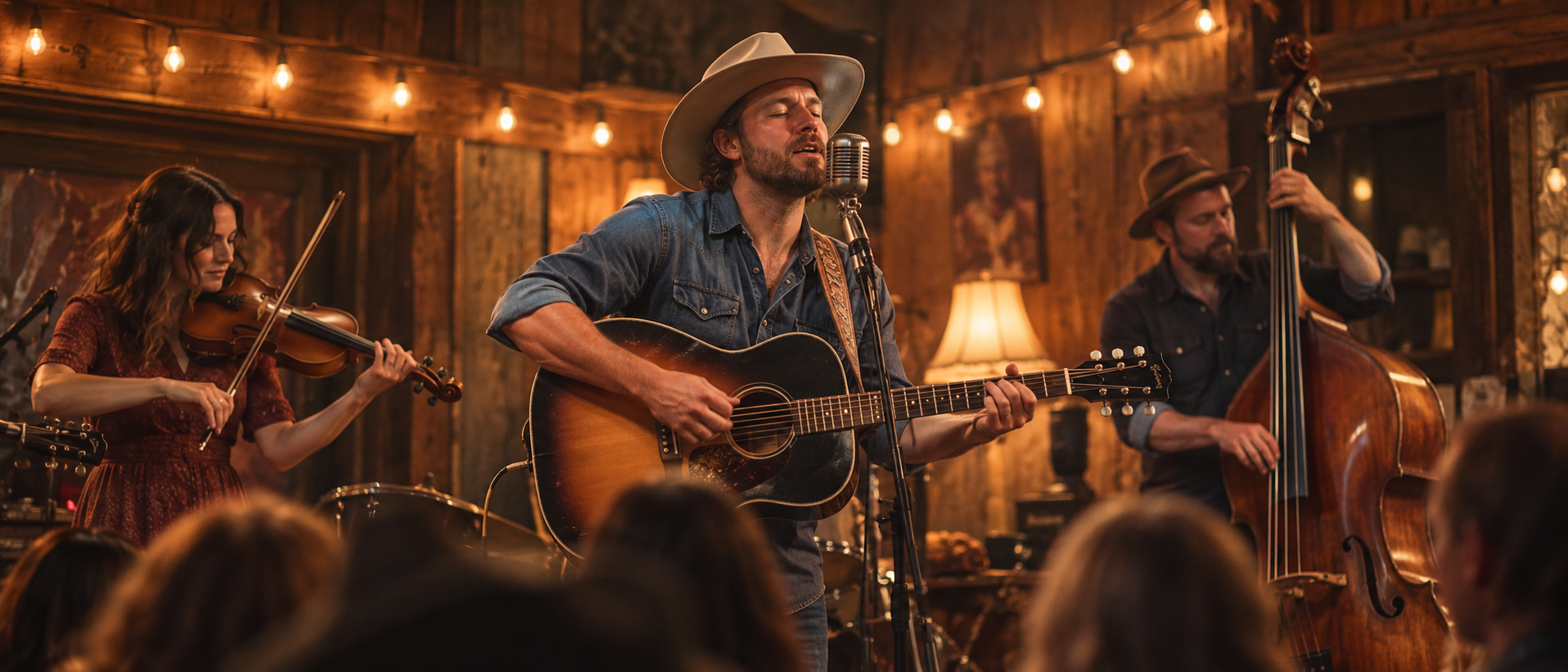
Country music has a remarkable ability to turn everyday experiences into memorable songs. A story about leaving home, a relationship coming to an end, or a journey along an open highway can become unforgettable through a simple melody and a distinctive voice.
From the recordings of Johnny Cash and Patsy Cline to the songwriting of Dolly Parton, the outlaw country movement, and today's Nashville stars, country music has developed into a broad and constantly evolving musical tradition.
Country music radio brings these different sounds together, offering listeners an opportunity to discover classic recordings, modern hits, regional styles, and artists who approach storytelling in their own ways.
But country music is more than acoustic guitars, cowboy imagery, or songs about heartbreak.
Its history includes folk ballads, blues influences, dance music, honky-tonk, Western swing, bluegrass, country rock, and contemporary pop production.
This guide explores the origins of country music, its major styles, legendary performers, essential songs, and practical ways to find country radio stations online.
What Is Country Music?
Country music is a broad genre of popular music that developed in the United States from a combination of regional folk traditions, blues, gospel, string-band music, and other influences.
It became a recognizable commercial recording category during the 1920s and continued to evolve throughout the twentieth and twenty-first centuries.
Country music is often associated with:
-
Story-driven songwriting.
-
Distinctive vocal styles.
-
Acoustic and electric guitars.
-
Fiddle and steel guitar.
-
Memorable melodies.
-
Themes of love, family, travel, work, and everyday life.
-
Influences from folk, blues, gospel, and dance music.
However, not every country song features the same instruments or themes.
A traditional honky-tonk recording may sound very different from a contemporary country-pop single.
The genre is best understood as a collection of related musical traditions rather than one fixed sound.
The History of Country Music
Early Roots: Folk, Blues, and String-Band Traditions
Country music emerged through interactions among different musical communities in the American South and other regions.
British and Irish ballad traditions, African American blues, gospel, fiddle music, and local dance traditions all contributed to its development.
Black musicians and musical practices played important roles in the genre's formation, including the development and transmission of banjo traditions.
The history of country music is therefore more culturally diverse than some popular stereotypes suggest.
The First Commercial Country Recordings
During the 1920s, recording companies began marketing rural Southern music under labels such as old-time music and hillbilly music.
The 1927 Bristol Sessions, featuring recordings by artists including the Carter Family and Jimmie Rodgers, became an important milestone in the commercial history of country music.
These sessions did not mark the literal beginning of country music, but they helped establish performers whose influence would endure.
Country Music in the 1930s and 1940s
During the following decades, country music expanded through radio broadcasting, touring performances, and commercial recordings.
Western swing combined country-related traditions with jazz and dance-band influences.
Honky-tonk developed into a recognizable style associated with amplified instruments, dance rhythms, and emotionally direct songs.
Nashville and the Country Music Industry
Nashville became a major center of country recording, publishing, broadcasting, and performance.
The Grand Ole Opry, which began as a radio program in 1925, played an important role in promoting country performers.
During the 1950s and 1960s, the Nashville Sound introduced polished arrangements that often included strings, background vocals, and smoother production.
Outlaw Country and Country Rock
During the 1970s, artists associated with outlaw country challenged aspects of Nashville's established commercial approach.
Willie Nelson and Waylon Jennings became leading figures in this movement.
At the same time, country rock blended country instrumentation and songwriting with rock music.
Country Music Today
Modern country music includes traditional approaches alongside pop, rock, hip-hop-influenced production, Americana, and independent singer-songwriter styles.
Contemporary artists continue to reinterpret older country traditions while developing new sounds.
The Main Styles of Country Music
1. Traditional Country
Traditional country is a broad term for music associated with older country songwriting, instrumentation, and performance practices.
Recordings often emphasize clear melodies, acoustic or electric string instruments, and direct storytelling.
Artists to explore:
-
Hank Williams.
-
George Jones.
-
Loretta Lynn.
-
Kitty Wells.
-
Merle Haggard.
Traditional country is not limited to one decade or production style.
2. Honky-Tonk
Honky-tonk became especially influential during the 1940s and 1950s.
The style is commonly associated with dance-oriented rhythms, prominent steel guitar, fiddle, and songs about relationships and everyday struggles.
Artists to explore:
-
Hank Williams.
-
Ernest Tubb.
-
Lefty Frizzell.
-
George Jones.
Honky-tonk recordings often balance lively musical accompaniment with emotionally direct lyrics.
3. Outlaw Country
Outlaw country is associated with artists who sought greater creative independence from established Nashville production conventions.
The movement became especially prominent during the 1970s.
Artists to explore:
-
Willie Nelson.
-
Waylon Jennings.
-
Jessi Colter.
-
Tompall Glaser.
The term describes a historical movement and artistic approach rather than one strict instrumental formula.
4. Country Pop
Country pop combines country songwriting or instrumentation with accessible popular music arrangements.
Its history extends back decades, although contemporary production has introduced new sounds.
Artists to explore:
-
Shania Twain.
-
Faith Hill.
-
Taylor Swift's early country recordings.
-
Carrie Underwood.
-
Kelsea Ballerini.
Country pop often reaches audiences beyond traditional country radio.
5. Bluegrass
Bluegrass developed during the 1940s through the work of Bill Monroe and other influential musicians.
It typically features acoustic string instruments, fast instrumental passages, and distinctive vocal harmonies.
Common instruments include banjo, fiddle, mandolin, guitar, and upright bass.
Artists to explore:
-
Bill Monroe.
-
Flatt & Scruggs.
-
Alison Krauss.
-
Del McCoury.
Bluegrass has its own history and musical identity, although it is closely related to the broader country music landscape.
6. Western Swing
Western swing combines elements of country-related string-band music, jazz, blues, and popular dance music.
It became particularly influential during the 1930s and 1940s.
Artists to explore:
-
Bob Wills and His Texas Playboys.
-
Milton Brown and His Musical Brownies.
Western swing demonstrates the importance of musical exchange in country music's development.
7. Country Rock
Country rock combines elements of country and rock music.
It became particularly prominent during the late 1960s and 1970s.
Artists to explore:
-
The Flying Burrito Brothers.
-
Gram Parsons.
-
Eagles.
-
Poco.
Country rock often features electric guitars, vocal harmonies, and roots-oriented songwriting.
8. Americana and Alternative Country
Americana is a broad category drawing on country, folk, blues, roots rock, and related traditions.
Alternative country often refers to artists who combine country influences with independent rock, punk, or unconventional songwriting approaches.
Artists to explore:
-
Jason Isbell.
-
Gillian Welch.
-
Lucinda Williams.
-
Uncle Tupelo.
-
Steve Earle.
These categories overlap with country music but are not identical to mainstream country radio formats.
Country Music Styles Compared
Style Musical Characteristics Listening Focus Traditional country Classic songwriting and string instrumentation Melody and storytelling Honky-tonk Dance rhythms, steel guitar, emotionally direct lyrics Rhythm and vocal expression Outlaw country Individualistic songwriting and varied arrangements Artistic identity and storytelling Country pop Polished production and accessible melodies Vocal hooks and contemporary arrangements Bluegrass Acoustic strings and instrumental virtuosity Instrumental interplay Western swing Country-related sounds with jazz and dance influences Rhythmic energy and ensemble playing Country rock Country songwriting with rock instrumentation Guitar arrangements and harmonies Americana Roots-oriented blend of several traditions Songwriting and musical influencesThese distinctions are useful starting points rather than rigid boundaries.
Legendary Country Music Artists
Johnny Cash
Johnny Cash became one of the most recognizable figures in country music.
His deep voice, direct delivery, and distinctive rhythmic arrangements helped establish a lasting musical identity.
Cash recorded songs about love, faith, hardship, social concerns, and personal experience.
Essential songs:
-
I Walk the Line.
-
Ring of Fire.
-
Folsom Prison Blues.
-
A Boy Named Sue.
-
Sunday Morning Coming Down.
Listening tip: Notice how Cash uses relatively restrained vocal phrasing to communicate powerful stories.
Dolly Parton
Dolly Parton is an influential country singer, songwriter, and performer known for memorable melodies and emotionally expressive storytelling.
Her career includes country recordings, pop crossover success, and extensive songwriting.
Essential songs:
-
Jolene.
-
Coat of Many Colors.
-
I Will Always Love You.
-
9 to 5.
-
Here You Come Again.
Parton's work illustrates how country songwriting can move between personal reflection, humor, and broader popular appeal.
Willie Nelson
Willie Nelson is strongly associated with outlaw country and distinctive vocal phrasing.
His recordings combine country songwriting with influences from jazz, blues, and other styles.
Essential songs:
-
On the Road Again.
-
Blue Eyes Crying in the Rain.
-
Always on My Mind.
-
Angel Flying Too Close to the Ground.
Listening tip: Pay attention to how Nelson sometimes sings slightly behind or ahead of the expected beat.
Hank Williams
Hank Williams was one of the most influential country songwriters and performers of the twentieth century.
His recordings helped establish lasting approaches to country melody and emotionally direct lyrics.
Essential songs:
-
Your Cheatin' Heart.
-
I'm So Lonesome I Could Cry.
-
Hey, Good Lookin'.
-
Cold, Cold Heart.
Patsy Cline
Patsy Cline was known for her expressive voice and recordings that crossed boundaries between country and popular music.
Essential songs:
-
Crazy.
-
I Fall to Pieces.
-
Walkin' After Midnight.
Her performances are especially rewarding for listeners interested in vocal phrasing and emotional interpretation.
George Jones
George Jones is widely regarded as one of country music's most influential vocal interpreters.
His singing combined distinctive phrasing with emotional nuance.
Essential songs:
-
He Stopped Loving Her Today.
-
The Grand Tour.
-
She Thinks I Still Care.
Loretta Lynn
Loretta Lynn became an influential country singer-songwriter whose songs often addressed personal experiences and the lives of women.
Essential songs:
-
Coal Miner's Daughter.
-
You Ain't Woman Enough.
-
The Pill.
Merle Haggard
Merle Haggard was a major figure in country music and the Bakersfield Sound.
His work often featured direct storytelling, prominent electric guitar, and themes connected to working-class life.
Essential songs:
-
Mama Tried.
-
Sing Me Back Home.
-
Today I Started Loving You Again.
Shania Twain
Shania Twain helped expand the commercial reach of country pop during the 1990s.
Her recordings combined country influences with polished pop-rock production.
Essential songs:
-
Man! I Feel Like a Woman!.
-
You're Still the One.
-
That Don't Impress Me Much.
Garth Brooks
Garth Brooks became one of the most commercially successful country performers of the 1990s.
His music combines traditional country influences with energetic live performances and rock-related production elements.
Essential songs:
-
The Dance.
-
Friends in Low Places.
-
The Thunder Rolls.
Modern Country Music Artists to Explore
Country music continues to evolve through artists who draw on different traditions.
Chris Stapleton
Chris Stapleton is known for his powerful vocals and blend of country, blues, soul, and Southern rock influences.
Songs to explore:
-
Tennessee Whiskey.
-
Starting Over.
-
Broken Halos.
Kacey Musgraves
Kacey Musgraves combines country songwriting with pop, folk, and other musical influences.
Songs to explore:
-
Follow Your Arrow.
-
Merry Go 'Round.
-
Slow Burn.
Luke Combs
Luke Combs is known for contemporary country recordings featuring strong vocal performances and accessible songwriting.
Songs to explore:
-
Hurricane.
-
Beautiful Crazy.
-
When It Rains It Pours.
Miranda Lambert
Miranda Lambert combines country, rock, and roots-oriented influences with distinctive songwriting.
Songs to explore:
-
The House That Built Me.
-
Bluebird.
-
Gunpowder & Lead.
Zach Bryan
Zach Bryan is associated with contemporary country and Americana-influenced songwriting.
His recordings often emphasize personal storytelling and relatively direct arrangements.
Songs to explore:
-
Something in the Orange.
-
Heading South.
-
I Remember Everything.
These artists represent different approaches to modern country rather than one uniform style.
Essential Country Songs for Beginners
Song Artist What to Listen For I Walk the Line Johnny Cash Distinctive rhythm and vocal delivery Jolene Dolly Parton Storytelling and melodic tension Crazy Patsy Cline Expressive vocal phrasing Your Cheatin' Heart Hank Williams Traditional country songwriting On the Road Again Willie Nelson Relaxed rhythm and memorable melody He Stopped Loving Her Today George Jones Emotional narrative performance Coal Miner's Daughter Loretta Lynn Autobiographical storytelling Mama Tried Merle Haggard Bakersfield-influenced country sound Friends in Low Places Garth Brooks Communal chorus and humor You're Still the One Shania Twain Country-pop crossover production Tennessee Whiskey Chris Stapleton Soulful vocal interpretation Follow Your Arrow Kacey Musgraves Contemporary lyrical perspectiveThese recordings provide a starting point rather than a definitive ranking.
Essential Country Music Albums
Albums can reveal an artist's musical identity more fully than individual radio singles.
Album Artist Release Year Why Explore It At Folsom Prison Johnny Cash 1968 Influential live country recording Coat of Many Colors Dolly Parton 1971 Personal storytelling and country songwriting Red Headed Stranger Willie Nelson 1975 Conceptual storytelling and restrained arrangements Honky Tonk Heroes Waylon Jennings 1973 Important outlaw-country-era recording Stardust Willie Nelson 1978 Country interpretation of popular standards Come On Over Shania Twain 1997 Influential country-pop crossover No Fences Garth Brooks 1990 Major commercial country album Traveller Chris Stapleton 2015 Country, blues, and soul influences Golden Hour Kacey Musgraves 2018 Contemporary country-pop experimentationThese albums reflect different eras and styles, not a single definition of country music.
The Instruments That Shape Country Music
Acoustic Guitar
Acoustic guitar is central to many country arrangements.
It may provide rhythmic strumming, fingerpicked accompaniment, or melodic passages.
Steel Guitar
Steel guitar is one of the most recognizable sounds associated with country music.
The instrument can produce smooth, sliding pitches that add expressive movement to a melody.
Pedal steel guitar became particularly important in many twentieth-century country recordings.
Fiddle
The fiddle connects country music with older folk and dance traditions.
It can provide energetic instrumental passages or expressive accompaniment.
Banjo
The banjo has deep roots in African American musical history and became important in several American string-band traditions.
It is especially prominent in bluegrass but also appears in other country-related styles.
Mandolin
Mandolin is common in bluegrass and acoustic roots music.
Its bright tone can provide rhythmic accents and fast melodic lines.
Electric Guitar
Electric guitar became increasingly important in honky-tonk, the Bakersfield Sound, country rock, and modern country.
Upright and Electric Bass
Bass instruments establish harmonic movement and rhythmic support.
Drums
Drum kits appear in many modern country styles, from honky-tonk to contemporary country pop.
What Makes Country Songwriting Distinctive?
Country music is often celebrated for storytelling.
Everyday Characters
Many songs focus on recognizable people and situations rather than abstract ideas.
Clear Narrative Structure
A country song may introduce a situation, develop a conflict, and reach an emotional conclusion.
Conversational Language
Some country songwriters use direct, familiar expressions to create a sense of intimacy.
Humor
Country music includes playful songs, irony, and witty observations alongside serious themes.
Emotional Detail
Small details can make a song memorable.
A place, object, or conversation may carry emotional meaning within the story.
Musical Support
The arrangement often reinforces the lyric.
A restrained verse can make an emotional chorus more powerful, while a steel guitar phrase may respond to the singer between lines.
Not every country song is narrative-driven, but storytelling remains one of the genre's important traditions.
Country Music vs. Bluegrass vs. Americana
These categories overlap, but their identities differ.
Country music is the broad popular genre encompassing numerous styles, from honky-tonk to country pop.
Bluegrass is a more specific acoustic string-band tradition associated with Bill Monroe and later musicians.
Americana is a broad roots-oriented category that draws from country, folk, blues, roots rock, and other styles.
A recording may fit more than one category.
However, the terms should not be treated as interchangeable.
Traditional Country vs. Modern Country
Traditional and modern country often differ in production and musical influences.
Feature Traditional Country Modern Mainstream Country Instrumentation Frequently steel guitar, fiddle, acoustic and electric guitar May include traditional instruments, rock guitars, and electronic production Production Often relatively direct arrangements Often polished, layered studio production Songwriting Strong focus on storytelling and melody Broad range, including storytelling and pop-oriented hooks Influences Folk, blues, honky-tonk, Western swing Country traditions alongside pop, rock, and other genres Examples Hank Williams, Loretta Lynn, George Jones Luke Combs, Carrie Underwood, and other contemporary artistsThese are general tendencies.
Many modern artists use traditional instrumentation, and some older country recordings were highly polished for their time.
How to Find Country Music Radio Online
Online radio provides an accessible way to explore different country styles.
Step 1: Search for Country Stations
Useful search terms include:
-
Country music radio online.
-
Classic country radio.
-
Traditional country music.
-
Modern country hits.
-
Honky-tonk radio.
-
Outlaw country radio.
-
Country pop radio.
-
Americana radio.
Different stations may specialize in particular decades or musical approaches.
Step 2: Explore Radio Directories
Visit the 1LiveRadio online radio directory to browse available radio stations and music categories.
Look for station descriptions that mention country, classic country, Nashville hits, Americana, or related styles.
Programming and stream availability can change, so check the current listings.
Step 3: Compare Station Formats
A classic country station may emphasize older recordings.
A contemporary country station may focus on recent chart-oriented releases.
An Americana station may feature more independent singer-songwriters and roots music.
Step 4: Discover Artists Through Radio
When a song catches your attention, note the title and performer if the information is available.
Explore the artist's albums to hear more than the familiar singles.
Step 5: Explore Related Genres
Country music connects with bluegrass, folk, blues, rockabilly, and Americana.
You can discover additional listening guides through the 1LiveRadio music blog.
Country Music for Different Listening Preferences
Country music includes a wide range of moods and musical styles.
For classic storytelling: Explore Johnny Cash, Dolly Parton, and Loretta Lynn.
For emotional ballads: Try Patsy Cline and George Jones.
For energetic honky-tonk: Explore Hank Williams and other traditional country performers.
For independent-minded songwriting: Listen to Willie Nelson, Waylon Jennings, and Jessi Colter.
For melodic country pop: Try Shania Twain and Carrie Underwood.
For roots-oriented modern country: Explore Chris Stapleton, Miranda Lambert, and selected Americana artists.
For acoustic instrumental music: Discover bluegrass and traditional string-band recordings.
These suggestions are starting points rather than strict rules.
A One-Hour Country Music Listening Journey
Try this listening session to explore the variety of country music.
Time Style Listening Focus 0–10 minutes Early traditional country Hear foundational melodies and storytelling 10–20 minutes Honky-tonk Notice steel guitar and dance rhythms 20–30 minutes Outlaw country Explore individualistic songwriting 30–40 minutes Country pop Compare polished arrangements and melodic hooks 40–50 minutes Bluegrass or acoustic country Focus on string instruments 50–60 minutes Modern country and Americana Hear contemporary approaches to roots musicThis is a suggested listening exercise, not a scheduled radio broadcast.
How to Listen to Country Music More Attentively
Country songs can reveal new details when you focus on different musical elements.
Follow the Story
Pay attention to how the lyrics introduce characters, settings, and emotional changes.
Listen to the Steel Guitar
Notice how steel guitar phrases often appear between vocal lines.
Compare Vocal Phrasing
Johnny Cash, Willie Nelson, Patsy Cline, and George Jones developed very different vocal approaches.
Notice the Rhythm
Compare the rhythmic feel of honky-tonk, Western swing, bluegrass, and modern country pop.
Explore Different Recordings of the Same Song
Country music has a long tradition of artists interpreting songs written by others.
Comparing versions can reveal how vocal style and arrangement change the meaning of a recording.
Why Country Music Remains Popular
Country music continues to evolve while maintaining connections to older traditions.
Storytelling
Many listeners appreciate songs that communicate recognizable experiences.
Musical Variety
Country includes acoustic traditions, dance music, rock influences, and modern pop production.
Distinctive Performers
Individual voices and songwriting styles help define the genre.
Cultural History
Country music reflects interactions among regional musical communities and changing social environments.
Ongoing Innovation
Contemporary artists continue to reinterpret country traditions and incorporate new influences.
Common Mistakes When Exploring Country Music
Assuming Every Country Song Sounds the Same
Country includes numerous styles with different instruments and production approaches.
Thinking Country Music Has Only One Cultural Origin
The genre developed through contributions from multiple musical communities, including African American traditions.
Treating Bluegrass and Country as Identical
Bluegrass is a distinct tradition with its own history and instrumental practices.
Ignoring Female Country Artists
Women such as Patsy Cline, Kitty Wells, Loretta Lynn, Dolly Parton, and many others played major roles in country music's development.
Assuming Modern Country Has Abandoned Traditional Sounds
Many contemporary artists continue to draw on older country instrumentation and songwriting.
Listening Only to Radio Singles
Albums and live recordings can reveal additional sides of an artist's work.
Frequently Asked Questions About Country Music
What is country music?
Country music is a broad American popular music genre that developed through folk, blues, gospel, string-band, and related traditions. It is often associated with storytelling, distinctive vocals, and string instruments.
What are the main types of country music?
Major styles include traditional country, honky-tonk, outlaw country, country pop, Western swing, country rock, and related genres such as bluegrass and Americana.
Who are the most famous country singers?
Influential performers include Johnny Cash, Dolly Parton, Willie Nelson, Hank Williams, Patsy Cline, George Jones, Loretta Lynn, and many others.
What instruments are used in country music?
Common instruments include acoustic and electric guitars, steel guitar, fiddle, banjo, mandolin, bass, piano, and drums.
What is the difference between classic country and modern country?
Classic country radio generally focuses on older recordings, while modern country programming emphasizes more recent music. Musical differences vary by artist and station.
Is bluegrass the same as country music?
No. Bluegrass is a distinct acoustic string-band tradition closely related to the broader country music landscape.
What is outlaw country?
Outlaw country is associated with a movement of artists, particularly during the 1970s, who pursued greater creative independence from established Nashville recording conventions.
What are some essential country songs?
Useful starting points include I Walk the Line, Jolene, Crazy, Your Cheatin' Heart, On the Road Again, and He Stopped Loving Her Today.
Is country music only popular in the United States?
No. Although country music developed in the United States, it has listeners and performers internationally.
Where can I listen to country music radio online?
You can explore online broadcasters and radio directories featuring country music. Visit 1LiveRadio to browse available stations and current programming.
Is country music still evolving?
Yes. Contemporary country incorporates influences from pop, rock, Americana, and other styles while many artists continue to draw on traditional country sounds.
Explore More Country and Roots Music on 1LiveRadio
Country music connects with several important musical traditions.
If you enjoy acoustic string instruments, explore bluegrass.
If you appreciate traditional storytelling, discover folk music.
For blues-influenced guitar and vocals, explore blues and related roots styles.
For a mixture of country, folk, and rock, try Americana.
Visit the 1LiveRadio music blog for more music guides and browse the 1LiveRadio online radio directory to discover available stations.
For additional historical information, explore the Country Music Hall of Fame and Museum, which documents country music's artists, recordings, and cultural development.
Conclusion: Discover the Stories Behind Country Music
Country music is much more diverse than its most familiar stereotypes.
From traditional ballads and honky-tonk to outlaw country, bluegrass, country pop, and modern roots-oriented songwriting, the genre offers a wide range of listening experiences.
Artists such as Johnny Cash, Dolly Parton, Willie Nelson, Patsy Cline, and George Jones helped shape its history, while contemporary performers continue to develop new approaches.
The best way to explore country music is to listen beyond one decade or style.
Follow the lyrics, notice the instruments, compare different vocal performances, and discover artists through radio.
Country music radio offers an accessible way to explore memorable stories, influential performers, and the many musical traditions that continue to shape country music today.
Reader comments
No comments yet. Start the conversation.
Leave a comment
Your email stays private. Comments appear after approval.