
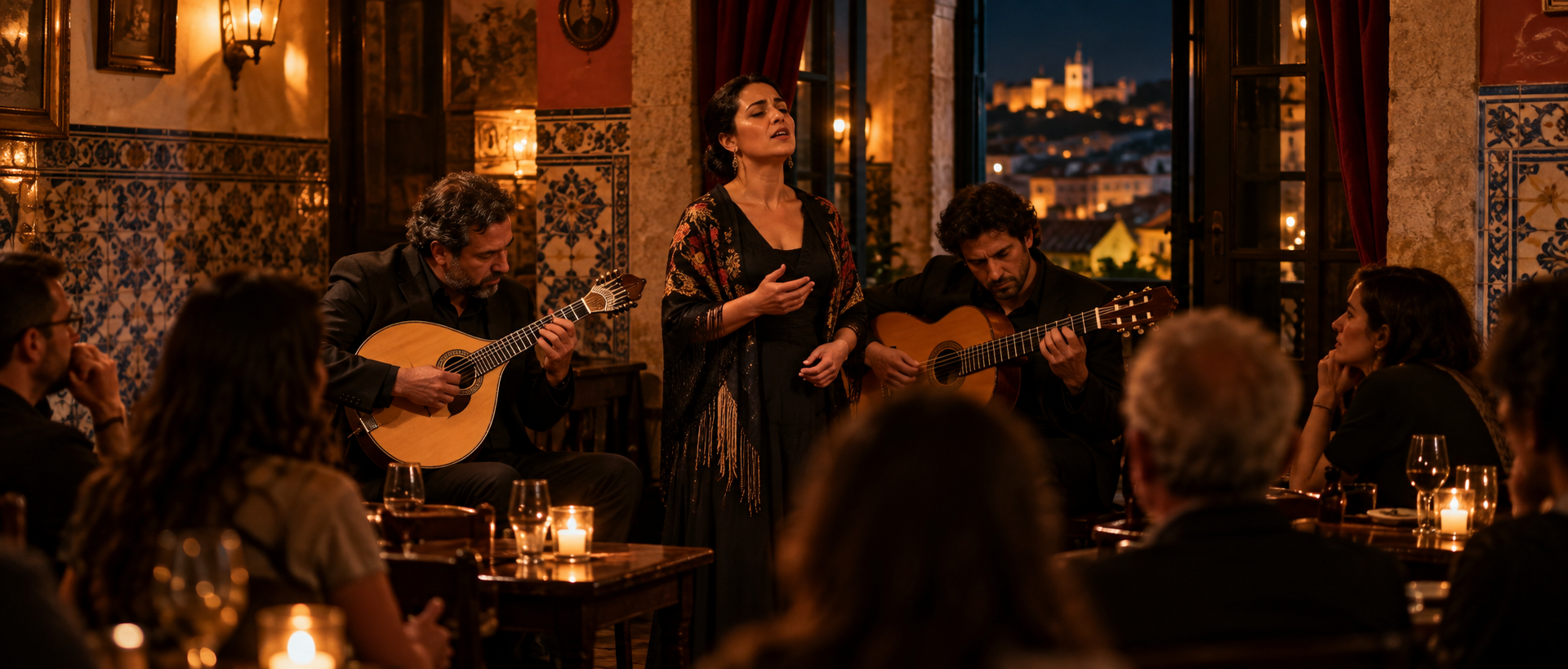
Some musical traditions are immediately recognizable through their rhythms. Others are defined by particular instruments, dance movements, or production techniques.
Fado music is different.
Its identity often begins with a voice.
A singer delivers a phrase with remarkable emotional intensity. A Portuguese guitar responds with a delicate melodic figure. A classical guitar provides a steady harmonic foundation, allowing the performance to unfold naturally.
The result can feel intimate, dramatic, reflective, or deeply personal.
Originating in Portugal, fado has become one of the country's most recognizable musical traditions. Its expressive singing, poetic lyrics, and distinctive instrumental accompaniment have attracted listeners far beyond Portuguese-speaking communities.
For newcomers, Fado radio provides an accessible introduction to this fascinating musical world.
You do not need to understand Portuguese to appreciate the relationship between the singer and the accompanying musicians.
The smallest details often communicate the most.
A pause before an important lyric, a change in vocal intensity, or a short phrase played on the Portuguese guitar can transform the atmosphere of an entire performance.
Although fado is frequently associated with longing and melancholy, its musical identity is richer than a single emotion.
Performances can express love, memory, pride, humor, hope, nostalgia, and the complexities of everyday life.
In this guide, we'll explore the history of fado, its musical characteristics, important instruments, legendary singers, essential recordings, and practical ways to appreciate fado radio.
Most importantly, we'll discover how to listen beyond the surface and recognize the details that make each performance unique.
1. What Is Fado Music?
Fado is a traditional Portuguese musical genre closely associated with expressive singing, poetic lyrics, and distinctive string accompaniment.
It developed primarily in urban Portuguese environments, particularly Lisbon, during the nineteenth century.
Over time, different performance traditions emerged, including those associated with Lisbon and Coimbra.
What does the word Fado mean?
The Portuguese word fado is related to the idea of fate or destiny.
However, the musical tradition explores a much wider range of subjects.
Songs may describe romantic relationships, personal experiences, city life, social observations, and emotional memories.
Common characteristics of Fado
Traditional fado frequently features:
-
Expressive solo singing.
-
Poetic Portuguese lyrics.
-
Portuguese guitar accompaniment.
-
Classical or viola guitar.
-
Intimate musical arrangements.
-
Flexible vocal phrasing.
-
Strong melodic expression.
-
Emotional storytelling.
-
Close interaction between singer and instrumentalists.
-
A performance style that emphasizes interpretation.
Not every fado performance follows exactly the same structure.
Some recordings are restrained and intimate.
Others feature dramatic vocal delivery or more elaborate arrangements.
Why Fado sounds distinctive
Fado often places the human voice at the center of the musical experience.
The instruments support the singer rather than competing for attention.
This creates a close relationship between melody, language, and emotion.
2. The History of Fado: Portugal's Musical Heritage
Fado's origins are complex and remain the subject of historical discussion.
The genre developed in Lisbon during the nineteenth century, drawing from the social and cultural life of the city.
Its early history is associated with working-class neighborhoods, taverns, entertainment venues, and urban musical traditions.
Fado in nineteenth-century Lisbon
During the nineteenth century, fado became increasingly recognizable as a distinctive form of Portuguese urban music.
Performances were connected with everyday social environments and popular entertainment.
The genre gradually developed its own musical conventions and cultural identity.
The emergence of professional performers
As fado became more widely recognized, professional singers and musicians helped shape its development.
Performance venues provided opportunities for artists to reach larger audiences.
Fado and recording technology
The development of commercial recording allowed fado performances to circulate beyond live venues.
Recordings helped preserve influential interpretations and introduce the genre to new listeners.
Radio and Fado
Radio broadcasting became an important way for audiences to discover Portuguese singers and instrumentalists.
It helped expand the genre's reach beyond local performance spaces.
Fado in the twentieth century
During the twentieth century, fado became increasingly associated with Portuguese cultural identity.
Artists such as Amália Rodrigues achieved international recognition.
Their recordings introduced the tradition to audiences around the world.
Fado today
Contemporary performers continue to interpret traditional songs while introducing new compositions and musical approaches.
Modern fado maintains strong connections with its historical roots while allowing artistic development.
3. Fado and UNESCO Recognition
In 2011, Fado, urban popular song of Portugal, was inscribed on UNESCO's Representative List of the Intangible Cultural Heritage of Humanity.
This recognition acknowledged the tradition's cultural significance and its importance within Portuguese musical heritage.
Why this recognition matters
Fado represents more than a collection of songs.
It includes performance practices, instrumental traditions, artistic knowledge, and connections between musicians and communities.
A living musical tradition
UNESCO recognition does not mean fado is a fixed historical style.
The tradition continues to evolve through new singers, instrumentalists, composers, and audiences.
The importance of transmission
Fado knowledge is passed between generations through performance, teaching, observation, and musical collaboration.
This ongoing exchange helps preserve the genre while allowing new interpretations.
4. Understanding Saudade in Fado Music
One of the words most frequently associated with fado is saudade.
Saudade is a Portuguese term commonly connected with longing, absence, nostalgia, and emotional attachment.
It can describe a complex feeling involving memory, affection, and the awareness that something or someone is missing.
Why Saudade matters
Many fado songs explore emotional experiences that relate to saudade.
These may include:
-
Remembering a loved one.
-
Missing a familiar place.
-
Reflecting on the passage of time.
-
Thinking about lost opportunities.
-
Remembering childhood.
-
Expressing romantic longing.
-
Finding beauty in memories.
Is Fado always sad?
No.
Although melancholy is an important part of fado's public image, the genre includes a wider emotional range.
Some songs are playful, proud, celebratory, or humorous.
Others explore social life and everyday experiences.
Listening beyond emotion
Rather than assuming every fado song expresses sadness, pay attention to the singer's interpretation.
The tone may shift between tenderness, determination, nostalgia, and hope.
Understanding this variety makes listening more rewarding.
5. The Portuguese Guitar: Fado's Signature Instrument
One of fado's most recognizable sounds comes from the Portuguese guitar, known as the guitarra portuguesa.
Despite its name, it differs significantly from a standard acoustic guitar.
What is a Portuguese guitar?
The Portuguese guitar is a plucked string instrument traditionally associated with Portuguese musical culture.
It typically has twelve metal strings arranged in six courses.
Its distinctive construction and tuning contribute to its bright, resonant sound.
The role of the Portuguese guitar
In fado, the instrument often provides melodic responses to the singer.
It may introduce a song, decorate a vocal phrase, or perform short passages between verses.
Why its sound matters
The Portuguese guitar can produce a clear, shimmering tone.
Its melodic lines add emotional depth without overwhelming the voice.
Lisbon and Coimbra instruments
Portuguese guitars associated with Lisbon and Coimbra have different design and tuning traditions.
These differences contribute to the distinctive character of their respective performance styles.
Listening tip
Choose a traditional fado recording.
Listen to the Portuguese guitar during the pauses between vocal lines.
Notice how its short melodic phrases respond to the singer.
This exchange is one of the most rewarding details in fado music.
6. The Role of Classical Guitar in Fado
Alongside the Portuguese guitar, traditional fado frequently uses a classical-style guitar known in this context as the viola de fado.
Harmonic foundation
The viola provides chords and rhythmic support.
It helps establish the harmonic structure of the performance.
Rhythmic stability
While the singer may use expressive phrasing, the accompaniment maintains a recognizable musical foundation.
Interaction with the Portuguese guitar
The two instruments perform complementary roles.
The Portuguese guitar often contributes melodic ornamentation.
The viola supports harmony and rhythm.
Why balance matters
A successful fado arrangement allows the voice and instruments to remain clearly connected.
The accompaniment should provide support without obscuring the lyrics.
Listening exercise
Focus on the lower-pitched guitar accompaniment.
Notice how it establishes the pulse.
Then listen to the brighter Portuguese guitar.
Observe how the instruments create different layers of the arrangement.
7. The Art of Fado Singing
Fado singing is often associated with expressive vocal interpretation.
A singer of fado is commonly called a fadista.
Vocal phrasing
Fadistas frequently use flexible phrasing to emphasize important words or emotional moments.
A phrase may be extended or slightly delayed.
Dynamic expression
Changes in volume can create dramatic contrasts.
A quiet passage may lead into a powerful vocal statement.
Emotional interpretation
The singer communicates meaning through tone, timing, and articulation.
The importance of lyrics
Fado often places considerable emphasis on poetry.
The relationship between words and melody is central to the performance.
Individual style
Different singers may interpret the same composition in very different ways.
Some favor restrained expression.
Others use a more dramatic approach.
Listening without understanding Portuguese
Even if you do not understand the language, you can still appreciate:
-
Vocal tone.
-
Changes in intensity.
-
Melodic phrasing.
-
Pauses.
-
Instrumental responses.
-
Emotional contrasts.
These elements communicate important aspects of the performance.
8. Lisbon Fado: The Sound of the Portuguese Capital
Lisbon is closely associated with the development of fado.
The genre became part of the city's cultural identity through neighborhoods, performance venues, and generations of musicians.
Traditional neighborhoods
Lisbon neighborhoods such as Alfama and Mouraria are strongly associated with fado history.
These areas remain important cultural reference points.
Fado houses
Traditional performance venues, commonly called casas de fado, provide spaces for live music.
The intimate environment can strengthen the connection between performers and audiences.
Musical characteristics
Lisbon fado often emphasizes expressive solo singing accompanied by Portuguese guitar and viola.
Its repertoire includes both traditional and composed songs.
Why Lisbon Fado is important
The Lisbon tradition played a central role in the genre's historical development and international recognition.
Listening tip
Explore recordings by different Lisbon-associated fadistas.
Compare how each singer interprets melody, rhythm, and emotion.
9. Coimbra Fado: A Distinct Portuguese Tradition
Coimbra has its own important fado tradition.
It developed through the city's academic and cultural environment, particularly its university.
The university connection
Coimbra fado is historically associated with student culture and academic traditions.
Performance customs
The Coimbra tradition includes distinctive performance practices and repertoire.
Male performers have historically played a particularly prominent role in this tradition.
Musical differences
Coimbra fado has its own vocal and instrumental conventions.
Its Portuguese guitar tradition also differs from that of Lisbon.
Common themes
Songs may explore:
-
Student life.
-
Love.
-
Separation.
-
Nostalgia.
-
The city of Coimbra.
-
Academic memories.
Why listeners should explore both
Comparing Lisbon and Coimbra fado reveals the diversity within Portuguese musical heritage.
Although both traditions share important characteristics, they have different historical and cultural identities.
10. Legendary Fado Singers
Fado's history includes many influential singers whose interpretations helped shape the genre.
Amália Rodrigues
Amália Rodrigues is one of the most important figures in fado history.
Born in 1920, she achieved international recognition and became closely associated with Portuguese musical culture.
Her expressive singing and influential repertoire helped introduce fado to audiences worldwide.
Essential recordings to explore:
-
Estranha Forma de Vida
-
Barco Negro
-
Povo Que Lavas no Rio
Her performances demonstrate the emotional and interpretive possibilities of fado.
Carlos do Carmo
Carlos do Carmo was an influential Portuguese fado singer known for his expressive vocal style and important contributions to the genre.
His recordings helped connect traditional fado with modern musical interpretation.
Essential recording:
-
Lisboa Menina e Moça
Mariza
Mariza is one of the most internationally recognized contemporary fado singers.
Her recordings combine traditional fado elements with modern artistic approaches.
Essential recordings:
-
Ó Gente da Minha Terra
-
Chuva
Her performances offer an accessible introduction to contemporary fado.
Ana Moura
Ana Moura is known for her distinctive voice and her exploration of both traditional fado and contemporary musical influences.
Essential recording:
-
Desfado
Her work demonstrates how fado can evolve while maintaining connections to its heritage.
Camané
Camané is widely respected for his traditional fado interpretations and expressive vocal technique.
His performances emphasize phrasing, lyrical interpretation, and musical precision.
Carminho
Carminho is a contemporary Portuguese singer known for her strong connection to fado traditions.
Her recordings combine expressive singing with carefully developed arrangements.
Argentina Santos
Argentina Santos was an important traditional fadista associated with Lisbon's fado culture.
Her performances are valued for their direct emotional expression and connection to the genre's traditional repertoire.
Alfredo Marceneiro
Alfredo Marceneiro was one of the most influential male fado singers of the twentieth century.
His distinctive phrasing and interpretation helped shape traditional Lisbon fado.
These artists demonstrate the genre's diversity across generations.
11. Essential Fado Songs for Beginners
If you're new to fado, several recordings provide useful starting points.
1. Amália Rodrigues – Estranha Forma de Vida
A powerful example of expressive fado singing.
Listen to the vocal phrasing and emotional intensity.
2. Amália Rodrigues – Barco Negro
One of Amália Rodrigues's best-known recordings.
Pay attention to the relationship between the melody and instrumental accompaniment.
3. Carlos do Carmo – Lisboa Menina e Moça
A celebrated song associated with Lisbon.
Its melodic character and lyrical imagery reflect the city's cultural importance.
4. Mariza – Ó Gente da Minha Terra
A widely recognized contemporary fado performance.
Notice the gradual development of vocal intensity.
5. Mariza – Chuva
A recording that demonstrates Mariza's expressive vocal style.
6. Ana Moura – Desfado
A contemporary interpretation that illustrates fado's ability to explore different emotional and musical approaches.
7. Amália Rodrigues – Povo Que Lavas no Rio
A memorable performance demonstrating the dramatic possibilities of fado.
8. Traditional Fado Repertoire
Explore recordings by Camané, Carminho, and other contemporary fadistas.
Comparing interpretations can reveal how individual performers shape the tradition.
12. Fado vs. Flamenco
Fado and flamenco are sometimes compared because both feature expressive performances and strong cultural identities.
However, they are distinct musical traditions.
Fado
Fado originated in Portugal.
It is closely associated with expressive singing, Portuguese guitar, and poetic lyrics.
Flamenco
Flamenco developed in southern Spain, particularly Andalusia.
It includes distinctive singing, guitar playing, rhythmic structures, and dance traditions.
Important differences
Fado and flamenco differ in:
-
Historical development.
-
Instrumentation.
-
Rhythmic traditions.
-
Performance conventions.
-
Cultural context.
Why the comparison is useful
Both traditions demonstrate how musical expression can communicate complex emotions.
However, each should be appreciated on its own terms.
13. Fado vs. Portuguese Folk Music
Fado is part of Portugal's musical heritage, but it is not identical to the country's broader folk traditions.
Portuguese folk music
Portugal has numerous regional musical traditions.
These include different instruments, dances, songs, and performance practices.
Fado
Fado developed primarily as an urban popular musical tradition.
Its historical identity is particularly connected to Lisbon and Coimbra.
Shared cultural connections
Fado and other Portuguese musical traditions can share language, themes, and certain musical influences.
However, they remain distinct categories.
14. The Importance of Poetry in Fado
Fado is deeply connected to poetic expression.
Lyrics frequently explore personal experiences, emotional memories, and reflections on everyday life.
Common lyrical themes
Fado songs may address:
-
Love and separation.
-
Fate and destiny.
-
Memory.
-
Urban life.
-
The sea.
-
Personal identity.
-
Social experiences.
-
Longing.
-
Hope.
-
Human relationships.
Why words matter
The emotional meaning of a fado performance often depends on the relationship between lyrics and vocal interpretation.
A singer may emphasize a particular word through changes in timing or intensity.
Understanding translations
Reading translated lyrics can help non-Portuguese-speaking listeners appreciate the themes.
However, translations may not capture every poetic nuance.
Listening tip
Choose a fado song you enjoy.
Listen to it once without reading the lyrics.
Then find a reliable translation and listen again.
Notice whether understanding the words changes your interpretation.
15. The Intimate Atmosphere of Traditional Fado
Fado is often performed in intimate environments.
This setting can influence how audiences experience the music.
Close interaction
Smaller venues allow listeners to notice subtle vocal and instrumental details.
Respectful listening
Traditional fado performances often encourage quiet attention.
This allows the singer's interpretation to remain central.
Minimal amplification
Some performances rely on relatively restrained sound reinforcement.
This can emphasize the natural relationship between voice and instruments.
Emotional connection
An intimate setting may strengthen the sense of communication between performer and audience.
Why atmosphere matters
Fado is not only about the composition.
The performance environment can shape how the music is experienced.
16. How to Listen to Fado More Closely
Fado rewards attentive listening.
The smallest details can reveal the personality of a performance.
First listen: Focus on the voice
Listen to the singer's tone.
Notice changes in intensity.
Second listen: Follow the Portuguese guitar
Pay attention to the melodic responses between vocal lines.
Third listen: Identify the rhythmic foundation
Focus on the viola accompaniment.
Notice how it supports the singer.
Fourth listen: Observe the pauses
Silence can be an important expressive element.
Notice when the singer allows a phrase to settle.
Fifth listen: Explore the melody
Follow the main melodic line.
Observe how the singer changes or ornaments it.
Sixth listen: Consider the emotional atmosphere
Ask yourself what feelings the performance communicates.
Seventh listen: Experience the complete arrangement
Finally, listen without concentrating on a particular element.
Notice how voice, instruments, and atmosphere work together.
17. A One-Hour Fado Listening Journey
An hour of fado can introduce you to several important performers and musical approaches.
The following plan provides a balanced introduction.
Use the time blocks as flexible listening windows rather than exact track durations.
Minutes 0–10: Begin with traditional Fado
Suggested artist: Amália Rodrigues
Start with recordings such as "Estranha Forma de Vida."
Focus on vocal expression and the relationship between singer and accompaniment.
Minutes 10–20: Explore classic Lisbon Fado
Suggested artist: Alfredo Marceneiro
Listen to his distinctive phrasing and traditional performance style.
Minutes 20–30: Discover modern interpretations
Suggested artist: Carlos do Carmo
Explore "Lisboa Menina e Moça."
Notice how the arrangement supports the vocal melody.
Minutes 30–40: Experience contemporary Fado
Suggested artist: Mariza
Listen to "Ó Gente da Minha Terra."
Pay attention to the gradual development of emotional intensity.
Minutes 40–50: Explore different vocal approaches
Suggested artist: Ana Moura
Choose recordings such as "Desfado."
Notice how contemporary interpretations can introduce new musical elements.
Minutes 50–60: Finish with traditional and modern voices
Suggested artists: Camané and Carminho
Compare their phrasing, vocal tone, and musical interpretation.
Reflect on your listening experience
After the hour, consider:
-
Which singer's voice was most memorable?
-
Which Portuguese guitar passage stood out?
-
Did you prefer traditional or contemporary arrangements?
-
Which performance communicated the strongest emotion?
-
Which artist would you like to explore further?
These questions can help you discover your preferred fado style.
18. Fado Music for Different Listening Moments
Fado can suit different listening environments.
Quiet evenings
Reflective recordings can provide an intimate atmosphere.
Focused listening
Fado rewards close attention to vocal phrasing and instrumental detail.
Cultural exploration
Listening to fado can introduce audiences to Portuguese language, poetry, and musical traditions.
Relaxed moments
Some listeners enjoy fado during quiet breaks or personal reflection.
Travel inspiration
Fado can provide a musical connection to Portuguese culture.
Discovering new artists
Online radio offers opportunities to explore singers from different generations.
The best listening environment depends on personal preference.
19. How to Choose a Good Fado Radio Station
A good fado radio selection should offer musical authenticity, variety, and thoughtful programming.
Traditional recordings
Classic fado performances provide important historical context.
Contemporary singers
Modern performers demonstrate how the tradition continues to evolve.
Lisbon and Coimbra traditions
Programming that includes both traditions can introduce listeners to different musical approaches.
Vocal diversity
Featuring different singers helps reveal the genre's expressive range.
Instrumental recordings
Portuguese guitar performances can provide additional insight into fado's musical identity.
Clear station descriptions
Some stations focus exclusively on fado.
Others include broader Portuguese music programming.
Checking the station description can help you find the experience you prefer.
20. Building Your Own Fado Playlist
Creating a fado playlist can help you explore the tradition at your own pace.
Start with Amália Rodrigues
Her recordings provide an important introduction to classic fado.
Add influential male singers
Include Alfredo Marceneiro, Carlos do Carmo, or Camané.
Explore contemporary voices
Add Mariza, Ana Moura, and Carminho.
Compare different interpretations
Choose a familiar song performed by multiple artists.
Include instrumental passages
Portuguese guitar recordings can provide variety.
Consider emotional flow
Organize the playlist so that changes in mood feel natural.
Finish with a favorite performance
Choose a recording that captures the qualities you appreciate most.
The goal is to create a meaningful listening journey rather than simply collect famous songs.
21. Why Fado Remains Relevant Today
Fado continues to attract audiences because of its expressive depth and cultural importance.
Emotional storytelling
Its songs explore experiences that listeners from different backgrounds can recognize.
Musical craftsmanship
Traditional fado requires skilled singing and instrumental accompaniment.
Cultural identity
Fado remains an important part of Portuguese musical heritage.
International recognition
Performers have introduced fado to audiences around the world.
Contemporary creativity
Modern artists continue to explore new interpretations while maintaining connections to tradition.
Personal discovery
Listeners can find different meanings in the same performance.
This combination of heritage and artistic expression helps explain fado's lasting appeal.
22. Discover Fado and Other World Music on 1LiveRadio
Online radio provides a convenient way to explore musical traditions from different countries and cultures.
If you enjoy fado, you may also appreciate:
-
Traditional Portuguese music.
-
Acoustic folk.
-
World music.
-
Flamenco.
-
Singer-songwriter music.
-
Traditional vocal music.
-
Instrumental guitar music.
-
European folk traditions.
Each style offers a different approach to melody, storytelling, and cultural expression.
Visit 1LiveRadio to browse available radio stations and discover music from around the world.
Explore station categories and descriptions to find programming that matches your interests.
Whether you're interested in traditional Portuguese singing or contemporary interpretations, online radio can help you discover new musical experiences.
Station availability and programming may vary.
Frequently Asked Questions About Fado Music
What is Fado music?
Fado is a traditional Portuguese musical genre associated with expressive singing, poetic lyrics, and Portuguese guitar accompaniment.
Where did Fado originate?
Fado developed primarily in Lisbon during the nineteenth century.
What does Fado mean?
The word fado is associated with fate or destiny.
What is Saudade?
Saudade is a Portuguese concept commonly associated with longing, nostalgia, absence, and emotional attachment.
Is Fado always sad?
No. Although melancholy is an important part of fado's identity, the genre explores many emotions and subjects.
What instruments are used in Fado?
Traditional fado commonly features Portuguese guitar and viola guitar accompanying a singer.
What is a Fadista?
A fadista is a performer who sings fado.
Who is the most famous Fado singer?
Amália Rodrigues is widely regarded as one of the most influential and internationally recognized fado singers.
Who are some modern Fado singers?
Contemporary performers include Mariza, Ana Moura, Carminho, and Camané.
What is the difference between Lisbon and Coimbra Fado?
The traditions have different historical contexts, performance conventions, and instrumental approaches.
Is Fado recognized by UNESCO?
Yes. Fado was inscribed on UNESCO's Representative List of the Intangible Cultural Heritage of Humanity in 2011.
Is Fado the same as Flamenco?
No. Fado is Portuguese, while flamenco developed in Spain. They have different musical and cultural traditions.
Can I enjoy Fado without understanding Portuguese?
Yes. Vocal expression, melody, instrumental interaction, and musical atmosphere can be appreciated without understanding every lyric.
What is the best way to start listening to Fado?
Begin with recordings by Amália Rodrigues, then explore contemporary performers such as Mariza and Carminho.
Where can I listen to Fado online?
You can discover fado through online radio, streaming services, specialist playlists, and Portuguese music collections.
Final Thoughts: Discovering the Emotional Beauty of Fado
Fado is one of Portugal's most distinctive musical traditions.
Its appeal lies in the relationship between expressive singing, poetic storytelling, and carefully balanced instrumental accompaniment.
A powerful performance does not always require a large ensemble or elaborate production.
Sometimes, a voice and two guitars are enough to communicate an extraordinary range of emotions.
The Portuguese guitar introduces a delicate melodic phrase.
The viola provides a steady foundation.
The singer delivers a line with carefully chosen emphasis.
Then a brief pause allows the music to breathe.
These details make fado deeply rewarding for attentive listeners.
From the influential recordings of Amália Rodrigues to the contemporary interpretations of Mariza, Ana Moura, and Carminho, fado continues to connect musical heritage with personal expression.
For newcomers, fado radio offers a natural introduction.
Start with a classic recording.
Follow the singer's phrasing.
Listen to the Portuguese guitar.
Notice the pauses.
Explore the lyrics when possible.
Then allow different performers to reveal their own interpretations.
Fado is not simply music about sadness. It is a musical tradition that gives voice to the complexity of human experience.
Whether you're discovering Portuguese culture or searching for expressive acoustic music, fado offers a listening journey filled with history, melody, and emotional depth.
Explore more music and discover online radio stations at 1LiveRadio.
Reader comments
No comments yet. Start the conversation.
Leave a comment
Your email stays private. Comments appear after approval.