
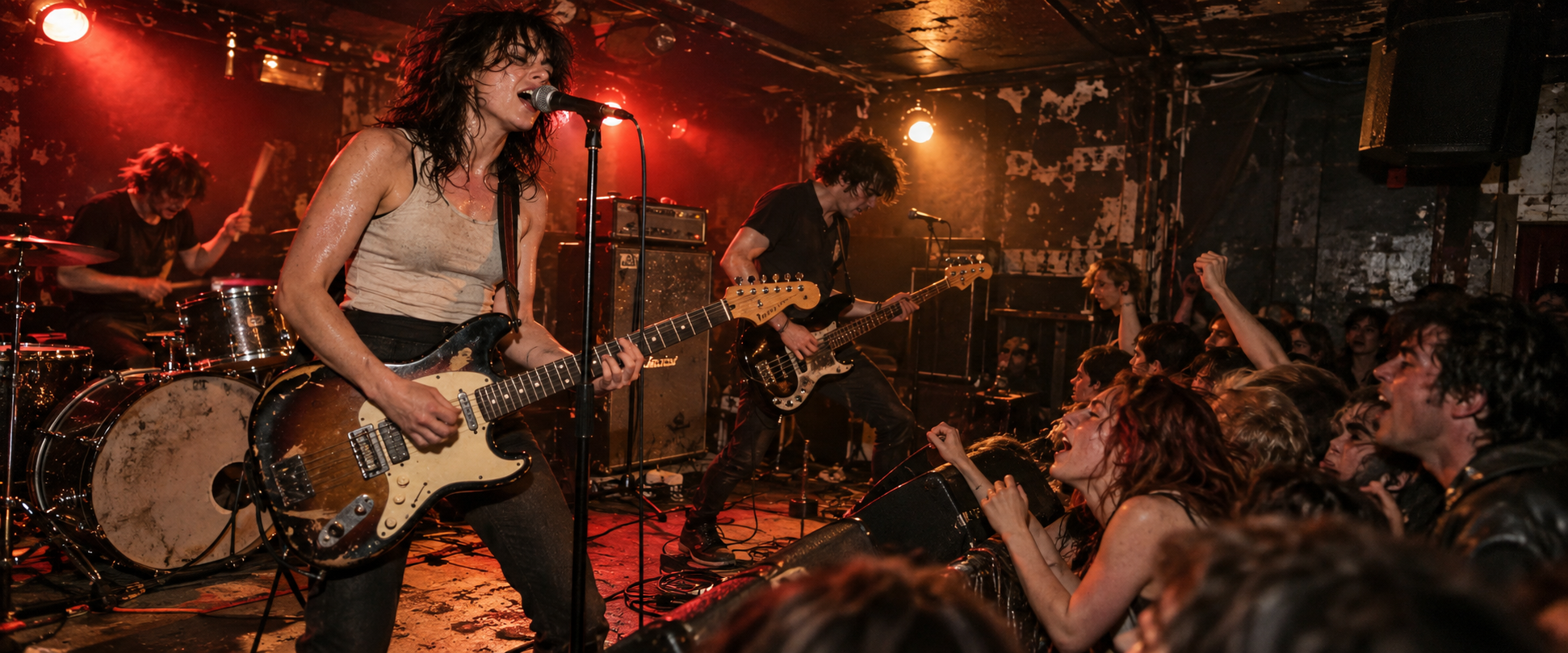
Some rock music is built around elaborate arrangements, sophisticated production, and carefully layered instrumental performances.
Garage rock often takes a different approach.
A distorted electric guitar introduces a short riff. The drums establish a direct, forceful rhythm. The bass follows closely, and a singer delivers a vocal performance that feels urgent, spontaneous, and sometimes deliberately rough around the edges.
The result can sound immediate and exciting.
Garage rock has long been associated with raw energy, straightforward songwriting, and the expressive possibilities of a small band playing together.
Its roots reach back to the 1960s, when numerous young musicians formed groups inspired by rock and roll, rhythm and blues, and the British Invasion.
Many of these bands recorded songs with relatively simple arrangements and an unmistakable sense of enthusiasm.
Some achieved national success. Others released only a few singles before disappearing from the commercial music industry.
Yet their recordings helped shape the development of punk rock, alternative rock, and later garage rock revival movements.
Today, garage rock radio offers an enjoyable way to explore this influential musical tradition.
One song might feature a classic 1960s guitar riff. Another could introduce a psychedelic garage recording, a proto-punk performance, or a modern band inspired by vintage rock sounds.
The appeal comes from more than distortion and volume.
Garage rock rewards listeners who pay attention to rhythmic interplay, memorable hooks, vocal personality, and the small imperfections that make a performance feel human.
In this guide, we'll explore the history of garage rock, its defining musical characteristics, influential bands, essential recordings, and connections with other rock genres.
We'll also discover practical listening techniques and a one-hour garage rock listening journey.
Whether you're discovering the genre for the first time or returning to familiar favorites, garage rock offers a direct and exciting approach to rock music.
1. What Is Garage Rock?
Garage rock is a style of rock music associated with energetic performances, guitar-driven arrangements, and relatively direct songwriting.
The term is especially connected with bands that emerged during the 1960s, although later musicians adopted and reinterpreted the sound.
Common characteristics of garage rock
Garage rock often features:
-
Distorted electric guitars.
-
Short, memorable riffs.
-
Strong drum patterns.
-
Straightforward basslines.
-
Energetic vocal performances.
-
Repeating chord progressions.
-
Compact song structures.
-
Rough or minimally polished production.
-
Influences from rhythm and blues.
-
A strong emphasis on band interaction.
Not every garage rock recording includes all these characteristics.
Some bands favor melodic songwriting, while others emphasize distortion, improvisation, or psychedelic experimentation.
Why is it called garage rock?
The name reflects the image of young bands rehearsing in garages and other informal spaces.
However, not every garage rock group literally practiced in a garage.
The term became a useful description for a particular approach to rock music rather than a precise statement about rehearsal locations.
2. The History of Garage Rock
Garage rock developed during a period of rapid change in popular music.
Its early history is closely associated with the United States during the 1960s.
Early rock and roll influences
Rock and roll established many of the musical foundations that later garage bands adopted.
Electric guitars, strong rhythms, and energetic performances became central elements.
Rhythm and blues
American rhythm and blues influenced garage rock's guitar playing, vocal delivery, and rhythmic approach.
The British Invasion
The international popularity of bands such as The Beatles, The Rolling Stones, and The Kinks inspired numerous young musicians to form their own groups.
Local music scenes
Garage bands emerged in towns and cities across the United States.
Many performed at school dances, local clubs, and community events.
Independent recordings
Some groups released singles through small record labels.
Others recorded only a handful of songs.
Regional variation
Different local scenes developed distinctive approaches.
Some emphasized melodic pop influences, while others favored harder guitar sounds.
Decline and transformation
By the late 1960s, many original garage rock groups had disbanded or moved toward other musical styles.
However, their influence continued through later rock movements.
3. Why Garage Rock Sounds Raw
One of garage rock's most recognizable qualities is its relatively unpolished sound.
This can result from several factors.
Simple arrangements
Many recordings use a small number of instruments.
Limited studio resources
Some early bands recorded with modest budgets and relatively basic equipment.
Energetic performances
Musicians often emphasized excitement over technical perfection.
Guitar distortion
Overdriven amplifiers and effects contribute to a rougher sound.
Direct vocal delivery
Singers may use forceful or expressive vocal styles.
Minimal overdubbing
Some recordings preserve the interaction of musicians performing together.
Why rawness matters
The roughness can make the performance feel immediate.
However, raw production does not automatically mean poor musicianship.
Many garage rock recordings demonstrate strong songwriting and effective ensemble coordination.
4. The Electric Guitar: The Heart of Garage Rock
Electric guitar is central to much garage rock.
Its role is often rhythmic as well as melodic.
Power chords
Power chords provide a direct, forceful sound.
Repeating riffs
Short guitar phrases can become the defining feature of a song.
Distortion
Distorted guitar tones create intensity and texture.
Rhythmic strumming
Repeated chord patterns establish momentum.
Simple lead lines
Some garage rock songs feature compact guitar solos.
Feedback
Controlled or uncontrolled amplifier feedback can contribute to the recording's character.
Why guitar simplicity works
A memorable riff does not need to be technically complicated.
Its impact often comes from rhythm, repetition, and performance energy.
Listening tip
Choose a garage rock recording.
Focus on the guitar riff.
Notice how many times it repeats.
Then listen for small variations in timing, articulation, or intensity.
5. Garage Rock Drumming: Direct and Energetic
Garage rock drumming frequently emphasizes a strong pulse.
Backbeat
The snare drum often reinforces the main rhythmic structure.
Kick drum
The kick provides low-frequency rhythmic support.
Cymbals
Cymbal patterns contribute energy and movement.
Drum fills
Short fills may introduce a chorus or emphasize a transition.
Performance intensity
Drummers often use dynamic playing to support the band's energy.
Why the drums matter
A direct drum pattern can make a simple guitar riff feel powerful.
Listening exercise
Follow the snare drum through an entire song.
Notice when the drummer introduces fills or changes intensity.
Then listen to how the guitar and bass respond.
6. The Bass Guitar in Garage Rock
Bass guitar often supports the relationship between drums and electric guitar.
Root-note patterns
Some basslines follow the main chord progression.
Rhythmic reinforcement
The bass may emphasize the same accents as the drums.
Melodic movement
Other basslines introduce short melodic phrases.
Interaction with guitar
The bass can reinforce a riff or provide contrasting movement.
Why bass matters
A strong bassline gives the arrangement weight and rhythmic stability.
Even when it is less prominent in the mix, it contributes to the overall sound.
7. The Garage Rock Vocal Style
Garage rock vocals are often expressive and direct.
Forceful singing
Some performers use energetic vocal delivery.
Rough vocal textures
A singer may emphasize intensity rather than polished tone.
Shouting and spoken phrases
Certain recordings include shouted lines or spoken passages.
Group vocals
Backing singers may reinforce choruses.
Melodic singing
Not all garage rock vocals are aggressive.
Some bands emphasize memorable pop melodies.
Why vocal personality matters
The singer's individual character can make a relatively simple song distinctive.
Listening tip
Focus on the vocal phrasing.
Notice how the singer interacts with the rhythm.
Pay attention to changes in intensity between verses and choruses.
8. The Importance of Simple Songwriting
Garage rock frequently uses compact musical structures.
Short songs
Many classic garage recordings are relatively brief.
Repeated chord progressions
Simple harmonic patterns allow listeners to focus on rhythm and melody.
Memorable choruses
A strong chorus can become the song's main attraction.
Instrumental hooks
A guitar riff may be as memorable as the vocal melody.
Direct lyrics
Lyrics often explore familiar subjects such as relationships, frustration, excitement, and youthful experiences.
Why simplicity works
A song does not need elaborate harmony to be effective.
Garage rock demonstrates how rhythm, melody, and performance can create a memorable recording.
9. Garage Rock and the British Invasion
The British Invasion played an important role in the development of American garage rock.
The Beatles
The Beatles inspired countless young musicians to form bands.
The Rolling Stones
The Rolling Stones introduced many listeners to rhythm-and-blues-influenced rock performances.
The Kinks
The Kinks' guitar-driven recordings became influential for their aggressive riffs and direct musical approach.
The Yardbirds
The Yardbirds explored blues-based rock and guitar experimentation.
The Animals
The Animals demonstrated the expressive possibilities of rhythm-and-blues-influenced rock.
Why these influences mattered
Young musicians could hear energetic guitar-based music on radio and attempt to create their own versions.
This encouraged the growth of local garage bands.
10. The Kingsmen and the Garage Rock Spirit
The Kingsmen became famous for their recording of "Louie Louie."
Released in 1963, the song became one of the most recognizable recordings associated with early garage rock.
Musical characteristics
The recording features:
-
A simple chord progression.
-
Energetic drumming.
-
Direct guitar playing.
-
Rough vocal delivery.
-
A memorable rhythmic feel.
Why it became influential
Its straightforward arrangement demonstrated how a relatively simple performance could create enormous impact.
Essential recording
The Kingsmen – Louie Louie
Listening tip
Focus on the band's collective energy.
Notice how the instruments maintain momentum through repetition.
11. The Sonics: The Aggressive Side of Garage Rock
The Sonics were an influential American garage rock band from Tacoma, Washington.
Their recordings became known for aggressive performances and raw production.
Musical identity
The band's sound featured distorted guitars, energetic drums, and intense vocals.
Essential songs
-
The Witch
-
Psycho
-
Strychnine
Why The Sonics matter
Their recordings anticipated aspects of later punk and hard rock.
Listening tip
Notice how the band creates intensity through relatively simple musical structures.
12. The Seeds: Repetition and Hypnotic Energy
The Seeds became associated with a distinctive style of garage rock.
Their recordings often emphasized repetition, organ textures, and memorable riffs.
Musical characteristics
The band frequently used:
-
Repeating guitar patterns.
-
Organ accompaniment.
-
Direct vocals.
-
Compact arrangements.
Essential song
The Seeds – Pushin' Too Hard
Why the song matters
Its repeated musical phrases demonstrate how garage rock can build intensity without elaborate arrangements.
13. The Standells and Dirty Water
The Standells are strongly associated with the garage rock classic "Dirty Water."
Musical identity
The recording combines a memorable guitar riff with direct vocal delivery.
Essential song
The Standells – Dirty Water
Why it matters
The song became an enduring example of 1960s garage rock.
Listening tip
Focus on the guitar riff and rhythmic accents.
Notice how repetition creates momentum.
14. The 13th Floor Elevators and Psychedelic Garage Rock
The 13th Floor Elevators were an influential American psychedelic rock band.
Their recordings combined garage rock energy with experimental musical ideas.
Musical characteristics
The band's sound included:
-
Distorted guitars.
-
Psychedelic influences.
-
Repeating riffs.
-
Unusual instrumental textures.
Essential song
The 13th Floor Elevators – You're Gonna Miss Me
Why the band matters
Their work demonstrates the connection between garage rock and early psychedelic rock.
15. The Count Five and Psychotic Reaction
Count Five became known for the 1966 recording "Psychotic Reaction."
Musical characteristics
The song combines:
-
A memorable guitar riff.
-
Energetic drumming.
-
Blues-influenced passages.
-
Dynamic changes.
-
Garage rock intensity.
Essential song
Count Five – Psychotic Reaction
Why it matters
The recording became one of the recognizable examples of mid-1960s garage rock.
16. The Music Machine and Talk Talk
The Music Machine were associated with a harder-edged approach to garage rock.
Musical characteristics
Their recordings featured forceful rhythms and distinctive arrangements.
Essential song
The Music Machine – Talk Talk
Why it matters
The song demonstrates how garage rock could combine concise songwriting with intense performance.
17. Garage Rock and Psychedelic Rock
Garage rock and psychedelic rock developed during overlapping historical periods.
Some bands incorporated elements of both styles.
Garage rock
Garage rock frequently emphasizes direct songwriting and energetic performances.
Psychedelic rock
Psychedelic rock often explores experimental sounds, unusual arrangements, and expanded musical structures.
Shared characteristics
Both may feature:
-
Distorted guitars.
-
Repeating riffs.
-
Organ sounds.
-
Experimental effects.
-
Strong rhythmic foundations.
Important distinction
Not every garage rock band was psychedelic.
Similarly, psychedelic rock encompasses many approaches beyond garage rock.
18. Garage Rock and Proto-Punk
Garage rock played an important role in the development of punk rock.
The term proto-punk is often used for earlier music that anticipated characteristics associated with punk.
Musical connections
Garage rock and proto-punk may share:
-
Direct guitar riffs.
-
Energetic drumming.
-
Rough production.
-
Short song structures.
-
Expressive vocals.
The Stooges
The Stooges became influential through their aggressive, minimalist approach to rock music.
MC5
MC5 developed an energetic style combining rock, blues, and political expression.
Why the connection matters
These performers helped establish musical approaches that influenced later punk bands.
19. Garage Rock vs. Punk Rock
Garage rock and punk rock share several musical characteristics.
However, they emerged through different historical contexts.
Garage rock
Garage rock is especially associated with 1960s bands influenced by rock and roll, rhythm and blues, and the British Invasion.
Punk rock
Punk developed as a distinct movement during the 1970s.
Shared qualities
Both may emphasize:
-
Direct songwriting.
-
Distorted guitars.
-
Energetic performances.
-
Short songs.
-
Minimalist arrangements.
Differences
Punk developed its own cultural identity, independent music networks, and performance conventions.
Why the distinction matters
Garage rock influenced punk, but the genres are not identical.
20. Garage Rock vs. Indie Rock
Garage rock and indie rock sometimes overlap.
However, they describe different aspects of music.
Garage rock
Garage rock is primarily associated with particular musical characteristics.
Indie rock
Indie rock originally referred to music connected with independent record labels and later developed into a broad stylistic category.
Shared characteristics
Both can feature:
-
Guitar-driven arrangements.
-
Alternative production approaches.
-
Independent music scenes.
-
Experimental songwriting.
Important difference
Indie rock encompasses many styles that do not resemble garage rock.
Garage rock can also be released through major record labels.
21. The Garage Rock Revival
Garage rock experienced renewed attention through several revival movements.
Musicians revisited the direct guitar sounds and energetic arrangements of earlier recordings.
The 1980s garage revival
During the 1980s, bands associated with garage revival scenes drew inspiration from 1960s rock.
The 1990s
Garage-influenced bands continued to develop different approaches.
The early 2000s
Garage rock became particularly visible again through internationally successful bands.
Why revival movements matter
They introduced classic garage rock ideas to new generations.
22. The White Stripes and Modern Garage Rock
The White Stripes became one of the most recognizable bands associated with the early-2000s garage rock revival.
Musical identity
The duo frequently emphasized guitar, drums, and direct arrangements.
Influences
Their music drew from blues, garage rock, punk, and other traditions.
Essential songs
-
Fell in Love with a Girl
-
Seven Nation Army
-
Dead Leaves and the Dirty Ground
Why the band matters
The White Stripes demonstrated how relatively minimal instrumentation could create a powerful modern rock sound.
23. The Strokes and Garage Rock Revival
The Strokes became influential during the early-2000s rock revival.
Their recordings combined garage rock influences with a distinctive modern approach.
Musical characteristics
Their sound featured:
-
Interlocking guitars.
-
Direct drum patterns.
-
Memorable riffs.
-
Compact songwriting.
-
Distinctive vocal delivery.
Essential songs
-
Last Nite
-
Someday
-
Hard to Explain
Why The Strokes matter
Their early recordings helped renew mainstream interest in guitar-driven rock.
24. Other Important Garage Rock Revival Bands
The garage rock revival included numerous influential groups.
The Hives
The Hives became known for energetic performances and direct garage-punk songwriting.
Essential song: "Hate to Say I Told You So"
The Black Keys
The Black Keys developed a sound influenced by blues rock and garage rock.
Essential song: "Thickfreakness"
The Kills
The Kills became associated with stripped-down rock arrangements and distinctive production.
Essential song: "Fried My Little Brains"
Thee Oh Sees / Osees
Osees became known for prolific releases and energetic music drawing from garage rock, psychedelic rock, and experimental styles.
Ty Segall
Ty Segall has explored garage rock, psychedelic rock, punk, and related styles through numerous recordings.
King Gizzard & the Lizard Wizard
The Australian band has incorporated garage rock influences alongside psychedelic rock and many other musical approaches.
Why explore these artists?
They demonstrate how garage rock's musical ideas continue to evolve.
25. Essential Garage Rock Songs for Beginners
If you're discovering garage rock for the first time, several recordings provide useful starting points.
1. The Kingsmen – Louie Louie
A foundational garage rock recording with a direct rhythmic feel.
2. The Sonics – The Witch
An aggressive performance featuring distorted guitars and intense vocals.
3. The Seeds – Pushin' Too Hard
A classic example of repetition and garage rock energy.
4. The Standells – Dirty Water
A memorable guitar-driven recording.
5. The 13th Floor Elevators – You're Gonna Miss Me
A recording connecting garage rock with psychedelic experimentation.
6. Count Five – Psychotic Reaction
A recognizable garage rock classic featuring dynamic changes.
7. The Music Machine – Talk Talk
A concise and energetic performance.
8. The Stooges – I Wanna Be Your Dog
An influential proto-punk recording with garage rock connections.
9. The White Stripes – Fell in Love with a Girl
A modern example of direct guitar-and-drum energy.
10. The Strokes – Last Nite
A recognizable recording associated with the early-2000s garage rock revival.
These songs provide an introduction to different periods and approaches.
26. How to Listen to Garage Rock More Closely
Garage rock rewards attentive listening.
Its relatively direct arrangements make individual musical elements easier to identify.
First listen: Follow the guitar riff
Identify the main musical phrase.
Notice how frequently it repeats.
Second listen: Focus on the drums
Follow the backbeat and rhythmic accents.
Third listen: Hear the bass
Notice how the bass supports the guitar and drums.
Fourth listen: Explore the vocals
Pay attention to tone, phrasing, and intensity.
Fifth listen: Notice the production
Listen for distortion, room sound, and the overall recording texture.
Sixth listen: Follow the arrangement
Identify transitions between verses, choruses, and instrumental passages.
Seventh listen: Enjoy the complete performance
Finally, listen without focusing on one instrument.
Notice how the band's collective energy creates the song's character.
27. A One-Hour Garage Rock Listening Journey
An hour of garage rock can introduce several important musical periods.
The following plan moves from early recordings to modern revival bands.
Use the time blocks as flexible listening windows rather than exact track durations.
Minutes 0–10: Begin with Early Garage Rock
Suggested artists:
-
The Kingsmen
-
The Standells
Listen for direct guitar riffs and simple arrangements.
Minutes 10–20: Explore Raw Garage Energy
Suggested artist: The Sonics
Listen to "The Witch" and "Psycho."
Focus on distortion and performance intensity.
Minutes 20–30: Discover Psychedelic Garage
Suggested artists:
-
The Seeds
-
The 13th Floor Elevators
Notice the use of repetition and unusual instrumental textures.
Minutes 30–40: Explore Proto-Punk Connections
Suggested artists:
-
The Stooges
-
MC5
Focus on aggressive rhythms and direct musical expression.
Minutes 40–50: Enjoy the Early-2000s Revival
Suggested artists:
-
The White Stripes
-
The Strokes
Notice how classic garage rock ideas appear in modern arrangements.
Minutes 50–60: Discover Contemporary Garage Influences
Suggested artists:
-
Ty Segall
-
Osees
Explore the relationship between garage rock and psychedelic experimentation.
Reflect on your listening experience
After the hour, consider:
-
Which guitar riff was most memorable?
-
Did you prefer classic or modern recordings?
-
Which band had the strongest rhythmic energy?
-
Did you enjoy raw or more polished production?
-
Which artist would you like to explore further?
These questions can help guide your next listening session.
28. Garage Rock for Different Listening Moments
Garage rock can suit many different activities.
Driving
Energetic guitar riffs can create an engaging soundtrack.
Exercise
Fast rhythms may provide motivation.
Social gatherings
Classic garage rock can create a lively atmosphere.
Music discovery
Garage rock offers an introduction to important developments in rock history.
Guitar practice
Simple riffs can be useful for musicians learning rock guitar.
Focused listening
Garage recordings reward attention to rhythmic interaction and performance.
Relaxed listening
Some melodic garage rock songs can suit casual listening.
The best selection depends on personal preference.
29. How to Choose a Good Garage Rock Radio Station
A good garage rock station should offer a recognizable musical identity while including different approaches.
Classic 1960s Garage Rock
Some stations focus on original garage rock recordings.
Garage Punk
These selections emphasize aggressive guitar sounds and energetic performances.
Psychedelic Garage
Other stations explore experimental and psychedelic influences.
Garage Rock Revival
Programming may feature bands from the 1980s through the early 2000s.
Contemporary Garage Rock
Modern selections introduce newer artists influenced by the genre.
Balanced Programming
A station combining familiar classics with lesser-known recordings can encourage discovery.
Clear Descriptions
Checking station descriptions can help identify the musical focus.
30. Building Your Own Garage Rock Playlist
Creating a garage rock playlist is an enjoyable way to explore the genre.
Begin with classic recordings
Start with The Kingsmen and The Standells.
Add raw energy
Include The Sonics.
Explore psychedelic influences
Add The Seeds and The 13th Floor Elevators.
Introduce proto-punk
Include The Stooges and MC5.
Explore revival bands
Add The White Stripes and The Strokes.
Discover contemporary artists
Include Ty Segall and Osees.
Balance intensity
Mix aggressive tracks with more melodic selections.
Pay attention to transitions
Arrange songs so that the energy develops naturally.
Finish with a favorite
Choose a recording that captures the qualities you enjoy most.
A thoughtful playlist can reveal how garage rock evolved across different generations.
31. Why Garage Rock Remains Influential
Garage rock continues to attract listeners because of its direct musical approach.
Memorable riffs
Short guitar phrases can create lasting musical identities.
Performance energy
The genre emphasizes the excitement of musicians playing together.
Accessible songwriting
Relatively simple arrangements can encourage new musicians to form bands.
Historical importance
Garage rock influenced punk and later alternative rock.
Independent music culture
The genre is associated with local scenes and independent recordings.
Creative flexibility
Modern artists continue to reinterpret garage rock sounds.
Musical authenticity
Many listeners appreciate recordings that preserve a sense of spontaneous performance.
These qualities help explain the genre's lasting appeal.
32. Discover Garage Rock and Related Music on 1LiveRadio
Online radio provides a convenient way to explore garage rock and related styles.
If you enjoy garage rock, you may also appreciate:
-
Classic rock.
-
Punk rock.
-
Proto-punk.
-
Psychedelic rock.
-
Indie rock.
-
Alternative rock.
-
Garage punk.
-
Blues rock.
-
Surf rock.
-
Rock and roll.
Each category offers a different approach to guitar-driven music.
Visit 1LiveRadio to browse available radio stations and discover music from around the world.
Explore station categories and descriptions to find programming that matches your interests.
Whether you're interested in classic 1960s garage bands, energetic proto-punk, or modern garage rock revival artists, online radio can help you discover new favorites.
Station availability and programming may vary.
Frequently Asked Questions About Garage Rock
What is garage rock?
Garage rock is a guitar-driven style of rock music associated with direct songwriting, energetic performances, and relatively raw production.
When did garage rock begin?
Garage rock became especially prominent during the 1960s.
Where did garage rock originate?
The style developed through numerous local music scenes, particularly in the United States.
Why is it called garage rock?
The term reflects the image of young bands rehearsing in informal spaces such as garages.
What instruments are used in garage rock?
Common instruments include electric guitar, bass guitar, drums, and vocals. Some bands also use keyboards and organs.
What makes garage rock different from classic rock?
Garage rock generally emphasizes direct arrangements and a rawer performance style, while classic rock is a broad radio category covering many rock genres.
Is garage rock the same as punk rock?
No. Garage rock influenced punk, but the genres developed through different historical contexts.
What is garage punk?
Garage punk combines garage rock influences with punk's aggressive musical approach.
What is psychedelic garage rock?
Psychedelic garage rock combines garage rock energy with experimental and psychedelic musical elements.
Who are some famous garage rock bands?
Important bands include The Kingsmen, The Sonics, The Seeds, The Standells, and Count Five.
What are some modern garage rock bands?
Modern and revival-associated artists include The White Stripes, The Strokes, The Hives, Ty Segall, and Osees.
Did garage rock influence punk?
Yes. Garage rock contributed important musical ideas to the development of punk rock.
Is garage rock always lo-fi?
No. Although raw production is common, garage rock can also feature polished recordings.
What are some classic garage rock songs?
Examples include "Louie Louie," "The Witch," "Pushin' Too Hard," "Dirty Water," and "Psychotic Reaction."
Is garage rock still popular?
Yes. Contemporary musicians continue to explore garage rock influences.
Where can I listen to garage rock online?
You can explore garage rock through online radio, streaming services, specialist playlists, and classic rock collections.
Final Thoughts: Discovering the Raw Energy of Garage Rock
Garage rock demonstrates how powerful a relatively simple musical arrangement can become.
A guitar introduces a short riff.
The drums establish a direct rhythm.
The bass reinforces the groove.
The singer delivers a memorable phrase.
Together, these elements create a performance that feels immediate and exciting.
From the classic recordings of The Kingsmen and The Sonics to the experimental sounds of The 13th Floor Elevators and the modern revival associated with The White Stripes and The Strokes, garage rock offers an engaging journey through rock history.
For newcomers, garage rock radio provides an accessible starting point.
Begin with the guitar riff.
Follow the drums.
Notice the bass.
Listen to the singer's phrasing.
Then pay attention to how the band builds energy through repetition and dynamics.
You may discover that the most memorable moments are not always technically complicated.
A slightly rough guitar tone, an unexpected drum fill, or an enthusiastic vocal performance can give a recording its distinctive character.
Garage rock reminds us that great rock music does not always require elaborate production. Sometimes, a strong riff and a band playing with conviction are enough.
Whether you're exploring 1960s garage classics, discovering proto-punk, or enjoying contemporary revival bands, garage rock radio offers countless opportunities for musical discovery.
Explore more music and discover online radio stations at 1LiveRadio.
Reader comments
No comments yet. Start the conversation.
Leave a comment
Your email stays private. Comments appear after approval.