
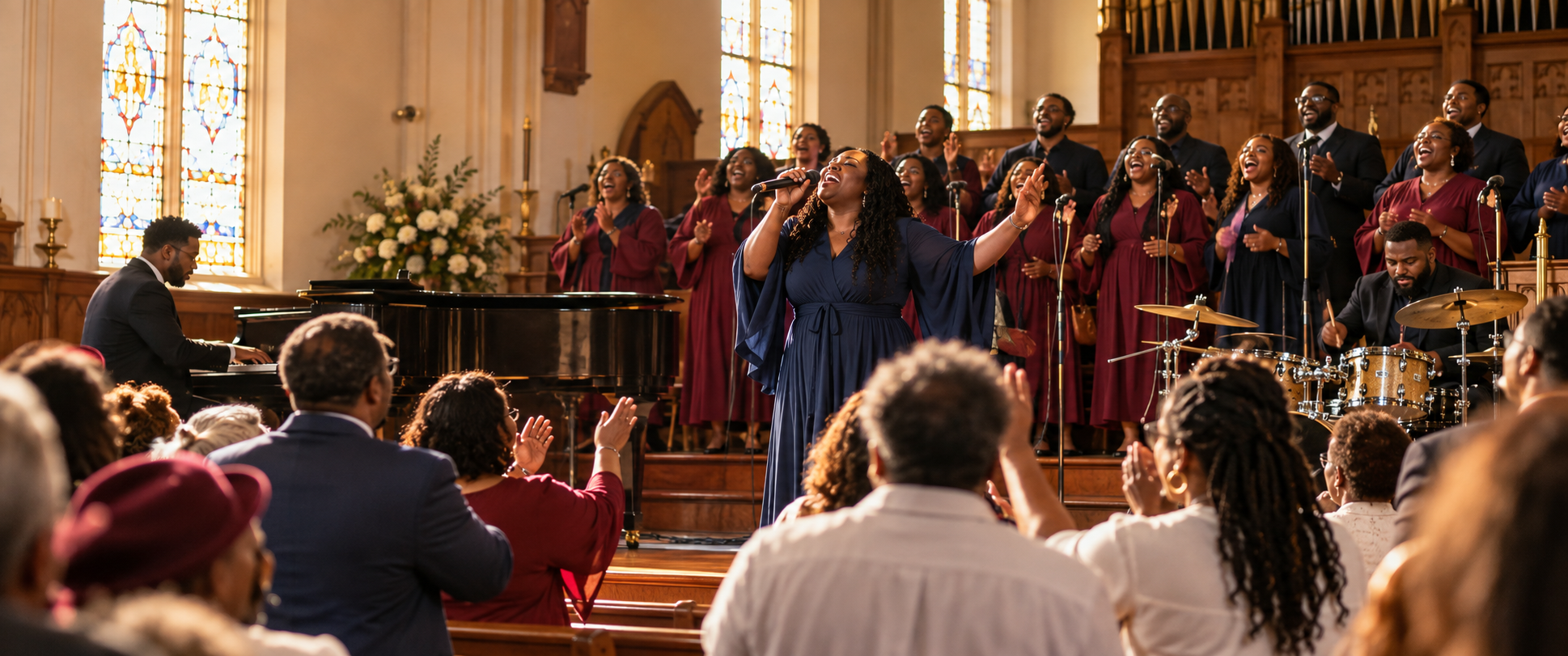
Some music captures our attention through powerful instrumental arrangements. Other styles create memorable experiences through rhythm, melody, or storytelling.
Gospel music often brings these elements together through the expressive power of the human voice.
A singer begins a phrase.
A choir answers.
The piano introduces a familiar chord progression, and the rhythm section gradually builds momentum.
As more voices join, the performance becomes increasingly energetic.
Yet the most memorable moment may be surprisingly subtle.
A brief pause before the chorus.
A change in vocal harmony.
A repeated phrase delivered with greater intensity.
Or a quiet response from the choir that transforms the emotional character of the song.
These details help explain why gospel music has remained such an important and influential tradition.
Rooted in Christian religious expression and shaped by several distinct musical histories, gospel encompasses a wide range of performance styles.
Some recordings feature traditional church choirs.
Others emphasize solo singers, vocal quartets, contemporary bands, or modern production.
The genre has also influenced soul, rhythm and blues, rock and roll, popular music, and many other styles.
For listeners, gospel radio offers an opportunity to discover both the spiritual meaning and musical creativity of this tradition.
One recording might feature an intimate piano-and-voice performance.
Another could introduce a powerful choir, a traditional gospel quartet, or a contemporary gospel arrangement incorporating elements of R&B and pop.
In this guide, we'll explore the history of gospel music, its distinctive vocal techniques, influential artists, essential recordings, and the different musical traditions associated with the genre.
We'll also discover how to listen more closely and appreciate the small musical details that make gospel performances memorable.
1. What Is Gospel Music?
Gospel music is a broad category of Christian religious music associated with several musical traditions, particularly those that developed in the United States.
It often emphasizes expressive singing, spiritual messages, and musical participation.
However, gospel does not have one fixed sound.
Different traditions developed through distinct religious, cultural, and historical contexts.
Common characteristics of gospel music
Depending on the style, gospel may include:
-
Expressive lead vocals.
-
Choir singing.
-
Call-and-response patterns.
-
Rich vocal harmonies.
-
Piano or organ accompaniment.
-
Repeated refrains.
-
Rhythmic handclapping.
-
Improvisation.
-
Dynamic changes.
-
Spiritual and religious lyrics.
-
Group participation.
-
Contemporary instrumental arrangements.
Not every gospel recording includes all these characteristics.
Some performances are quiet and reflective.
Others are energetic and rhythmically powerful.
Why gospel music is distinctive
Gospel frequently emphasizes the relationship between musical expression and religious meaning.
The performance itself can become an important part of communicating the song's message.
2. The History of Gospel Music
Gospel music developed through several interconnected but distinct musical histories.
Its roots include Christian hymn traditions, African American sacred music, spirituals, and other forms of religious singing.
Early Christian hymn traditions
Hymns have played an important role in Christian worship for centuries.
These traditions influenced later forms of gospel music.
African American sacred music
African American communities developed distinctive sacred musical practices shaped by religious life, historical experiences, and musical creativity.
Spirituals
African American spirituals emerged through the experiences of enslaved African Americans and their descendants.
They became an important part of the broader history of African American sacred music.
Spirituals and gospel are related but should not be treated as identical categories.
The emergence of modern gospel
During the late nineteenth and early twentieth centuries, gospel music developed through changing church practices, religious songwriting, and performance traditions.
Thomas A. Dorsey
Thomas A. Dorsey played a central role in the development of modern Black gospel music.
His compositions helped bring together religious lyrics and musical approaches influenced by blues and other popular styles.
Gospel recordings
Recording technology introduced gospel performances to wider audiences.
Radio broadcasting
Radio helped spread gospel music beyond local congregations.
Contemporary gospel
Modern gospel incorporates a wide variety of instrumental and production approaches.
The genre continues to evolve through church traditions, commercial recordings, and contemporary artists.
3. The Difference Between Gospel and Spirituals
Gospel music and African American spirituals share important historical connections.
However, they are not identical.
African American spirituals
Spirituals developed through the religious and musical experiences of enslaved African Americans and their descendants.
Many spirituals circulated through oral tradition.
Gospel music
Modern gospel developed through later religious songwriting, church performance, and commercial recording practices.
Shared characteristics
Both may include:
-
Christian religious themes.
-
Expressive singing.
-
Group participation.
-
Call-and-response.
-
Repeated melodic phrases.
Important differences
The historical circumstances and musical development of spirituals and gospel are distinct.
Why this matters
Understanding these differences helps listeners appreciate the history of African American sacred music without reducing it to one category.
4. The Importance of the Human Voice in Gospel
The human voice is central to many gospel traditions.
Expressive singing
Gospel singers often use changes in tone, volume, and phrasing to communicate emotion.
Vocal ornamentation
A singer may decorate a melody with additional notes or variations.
Improvisation
Some performances include spontaneous melodic or rhythmic changes.
Sustained notes
Long vocal phrases can create moments of intensity.
Rhythmic delivery
The placement of words can contribute to the musical groove.
Personal interpretation
Different singers may perform the same song in distinctive ways.
Why vocal details matter
A small change in phrasing can transform the emotional effect of a familiar melody.
This is one reason gospel recordings reward repeated listening.
5. Call-and-Response in Gospel Music
Call-and-response is an important musical practice in many gospel traditions.
It involves an exchange between a leader and another singer, choir, or congregation.
Lead singer
A soloist introduces a phrase.
Choir response
The choir answers or repeats part of the phrase.
Congregational participation
In some worship settings, the congregation may respond.
Rhythmic interaction
Responses can reinforce the musical pulse.
Building intensity
Repeated exchanges may gradually increase energy.
Why call-and-response matters
It creates a sense of participation and musical dialogue.
Listening exercise
Choose a gospel recording featuring a choir.
Identify the lead singer's phrases.
Then listen to the responses.
Notice how the interaction changes as the performance develops.
6. Gospel Choirs and Vocal Harmony
Gospel choirs are among the most recognizable expressions of the genre.
However, choir size and musical style vary considerably.
Multiple vocal parts
Choirs may divide singers into different vocal sections.
Harmonic richness
Layered voices create a full musical texture.
Dynamic contrast
A choir can move from quiet singing to powerful collective passages.
Repeated refrains
Repetition allows singers to develop intensity.
Lead and ensemble interaction
A soloist may improvise while the choir maintains a repeated phrase.
Why choir singing is memorable
The combination of individual expression and collective sound can create a powerful musical experience.
7. The Role of Piano in Gospel Music
Piano has played an important role in many gospel traditions.
Harmonic accompaniment
The piano supports vocal melodies with chords.
Rhythmic patterns
Pianists may use repeated figures to establish momentum.
Musical introductions
Piano introductions can establish the song's character.
Improvisation
Performers may introduce variations between vocal phrases.
Dynamic changes
The pianist can support quiet passages or energetic climaxes.
Why piano matters
Its versatility allows it to accompany both intimate solo performances and larger ensembles.
Listening tip
Focus on the piano during a gospel recording.
Notice how its playing changes when the singer becomes more expressive.
8. The Hammond Organ and Gospel Sound
The Hammond organ became important in many twentieth-century gospel and church music traditions.
Sustained harmony
The organ can maintain chords beneath the vocals.
Rhythmic accompaniment
Organists may use short rhythmic figures.
Expressive dynamics
Changes in registration and performance technique create tonal variety.
Interaction with singers
The organ may respond to vocal phrases.
Influence on other genres
Gospel organ techniques influenced soul, R&B, jazz, and other musical styles.
Listening exercise
Choose a recording featuring organ.
Notice how the instrument supports the choir.
Pay attention to changes in intensity.
9. Rhythm and Percussion in Gospel
Rhythm plays an important role in many gospel styles.
Handclapping
Clapping may reinforce the beat.
Drums
Drum kits appear in many modern gospel arrangements.
Bass guitar
Basslines can provide rhythmic and harmonic foundations.
Tambourine
Tambourines are associated with certain gospel and church performance traditions.
Rhythmic accents
Instrumental and vocal accents can create momentum.
Why rhythm matters
Rhythm helps connect the different musical parts.
It can also support congregational participation and movement.
10. Traditional Black Gospel Music
Black gospel developed through African American Christian religious traditions.
It became an important musical and cultural force during the twentieth century.
Musical characteristics
Depending on the period and performer, Black gospel may feature:
-
Expressive solo singing.
-
Choirs.
-
Gospel quartets.
-
Piano and organ.
-
Call-and-response.
-
Improvisation.
-
Strong rhythmic emphasis.
Cultural significance
Black gospel is deeply connected with African American religious and cultural history.
Musical influence
Its vocal techniques and rhythmic approaches influenced numerous popular music genres.
Important distinction
Black gospel includes different styles and historical developments.
It should not be reduced to one musical sound.
11. Southern Gospel Music
Southern gospel developed through religious singing traditions in the American South.
It is particularly associated with vocal harmony groups and Christian music performance.
Quartet singing
Male quartets became especially influential within Southern gospel.
Vocal harmony
Multi-part harmonies are an important characteristic.
Songwriting
Southern gospel frequently emphasizes clear religious messages and memorable melodies.
Instrumental accompaniment
Arrangements may include piano, guitars, bass, and other instruments.
Contemporary developments
Modern Southern gospel includes different ensemble types and production styles.
Why Southern gospel matters
It represents a distinct historical tradition within the broader gospel category.
12. Gospel Quartet Singing
Quartet singing is important in several gospel traditions.
However, different quartet styles developed through distinct musical histories.
Black gospel quartets
African American gospel quartets developed expressive vocal approaches involving close harmony, lead singing, and rhythmic interaction.
Southern gospel quartets
Southern gospel quartets developed different vocal conventions and performance practices.
Vocal arrangement
Quartets may assign different melodic and harmonic roles to singers.
Lead singer
A lead vocalist often carries the main melody.
Group interaction
Other singers provide harmony and responses.
Why quartets are interesting
A small group can create a surprisingly rich vocal sound.
13. Contemporary Gospel Music
Contemporary gospel incorporates modern musical influences and production techniques.
Modern instrumentation
Arrangements may feature:
-
Electric guitars.
-
Bass guitars.
-
Drum kits.
-
Keyboards.
-
Synthesizers.
-
Electronic percussion.
-
Choirs.
-
Solo vocalists.
R&B influences
Some contemporary gospel incorporates elements of modern R&B.
Pop influences
Other recordings use accessible pop songwriting structures.
Hip-hop influences
Certain artists combine gospel messages with hip-hop production.
Traditional connections
Many contemporary performers maintain connections with earlier gospel traditions.
Why contemporary gospel matters
It demonstrates how gospel continues to evolve through new musical approaches.
14. Gospel Music vs. Contemporary Christian Music
Gospel and contemporary Christian music, often abbreviated CCM, can overlap.
However, the terms have different historical and industry contexts.
Gospel music
Gospel includes several traditions associated with Christian religious music, particularly those developed through African American sacred music and Southern gospel.
Contemporary Christian music
CCM is a broad commercial category often associated with Christian pop, rock, and related styles.
Shared characteristics
Both may feature:
-
Christian lyrics.
-
Modern production.
-
Solo singers.
-
Bands.
-
Inspirational themes.
Important differences
The categories developed through different musical histories and audiences.
Why the distinction matters
A gospel radio station may focus on traditional gospel, contemporary gospel, CCM, or a mixture.
Checking the station's programming helps clarify its musical identity.
15. Gospel Music vs. Worship Music
Gospel and worship music share religious themes.
However, they are not identical categories.
Gospel
Gospel refers to several musical traditions with distinctive histories.
Worship music
Worship music describes music used in religious worship.
Areas of overlap
Gospel songs may be performed during worship services.
Different musical styles
Worship music can include hymns, contemporary songs, gospel, and other traditions.
Why the distinction matters
The purpose of a song and its musical genre are related but separate questions.
16. Mahalia Jackson: A Legendary Gospel Voice
Mahalia Jackson is one of the most influential singers in gospel history.
Her recordings and performances helped introduce gospel music to wider audiences.
Vocal expression
Jackson became known for her powerful and expressive singing.
Religious commitment
She maintained a strong connection with sacred music.
Cultural importance
Her performances became associated with important moments in American religious and civil rights history.
Essential recordings
-
Move On Up a Little Higher
-
Take My Hand, Precious Lord
-
How I Got Over
Why Mahalia Jackson matters
Her singing demonstrated the expressive power of gospel music and influenced generations of vocalists.
17. Sister Rosetta Tharpe: Gospel and Electric Guitar
Sister Rosetta Tharpe was a pioneering musician whose work connected gospel with early electric guitar performance.
Musical identity
She combined expressive gospel singing with distinctive guitar playing.
Electric guitar
Her instrumental approach influenced later developments in rock and roll.
Performance energy
Tharpe became known for energetic live performances.
Essential recordings
-
Strange Things Happening Every Day
-
Up Above My Head
-
Didn't It Rain
Why she matters
Her career demonstrates the important relationship between gospel and the development of popular music.
18. Thomas A. Dorsey and Modern Gospel Songwriting
Thomas A. Dorsey is widely recognized as a foundational figure in modern Black gospel music.
Musical background
Dorsey worked in blues and other musical styles before becoming especially associated with religious songwriting.
Gospel compositions
His songs helped shape the development of modern gospel.
Essential song
Precious Lord, Take My Hand
Musical influence
His compositions became important parts of gospel repertoire.
Why Dorsey matters
He contributed significantly to the musical language of twentieth-century gospel.
19. The Staple Singers and Gospel's Wider Influence
The Staple Singers developed a distinctive sound rooted in gospel traditions.
Their music later reached wider audiences through soul and popular recordings.
Family ensemble
The group featured members of the Staples family.
Vocal harmony
Their arrangements emphasized expressive group singing.
Cultural significance
Their music became associated with social themes and the civil rights era.
Essential recordings
-
Uncloudy Day
-
I'll Take You There
-
Respect Yourself
Why the group matters
The Staple Singers demonstrate how gospel influences contributed to the development of soul music.
20. Aretha Franklin and Gospel Traditions
Aretha Franklin became internationally recognized as one of the most influential singers in popular music.
Her musical background included gospel singing.
Early musical experiences
Franklin grew up in a religious and musical environment.
Gospel influence
Her vocal techniques reflected important gospel traditions.
Gospel recordings
She recorded significant sacred music during her career.
Essential album
Amazing Grace (1972)
Why it matters
The album remains an important example of gospel performance by a major popular music artist.
21. Kirk Franklin and Contemporary Gospel
Kirk Franklin became an influential figure in contemporary gospel.
His recordings helped introduce gospel music to broader audiences through modern production and songwriting.
Musical approach
Franklin frequently combines choir singing with contemporary rhythmic arrangements.
Gospel choirs
Choir performance remains central to much of his work.
Modern influences
His music incorporates elements of R&B, hip-hop, and pop.
Essential recordings
-
Stomp
-
Revolution
-
I Smile
Why Kirk Franklin matters
His work demonstrates how contemporary gospel can incorporate modern musical styles while maintaining religious themes.
22. Other Important Gospel Artists
Gospel music includes numerous influential performers.
The Clark Sisters
The Clark Sisters are known for their vocal harmonies and contributions to contemporary gospel.
Essential recording: "You Brought the Sunshine"
Andraé Crouch
Andraé Crouch was an influential gospel singer, songwriter, and arranger.
Essential song: "Soon and Very Soon"
Shirley Caesar
Shirley Caesar is a prominent gospel singer known for expressive performances.
The Winans
The Winans became influential through their vocal harmonies and contemporary gospel recordings.
CeCe Winans
CeCe Winans is a major gospel vocalist whose career includes traditional and contemporary approaches.
The Blind Boys of Alabama
The Blind Boys of Alabama are known for their long history of gospel singing.
Why explore different artists?
Each performer offers a distinctive approach to melody, harmony, rhythm, and religious expression.
23. Essential Gospel Songs for Beginners
If you're discovering gospel music for the first time, several recordings provide useful starting points.
1. Mahalia Jackson – Move On Up a Little Higher
A landmark gospel recording featuring powerful vocal expression.
2. Mahalia Jackson – Take My Hand, Precious Lord
An important interpretation of Thomas A. Dorsey's composition.
3. Sister Rosetta Tharpe – Strange Things Happening Every Day
A recording demonstrating the connection between gospel and early electric guitar performance.
4. The Staple Singers – Uncloudy Day
A memorable example of gospel-influenced family harmony.
5. Aretha Franklin – Amazing Grace
A powerful gospel performance associated with her 1972 album.
6. Andraé Crouch – Soon and Very Soon
A well-known contemporary gospel composition.
7. The Clark Sisters – You Brought the Sunshine
An influential recording combining gospel singing with contemporary musical approaches.
8. Kirk Franklin – Stomp
A recognizable example of contemporary gospel production.
9. CeCe Winans – Alabaster Box
A recording emphasizing expressive gospel singing.
10. The Blind Boys of Alabama – Amazing Grace
An example of gospel vocal interpretation.
These recordings introduce different musical periods and approaches.
24. How Gospel Influenced Soul Music
Gospel played an important role in the development of soul music.
Vocal expression
Soul singers adopted techniques associated with gospel performance.
Call-and-response
Gospel's interactive vocal patterns influenced soul arrangements.
Improvisation
Expressive melodic variation became important in soul singing.
Rhythmic energy
Gospel performance practices contributed to soul's rhythmic identity.
Important artists
Performers such as Sam Cooke and Aretha Franklin demonstrate important connections between gospel and soul.
Why this matters
Understanding gospel helps listeners recognize musical ideas that appear throughout modern popular music.
25. Gospel's Influence on Rock and R&B
Gospel contributed to the development of several popular music styles.
Rock and roll
Early rock and roll incorporated musical ideas associated with gospel and rhythm and blues.
R&B
Gospel vocal techniques influenced rhythm and blues performers.
Pop music
Expressive gospel-inspired singing appears in many popular recordings.
Choir arrangements
Gospel-style choirs have been used in rock, pop, and other genres.
Contemporary production
Modern artists continue to incorporate gospel harmonies and vocal approaches.
Why the influence matters
Gospel's musical vocabulary extends far beyond recordings categorized as gospel.
26. How to Listen to Gospel More Closely
Gospel music rewards attentive listening.
Its performances often contain subtle interactions between singers and instruments.
First listen: Follow the lead singer
Notice the main melody and vocal phrasing.
Second listen: Focus on the choir
Identify the different vocal responses.
Third listen: Explore the harmony
Notice how multiple voices create a rich musical texture.
Fourth listen: Follow the rhythm
Listen to the piano, organ, drums, or handclapping.
Fifth listen: Notice repetition
Pay attention to repeated phrases.
Sixth listen: Observe the dynamics
Notice how the performance moves between quiet and energetic passages.
Seventh listen: Hear the complete performance
Finally, listen without focusing on one element.
Notice how the voices and instruments work together.
27. A One-Hour Gospel Listening Journey
An hour of gospel music can introduce several important musical traditions.
The following plan moves from classic recordings to contemporary gospel.
Use the time blocks as flexible listening windows rather than exact track durations.
Minutes 0–10: Begin With Mahalia Jackson
Suggested songs:
-
Move On Up a Little Higher
-
Take My Hand, Precious Lord
Focus on vocal expression.
Minutes 10–20: Discover Sister Rosetta Tharpe
Suggested songs:
-
Strange Things Happening Every Day
-
Didn't It Rain
Notice the interaction between guitar and voice.
Minutes 20–30: Explore Gospel Harmony
Suggested artists:
-
The Staple Singers
-
The Blind Boys of Alabama
Focus on group singing and vocal arrangements.
Minutes 30–40: Experience Gospel Choirs
Suggested artists:
-
The Clark Sisters
-
Andraé Crouch
Listen for harmony and musical intensity.
Minutes 40–50: Explore Contemporary Gospel
Suggested artist: Kirk Franklin
Listen to "Stomp" and other recordings.
Notice the modern production.
Minutes 50–60: Finish With Expressive Gospel Vocals
Suggested artist: CeCe Winans
Focus on melody, phrasing, and emotional expression.
Reflect on your listening experience
After the hour, consider:
-
Which vocal performance was most memorable?
-
Did you prefer solo singers or choirs?
-
Which arrangement created the strongest emotional response?
-
Did you enjoy traditional or contemporary gospel?
-
Which artist would you like to explore further?
These questions can guide your next listening session.
28. Gospel Music for Different Listening Moments
Gospel music can suit many different activities and experiences.
Spiritual reflection
Many listeners enjoy gospel for its religious messages.
Quiet listening
Gentle gospel recordings can create a reflective atmosphere.
Community gatherings
Choir performances may encourage shared participation.
Music education
Gospel provides valuable examples of vocal technique and harmony.
Cultural exploration
The genre offers insight into important religious and musical histories.
Inspirational listening
Some listeners appreciate gospel's hopeful themes.
Focused listening
Complex vocal arrangements reward close attention.
The best selection depends on personal preference.
29. How to Choose a Good Gospel Radio Station
A good gospel station should clearly communicate its musical focus.
Traditional Gospel
Some stations emphasize historical recordings and traditional performance styles.
Black Gospel
These selections may focus on African American gospel traditions.
Southern Gospel
Other stations emphasize vocal harmony groups and Southern gospel repertoire.
Gospel Choir Music
Specialist programming may feature large vocal ensembles.
Contemporary Gospel
Modern stations may include R&B-influenced gospel recordings.
Gospel Worship Music
Some stations focus on music used in worship settings.
Balanced Programming
A mixture of familiar recordings and lesser-known performers can encourage discovery.
Clear Station Descriptions
Checking a station's description helps identify its musical focus.
30. Building Your Own Gospel Playlist
Creating a gospel playlist is an enjoyable way to explore the genre.
Begin with classic recordings
Start with Mahalia Jackson.
Add gospel guitar
Include Sister Rosetta Tharpe.
Explore vocal harmony
Add The Staple Singers and The Blind Boys of Alabama.
Include choir performances
Choose recordings featuring rich vocal arrangements.
Explore contemporary gospel
Add Kirk Franklin and other modern artists.
Balance energy levels
Mix reflective songs with energetic performances.
Pay attention to transitions
Arrange songs so that the musical atmosphere develops naturally.
Include unfamiliar artists
Explore performers beyond the most famous names.
Finish with a favorite
Choose a recording that captures the qualities you enjoy most.
A thoughtful playlist can reveal gospel's musical diversity.
31. Why Gospel Music Remains Important Today
Gospel continues to attract listeners because of its musical and cultural significance.
Religious expression
Gospel remains an important form of Christian musical expression.
Community participation
Choirs and congregational singing bring people together.
Vocal creativity
Gospel performers continue to develop expressive singing techniques.
Cultural history
The genre reflects important religious and social experiences.
Musical influence
Gospel has shaped numerous popular music genres.
Contemporary innovation
Modern artists continue to introduce new arrangements.
International audiences
Gospel music has listeners and performers around the world.
Digital discovery
Online radio makes gospel recordings accessible to broader audiences.
These qualities help explain the genre's continued relevance.
32. Discover Gospel and Related Music on 1LiveRadio
Online radio provides a convenient way to explore gospel and related musical traditions.
If you enjoy gospel music, you may also appreciate:
-
Soul.
-
Contemporary Christian music.
-
Worship music.
-
Spirituals.
-
Southern gospel.
-
R&B.
-
Christian pop.
-
Gospel choir music.
-
Inspirational music.
-
Traditional hymns.
Each category offers different approaches to melody, harmony, and musical expression.
Visit 1LiveRadio to browse available radio stations and discover music from around the world.
Explore station categories and descriptions to find programming that matches your interests.
Whether you're interested in classic gospel singers, traditional quartets, powerful choirs, or contemporary gospel, online radio can help you discover new favorites.
Station availability and programming may vary.
Frequently Asked Questions About Gospel Music
What is gospel music?
Gospel is a broad category of Christian religious music associated with several traditions, particularly those developed in the United States.
Where did gospel music originate?
Modern gospel developed through Christian religious traditions in the United States, including African American sacred music and other religious singing practices.
Who is considered the father of gospel music?
Thomas A. Dorsey is often called the father of modern Black gospel music because of his influential songwriting and musical contributions.
What instruments are used in gospel music?
Common instruments include piano, organ, drums, bass guitar, electric guitar, and various percussion instruments.
What is a gospel choir?
A gospel choir is a group of singers performing gospel music, often using layered harmonies and expressive arrangements.
What is call-and-response?
Call-and-response is a musical exchange between a lead performer and another singer, choir, or congregation.
What is the difference between gospel and spirituals?
Spirituals developed through the experiences of enslaved African Americans and their descendants, while modern gospel developed through later musical and religious traditions.
What is Southern gospel?
Southern gospel is a Christian music tradition associated with the American South and particularly known for vocal harmony groups.
What is contemporary gospel?
Contemporary gospel combines gospel traditions with modern musical styles and production techniques.
Is gospel the same as worship music?
No. Gospel is a musical category with specific historical traditions, while worship music refers broadly to music used in religious worship.
Is gospel the same as CCM?
No. Gospel and contemporary Christian music have different historical and industry contexts, although they sometimes overlap.
Who are some famous gospel singers?
Important performers include Mahalia Jackson, Sister Rosetta Tharpe, Shirley Caesar, CeCe Winans, and Kirk Franklin.
Did gospel influence soul music?
Yes. Gospel vocal techniques and performance practices played an important role in the development of soul.
Did gospel influence rock and roll?
Yes. Gospel contributed important vocal and musical influences to early rock and roll.
Can gospel music be instrumental?
Yes. Although singing is central to many gospel traditions, instrumental gospel recordings also exist.
Where can I listen to gospel online?
You can explore gospel through online radio, streaming services, specialist playlists, and historical music collections.
Final Thoughts: Discovering the Small Details That Make Gospel Memorable
Gospel music offers a powerful combination of vocal expression, musical creativity, and cultural meaning.
Its appeal comes from the interaction between individual performers and the wider ensemble.
A singer begins a phrase.
The choir responds.
The piano introduces a familiar harmony.
The rhythm section gradually builds momentum.
Then a repeated refrain becomes more powerful as additional voices join.
These moments demonstrate how gospel music can transform relatively simple musical ideas into memorable performances.
From the foundational work of Thomas A. Dorsey to the influential singing of Mahalia Jackson, the guitar innovations of Sister Rosetta Tharpe, and the contemporary arrangements of Kirk Franklin, gospel encompasses a rich musical history.
For newcomers, gospel radio provides an accessible starting point.
Begin with the lead singer.
Listen to the choir.
Notice the harmony.
Follow the rhythm.
Then pay attention to how the performance develops.
You may discover that the most memorable moments are not always the loudest.
A quiet vocal response, a subtle change in harmony, or a carefully placed pause can communicate as much as a powerful chorus.
Gospel music reminds us that musical expression is often strongest when individual voices come together with a shared purpose.
Whether you're exploring traditional gospel, discovering historical recordings, or enjoying contemporary gospel arrangements, the genre offers countless opportunities for meaningful musical discovery.
Explore more music and discover online radio stations at 1LiveRadio.
Reader comments
No comments yet. Start the conversation.
Leave a comment
Your email stays private. Comments appear after approval.