
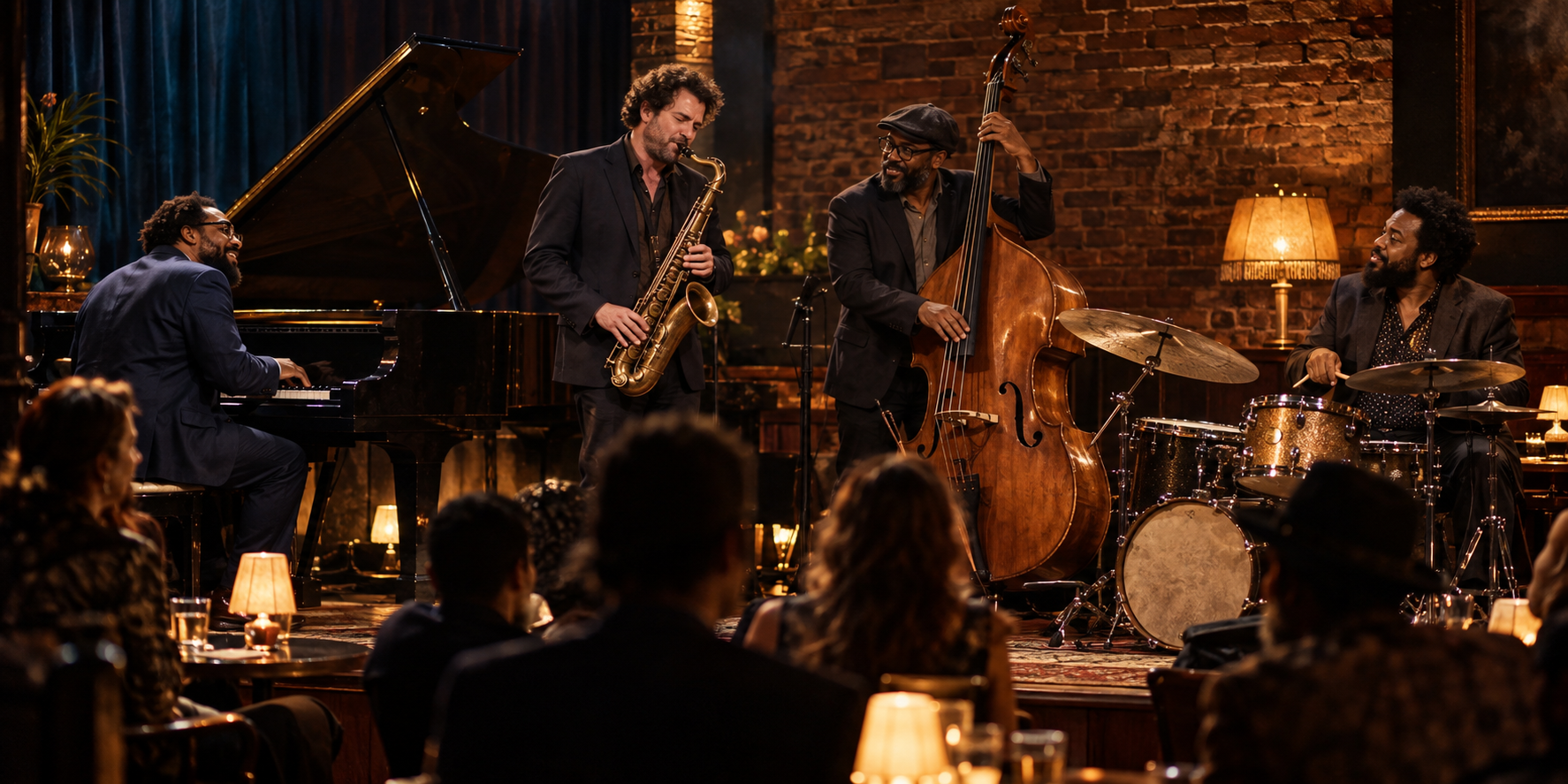
A trumpet introduces a melody. The piano answers with a few carefully placed chords, while the double bass maintains a steady pulse.
Then something changes.
The trumpet player begins improvising, transforming the original melody into a series of unexpected phrases. The drummer responds with a subtle rhythmic accent, and the pianist leaves a brief silence before entering again.
No two moments feel exactly alike.
This musical conversation is one of the qualities that makes jazz music so memorable.
Jazz is a diverse musical tradition that developed in African American communities in the United States around the turn of the twentieth century. Over time, it expanded into numerous styles, including swing, bebop, cool jazz, hard bop, modal jazz, free jazz, and fusion.
Some jazz recordings feature large orchestras. Others bring together a small group of musicians or focus on a solo performer.
The music can be energetic, reflective, complex, playful, or deeply expressive.
Yet one of the most rewarding ways to appreciate jazz is surprisingly simple: listen to how the musicians respond to one another.
A drummer may change a rhythmic pattern after hearing a soloist. A pianist may introduce an unexpected chord. A saxophonist may repeat a phrase with a slightly different ending.
These details can turn a familiar composition into a distinctive performance.
In this guide, we'll explore jazz history, improvisation, rhythm, major styles, influential musicians, and essential recordings.
We'll also create a practical one-hour listening journey and introduce several jazz radio stations on 1LiveRadio.
Whether you're discovering jazz for the first time or returning to familiar recordings, the goal is to help you hear more of what makes each performance special.
1. What Is Jazz Music?
Jazz is a musical tradition characterized by a wide variety of approaches to rhythm, improvisation, melody, harmony, and ensemble performance.
Although jazz has evolved considerably, improvisation and musical interaction have been especially important throughout much of its history.
Jazz encompasses many styles rather than one fixed sound.
Traditional jazz
Early jazz traditions associated with New Orleans and related developments.
Swing
Music often associated with strong rhythmic momentum and, historically, large dance orchestras.
Bebop
A style emphasizing intricate melodies, rapid passages, and sophisticated improvisation.
Cool jazz
A broad label associated with certain restrained or carefully arranged approaches to modern jazz.
Hard bop
A style that developed from bebop while incorporating influences associated with blues, gospel, and rhythm and blues.
Modal jazz
An approach in which musicians may improvise using modes rather than relying primarily on rapidly changing chord progressions.
Free jazz
A broad category associated with experimentation beyond some conventional harmonic and formal structures.
Jazz fusion
Music combining jazz approaches with influences from rock, funk, and other genres.
Contemporary jazz
Modern jazz encompasses many approaches, including acoustic improvisation, electronic production, and cross-genre experimentation.
Why the variety matters
A traditional New Orleans ensemble may sound completely different from a contemporary jazz trio.
Both can belong to jazz while using different musical conventions.
For a broader historical overview, explore Encyclopaedia Britannica's guide to jazz.
2. The Origins of Jazz
Jazz developed through the interaction of several musical traditions in the United States.
Its emergence is closely associated with African American musical culture, particularly in New Orleans.
African American musical traditions
Blues, spirituals, ragtime, and other traditions contributed to jazz's early development.
New Orleans
New Orleans was an important center for early jazz musicians and ensembles.
Collective improvisation
Early jazz performances sometimes featured several instruments improvising simultaneously.
Brass bands
Brass band traditions contributed to the musical environment in which jazz developed.
Dance music
Jazz was connected with social dancing and entertainment.
Musical exchange
Musicians combined and transformed different musical influences.
Why this history matters
Jazz cannot be understood only as a collection of instruments or technical devices.
Its development is closely connected with African American creativity, cultural history, and musical innovation.
For additional historical context, read the National Park Service's overview of jazz origins in New Orleans.
3. Why Improvisation Matters in Jazz
Improvisation is one of jazz's most recognizable characteristics.
In musical improvisation, performers create or develop musical material during a performance.
However, improvisation does not mean that musicians are simply playing random notes.
Musical knowledge
Improvisers draw on their understanding of melody, harmony, rhythm, and musical form.
Listening
Musicians respond to the other performers.
Variation
A familiar theme may be transformed into new phrases.
Timing
A soloist may place notes ahead of, behind, or directly on the beat.
Interaction
The rhythm section may respond to changes in a solo.
Personal expression
Different musicians can interpret the same composition in distinctive ways.
Listening exercise
Choose a jazz recording that begins with a clear melody.
Listen to the opening theme.
Then follow the first solo.
Ask yourself:
-
Can you recognize parts of the original melody?
-
Does the soloist repeat certain phrases?
-
Does the rhythm section change its intensity?
-
Are there moments of silence?
-
How does the performance return to the theme?
These questions can make improvisation easier to appreciate.
4. Jazz as a Musical Conversation
One of the most enjoyable aspects of jazz is the interaction between performers.
A jazz ensemble can resemble a conversation in which musicians exchange musical ideas.
Call and response
One musician presents a phrase, and another answers.
Musical handoffs
A soloist finishes a phrase, creating space for another performer.
Rhythmic responses
The drummer may emphasize a moment in the solo.
Harmonic support
The pianist or guitarist may change the accompaniment.
Shared development
Musicians can build intensity together.
Silence
A pause can be as expressive as a played note.
Why it matters
Jazz often rewards attention to the relationships between instruments rather than focusing exclusively on the soloist.
Listening tip
Choose one instrument to follow.
Then notice how it responds to another musician.
A small exchange may become the most memorable part of the recording.
5. Understanding Swing Rhythm
Swing is an important concept in jazz, although not every jazz recording uses a swinging rhythmic feel.
The term can refer to a historical jazz style and to a particular sense of rhythmic movement.
Swing feel
In many jazz performances, the subdivision of the beat creates a distinctive rhythmic character.
Rhythmic flexibility
Musicians may vary the placement and emphasis of notes.
Interaction
The rhythm section contributes to the overall groove.
Historical swing music
Swing became especially prominent during the big-band era.
Why swing is difficult to reduce to one formula
Different performers and musical periods use different rhythmic approaches.
Listening exercise
Choose a swing recording.
Tap your foot to the main beat.
Then listen to how the melody moves around that beat.
Notice whether the notes feel evenly spaced or more flexible.
6. The Role of the Jazz Rhythm Section
The rhythm section provides an important foundation for many jazz ensembles.
It commonly includes piano or guitar, bass, and drums.
However, instrumentation varies.
Double bass
The bassist may establish a walking bassline or another rhythmic foundation.
Drums
The drummer shapes the groove and interacts with the ensemble.
Piano
The pianist may provide harmonic accompaniment, rhythmic accents, or melodic ideas.
Guitar
In some ensembles, guitar contributes chords, rhythm, or solos.
Why the rhythm section matters
The rhythm section does more than maintain a steady beat.
Its musicians often participate actively in the performance's development.
Listening exercise
During a jazz solo, focus only on the bass.
Notice how the bassline moves.
Then listen again and focus on the drums.
Finally, pay attention to the piano or guitar.
You may discover several different musical conversations happening at once.
7. Walking Basslines in Jazz
A walking bassline is a recognizable feature of many jazz recordings.
It commonly involves a sequence of notes that creates a steady sense of movement.
Rhythmic foundation
Walking basslines often emphasize regular beats.
Harmonic movement
The notes help outline the changing harmony.
Connection with the drums
Bass and drums work together to establish the groove.
Interaction with soloists
The bassist may adjust phrasing and note choices in response to the ensemble.
Why it matters
A walking bassline can make a performance feel grounded even when the soloist plays rhythmically complex phrases.
Listening tip
Follow the bassline through a complete chorus.
Notice whether it moves steadily or introduces variations.
8. The Importance of Jazz Drumming
Jazz drumming involves more than keeping time.
Drummers contribute rhythm, texture, accents, and musical responses.
Ride cymbal
The ride cymbal often helps establish a rhythmic pattern.
Snare drum
The snare can provide accents and responses.
Bass drum
The bass drum may reinforce the pulse or contribute rhythmic emphasis.
Hi-hat
The hi-hat can help shape the groove.
Brushes
Some drummers use brushes to create softer textures.
Improvisational interaction
Drummers may respond directly to soloists.
Listening tip
Choose a small-group jazz recording.
Listen for moments when the drummer changes the intensity.
Notice whether those changes follow the soloist's phrasing.
9. New Orleans Jazz
New Orleans played a central role in jazz's early development.
Early jazz ensembles often featured several instruments interacting simultaneously.
Common instruments
These could include:
-
Cornet or trumpet.
-
Clarinet.
-
Trombone.
-
Piano.
-
Banjo.
-
Bass or tuba.
-
Drums.
Collective improvisation
Several musicians may develop different melodic lines at the same time.
Rhythmic movement
The ensemble maintains a shared pulse while individual instruments contribute distinct ideas.
Historical importance
New Orleans jazz influenced later developments in jazz performance.
Artists to explore
Louis Armstrong is one of the most influential figures associated with early jazz and its development.
Listening tip
Try following the trumpet or cornet.
Then shift your attention to the clarinet and trombone.
Notice how the melodic lines interact.
10. Swing and the Big-Band Era
Swing became a major popular music style during the 1930s and 1940s.
Large jazz orchestras played an important role in this period.
Big-band arrangements
These ensembles often included sections of trumpets, trombones, saxophones, and a rhythm section.
Dance rhythms
Swing music was closely associated with social dancing.
Arranged passages
Many performances combined written arrangements with improvised solos.
Section interaction
Different instrumental sections could answer one another.
Important bandleaders
Examples include:
-
Duke Ellington.
-
Count Basie.
-
Benny Goodman.
-
Chick Webb.
Listening tip
Focus on the brass and saxophone sections.
Notice how arranged passages alternate with individual solos.
11. Bebop: A New Approach to Jazz
Bebop emerged during the 1940s and became an important development in modern jazz.
It emphasized new approaches to improvisation, harmony, and rhythmic complexity.
Intricate melodies
Bebop compositions often feature demanding melodic lines.
Improvisation
Soloists explore complex musical ideas.
Harmonic development
Performers frequently improvise over sophisticated chord progressions.
Small ensembles
Bebop is strongly associated with small-group performance.
Rhythmic interaction
Drummers and other rhythm-section players contribute flexible accents.
Important musicians
Examples include:
-
Charlie Parker.
-
Dizzy Gillespie.
-
Thelonious Monk.
-
Bud Powell.
Listening tip
Do not try to follow every note immediately.
Begin by listening to the main theme.
Then notice how the soloist develops phrases over the rhythm section.
12. Cool Jazz
Cool jazz is a broad term associated with certain approaches to modern jazz that developed during the mid-twentieth century.
It should not be understood simply as jazz played quietly.
Arrangement
Some recordings emphasize carefully organized instrumental textures.
Timbre
Instrumental tone can play an important expressive role.
Phrasing
Certain performances feature restrained or spacious melodic approaches.
Ensemble interaction
The relationship between instruments remains important.
Artists to explore
Examples include:
-
Miles Davis.
-
Gerry Mulligan.
-
Chet Baker.
-
Dave Brubeck.
These musicians represent different approaches within the broader jazz landscape.
Listening tip
Pay attention to space between phrases.
Notice how the musicians use silence and changes in tone.
13. Hard Bop
Hard bop developed during the 1950s.
It built on bebop while incorporating influences associated with blues, gospel, and rhythm and blues.
Strong rhythmic identity
Many recordings emphasize a pronounced groove.
Blues influences
Blues-related phrasing and harmonic ideas are important in numerous performances.
Expressive solos
Improvisation remains central.
Small-group interaction
Hard bop is strongly associated with small jazz ensembles.
Important artists
Examples include:
-
Art Blakey.
-
Horace Silver.
-
Clifford Brown.
-
Lee Morgan.
Listening tip
Focus on the relationship between the soloist and the rhythm section.
Notice how the drummer and pianist respond to the solo.
14. Modal Jazz
Modal jazz is associated with improvisation based on modes.
This approach can provide different possibilities from improvisation over rapidly changing chord progressions.
Harmonic space
Some modal compositions remain within a particular harmonic area for extended passages.
Melodic development
Soloists can explore variations within the musical framework.
Repetition
Repeated harmonic patterns may create a recognizable atmosphere.
Ensemble interaction
The rhythm section remains important.
Influential recordings
Miles Davis's Kind of Blue is a major reference point in discussions of modal jazz.
Artists to explore
Examples include:
-
Miles Davis.
-
John Coltrane.
-
McCoy Tyner.
Listening tip
Notice whether the harmony changes frequently.
Then focus on how the soloist develops melodic ideas over the accompaniment.
15. Free Jazz
Free jazz encompasses approaches that challenge or move beyond some established jazz conventions.
However, free jazz is not one uniform style.
Open structures
Some performances use less conventional formal arrangements.
Rhythmic freedom
Musicians may explore flexible or changing rhythmic relationships.
Collective improvisation
Several performers may improvise simultaneously.
Extended techniques
Musicians may use unusual instrumental sounds.
Expressive intensity
Some recordings emphasize strong contrasts and experimentation.
Important artists
Examples include:
-
Ornette Coleman.
-
Cecil Taylor.
-
Albert Ayler.
Listening tip
Rather than searching immediately for a familiar melody, focus on texture, interaction, and changes in intensity.
16. Jazz Fusion
Jazz fusion developed through combinations of jazz with other musical influences, particularly from the late 1960s onward.
Rock influences
Some recordings use electric guitars and rock-related rhythms.
Funk influences
Groove-oriented basslines and percussion can become prominent.
Electronic instruments
Synthesizers and electric keyboards appear in many fusion recordings.
Improvisation
Jazz improvisational approaches remain important.
Complex arrangements
Some recordings feature intricate rhythms and extended instrumental passages.
Important artists
Examples include:
-
Miles Davis.
-
Weather Report.
-
Herbie Hancock.
-
Mahavishnu Orchestra.
Listening tip
Focus on the rhythm section.
Notice how electric instruments interact with improvising soloists.
17. Smooth Jazz
Smooth jazz is commonly associated with accessible melodies, polished production, and influences from jazz, R&B, pop, and related styles.
Melodic emphasis
Many recordings feature recognizable instrumental melodies.
Production
Studio arrangements can be an important part of the sound.
Rhythm
Groove-oriented accompaniment is common.
Instrumentation
Saxophone, guitar, keyboards, and other instruments frequently appear.
Important distinction
Smooth jazz is not representative of every jazz style.
Its musical priorities may differ from those of bebop, free jazz, or traditional jazz.
Listening tip
Pay attention to how the melody interacts with the rhythmic accompaniment.
18. Jazz Piano
The piano is one of jazz's most versatile instruments.
It can provide melody, harmony, accompaniment, and rhythmic accents.
Solo piano
A pianist may create a complete performance alone.
Trio performances
Piano trios commonly feature piano, bass, and drums.
Comping
Comping refers to the harmonic and rhythmic accompaniment provided behind a soloist.
Improvisation
Jazz pianists often develop melodic ideas during performance.
Important pianists
Examples include:
-
Thelonious Monk.
-
Bill Evans.
-
Oscar Peterson.
-
Herbie Hancock.
-
McCoy Tyner.
Listening tip
Notice how the pianist changes roles.
At one moment, the piano may support another musician.
Later, it may become the main solo instrument.
19. Jazz Saxophone
The saxophone has played a major role in many jazz styles.
Its sound can vary considerably depending on the performer and instrument.
Alto saxophone
Often associated with a distinctive, expressive tone.
Tenor saxophone
Commonly used for both melodic themes and improvisation.
Soprano saxophone
Offers a different register and tonal character.
Baritone saxophone
Can provide lower-register melodic or ensemble parts.
Important saxophonists
Examples include:
-
Charlie Parker.
-
John Coltrane.
-
Sonny Rollins.
-
Cannonball Adderley.
-
Wayne Shorter.
Listening tip
Focus on phrasing.
Notice how the saxophonist begins and ends musical ideas.
A pause or change in tone can be as expressive as a rapid passage.
20. Jazz Trumpet
The trumpet is closely associated with several important periods of jazz history.
Early jazz
Trumpet and cornet players were central to many early ensembles.
Swing
Trumpet sections contributed to big-band arrangements.
Bebop
Trumpeters developed complex improvisational approaches.
Modern jazz
The instrument remains important in contemporary performance.
Influential trumpeters
Examples include:
-
Louis Armstrong.
-
Dizzy Gillespie.
-
Miles Davis.
-
Clifford Brown.
-
Freddie Hubbard.
Listening tip
Notice differences in tone and phrasing.
Compare a forceful trumpet passage with a quieter, more spacious performance.
21. Jazz Guitar
Jazz guitar appears in several different musical settings.
Rhythm guitar
Guitarists may provide chordal accompaniment.
Solo guitar
A performer can combine melody, harmony, and rhythm.
Small ensembles
Guitar may take the role of a melodic solo instrument.
Fusion
Electric guitar can contribute powerful tones and extended improvisation.
Influential guitarists
Examples include:
-
Django Reinhardt.
-
Wes Montgomery.
-
Jim Hall.
-
Pat Metheny.
-
John Scofield.
Listening tip
Pay attention to the guitarist's tone and phrasing.
Notice whether the instrument is providing accompaniment or leading the melody.
22. Vocal Jazz
Jazz is not limited to instrumental music.
Vocal jazz includes a wide range of performance approaches.
Melodic interpretation
Singers may reshape familiar melodies.
Rhythmic phrasing
Vocalists can place words in flexible relationships with the beat.
Scat singing
Scat involves vocal improvisation using syllables rather than conventional lyrics.
Ensemble interaction
A vocalist may respond to instrumental accompaniment.
Important singers
Examples include:
-
Ella Fitzgerald.
-
Billie Holiday.
-
Sarah Vaughan.
-
Louis Armstrong.
-
Carmen McRae.
Listening tip
Choose two interpretations of the same jazz standard.
Compare how the singers phrase the melody.
The differences can reveal individual artistic choices.
23. Jazz Standards and Why They Matter
Jazz standards are compositions that have become widely performed within jazz traditions.
Different musicians may interpret the same standard in very different ways.
Shared repertoire
Standards provide familiar musical material.
Improvisation
Performers can create new ideas around a known composition.
Arrangement
The same melody may be presented by different ensembles.
Tempo
One group may perform a standard quickly, while another uses a slower approach.
Harmony
Musicians may explore different harmonic treatments.
Why standards are useful for beginners
Comparing versions of the same composition makes differences in performance easier to hear.
Listening exercise
Choose a familiar jazz standard.
Listen to two versions by different artists.
Compare the melody, tempo, instrumentation, and improvisation.
24. Ten Essential Jazz Recordings to Explore
The following recordings provide a varied introduction to jazz history and performance.
They are starting points rather than a definitive ranking.
1. Louis Armstrong and His Hot Five – West End Blues
An influential early jazz recording.
Listen for: Trumpet expression and ensemble interaction.
2. Duke Ellington – Take the “A” Train
A composition strongly associated with the Duke Ellington Orchestra.
Listen for: Big-band arrangement and rhythmic movement.
3. Charlie Parker – Ko-Ko
A major bebop recording.
Listen for: Rapid melodic ideas and improvisational complexity.
4. Thelonious Monk – 'Round Midnight
A well-known jazz composition.
Listen for: Distinctive melody and harmonic character.
5. Dave Brubeck Quartet – Take Five
A famous jazz recording featuring an unusual five-beat meter.
Listen for: Rhythmic structure and saxophone melody.
6. Miles Davis – So What
A landmark recording associated with modal jazz.
Listen for: Improvisation and harmonic space.
7. John Coltrane – My Favorite Things
A distinctive jazz interpretation of a familiar composition.
Listen for: Repetition, development, and saxophone phrasing.
8. Art Blakey and the Jazz Messengers – Moanin'
A well-known hard bop recording.
Listen for: Blues influences and rhythmic energy.
9. Herbie Hancock – Cantaloupe Island
A recognizable jazz composition.
Listen for: Groove, piano, and ensemble interaction.
10. Weather Report – Birdland
An influential jazz fusion recording.
Listen for: Electric instrumentation and melodic arrangement.
Why this selection is useful
These recordings represent different periods, styles, and performance approaches.
Listening to them together can reveal how jazz has developed over time.
25. How to Listen to Jazz More Closely
Jazz often becomes easier to appreciate when you focus on one musical element at a time.
First listen: Identify the melody
Follow the main theme.
Second listen: Focus on the bass
Notice how the bassist supports the harmony and rhythm.
Third listen: Follow the drums
Pay attention to accents and changes in intensity.
Fourth listen: Listen to the soloist
Notice how the improvisation develops.
Fifth listen: Explore the accompaniment
Focus on piano or guitar.
Sixth listen: Notice interaction
Listen for moments when one musician responds to another.
Seventh listen: Follow the return of the theme
Notice whether the melody returns in the same form.
A useful question
What changed between the opening melody and the final statement?
The answer may involve rhythm, harmony, phrasing, instrumentation, or improvisation.
26. A One-Hour Jazz Listening Journey
A one-hour listening session can introduce several important jazz styles.
The following plan is flexible.
Choose recordings that fit the suggested time blocks or listen to selected excerpts.
Minutes 0–10: Begin With Early Jazz
Suggested artist:
Louis Armstrong.
What to notice:
Focus on the trumpet and ensemble interaction.
Listening goal: Hear how early jazz musicians developed melodic ideas.
Minutes 10–20: Explore Swing
Suggested artists:
Duke Ellington and Count Basie.
What to notice:
Listen to the relationship between brass, saxophones, and the rhythm section.
Listening goal: Recognize big-band arrangement and swing feel.
Minutes 20–30: Discover Bebop
Suggested artists:
Charlie Parker and Dizzy Gillespie.
What to notice:
Follow the melody and improvised solos.
Listening goal: Understand how bebop developed new approaches to improvisation.
Minutes 30–40: Explore Modal Jazz
Suggested artists:
Miles Davis and John Coltrane.
What to notice:
Focus on melodic development and harmonic space.
Listening goal: Hear a different approach to improvisation.
Minutes 40–50: Experience Jazz Fusion
Suggested artists:
Herbie Hancock and Weather Report.
What to notice:
Listen for electric instruments and groove-oriented arrangements.
Listening goal: Recognize how jazz interacts with other musical styles.
Minutes 50–60: Discover Jazz Radio
Finish by exploring the Jazz category on 1LiveRadio.
Choose a station that interests you.
Listen to several recordings without selecting individual tracks.
Listening goal: Discover an unfamiliar jazz artist or style.
Reflect on your listening session
Ask yourself:
-
Which instrument interested you most?
-
Did you prefer small groups or big bands?
-
Which solo was most memorable?
-
Did you enjoy traditional or modern jazz?
-
Which style would you like to explore further?
Your answers can guide future listening.
27. How to Choose a Jazz Radio Station
Jazz radio stations may specialize in different styles and periods.
Traditional jazz stations
May feature early jazz and related recordings.
Swing stations
May emphasize big-band music.
Bebop stations
May focus on modern jazz recordings associated with bebop.
Smooth jazz stations
May feature accessible melodies and polished production.
Contemporary jazz stations
May introduce recent recordings and artists.
Mixed jazz stations
May combine several periods and styles.
How to choose
Read the station description.
Look for information about musical focus.
Then listen to several recordings before deciding whether the programming suits your preferences.
Browse jazz stations
Visit the Jazz radio category on 1LiveRadio.
28. Jazz Radio Stations on 1LiveRadio
1LiveRadio includes several jazz station listings.
These pages provide useful starting points for exploring different programming approaches.
OpenFM – Jazz
The OpenFM – Jazz station page is available in the directory.
Its name identifies it as a jazz-focused listing.
Check its description and player for current programming.
The Jazz Century
The The Jazz Century station page provides another starting point for exploring jazz-related programming.
SPLASH Jazz
The SPLASH Jazz station page offers an additional jazz station listing.
Jazz Variations
The Jazz Variations station page provides another option for listeners interested in jazz.
So Jazzy Radio
The So Jazzy Radio station page is also available in the directory.
Compare station programming
Station names provide clues, but they do not guarantee a particular playlist.
Programming and stream availability may change.
Discover more
Browse the complete Jazz category on 1LiveRadio.
29. Jazz and Blues: An Important Connection
Jazz and blues have a close historical relationship.
Blues contributed important musical ideas to jazz's development.
Blues phrasing
Many jazz musicians draw on expressive approaches associated with blues.
Harmonic structures
Blues-related forms appear in numerous jazz compositions.
Improvisation
Both traditions include important improvisational practices.
Rhythmic interaction
Jazz and blues performers have developed different approaches to rhythm and ensemble playing.
Important distinction
Jazz and blues are not identical genres.
Each has its own history and musical traditions.
Related listening guide
Explore How to spend an hour with Blues music for a broader introduction to blues.
30. Jazz for Different Listening Moods
Jazz offers recordings suitable for many different listening experiences.
Relaxed evenings
Some small-group jazz recordings feature restrained arrangements.
Energetic listening
Swing and hard bop can provide strong rhythmic momentum.
Focused listening
Bebop and complex modern jazz may reward close attention.
Background music
Certain recordings may suit listeners who prefer unobtrusive music.
Creative activities
Some listeners enjoy jazz while writing, drawing, or working.
Musical exploration
Free jazz and fusion can introduce unfamiliar sounds.
Why mood matters
Jazz is too varied to describe with one emotional label.
Choose recordings according to their individual characteristics.
31. Building Your Own Jazz Playlist
A personal jazz playlist can help you explore the genre systematically.
Start with a familiar recording
Choose a jazz track you already enjoy.
Add early jazz
Include a recording by Louis Armstrong.
Explore swing
Choose a big-band performance.
Discover bebop
Add a recording by Charlie Parker or Dizzy Gillespie.
Include modal jazz
Explore Miles Davis or John Coltrane.
Add vocal jazz
Choose a recording by Ella Fitzgerald or Billie Holiday.
Discover fusion
Include a recording by Weather Report or Herbie Hancock.
Compare different ensemble sizes
Listen to solo, trio, quartet, and big-band performances.
Revisit favorites
Repeated listening can reveal new musical details.
Expand gradually
Follow musicians and styles that interest you.
32. Common Mistakes When Exploring Jazz
Jazz is a broad tradition, and several assumptions can limit discovery.
Mistake 1: Assuming all jazz sounds relaxing
Jazz can be energetic, intense, experimental, or reflective.
Mistake 2: Treating improvisation as random playing
Improvisation often draws on musical knowledge and interaction.
Mistake 3: Focusing only on the soloist
The rhythm section contributes important musical ideas.
Mistake 4: Assuming every jazz recording swings
Jazz includes many different rhythmic approaches.
Mistake 5: Treating smooth jazz as representative of all jazz
Smooth jazz is only one part of a much larger musical landscape.
Mistake 6: Ignoring jazz history
Historical context can help explain different styles.
Mistake 7: Expecting every recording to use the same instruments
Jazz ensembles vary considerably.
Mistake 8: Assuming jazz requires advanced musical knowledge
Listeners can appreciate phrasing, rhythm, and interaction without identifying every chord.
Mistake 9: Judging a station after one track
Several recordings provide a better understanding of its programming.
Mistake 10: Treating jazz as a fixed historical genre
Jazz continues to develop through contemporary musicians.
A better approach
Listen with curiosity.
Follow one instrument, then notice how it interacts with the rest of the ensemble.
33. Why Jazz Radio Is Useful for Music Discovery
Jazz radio provides a convenient way to explore different musical styles.
Continuous listening
You can hear several recordings without selecting every track.
Historical variety
Some stations may feature music from different periods.
Artist discovery
An unfamiliar solo can introduce a new musician.
Instrument exploration
Different recordings highlight different instruments.
Comparing styles
Radio can reveal contrasts between swing, bebop, modal jazz, and fusion.
Unexpected discoveries
A station may introduce a recording you would not have selected yourself.
Why it matters
Jazz is a large musical tradition.
Radio can help listeners discover which styles and performers deserve closer attention.
34. Jazz as a Living Musical Tradition
Jazz is not limited to recordings from the early or middle twentieth century.
Contemporary musicians continue to explore new approaches.
Acoustic jazz
Small ensembles remain an important part of jazz performance.
Electronic influences
Some artists incorporate synthesizers and digital production.
Hip-hop connections
Jazz has influenced hip-hop, and contemporary musicians continue to explore connections between the styles.
Global influences
Jazz musicians draw on musical traditions from different parts of the world.
Experimental approaches
Some performers challenge conventional forms and arrangements.
New generations
Younger musicians continue to reinterpret jazz history while developing new sounds.
Why this matters
Jazz remains a developing musical tradition.
Understanding its history can make contemporary recordings more interesting.
35. Explore Jazz and Related Music on 1LiveRadio
Jazz connects with blues, swing, funk, soul, and many other musical traditions.
Exploring related recordings can help listeners understand those connections.
Browse Jazz radio
Visit the Jazz category on 1LiveRadio.
Explore OpenFM – Jazz
Visit the OpenFM – Jazz station listing.
Discover The Jazz Century
Explore The Jazz Century.
Try Jazz Variations
Visit the Jazz Variations station page.
Learn about blues
Read How to spend an hour with Blues music.
Continue learning about jazz
Explore the Smithsonian National Museum of American History's introduction to jazz.
These resources provide different starting points for discovering jazz.
Frequently Asked Questions About Jazz Music
What is jazz music?
Jazz is a musical tradition that developed in African American communities in the United States and includes varied approaches to improvisation, rhythm, harmony, and ensemble performance.
Where did jazz originate?
Jazz developed in the United States, with New Orleans playing an important role in its early history.
When did jazz begin?
Jazz emerged around the turn of the twentieth century through the development and interaction of several musical traditions.
What is jazz improvisation?
Jazz improvisation involves creating or developing musical ideas during a performance.
Is jazz improvisation random?
No. Improvisation commonly draws on musical knowledge, listening, and interaction.
What is swing in jazz?
Swing can refer to a historical jazz style and to a particular rhythmic feel.
Does all jazz swing?
No. Jazz includes many different rhythmic approaches.
What is bebop?
Bebop is a jazz style associated with intricate melodies, sophisticated improvisation, and developments during the 1940s.
What is cool jazz?
Cool jazz is a broad term associated with certain approaches to modern jazz, often emphasizing arrangement, tone, and phrasing.
What is hard bop?
Hard bop developed from bebop and incorporated influences associated with blues, gospel, and rhythm and blues.
What is modal jazz?
Modal jazz is an approach to improvisation that uses modes as an important musical framework.
What is free jazz?
Free jazz includes approaches that challenge some established jazz conventions.
What is jazz fusion?
Jazz fusion combines jazz approaches with influences from other musical styles, including rock and funk.
What is smooth jazz?
Smooth jazz is a style commonly associated with accessible melodies, polished production, and influences from jazz, pop, and R&B.
What instruments are used in jazz?
Common instruments include saxophone, trumpet, piano, guitar, bass, drums, and trombone.
What is a jazz rhythm section?
A jazz rhythm section commonly includes bass, drums, and a harmonic instrument such as piano or guitar.
What is a walking bassline?
A walking bassline is a sequence of bass notes that creates a steady rhythmic and harmonic foundation.
What is scat singing?
Scat singing is vocal improvisation using syllables rather than conventional lyrics.
What are jazz standards?
Jazz standards are compositions widely performed and interpreted by jazz musicians.
Who are some famous jazz musicians?
Examples include Louis Armstrong, Duke Ellington, Charlie Parker, Miles Davis, John Coltrane, and Thelonious Monk.
Who was Louis Armstrong?
Louis Armstrong was an influential jazz trumpeter and vocalist who played an important role in jazz history.
Who was Miles Davis?
Miles Davis was an influential jazz trumpeter and bandleader associated with several important developments in modern jazz.
Who was John Coltrane?
John Coltrane was an influential jazz saxophonist and composer.
Is jazz the same as blues?
No. Jazz and blues have important historical connections but are distinct musical traditions.
Is jazz always instrumental?
No. Jazz includes both instrumental and vocal music.
Is jazz good for studying?
Some listeners enjoy jazz while studying, but the effect depends on the recording, the task, and individual preferences.
What is jazz radio?
Jazz radio refers to stations or programs featuring jazz recordings.
Can I listen to jazz radio online?
Yes. Online radio directories include jazz stations.
Where can I find jazz radio stations?
You can browse the Jazz category on 1LiveRadio.
Final Thoughts: The Small Details That Make Jazz Memorable
Jazz offers an extraordinary range of musical experiences.
A trumpet can introduce a memorable melody.
A saxophonist can reshape that melody through improvisation.
A pianist can respond with an unexpected chord.
A bassist can maintain a steady pulse while subtly changing the harmony.
A drummer can transform the energy of a performance with a single accent.
These moments may seem small, but they can become the details that make a recording unforgettable.
Jazz is not simply about technical complexity.
It is also about listening, interaction, timing, and expression.
Some recordings are carefully arranged.
Others leave considerable room for improvisation.
Some emphasize a strong groove.
Others explore unusual rhythms or open musical structures.
The most rewarding approach is to begin with one simple question:
How are the musicians responding to one another?
Follow the bass.
Listen to the drums.
Shift your attention to the piano, trumpet, saxophone, or guitar.
Notice when a musician repeats a phrase.
Pay attention when another performer answers.
Listen for changes in rhythm and intensity.
You do not need to identify every chord to enjoy these exchanges.
A pause, variation, or musical handoff can be enough to capture your attention.
And because jazz encompasses so many styles, there is no single correct starting point.
Some listeners will prefer traditional jazz.
Others may enjoy swing, bebop, modal jazz, fusion, or contemporary recordings.
Each offers a different way to experience musical creativity.
The small details that make jazz memorable are often the moments when musicians listen to one another and transform a shared musical idea into something unexpected.
To continue exploring, browse the Jazz radio stations on 1LiveRadio, visit the OpenFM – Jazz station page, or explore the relationship between jazz and blues through How to spend an hour with Blues music.
Your next favorite jazz recording may be remembered not for its loudest moment, but for one quiet musical exchange.
Reader comments
No comments yet. Start the conversation.
Leave a comment
Your email stays private. Comments appear after approval.