
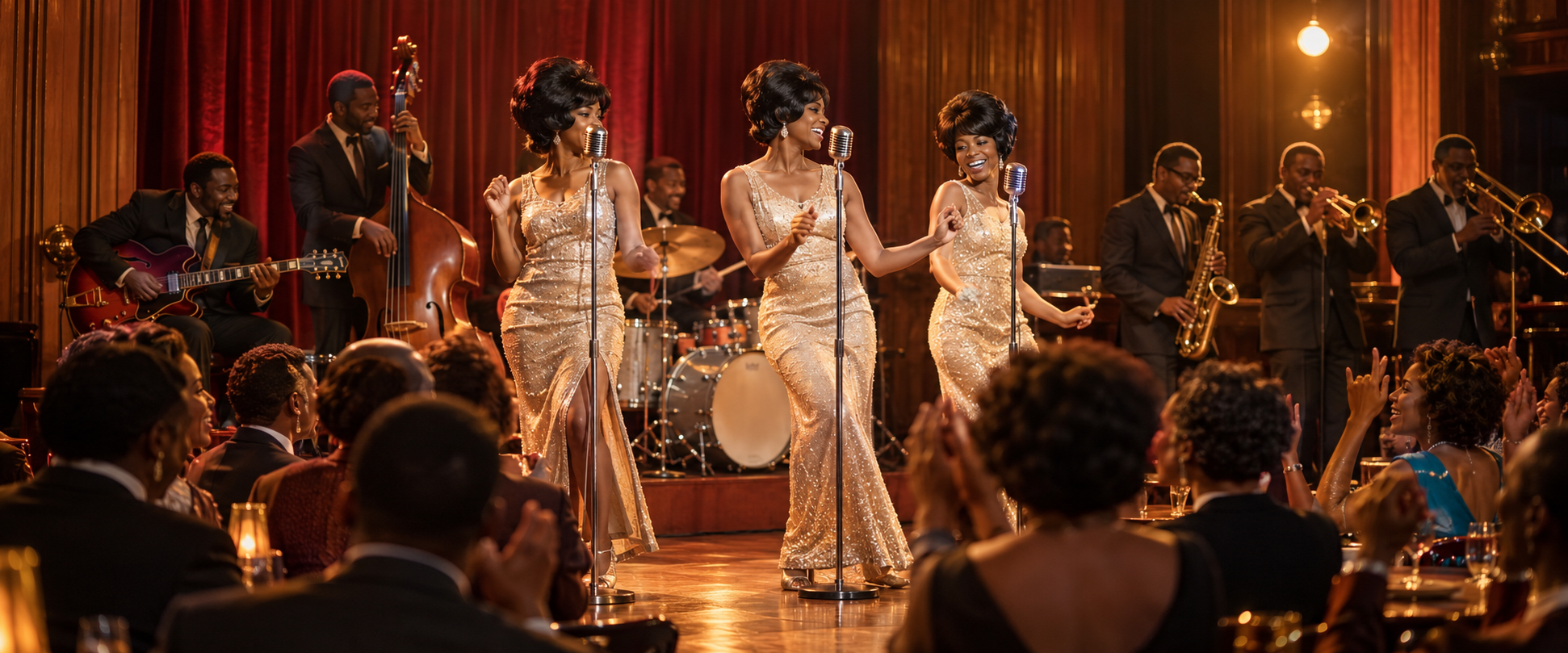
A bass guitar introduces a memorable groove. The drums establish a steady rhythm, while a piano adds bright chords behind the melody.
Then the singer enters.
The lead vocal is expressive and immediate. Behind it, a group of backing singers adds carefully arranged harmonies, responding to individual phrases and giving the chorus additional energy.
The result feels effortless.
Yet every musical element has a purpose.
This combination of memorable songwriting, distinctive rhythms, expressive vocals, and precise arrangements helps explain what makes Motown music so memorable.
Motown is more than a collection of classic songs. It represents an important chapter in American popular music, shaped by the musicians, songwriters, producers, and performers who helped establish one of the most recognizable sounds of the twentieth century.
Founded by Berry Gordy in Detroit in 1959, Motown Records became closely associated with artists such as The Supremes, The Temptations, Marvin Gaye, Stevie Wonder, Smokey Robinson, and The Four Tops.
Its recordings brought together influences from rhythm and blues, gospel, pop, and soul music.
Behind many of these performances stood a remarkable group of studio musicians known as The Funk Brothers, whose rhythmic precision and creative playing helped define the Motown sound.
But what makes these recordings rewarding is not simply their historical importance.
It is the small musical details.
The movement of a bassline.
The placement of a snare drum.
A short guitar phrase between vocal lines.
A piano chord that adds momentum.
The way backing singers respond to the lead vocalist.
These elements work together to create recordings that remain engaging decades after their original release.
In this guide, we'll explore Motown's history, signature sound, influential artists, essential songs, studio musicians, and practical listening techniques.
We'll also create a one-hour listening journey and introduce ways to discover Motown radio on 1LiveRadio.
Whether you're discovering Motown for the first time or returning to familiar classics, listening closely can reveal how much musical craftsmanship exists beneath those unforgettable melodies.
1. What Is Motown Music?
Motown music refers primarily to recordings associated with Motown Records and the musical tradition that developed around the label.
Motown became famous for a distinctive approach to popular music that combined rhythm and blues, soul, gospel influences, and accessible pop songwriting.
The label's most influential early recordings emerged during the 1960s, although Motown continued producing important music in later decades.
Memorable melodies
Many Motown songs feature strong melodic hooks.
Expressive lead vocals
Singers communicate emotion through phrasing, tone, and rhythmic delivery.
Backing harmonies
Vocal groups frequently contribute layered harmonies and responses.
Prominent basslines
Bass guitar often plays an unusually melodic and recognizable role.
Danceable rhythms
Many recordings feature a clear, energetic groove.
Carefully arranged instruments
Drums, guitar, keyboards, percussion, and horns work together without overwhelming the vocals.
Professional production
Motown developed a distinctive approach to songwriting, recording, and artist development.
An important distinction
Motown is both the name of a record label and a musical identity.
Not every Motown release sounds the same, and not every recording described as Motown-style was released by Motown Records.
For historical background, explore Encyclopaedia Britannica's overview of Motown.
2. The Origins of Motown Records
Motown's story begins in Detroit, Michigan.
In 1959, songwriter and entrepreneur Berry Gordy founded Tamla Records, which became part of the Motown organization.
The company developed into one of the most influential independent record businesses in American music.
Why Detroit mattered
Detroit had a rich musical culture, including gospel, jazz, blues, and rhythm and blues.
The city also had an established industrial identity.
Motown developed its own organized approach to recording and artist development within this environment.
Berry Gordy's vision
Gordy wanted to build a successful record company capable of reaching a broad audience.
The label emphasized songwriting, recording quality, artist presentation, and commercial appeal.
Early development
Motown assembled talented performers, songwriters, producers, and studio musicians.
Their collaboration produced a remarkable collection of recordings.
National success
During the 1960s, Motown became an important force in American popular music.
Its songs reached audiences across racial and cultural boundaries during a period of major social change.
An enduring legacy
Motown's influence extended beyond the 1960s.
Its approach to songwriting, production, and performance helped shape later developments in soul, R&B, pop, and dance music.
For more background, read the Motown Museum's profile of Berry Gordy.
3. Hitsville U.S.A.: The Home of the Motown Sound
One of Motown's most recognizable historical locations is Hitsville U.S.A.
The name became associated with Motown's early headquarters and recording facilities in Detroit.
The building at 2648 West Grand Boulevard became an important center of the label's musical activity.
A creative environment
Songwriters, producers, performers, and musicians worked closely together.
Recording sessions
Artists recorded songs that would become internationally recognized.
Studio musicians
The Funk Brothers contributed instrumental performances to numerous recordings.
Songwriting
Composers and producers developed material for different artists.
Artist development
Motown invested in preparing performers for professional careers.
Why Hitsville matters
The location represents more than a recording studio.
It symbolizes a collaborative musical environment in which many people contributed to the development of Motown's distinctive identity.
Today, the site is associated with the Motown Museum.
You can learn more through the official Motown Museum website.
4. What Makes the Motown Sound Distinctive?
The phrase Motown sound describes a recognizable combination of musical and production characteristics.
However, it is important to remember that Motown recordings varied considerably between artists and periods.
Many classic recordings share several important elements.
Strong rhythmic foundations
Bass and drums create a clear groove.
Memorable melodies
Songs often feature accessible melodic phrases.
Vocal harmonies
Backing singers contribute depth and energy.
Carefully arranged instrumentation
Each instrument supports the composition.
Gospel influences
Some performances incorporate vocal intensity and call-and-response techniques associated with gospel traditions.
Pop songwriting
Many songs use concise structures and memorable choruses.
Danceable energy
Rhythmic movement is central to numerous recordings.
Listening tip
Choose a familiar Motown song.
Listen once for the lead vocal.
Then listen again, focusing only on the bass and drums.
You may discover that the rhythm section is more intricate than it first appears.
5. The Funk Brothers: The Musicians Behind the Hits
The Funk Brothers were the studio musicians who performed on many classic Motown recordings.
Their collective contribution was essential to the label's sound.
Although the group's membership changed over time, several musicians became particularly influential.
James Jamerson
Jamerson was a highly influential bassist whose melodic playing helped shape numerous Motown recordings.
Benny Benjamin
Benjamin was an important drummer associated with Motown's early rhythm sections.
Earl Van Dyke
Van Dyke contributed keyboard performances to many sessions.
Robert White
White was a guitarist whose work helped shape classic Motown arrangements.
Eddie Willis
Willis contributed guitar performances to numerous recordings.
Richard “Pistol” Allen
Allen was another important drummer in Motown's studio history.
Why their contribution matters
The Funk Brothers did more than accompany singers.
Their performances gave recordings rhythmic character, instrumental personality, and musical depth.
A song's identity often depends as much on the bassline or drum pattern as on its vocal melody.
For more information, explore Britannica's article about The Funk Brothers.
6. Why Motown Basslines Are So Memorable
The bass guitar is one of the most distinctive elements of many Motown recordings.
Instead of simply repeating the root note of each chord, bassists frequently developed melodic lines that moved through the harmony.
James Jamerson became especially influential for this approach.
Melodic movement
Basslines often include passing notes and distinctive phrases.
Rhythmic variation
The bass may play around the main beat.
Interaction with drums
Bass and percussion work together to create the groove.
Harmonic support
The bass reinforces the chord progression.
Instrumental personality
A recognizable bassline can become one of the song's defining features.
Listening exercise
Play Marvin Gaye's “What's Going On.”
Focus on the bass rather than the vocal.
Notice how the line moves through the arrangement.
Then listen again to the full recording.
Consider how the bass contributes to the song's overall character.
7. Motown Drumming: Rhythm Without Excess
Motown drumming often combines rhythmic clarity with expressive detail.
The drummer establishes a strong foundation while leaving room for vocals and other instruments.
Snare accents
The snare helps define the rhythmic feel.
Kick drum
The kick works closely with the bass.
Hi-hats and cymbals
These instruments contribute movement and texture.
Drum fills
Short fills introduce transitions.
Consistent grooves
Repeated patterns support the song's structure.
Dynamic control
The drummer adjusts intensity to match the arrangement.
Listening tip
Choose a classic Motown recording.
Follow the snare drum through the verse and chorus.
Notice how the groove remains clear even when the arrangement becomes more elaborate.
8. The Role of Guitar and Keyboards
Motown's instrumental arrangements often include carefully placed guitar and keyboard parts.
These elements may be less immediately noticeable than the lead vocal or bassline.
However, they contribute significantly to the recording.
Rhythm guitar
Short guitar patterns reinforce the groove.
Guitar accents
Brief phrases may appear between vocal lines.
Piano chords
Piano parts contribute harmony and rhythmic movement.
Organ textures
Organ sounds appear in some recordings.
Keyboard fills
Short melodic phrases add detail.
Instrumental interaction
Different parts complement one another.
Listening exercise
Choose a recording by The Supremes or The Temptations.
Focus on the guitar and keyboard parts.
Notice how often these instruments contribute without dominating the arrangement.
9. Backing Vocals and Motown Harmonies
Backing vocals are central to many classic Motown recordings.
Vocal groups frequently use harmonies and short responses to support the lead singer.
Call and response
Backing singers may answer phrases from the lead vocalist.
Harmonized choruses
Multiple voices create a fuller sound.
Rhythmic responses
Short vocal phrases reinforce the groove.
Emotional contrast
Backing vocals can add excitement or tenderness.
Repeated hooks
Memorable vocal responses help establish a song's identity.
Arrangement
Backing voices may enter only at important moments.
Listening tip
Play “My Girl” by The Temptations.
Listen to how the vocal arrangement develops around the lead melody.
Then focus on the instrumental backing.
Notice how the different parts support the song without competing for attention.
10. Holland–Dozier–Holland: The Songwriting Team
One of Motown's most influential songwriting and production teams was Holland–Dozier–Holland.
The trio consisted of:
-
Brian Holland.
-
Lamont Dozier.
-
Eddie Holland.
Their work contributed to numerous successful Motown recordings.
Memorable hooks
Their songs frequently featured recognizable melodic phrases.
Strong choruses
Choruses often became the emotional and commercial center of the recording.
Rhythmic arrangements
Instrumental grooves supported the songwriting.
Vocal expression
Songs provided opportunities for expressive performances.
Successful collaborations
The team worked closely with several important Motown artists.
Songs to explore
“You Can't Hurry Love” — The Supremes
“Stop! In the Name of Love” — The Supremes
“Reach Out I'll Be There” — The Four Tops
Listening tip
Compare these three recordings.
Notice how the songwriting balances memorable melodies with rhythmic movement.
11. Smokey Robinson and the Art of Motown Songwriting
Smokey Robinson played a major role in Motown's development as a singer, songwriter, and producer.
His work demonstrates the importance of lyrical expression and melodic detail.
The Miracles
Robinson became widely known as the lead singer of The Miracles.
Songwriting
He contributed numerous influential compositions.
Expressive vocals
His singing style often emphasized subtle emotional phrasing.
Melodic craftsmanship
His songs frequently combine memorable melodies with carefully shaped lyrics.
Essential songs
“The Tracks of My Tears” — The Miracles
“Ooo Baby Baby” — The Miracles
“You've Really Got a Hold on Me” — The Miracles
Listening tip
Focus on how Robinson shapes the ending of each vocal phrase.
Notice how the instrumental arrangement supports the emotional meaning.
12. The Supremes: Motown's Pop Breakthrough
The Supremes became one of Motown's most successful vocal groups.
Their recordings helped bring the label's sound to a broad international audience.
The group's best-known classic lineup featured Diana Ross, Mary Wilson, and Florence Ballard.
Memorable melodies
Many songs feature instantly recognizable hooks.
Vocal harmonies
Backing voices support the lead melody.
Rhythmic arrangements
The instrumental backing maintains a clear groove.
Polished production
Songs balance vocal clarity with instrumental energy.
Essential songs
“Where Did Our Love Go”
“Baby Love”
“Stop! In the Name of Love”
“You Can't Hurry Love”
Listening tip
Compare the vocal arrangements of “Baby Love” and “You Can't Hurry Love.”
Notice how the rhythm section supports the group's harmonies.
For additional background, explore Motown's official artist profile of The Supremes.
13. The Temptations: Vocal Harmony and Performance
The Temptations became one of Motown's most influential vocal groups.
Their recordings demonstrate the importance of ensemble singing and musical arrangement.
Lead vocal changes
Different singers contributed distinct vocal characteristics.
Harmonies
Group vocals create depth and contrast.
Rhythmic precision
The instrumental backing supports the vocal arrangement.
Performance
Choreography and stage presentation became important aspects of the group's identity.
Musical development
The Temptations explored different styles over the course of their career.
Essential songs
“My Girl”
“Ain't Too Proud to Beg”
“I Wish It Would Rain”
“Papa Was a Rollin' Stone”
Listening tip
Compare “My Girl” with “Papa Was a Rollin' Stone.”
Notice how the arrangements reflect different periods and musical approaches.
14. The Four Tops: Powerful Vocals and Emotional Delivery
The Four Tops became closely associated with classic Motown soul.
Their recordings often feature powerful lead singing and expressive group harmonies.
Levi Stubbs
Stubbs was known for his distinctive lead vocal performances.
Vocal intensity
His singing frequently conveys strong emotion.
Backing harmonies
The group supports the lead vocal with carefully arranged parts.
Rhythmic arrangements
Instrumental grooves contribute energy.
Essential songs
“Reach Out I'll Be There”
“I Can't Help Myself (Sugar Pie, Honey Bunch)”
“Bernadette”
Listening tip
Listen to “Reach Out I'll Be There.”
Notice how the arrangement creates urgency through rhythm, instrumentation, and vocal delivery.
15. Marvin Gaye: From Motown Hits to Artistic Exploration
Marvin Gaye was one of Motown's most influential artists.
His recordings demonstrate both the label's classic sound and its later musical development.
Early recordings
Gaye achieved success with numerous Motown songs.
Duets
He recorded influential duets, including performances with Tammi Terrell.
Expressive singing
His vocal style combined emotional detail with rhythmic sophistication.
Artistic development
Later recordings explored more complex themes and arrangements.
Essential songs
“How Sweet It Is (To Be Loved by You)”
“Ain't No Mountain High Enough” — with Tammi Terrell
“I Heard It Through the Grapevine”
“What's Going On”
Listening tip
Compare “I Heard It Through the Grapevine” with “What's Going On.”
Notice differences in arrangement, production, and musical atmosphere.
16. Stevie Wonder: Musical Innovation Within Motown
Stevie Wonder began his recording career with Motown and became one of the most influential musicians in popular music.
His work demonstrates how the label's musical identity expanded over time.
Expressive vocals
Wonder's singing combines melodic clarity with rhythmic flexibility.
Keyboard performance
Piano, organ, and synthesizers play important roles in his recordings.
Songwriting
His compositions frequently feature distinctive melodies and harmonies.
Rhythmic creativity
Many recordings contain sophisticated grooves.
Production development
His later work explored increasingly ambitious arrangements.
Essential songs
“Uptight (Everything's Alright)”
“Signed, Sealed, Delivered I'm Yours”
“Superstition”
“Living for the City”
Listening tip
Compare “Uptight (Everything's Alright)” with “Superstition.”
Notice how Wonder's musical approach developed beyond the classic 1960s Motown sound.
17. Martha and the Vandellas: Rhythm and Energy
Martha and the Vandellas contributed several enduring recordings to Motown's catalog.
Their music often emphasizes strong rhythms and expressive group vocals.
Danceable grooves
Many songs feature energetic instrumental arrangements.
Vocal power
Martha Reeves delivers distinctive lead performances.
Backing harmonies
Group vocals reinforce the melodies.
Memorable hooks
Choruses frequently provide the songs' central appeal.
Essential songs
“Heat Wave”
“Dancing in the Street”
“Nowhere to Run”
Listening tip
Play “Dancing in the Street.”
Focus on the rhythm section and the relationship between the lead and backing vocals.
18. The Jackson 5 and Motown's Next Generation
The Jackson 5 became an important part of Motown's musical development around the turn of the 1970s.
Their recordings introduced a youthful vocal-group sound to the label's catalog.
Energetic performances
Many songs feature lively rhythms.
Group harmonies
Backing vocals support the lead singer.
Memorable melodies
Songs often feature immediately recognizable choruses.
Pop appeal
Their recordings reached broad audiences.
Essential songs
“I Want You Back”
“ABC”
“The Love You Save”
“I'll Be There”
Listening tip
Compare “I Want You Back” with an earlier Supremes recording.
Notice how Motown's songwriting and production approaches developed.
19. Motown vs. Soul Music
Motown and soul music are closely connected, but they are not interchangeable.
Soul music
Soul developed through interactions among gospel, rhythm and blues, and other African American musical traditions.
Motown
Motown was a record label whose catalog included influential soul recordings alongside pop, R&B, and other styles.
Shared characteristics
Both frequently emphasize expressive vocals and rhythmic grooves.
Important differences
Motown's classic recordings are associated with a particular company, production environment, and group of artists.
Soul music developed across many different labels, cities, and regional traditions.
Listening comparison
Compare a classic Motown recording with a Southern soul recording.
Notice differences in instrumental arrangement, production, and vocal presentation.
Related guide
Read Finding your place in Soul radio.
20. Motown vs. Funk
Motown and funk share important rhythmic influences.
However, they emphasize different musical characteristics.
Classic Motown
Many recordings place strong emphasis on melody, vocal arrangements, and concise songwriting.
Funk
Funk frequently emphasizes interlocking rhythmic patterns and groove-centered arrangements.
Shared elements
Both may feature prominent basslines, syncopated rhythms, and expressive performances.
Musical overlap
Some Motown artists incorporated stronger funk influences as their careers developed.
Listening comparison
Compare an early Supremes recording with Stevie Wonder's “Superstition.”
Notice how the balance between melody and rhythmic groove differs.
Related guide
Explore What makes Funk radio worth a listen.
21. Motown and the Evolution of R&B
Motown played an important role in the development of rhythm and blues.
Its recordings helped establish approaches to songwriting, vocal arrangement, and production that influenced later R&B artists.
Vocal harmonies
Motown's group arrangements helped shape later vocal traditions.
Melodic songwriting
Memorable hooks became an important part of popular R&B.
Rhythmic production
Bass and drums contributed distinctive grooves.
Artist development
Motown's organized approach influenced the music industry.
Musical innovation
Artists such as Marvin Gaye and Stevie Wonder explored increasingly ambitious production and songwriting.
Related guide
Explore The small details that make R'n'B memorable.
22. Essential Motown Songs for Beginners
The following recordings provide an introduction to different aspects of Motown's catalog.
They are not intended as a definitive ranking.
Artist Song What to listen for The Supremes “You Can't Hurry Love” Energetic rhythm and vocal harmonies The Temptations “My Girl” Memorable melody and instrumental arrangement Marvin Gaye “I Heard It Through the Grapevine” Rhythmic tension and expressive singing Stevie Wonder “Uptight (Everything's Alright)” Driving rhythm and vocal energy The Four Tops “Reach Out I'll Be There” Dramatic arrangement and powerful lead vocal Martha and the Vandellas “Dancing in the Street” Danceable groove and group vocals The Miracles “The Tracks of My Tears” Emotional phrasing and melodic detail The Jackson 5 “I Want You Back” Bassline, rhythm and youthful vocal energy Marvin Gaye and Tammi Terrell “Ain't No Mountain High Enough” Vocal interaction and melodic songwriting Stevie Wonder “Signed, Sealed, Delivered I'm Yours” Rhythmic phrasing and instrumental energyHow to use this selection
Choose three recordings.
Listen once for the lead vocals.
Then replay them while focusing on the rhythm section.
Notice how different musical elements contribute to each song's identity.
23. How to Listen to Motown More Closely
Motown recordings often sound immediately accessible.
However, close listening can reveal considerable instrumental detail.
First listen: Follow the melody
Identify the main vocal phrase.
Second listen: Focus on the bass
Notice how the bassline moves through the arrangement.
Third listen: Follow the drums
Pay attention to rhythmic accents.
Fourth listen: Hear the backing vocals
Identify harmonies and call-and-response passages.
Fifth listen: Notice guitar and keyboards
Listen for short instrumental phrases.
Sixth listen: Explore the arrangement
Identify when instruments enter or disappear.
Seventh listen: Consider the production
Notice how the different parts fit together.
A useful question
Which musical detail would you miss most if it were removed?
The answer may reveal what makes the recording distinctive.
24. A One-Hour Motown Listening Journey
A structured listening session can introduce several important aspects of Motown.
The following plan takes approximately sixty minutes.
Choose songs or excerpts that fit each time block.
Minutes 0–10: Begin With The Supremes
Suggested songs:
-
“Baby Love.”
-
“You Can't Hurry Love.”
-
“Stop! In the Name of Love.”
Listen for: Memorable melodies and vocal harmonies.
Goal: Recognize classic Motown pop songwriting.
Minutes 10–20: Discover The Temptations
Suggested songs:
-
“My Girl.”
-
“Ain't Too Proud to Beg.”
-
“I Wish It Would Rain.”
Listen for: Group harmonies and expressive lead vocals.
Goal: Understand the importance of vocal arrangements.
Minutes 20–30: Explore Marvin Gaye
Suggested songs:
-
“I Heard It Through the Grapevine.”
-
“Ain't No Mountain High Enough.”
-
“What's Going On.”
Listen for: Vocal expression and rhythmic detail.
Goal: Hear how Motown's sound developed.
Minutes 30–40: Focus on Rhythm
Suggested songs:
-
“Dancing in the Street” — Martha and the Vandellas.
-
“Reach Out I'll Be There” — The Four Tops.
-
“I Want You Back” — The Jackson 5.
Listen for: Basslines, drums, and instrumental interaction.
Goal: Recognize the craftsmanship of Motown's rhythm sections.
Minutes 40–50: Discover Stevie Wonder
Suggested songs:
-
“Uptight (Everything's Alright).”
-
“Signed, Sealed, Delivered I'm Yours.”
-
“Superstition.”
Listen for: Rhythmic creativity and changing production styles.
Goal: Understand Motown's musical evolution.
Minutes 50–60: Explore Motown Radio
Browse the Motown category on 1LiveRadio.
Choose a station that interests you.
Listen to several recordings without selecting individual tracks.
Goal: Discover an unfamiliar Motown song or artist.
Reflect on your listening session
Ask yourself:
-
Which bassline stood out?
-
Which vocal arrangement interested you most?
-
Did you prefer the early or later recordings?
-
Which song had the most memorable groove?
-
Which artist would you like to explore further?
Your answers can guide future listening.
25. How to Choose a Motown Radio Station
Motown radio stations may feature different selections from the label's catalog.
Some emphasize familiar 1960s hits.
Others include later Motown recordings or related soul music.
Classic Motown
Look for programming featuring The Supremes, The Temptations, and The Four Tops.
Motown soul
Some stations may emphasize expressive soul recordings.
Motown and oldies
Other programming may combine Motown with classic pop and oldies.
Broader soul programming
Some stations include Motown alongside recordings from other labels.
Choosing a station
Read the station description.
Listen to several tracks before deciding whether the programming matches your preferences.
Browse Motown radio
Visit the Motown category on 1LiveRadio.
26. Motown Radio Stations on 1LiveRadio
1LiveRadio includes several station listings associated with Motown and related soul music.
24-7 Niche Radio – Motown
Explore 24-7 Niche Radio – Motown.
This station listing is explicitly associated with Motown.
It provides a starting point for discovering classic recordings.
Plexus Radio – Motown Classics
Explore Plexus Radio – Motown Classics.
This listing is associated with classic Motown programming.
Pop and Rock Music Radio Soul
Explore Pop and Rock Music Radio Soul.
This broader soul-related listing provides another option for exploring music connected with Motown's traditions.
Compare station programming
Station names and descriptions provide useful clues.
However, playlists and stream availability may change.
Listen to several recordings to understand each station's current musical focus.
Discover more
Browse the Motown radio category on 1LiveRadio.
27. Motown for Different Listening Preferences
Motown includes recordings suited to different musical interests.
For listeners who enjoy vocal harmonies
Explore The Supremes and The Temptations.
For listeners who enjoy expressive singing
Try Marvin Gaye and Smokey Robinson.
For listeners who enjoy strong rhythms
Explore Martha and the Vandellas and The Jackson 5.
For listeners who enjoy sophisticated songwriting
Listen to Holland–Dozier–Holland compositions.
For listeners who enjoy instrumental detail
Focus on recordings featuring The Funk Brothers.
For listeners who enjoy musical experimentation
Explore Stevie Wonder's and Marvin Gaye's later work.
Why this matters
Motown is not defined by one singer or one musical approach.
Its catalog contains a broad range of recordings.
28. Building Your Own Motown Playlist
A personal playlist can help you explore the label's history.
Begin with an early Motown recording.
Add a Supremes hit.
Choose a Temptations song.
Include a recording by The Four Tops.
Then add a Marvin Gaye performance.
Follow it with a Stevie Wonder recording.
Finish with a Jackson 5 hit.
Suggested playlist
-
The Miracles — “Shop Around.”
-
The Supremes — “Baby Love.”
-
The Temptations — “My Girl.”
-
The Four Tops — “Reach Out I'll Be There.”
-
Martha and the Vandellas — “Dancing in the Street.”
-
Marvin Gaye — “I Heard It Through the Grapevine.”
-
Stevie Wonder — “Signed, Sealed, Delivered I'm Yours.”
-
The Jackson 5 — “I Want You Back.”
What to compare
Notice differences in vocal style, rhythm, arrangement, and production.
This approach can reveal how Motown's sound developed over time.
29. Common Mistakes When Exploring Motown
Several assumptions can limit an appreciation of Motown.
Mistake 1: Treating Motown as one fixed musical style
The label released recordings across several genres.
Mistake 2: Focusing only on famous singers
Studio musicians and songwriters made essential contributions.
Mistake 3: Ignoring the bass
Basslines are central to many classic recordings.
Mistake 4: Overlooking backing vocals
Vocal harmonies frequently shape the chorus.
Mistake 5: Assuming every Motown song sounds alike
Different artists developed distinctive musical identities.
Mistake 6: Confusing Motown with all soul music
Motown represents a particular label and musical tradition.
Mistake 7: Ignoring later recordings
Motown continued developing beyond the 1960s.
Mistake 8: Focusing only on the melody
Rhythm and arrangement are equally important.
Mistake 9: Assuming polished production means simple musicianship
Many recordings feature sophisticated instrumental performances.
Mistake 10: Judging a radio station after one song
Several tracks provide a better understanding of its programming.
A better approach
Listen closely, compare different artists, and pay attention to the musicians behind the lead vocals.
30. Why Motown Radio Is Worth Exploring
Motown radio provides a convenient way to discover recordings from an influential musical catalog.
Familiar classics
Many stations feature recognizable hits.
Artist discovery
Radio can introduce less familiar performers.
Songwriting appreciation
Different recordings demonstrate varied approaches to melody and arrangement.
Instrumental detail
Listening to several songs reveals recurring rhythmic characteristics.
Historical exploration
Radio can introduce music from different periods.
Related genres
Some stations include soul, R&B, funk, and oldies.
Unexpected discoveries
A lesser-known recording may become a new favorite.
Why it matters
Motown's catalog includes far more than its most frequently played songs.
Radio offers a way to explore that variety.
31. Motown's Influence on Popular Music
Motown helped shape later developments in popular music.
Soul
Its recordings became central to the history of soul music.
R&B
Motown's vocal arrangements and songwriting influenced later performers.
Pop
The label demonstrated the commercial appeal of carefully crafted songs.
Funk
Some Motown recordings incorporated increasingly prominent funk influences.
Dance music
Its rhythmic arrangements contributed to the broader development of dance-oriented popular music.
Music production
Motown's organized approach to recording and artist development influenced the music industry.
Vocal groups
Its ensemble arrangements helped establish influential models for later groups.
An enduring legacy
Motown recordings continue to be studied, performed, and enjoyed.
Their influence extends across generations.
32. Explore Motown and Related Music on 1LiveRadio
Motown connects with several musical traditions worth exploring.
Discover Motown radio
Browse the Motown category on 1LiveRadio.
Explore Soul
Read Finding your place in Soul radio.
Discover Funk
Read What makes Funk radio worth a listen.
Explore R'n'B
Read The small details that make R'n'B memorable.
Discover Oldies
Read How to spend an hour with Oldies music.
Learn about Motown history
Explore Encyclopaedia Britannica's Motown overview.
Discover Hitsville U.S.A.
Visit the Motown Museum website.
Learn about The Funk Brothers
Read Britannica's profile of The Funk Brothers.
Discover Berry Gordy
Explore the Songwriters Hall of Fame's Berry Gordy profile.
These resources provide different starting points for understanding Motown's history and musical influence.
Frequently Asked Questions About Motown Music
What is Motown music?
Motown music refers primarily to recordings associated with Motown Records and the distinctive musical tradition that developed around the label.
When was Motown founded?
Berry Gordy founded Tamla Records in 1959, beginning the business that developed into Motown.
Where did Motown originate?
Motown originated in Detroit, Michigan.
Who founded Motown?
Berry Gordy founded the company.
What does Motown mean?
The name is associated with Detroit's nickname, Motor City.
What is the Motown sound?
The Motown sound is commonly associated with memorable melodies, expressive vocals, prominent basslines, danceable rhythms, and carefully arranged instrumentation.
Is Motown the same as soul music?
No. Motown is a record label and musical tradition closely associated with soul, R&B, and pop.
Who were The Funk Brothers?
The Funk Brothers were the studio musicians who performed on many classic Motown recordings.
Who was James Jamerson?
James Jamerson was an influential bassist whose playing helped define numerous Motown recordings.
Who are The Supremes?
The Supremes were a highly successful Motown vocal group.
Who are The Temptations?
The Temptations are an influential vocal group associated with Motown.
Who was Smokey Robinson?
Smokey Robinson is a singer, songwriter, and producer who played an important role in Motown's development.
Was Marvin Gaye a Motown artist?
Yes. Marvin Gaye was one of Motown's most influential performers.
Was Stevie Wonder signed to Motown?
Yes. Stevie Wonder began his recording career with Motown.
Were The Jackson 5 Motown artists?
Yes. The Jackson 5 released several major hits through Motown.
What is Hitsville U.S.A.?
Hitsville U.S.A. is the name associated with Motown's historic Detroit headquarters and recording facilities.
What are some famous Motown songs?
Examples include “My Girl,” “You Can't Hurry Love,” “I Heard It Through the Grapevine,” and “Dancing in the Street.”
Why are Motown basslines famous?
Many recordings feature melodic, rhythmically sophisticated bass performances.
What is Holland–Dozier–Holland?
Holland–Dozier–Holland was an influential Motown songwriting and production team.
Is Motown still influential?
Yes. Its recordings and production approaches continue to influence popular music.
What is Motown radio?
Motown radio refers to stations or programs featuring Motown recordings and sometimes related soul music.
Can I listen to Motown radio online?
Yes. Online radio directories include stations associated with Motown.
Where can I find Motown radio stations?
You can browse the Motown radio category on 1LiveRadio.
Final Thoughts: The Small Details That Make Motown Memorable
Motown's lasting appeal comes from the relationship between memorable songwriting, expressive performances, and carefully arranged instrumentation.
A bassline establishes movement.
The drums create a steady groove.
The guitar adds a rhythmic accent.
The piano reinforces the harmony.
The lead singer introduces a memorable melody.
Then the backing voices enter.
Each element contributes to the recording's identity.
What makes Motown memorable is not simply the familiarity of its greatest hits, but the musical craftsmanship beneath them.
The Funk Brothers provided distinctive instrumental performances.
Songwriters developed memorable melodies and carefully structured compositions.
Producers shaped recordings that balanced rhythm, harmony, and vocal expression.
Performers brought the songs to life.
Together, these contributions created a body of music that remains influential.
For listeners, the best approach is to pay attention to the small details.
Follow the bass.
Listen to the drums.
Notice the guitar and keyboards.
Hear the backing harmonies.
Consider how the arrangement supports the lead vocal.
Some listeners will prefer the melodic charm of The Supremes.
Others may enjoy the vocal sophistication of The Temptations, the emotional expression of Marvin Gaye, or the musical creativity of Stevie Wonder.
There is no single correct starting point.
The beauty of Motown lies in discovering how many individual musical contributions can come together to create a song that feels immediately unforgettable.
To continue exploring, browse the Motown category on 1LiveRadio, discover 24-7 Niche Radio – Motown or Plexus Radio – Motown Classics, and explore related styles through the Soul and Funk listening guides.
Your next favorite Motown recording may be the one that reveals a remarkable bassline, a subtle backing harmony, or an instrumental detail you had never noticed before.
Reader comments
No comments yet. Start the conversation.
Leave a comment
Your email stays private. Comments appear after approval.