
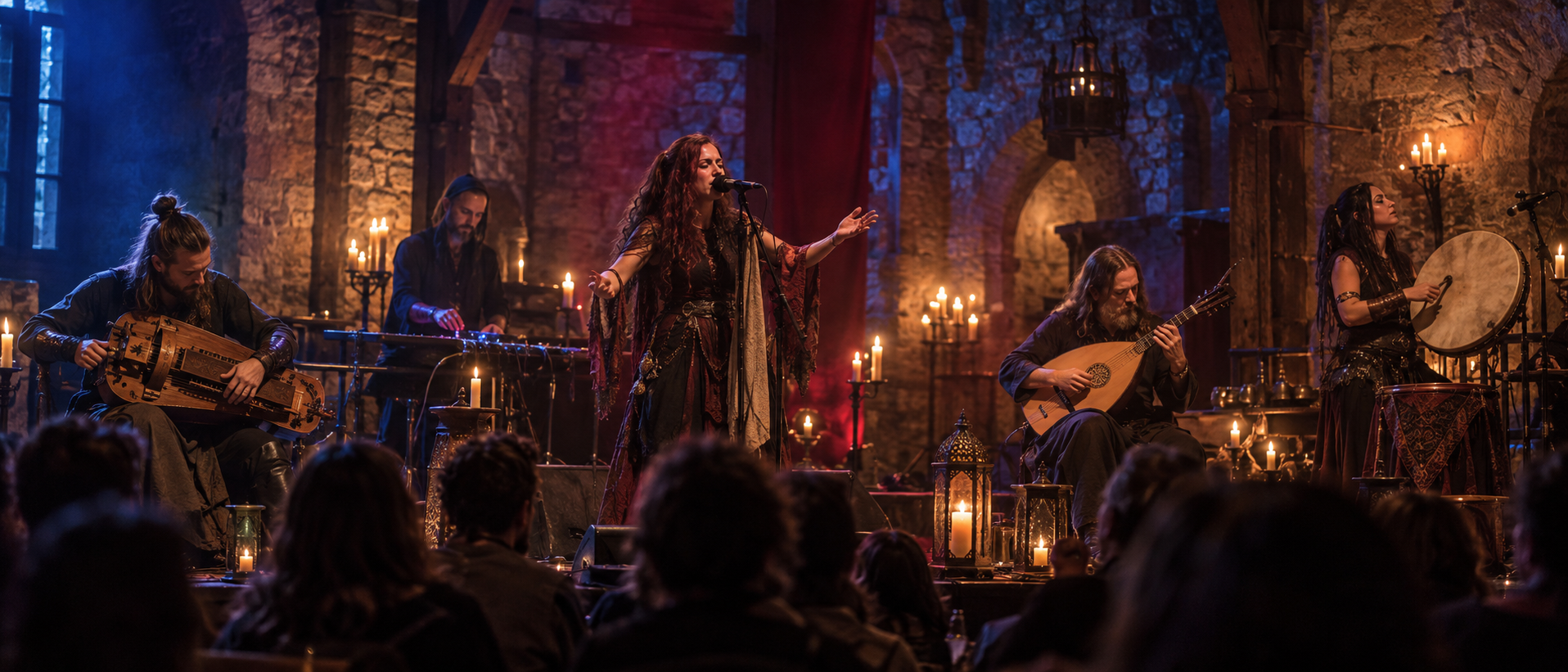
A deep drum begins to pulse. A bagpipe introduces a striking melody, followed by layered voices that seem to echo through an ancient stone hall.
The atmosphere feels medieval.
Yet the recording may have been produced in a modern studio, using contemporary microphones, electronic effects, and instruments that were not necessarily played together during the Middle Ages.
This combination of historical inspiration and modern creativity is central to neo-medieval music.
Neo-medieval music draws on ideas associated with medieval culture, including traditional instruments, modal melodies, historical poetry, folk traditions, and imagined medieval landscapes.
Some performers study surviving musical sources and historical instruments. Others combine medieval-inspired sounds with rock, metal, electronic music, or fantasy themes.
The result is not one narrowly defined musical genre.
Instead, neo-medieval music is a broad modern category covering several approaches to recreating, reinterpreting, or imagining the musical past.
Artists such as Corvus Corax, Qntal, Faun, and Schandmaul demonstrate how differently medieval influences can appear in contemporary music.
Some recordings emphasize acoustic instruments and traditional melodies. Others feature powerful percussion, electric guitars, synthesizers, or dramatic vocals.
For listeners, the appeal often lies in the atmosphere.
A melody may suggest an ancient celebration. A choral arrangement may create a solemn mood. A combination of bagpipes and drums may produce the energy of a historical festival.
However, an important distinction should guide the listening experience:
Music inspired by the Middle Ages is not necessarily an accurate reconstruction of medieval music.
Understanding that difference makes the genre more interesting, not less.
In this guide, we'll explore neo-medieval music's influences, instruments, artists, notable recordings, related styles, and listening techniques.
We'll also create a one-hour listening journey and introduce several radio stations available through 1LiveRadio's Neo-Medieval category.
Whether you're interested in medieval history, atmospheric folk music, fantasy soundtracks, or medieval rock, this guide will help you discover the musical details behind the experience.
1. What Is Neo-Medieval Music?
Neo-medieval music is a modern label for music that draws inspiration from medieval musical traditions, imagery, instruments, or cultural themes.
The term does not describe a single historical style.
Instead, it refers to contemporary interpretations of medieval influences.
These interpretations can range from relatively restrained acoustic performances to elaborate productions incorporating rock and electronic elements.
Common characteristics
Medieval-inspired melodies: Musical phrases may draw on historical material or imitate its perceived characteristics.
Traditional instruments: Performers may use bagpipes, hurdy-gurdies, recorders, drums, or other acoustic instruments.
Modal sounds: Some compositions use melodic approaches associated with historical or folk traditions.
Vocal textures: Solo voices, group singing, and chant-inspired arrangements are common.
Historical themes: Lyrics may reference medieval poetry, mythology, or historical subjects.
Modern production: Contemporary recording techniques can shape the sound.
Atmosphere: Many recordings aim to evoke a particular historical or fantasy setting.
Why the label is broad
A historically informed performance of medieval music and a modern medieval rock song may sound completely different.
Both may interest listeners exploring medieval-related music, but they should not be treated as equivalent historical documents.
2. Medieval Music vs. Neo-Medieval Music
Understanding the distinction between medieval music and neo-medieval music is essential.
Medieval music
Medieval music refers to music associated with the Middle Ages, a long historical period generally spanning approximately the fifth through fifteenth centuries in European history.
Surviving sources include religious compositions, secular songs, and instrumental references.
Neo-medieval music
Neo-medieval music refers to modern interpretations inspired by medieval traditions or imagery.
A recording may incorporate historical melodies, reconstructed instruments, or newly composed material.
Historical reconstruction
Some performers use surviving manuscripts, historical research, and instrument studies to develop interpretations of medieval repertoire.
Creative reinterpretation
Other artists deliberately combine medieval influences with modern musical styles.
Fantasy-inspired music
Some recordings evoke an imagined medieval world without claiming historical authenticity.
Why this distinction matters
A modern recording can be artistically compelling without being historically accurate.
The important question is whether the performer is presenting historical research, a creative adaptation, or an imaginative composition.
For historical context, explore Britannica's overview of musical performance in the Middle Ages.
3. Where Does Neo-Medieval Music Come From?
Neo-medieval music emerged through several modern musical and cultural developments.
It does not have one universally recognized founding date or single creator.
Early music revival
During the twentieth century, growing interest in historical performance encouraged musicians to investigate older repertoire and instruments.
Folk revival
Traditional and folk music movements helped maintain interest in acoustic instruments and regional musical traditions.
Historical festivals
Medieval-themed events created opportunities for musicians to perform music inspired by historical settings.
Medieval rock
Some groups began combining traditional-sounding instruments with modern rock arrangements.
Gothic and darkwave scenes
Other performers incorporated medieval imagery and musical influences into atmospheric electronic and alternative music.
Fantasy culture
Literature, games, films, and historical fantasy helped expand interest in medieval-inspired soundscapes.
A useful perspective
Neo-medieval music is best understood as a meeting point between historical curiosity and contemporary artistic expression.
Different artists approach that relationship in different ways.
4. The Instruments Behind the Neo-Medieval Sound
One of the genre's most recognizable features is its use of instruments associated with older musical traditions.
However, the historical use of each instrument varies.
Some instruments have medieval predecessors, while others appear in modern forms that differ significantly from historical examples.
Bagpipes
Bagpipes create a powerful, sustained sound.
Their drones and melodic pipes can produce an immediately recognizable atmosphere.
Modern medieval-inspired groups frequently use bagpipes for energetic performances.
Hurdy-gurdy
The hurdy-gurdy produces sound through a wheel that rubs against strings.
Its drones and melodic possibilities make it particularly distinctive.
Recorders and flutes
Wind instruments can contribute clear melodic lines and softer textures.
Lute
The lute is associated with historical European musical traditions.
Its plucked strings can create delicate accompaniment.
Harp
Harps contribute resonant tones and arpeggiated patterns.
Drums and percussion
Percussion instruments establish rhythm and energy.
Shawms
The shawm is a historical double-reed instrument known for its penetrating sound.
Vocal ensembles
Voices can create chant-like textures or layered harmonies.
Listening tip
Choose a recording featuring several acoustic instruments.
Try identifying which instrument carries the melody and which instruments provide drones or rhythmic support.
For a closer look at historical instrument research, explore the Early Music Instrument Database's page on the medieval pipe and tabor.
5. Why Bagpipes Are Popular in Neo-Medieval Music
Bagpipes are particularly prominent in some medieval-inspired folk and rock scenes.
Their strong tone makes them effective in both acoustic and amplified performances.
Powerful melodic sound
Bagpipes can carry a melody above loud percussion.
Continuous drones
The sustained background tones create a distinctive musical foundation.
Outdoor performance
Certain bagpipe traditions are well suited to public and festival settings.
Rhythmic energy
Bagpipes can combine effectively with repeated drum patterns.
Historical associations
Different bagpipe traditions have long histories in several European regions.
Important distinction
There is no single universal medieval bagpipe sound.
Modern instruments and performance practices vary considerably.
Listening exercise
Compare an acoustic bagpipe performance with a medieval rock recording.
Notice how amplification, percussion, and production change the instrument's character.
6. The Hurdy-Gurdy: A Distinctive Medieval-Inspired Instrument
The hurdy-gurdy is one of the instruments most closely associated with modern medieval-inspired music.
It produces sound through a rotating wheel that acts somewhat like a continuous bow.
Drone strings
Some strings provide sustained pitches.
Melody strings
The performer uses keys to change the sounding pitches.
Rhythmic possibilities
Certain instruments include a buzzing bridge mechanism that can create rhythmic effects.
Acoustic texture
The combination of melody and drone produces a recognizable sound.
Modern use
Contemporary performers may combine the instrument with percussion, electronics, or amplified arrangements.
Listening tip
Focus on the relationship between the melody and the sustained drone.
Notice how the drone influences the atmosphere even when the melody changes.
7. Medieval-Inspired Melodies and Musical Modes
Many neo-medieval recordings use melodies that sound different from conventional modern pop songwriting.
One reason is the use of modal approaches.
What is a musical mode?
A mode is a way of organizing pitches and melodic relationships.
Historical modal systems differ from the modern major-minor tonal framework.
Why modes matter
Modal melodies can create distinctive musical colors.
Repeated phrases
Some neo-medieval compositions use short recurring melodic ideas.
Drones
A sustained pitch can reinforce the modal character of a melody.
Melodic ornamentation
Decorative notes may add expression.
Historical caution
A melody that sounds modal is not automatically medieval.
Modal music exists in many traditions and historical periods.
Listening exercise
Choose a neo-medieval recording.
Follow the main melody.
Notice whether it repeatedly returns to a particular note.
Then consider how the surrounding instruments support that tonal center.
8. Voices, Chants, and Choral Atmosphere
Vocals play an important role in many neo-medieval recordings.
Some performers draw inspiration from historical vocal traditions, while others create modern theatrical arrangements.
Solo singing
A single voice can communicate intimacy or storytelling.
Group vocals
Several singers may create a communal atmosphere.
Chant-inspired passages
Some recordings use sustained notes or repeated vocal phrases.
Harmonized singing
Modern arrangements may include layered harmonies.
Historical languages
Certain performers use Latin or historical European languages.
Contemporary lyrics
Other artists write modern songs inspired by medieval themes.
Listening tip
Focus on the relationship between the vocals and instruments.
Does the voice lead the melody, or does it function as part of the overall atmosphere?
Important distinction
Modern chant-inspired music should not automatically be classified as authentic Gregorian chant or medieval sacred music.
Historical terminology should be used carefully.
9. Corvus Corax: Medieval-Inspired Performance and Energy
Corvus Corax is a German group strongly associated with medieval-inspired music.
The band is known for energetic performances featuring instruments such as bagpipes and percussion.
Instrumental emphasis
Powerful acoustic instruments are central to much of the group's sound.
Rhythmic energy
Percussion contributes to a strong sense of movement.
Historical inspiration
The group draws on medieval-related themes and musical material.
Theatrical performance
Stage presentation is an important part of its identity.
Modern interpretation
Its music is not simply a neutral reconstruction of medieval performance practices.
Recommended listening
Explore the group's Mille Anni Passi Sunt album.
Listening tip
Focus on how bagpipes and percussion interact.
Notice how repeated rhythmic patterns create intensity.
10. Qntal: Medieval Influences and Electronic Music
Qntal is a German musical project associated with combining medieval musical influences and electronic production.
Its work demonstrates how historical material can be reinterpreted through contemporary sound design.
Historical inspiration
Some recordings draw on medieval texts and musical sources.
Electronic textures
Synthesizers and programmed rhythms contribute to the arrangements.
Atmospheric vocals
The vocal approach often emphasizes mood and texture.
Creative adaptation
Historical elements are presented within modern musical settings.
Distinctive identity
The combination creates a sound that differs from both historical performance and conventional electronic pop.
Recommended listening
Explore Qntal's early album Qntal I.
Listening tip
Try identifying which elements sound acoustic or historically inspired and which are clearly electronic.
11. Faun: Folk Traditions and Medieval Atmosphere
Faun is a German group associated with pagan folk and medieval-inspired music.
Its recordings often combine acoustic instruments, vocals, and contemporary arrangements.
Acoustic textures
Traditional and folk instruments contribute to the sound.
Vocal arrangements
Male and female voices appear across the group's catalog.
Mythological themes
Some songs draw on folklore and mythology.
Rhythmic variety
Recordings range from restrained atmospheric passages to energetic folk arrangements.
Modern production
The group's sound reflects contemporary musical choices.
Recommended listening
Explore Faun's Licht album.
Listening tip
Focus on how the instruments create atmosphere around the vocals.
Notice the balance between acoustic textures and modern arrangement.
12. Schandmaul: Medieval Folk Meets Rock
Schandmaul is a German group associated with medieval folk rock.
Its music combines folk-oriented instrumentation with modern rock elements.
Melodic songwriting
Songs frequently emphasize memorable melodies.
Rock instrumentation
Guitars, bass, and drums contribute energy.
Folk instruments
Traditional-sounding instruments add distinctive colors.
Storytelling
Lyrics often explore narrative or imaginative themes.
Musical contrast
Acoustic passages may alternate with fuller rock arrangements.
Recommended listening
Explore the album Wahre Helden.
Listening tip
Notice how folk instruments interact with electric guitars.
Consider whether the arrangement emphasizes historical atmosphere, contemporary rock energy, or both.
13. Neo-Medieval Music vs. Medieval Rock
Neo-medieval music and medieval rock overlap, but they are not identical.
Neo-medieval music
A broad category describing modern music inspired by medieval themes or musical traditions.
Medieval rock
A more specific style combining medieval-inspired elements with rock instrumentation.
Shared characteristics
Both may feature bagpipes, folk melodies, and historical imagery.
Important differences
Neo-medieval recordings do not necessarily use electric guitars or rock rhythms.
Examples
Corvus Corax is strongly associated with medieval-inspired acoustic performance.
Schandmaul is associated with medieval folk rock.
Listening comparison
Choose one recording by each group.
Notice the differences in instrumentation, rhythm, and production.
14. Neo-Medieval Music vs. Medieval Metal
Medieval metal combines elements of heavy metal with medieval-inspired sounds or themes.
It may feature electric guitars, powerful drums, and traditional instruments.
Heavy guitar arrangements
Distorted guitars contribute intensity.
Traditional instruments
Bagpipes, flutes, or other folk instruments may appear.
Historical themes
Lyrics may reference medieval history or fantasy.
Strong percussion
Modern metal drumming creates rhythmic weight.
Musical overlap
Some artists move between medieval rock, folk metal, and related styles.
Important distinction
Not every band using medieval imagery plays medieval metal.
Musical classification depends on the actual sound, not only the lyrics or artwork.
Related reading
Explore What makes Metal radio worth a listen.
15. Neo-Medieval Music and Gothic Atmosphere
Some neo-medieval recordings share characteristics with gothic and darkwave music.
These connections are especially noticeable in atmospheric electronic arrangements.
Dark textures
Low drones and sustained sounds may create a mysterious mood.
Historical imagery
Some artists reference medieval architecture, poetry, or symbolism.
Electronic production
Synthesizers and effects can shape the atmosphere.
Expressive vocals
Singing may emphasize theatrical or introspective moods.
Important distinction
Gothic music and neo-medieval music are not interchangeable categories.
A recording can share characteristics with both without fitting entirely into either.
Related reading
Explore A Relaxed Listener's Guide to Gothic Music.
16. Neo-Medieval Music and Traditional Folk
Neo-medieval music frequently overlaps with folk-oriented musical traditions.
However, the relationship requires careful interpretation.
Traditional folk music
Folk traditions develop within particular communities and cultural contexts.
Neo-medieval music
Modern artists may borrow instruments, melodies, or stylistic ideas associated with older traditions.
Shared characteristics
Both may emphasize acoustic instruments and storytelling.
Important differences
A modern medieval-inspired composition is not necessarily a traditional folk song.
Cultural context
Instruments and melodies should not automatically be assigned to a single historical period or culture.
Listening tip
Compare a traditional folk recording with a neo-medieval interpretation.
Notice which musical elements are preserved and which are transformed.
Related reading
Explore The Small Details That Make Folk Music Memorable.
17. Neo-Medieval Music and Fantasy Soundtracks
Fantasy films, games, and television productions have helped popularize musical sounds associated with imagined medieval worlds.
These soundtracks may incorporate instruments and textures that listeners associate with historical settings.
Acoustic instruments
Flutes, harps, and plucked strings can contribute to a traditional atmosphere.
Drones
Sustained tones may create a sense of mystery.
Percussion
Drums can suggest travel, conflict, or celebration.
Choral textures
Layered voices can create grandeur.
Modern orchestration
Film composers often combine historical inspiration with contemporary orchestral techniques.
Important distinction
A fantasy soundtrack is not automatically an example of historical medieval music.
Its purpose is usually to support a fictional world.
Listening tip
Choose a fantasy soundtrack with medieval-inspired instrumentation.
Compare it with a historically informed performance of medieval repertoire.
Notice how the two recordings use similar musical associations for different purposes.
18. Historical Authenticity: What Can We Really Know?
One of the most interesting questions surrounding medieval-inspired music concerns historical accuracy.
Some medieval musical sources survive in written form.
However, those sources do not always provide complete information about performance.
Surviving manuscripts
Written sources preserve important musical material.
Instrument evidence
Historical instruments and visual representations provide clues.
Performance interpretation
Musicians must sometimes make informed decisions about tempo, instrumentation, and ornamentation.
Regional differences
Medieval Europe contained many musical traditions.
Historical change
Music evolved significantly over the centuries.
Modern reconstruction
Historically informed performers use research to develop plausible interpretations.
Creative freedom
Neo-medieval artists may prioritize atmosphere rather than historical accuracy.
A useful question
Is this recording presenting a researched interpretation of historical music, or a modern composition inspired by the past?
Both approaches can be valuable.
They simply answer different artistic questions.
For a perspective on medieval recordings and historical interpretation, read The Metropolitan Museum of Art's article, “The Middle Ages, Now in High Fidelity”.
19. Essential Neo-Medieval Artists to Explore
The following artists provide different starting points for exploring medieval-inspired music.
Artist Musical approach What to listen for Corvus Corax Medieval-inspired acoustic performance Bagpipes, percussion and rhythmic energy Qntal Medieval influences and electronic music Historical inspiration and electronic textures Faun Pagan folk and medieval-inspired music Acoustic instruments and atmospheric vocals Schandmaul Medieval folk rock Folk instruments and rock arrangements In Extremo Medieval rock and metal influences Traditional instruments with heavy guitars Saltatio Mortis Medieval-inspired rock Energetic rhythms and modern rock production Estampie Medieval-inspired and early-music-oriented performance Acoustic textures and historical influencesHow to use this selection
Choose three artists with contrasting styles.
Listen to one recording by each.
Compare the instrumentation, vocal approach, rhythm, and production.
This reveals the diversity within modern medieval-inspired music.
20. How to Listen to Neo-Medieval Music More Closely
Neo-medieval music rewards attention to instrumentation, atmosphere, and musical context.
First listen: Identify the atmosphere
What kind of setting does the recording suggest?
Second listen: Follow the melody
Notice whether the melody repeats or develops.
Third listen: Identify the instruments
Try distinguishing acoustic instruments from electronic sounds.
Fourth listen: Focus on percussion
Notice how the rhythm shapes the energy.
Fifth listen: Hear the vocals
Pay attention to language, harmony, and delivery.
Sixth listen: Consider the production
Notice effects, amplification, and modern studio techniques.
Seventh listen: Think about historical inspiration
Ask whether the recording appears to be a reconstruction or a creative reinterpretation.
A useful question
Which musical elements create the impression of a medieval setting?
The answer may involve instrumentation, melody, rhythm, vocals, or production.
21. A One-Hour Neo-Medieval Listening Journey
A structured listening session can introduce several approaches to medieval-inspired music.
The following plan takes approximately sixty minutes.
Choose recordings or excerpts that fit each time block.
Minutes 0–10: Begin With Historical Medieval Music
Suggested approach: Listen to a historically informed performance of medieval repertoire.
Listen for: Melodic structure, instrumentation, and vocal style.
Goal: Establish a reference point for historical music.
Minutes 10–20: Explore Corvus Corax
Suggested recording: Selections from Mille Anni Passi Sunt.
Listen for: Bagpipes and energetic percussion.
Goal: Discover medieval-inspired performance with strong rhythmic energy.
Minutes 20–30: Discover Faun
Suggested recording: Selections from Licht.
Listen for: Acoustic textures and atmospheric vocals.
Goal: Explore the relationship between folk influences and medieval imagery.
Minutes 30–40: Explore Qntal
Suggested recording: Selections from Qntal I.
Listen for: Electronic production and medieval-inspired musical material.
Goal: Understand how historical influences can be transformed through modern technology.
Minutes 40–50: Discover Schandmaul
Suggested recording: Selections from Wahre Helden.
Listen for: Rock instrumentation and folk-oriented melodies.
Goal: Recognize the characteristics of medieval folk rock.
Minutes 50–60: Explore Neo-Medieval Radio
Browse the Neo-Medieval category on 1LiveRadio.
Choose a station that interests you.
Listen to several tracks without selecting each recording individually.
Goal: Discover an unfamiliar artist or musical approach.
Reflect on your listening session
Ask yourself:
-
Which instruments interested you most?
-
Did you prefer acoustic or electronic arrangements?
-
Which recording created the strongest atmosphere?
-
Did you enjoy medieval rock or more restrained performances?
-
Which artist would you like to explore further?
Your answers can guide future listening.
22. How to Choose a Neo-Medieval Radio Station
Neo-medieval radio programming can vary considerably.
Some stations emphasize medieval rock.
Others focus on historical music, folk traditions, or fantasy-inspired recordings.
Medieval rock
Look for stations featuring medieval-inspired instruments alongside rock arrangements.
Medieval folk
Choose programming emphasizing acoustic instruments and folk influences.
Historical medieval music
Look for stations featuring early music and historically informed performances.
Fantasy music
Some stations emphasize atmospheric recordings associated with imagined medieval settings.
Mixed programming
Broader stations may combine several of these styles.
Choosing a station
Read the station description before listening.
The word medieval does not guarantee historically authentic repertoire.
Start with the Neo-Medieval category on 1LiveRadio.
23. Neo-Medieval Radio Stations on 1LiveRadio
1LiveRadio includes several station listings associated with medieval-inspired music and related styles.
RADIO BOB! BOBs Mittelalter Rock
Explore RADIO BOB! BOBs Mittelalter Rock.
This listing is associated with medieval rock.
It provides a starting point for listeners interested in modern rock arrangements with medieval-inspired influences.
Medieval Fantasy
This listing is associated with medieval and fantasy-oriented music.
Radio Rabenwind
This station offers another listing worth exploring for listeners interested in medieval-inspired programming.
Ancient FM
Ancient FM provides a useful starting point for exploring early-music-oriented programming.
Its focus should be distinguished from modern medieval rock.
Dudelsack
The station name refers to the German word for bagpipes.
Check its current programming for the specific musical styles it features.
Radio Aena
This listing provides another option for exploring music associated with medieval-inspired scenes.
Compare station programming
Station names and descriptions provide useful clues.
However, playlists and stream availability may change.
Listen to several tracks before deciding which station matches your preferences.
Discover more
Browse the Neo-Medieval radio category on 1LiveRadio.
24. Neo-Medieval Music for Different Listening Preferences
Neo-medieval music includes several approaches suited to different interests.
For listeners who enjoy historical music
Explore historically informed medieval performances.
For listeners who enjoy acoustic folk
Try Faun and related folk-oriented artists.
For listeners who enjoy powerful percussion
Explore Corvus Corax.
For listeners who enjoy electronic music
Discover Qntal.
For listeners who enjoy rock
Explore Schandmaul and related medieval rock groups.
For listeners who enjoy heavy music
Try artists combining medieval influences with metal.
For listeners who enjoy fantasy atmospheres
Explore medieval-inspired soundtracks and atmospheric compositions.
Why this matters
Neo-medieval music is a broad category.
The best starting point depends on whether you prefer historical interpretation, acoustic textures, modern production, or energetic arrangements.
25. Building Your Own Neo-Medieval Playlist
A personal playlist can help you compare different musical approaches.
Begin with a historically informed medieval performance.
Add a recording featuring bagpipes and percussion.
Choose an acoustic folk-oriented track.
Include a medieval-inspired electronic composition.
Then add a medieval rock recording.
Finish with an atmospheric piece.
Suggested playlist structure
Track 1: A historically informed medieval recording.
Track 2: Corvus Corax — energetic medieval-inspired performance.
Track 3: Faun — acoustic folk atmosphere.
Track 4: Qntal — medieval influences and electronic production.
Track 5: Schandmaul — medieval folk rock.
Track 6: An atmospheric medieval-inspired recording of your choice.
What to compare
Notice differences in instrumentation, rhythm, vocal delivery, and production.
Consider which recordings aim to interpret historical music and which emphasize modern creativity.
26. Common Mistakes When Exploring Neo-Medieval Music
Several assumptions can make the genre harder to understand.
Mistake 1: Assuming every recording is historically accurate
Many artists prioritize atmosphere and creative interpretation.
Mistake 2: Treating medieval music as one fixed style
Medieval musical traditions varied across centuries and regions.
Mistake 3: Assuming bagpipes automatically indicate medieval authenticity
Bagpipe traditions have different histories, and modern instruments may differ from historical examples.
Mistake 4: Confusing medieval rock with historical performance
Medieval rock combines modern instrumentation with historical inspiration.
Mistake 5: Ignoring electronic production
Some neo-medieval artists deliberately incorporate contemporary technology.
Mistake 6: Assuming every medieval-inspired song uses historical lyrics
Many performers write modern material.
Mistake 7: Treating fantasy music as historical evidence
Fantasy soundtracks are usually designed to support fictional settings.
Mistake 8: Ignoring regional differences
Historical musical practices varied considerably.
Mistake 9: Assuming all folk music is medieval
Folk traditions developed across many historical periods.
Mistake 10: Judging a radio station by its name alone
Station descriptions and actual programming provide better information.
A better approach
Enjoy the atmosphere while remaining curious about the historical sources and modern artistic choices.
27. Why Neo-Medieval Radio Is Worth Exploring
Neo-medieval radio offers a convenient way to discover music inspired by historical traditions and imaginative settings.
Artist discovery
Radio can introduce unfamiliar performers.
Instrument exploration
Different recordings feature distinctive acoustic instruments.
Musical variety
Programming may include folk, rock, metal, electronic, and historical music.
Atmospheric listening
Many recordings create strong musical environments.
Cultural curiosity
Some songs encourage further exploration of historical subjects.
Musical comparison
Listeners can compare acoustic and modern arrangements.
Unexpected discoveries
A recording may introduce an instrument or musical approach you have never heard before.
Why it matters
Neo-medieval music includes more variety than its name initially suggests.
Radio provides a way to explore that diversity.
28. Explore Neo-Medieval and Related Music on 1LiveRadio
Neo-medieval music connects with several musical traditions worth exploring.
Discover Neo-Medieval radio
Browse the Neo-Medieval category on 1LiveRadio.
Explore Folk Music
Read The Small Details That Make Folk Music Memorable.
Discover Gothic Music
Read A Relaxed Listener's Guide to Gothic Music.
Explore Metal
Read What makes Metal radio worth a listen.
Discover Classical Music
Explore Classical Music Radio: Composers & Masterpieces.
Learn about medieval musical performance
Read Britannica's overview of music in the Middle Ages.
Explore historical recordings
Discover The Metropolitan Museum of Art's article on medieval music recordings.
Learn about historical instruments
Visit the Early Music Instrument Database.
These resources provide different perspectives on historical music and modern medieval-inspired interpretations.
Frequently Asked Questions About Neo-Medieval Music
What is neo-medieval music?
Neo-medieval music is a modern category describing music inspired by medieval musical traditions, instruments, themes, or imagery.
Is neo-medieval music historically accurate?
Not necessarily. Some recordings draw on historical research, while others prioritize modern creative interpretation.
What is the difference between medieval and neo-medieval music?
Medieval music refers to historical music from the Middle Ages. Neo-medieval music refers to modern interpretations inspired by medieval traditions or imagery.
When did neo-medieval music develop?
It developed through several modern musical movements, including early music revival, folk revival, and medieval-inspired rock scenes.
What instruments are used in neo-medieval music?
Common examples include bagpipes, hurdy-gurdies, flutes, lutes, harps, drums, and various modern instruments.
Are bagpipes medieval instruments?
Bagpipes have long histories in several regions, but their forms and traditions have changed over time.
What is a hurdy-gurdy?
A hurdy-gurdy is a string instrument that produces sound through a rotating wheel.
What are musical modes?
Modes are systems of organizing pitches and melodic relationships.
Does neo-medieval music use historical languages?
Some performers use historical languages or texts, while others use contemporary lyrics.
Is neo-medieval music the same as folk music?
No. The styles can overlap, but neo-medieval music specifically emphasizes medieval-related inspiration.
What is medieval rock?
Medieval rock combines medieval-inspired musical elements with modern rock instrumentation.
What is medieval metal?
Medieval metal combines heavy metal with medieval-inspired sounds or themes.
Who are Corvus Corax?
Corvus Corax is a German group associated with medieval-inspired music featuring powerful acoustic instruments and percussion.
Who are Qntal?
Qntal is a German project combining medieval influences with electronic music.
Who are Faun?
Faun is a German group associated with pagan folk and medieval-inspired music.
Who are Schandmaul?
Schandmaul is a German band associated with medieval folk rock.
Is neo-medieval music related to gothic music?
Some recordings share atmospheric and stylistic characteristics with gothic and darkwave music.
Is fantasy music the same as medieval music?
No. Fantasy music may use medieval-inspired sounds without representing historical musical practices.
Can neo-medieval music include electronic instruments?
Yes. Some artists deliberately combine medieval influences with modern electronic production.
Is neo-medieval music suitable for relaxation?
Some recordings are atmospheric and restrained, while others are energetic or intense.
What is neo-medieval radio?
Neo-medieval radio refers to stations or programs featuring medieval-inspired music and related styles.
Can I listen to neo-medieval radio online?
Yes. Online radio directories include stations associated with medieval-inspired music.
Where can I find neo-medieval radio stations?
Browse the Neo-Medieval radio category on 1LiveRadio.
Final Thoughts: Discover the Atmosphere of Neo-Medieval Music
Neo-medieval music offers a distinctive relationship between history and imagination.
A bagpipe melody may suggest an ancient celebration.
A hurdy-gurdy drone may create a mysterious atmosphere.
A group of singers may evoke a ceremonial setting.
Powerful percussion can transform a traditional-sounding melody into an energetic performance.
Electronic production may place medieval-inspired material within an entirely modern soundscape.
Each approach offers a different listening experience.
What makes neo-medieval music memorable is the way it transforms historical inspiration into contemporary musical expression.
Some performers emphasize research and historical interpretation.
Others prioritize storytelling, atmosphere, and creative experimentation.
Neither approach needs to replace the other.
For listeners, the most rewarding experience comes from understanding the difference.
Listen to the instruments.
Follow the melody.
Notice the rhythm.
Pay attention to the vocals.
Consider the production.
Ask which elements are historically inspired and which reflect modern artistic choices.
Some listeners will prefer the powerful percussion of Corvus Corax.
Others may enjoy the acoustic textures of Faun, the electronic experimentation of Qntal, or the folk-rock energy of Schandmaul.
There is no single correct starting point.
The appeal of neo-medieval music lies in discovering how modern musicians use the sounds and ideas of the past to create something new.
To continue exploring, browse the Neo-Medieval category on 1LiveRadio, discover RADIO BOB! BOBs Mittelalter Rock or Medieval Fantasy, and explore related traditions through the Folk and Gothic listening guides.
Your next favorite neo-medieval recording may be the one that introduces an unfamiliar instrument, a compelling melody, or an entirely new interpretation of the musical past.
Reader comments
No comments yet. Start the conversation.
Leave a comment
Your email stays private. Comments appear after approval.