
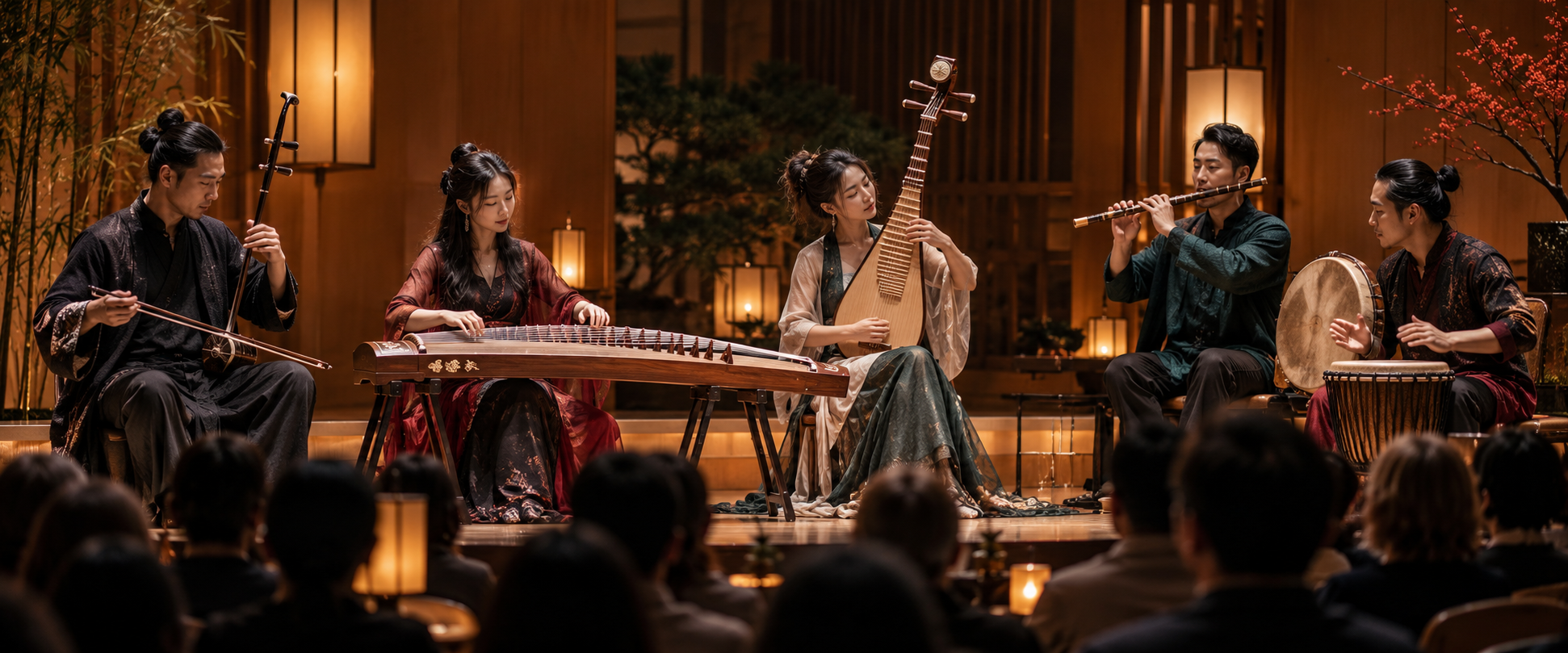
A plucked string instrument introduces a delicate melody. A singer follows with an expressive vocal phrase, while percussion establishes a rhythmic pattern that may be unfamiliar to some listeners.
The recording might come from an Arabic musical tradition, a Turkish ensemble, a Persian classical performance, or somewhere entirely different.
Yet on certain radio platforms, these recordings may appear under the same label: Oriental music.
That label requires some explanation.
“Oriental” is a broad, historically used term rather than the name of one clearly defined musical genre. Its meaning changes depending on the broadcaster, country, and context. In contemporary English, it can also sound dated or imprecise when applied broadly to cultures.
Music grouped under this category may represent distinct languages, histories, instruments, and performance traditions.
An Arabic oud performance is not automatically the same musical tradition as a Turkish makam composition or a Persian classical recording.
The differences matter.
Understanding them makes listening more rewarding and helps listeners discover the artists and musical traditions that genuinely interest them.
In this guide, we'll explain what the Oriental label can mean in radio programming, introduce several traditions that may appear beneath it, and explore instruments, rhythms, melodic structures, and practical listening techniques.
You'll also find a one-hour listening journey and suggestions for discovering more specific radio categories.
To begin exploring, visit the Oriental category on 1LiveRadio.
1. What Does Oriental Music Mean?
In radio directories, Oriental music is sometimes used as a broad category for recordings associated with parts of the Middle East, North Africa, or Asia.
However, the label does not consistently identify a particular region, language, or musical style.
Its meaning can vary significantly between stations.
One broadcaster might use it primarily for Arabic popular music.
Another might include Turkish recordings.
A different station might group together music from several unrelated traditions.
Why the term is imprecise
The word does not tell listeners:
-
Which country a recording comes from.
-
What language the performer uses.
-
Whether the music is traditional or contemporary.
-
Which instruments are being played.
-
What melodic system or rhythmic structure is involved.
-
Whether the recording belongs to a specific regional tradition.
A better approach
Treat the category as a starting point rather than a complete description.
When a recording interests you, identify its artist, language, origin, and musical style.
More precise terms such as Arabic music, Turkish classical music, Persian classical music, or Iraqi maqam are generally more informative.
2. Why Musical Traditions Should Not Be Grouped Together Carelessly
Music is shaped by history, geography, language, social practices, and artistic exchange.
Different traditions may share instruments or musical ideas without being identical.
For example, related modal concepts appear in several Middle Eastern musical systems.
However, Arabic maqam, Turkish makam, and Persian dastgah have distinct theoretical and performance traditions.
Shared influences
Trade, migration, historical empires, and cultural exchange have connected musicians across regions for centuries.
Important differences
Related traditions may differ in:
-
Melodic organization.
-
Rhythmic patterns.
-
Instrumental techniques.
-
Vocal styles.
-
Improvisational practices.
-
Repertoire.
-
Performance settings.
Why precision improves listening
Accurate descriptions make it easier to understand what makes a performance distinctive.
Rather than assuming that every plucked-string melody belongs to one genre, you can learn to recognize different instruments and musical approaches.
The purpose is not to create rigid boundaries between cultures.
It is to appreciate both their connections and their differences.
3. Arabic Music: A Diverse Musical Landscape
Arabic music includes many traditions across North Africa and the Middle East.
It is not a single uniform sound.
Classical, regional, religious, folk, and contemporary popular styles have developed in different communities and historical contexts.
Arabic classical traditions
Some classical traditions emphasize elaborate melodic development, expressive singing, and improvisation.
Regional popular music
Contemporary Arabic popular music incorporates many influences, including electronic production and international pop styles.
North African traditions
Music from Morocco, Algeria, Tunisia, and neighboring countries includes numerous distinctive regional styles.
Levantine traditions
Musical practices associated with countries such as Lebanon, Syria, Palestine, and Jordan include different vocal and instrumental traditions.
Egyptian popular music
Egypt has played an important role in the development and circulation of Arabic popular music.
Iraqi musical traditions
Iraq has rich musical traditions, including the historically significant Iraqi maqam repertoire.
What to listen for
Pay attention to the singer's ornamentation, the instruments, and the rhythmic accompaniment.
To explore more specific programming, visit the Arabic radio category on 1LiveRadio.
You can also read our Arabic Music Listening Guide.
4. Turkish Music: Classical, Folk, and Contemporary Styles
Turkish music includes several distinct traditions.
These range from Ottoman-derived classical repertoire to regional folk music and contemporary popular styles.
Turkish classical music
Classical traditions use a sophisticated melodic system commonly called makam.
Makam involves more than a scale. It includes characteristic melodic movement and performance conventions.
Turkish folk music
Regional folk traditions include different instruments, rhythms, and singing styles.
Contemporary Turkish pop
Modern Turkish popular music incorporates electronic production, international pop influences, and local musical elements.
Arabesk
Arabesk is a Turkish popular music style associated with particular vocal expressions, emotional themes, and historical cultural influences.
It should not be treated as identical to Arabic classical music.
Listening examples on 1LiveRadio
Joy Turk is a Turkish-language station listing.
Arabesk FM provides another starting point for exploring Turkish popular music.
Station schedules and current playlists may vary.
5. Persian Music: Understanding a Distinct Tradition
Persian classical music, associated especially with Iran, has its own historical repertoire and performance practices.
One of its central organizing concepts is the dastgah system.
What is dastgah?
Dastgah refers to a framework for melodic organization and performance.
It is associated with a body of traditional melodic material and characteristic approaches to musical development.
Important instruments
Persian musical traditions may feature instruments such as:
-
Tar.
-
Setar.
-
Santur.
-
Kamancheh.
-
Ney.
-
Tombak.
Vocal performance
Persian classical singing can include elaborate ornamentation and expressive melodic development.
Improvisation
Improvisation plays an important role in some performance traditions.
A useful distinction
Persian dastgah should not be described as simply another name for Arabic maqam.
The systems have historical connections but are not interchangeable.
Listening tip
Compare a Persian instrumental performance with an Arabic oud recording.
Listen for differences in melodic phrasing, instrumental timbre, and rhythmic development.
6. Understanding Maqam and Melodic Expression
One of the most interesting features of several Middle Eastern musical traditions is their approach to melodic organization.
In Arabic music, the term maqam refers to a system of melodic modes and associated musical practices.
A maqam is more than a collection of notes.
It also involves characteristic melodic behavior and ways of developing musical phrases.
What does maqam influence?
Maqam can shape:
-
Melodic movement.
-
Phrase development.
-
Musical emphasis.
-
Ornamentation.
-
Improvisational choices.
Are all maqamat identical?
No.
Different maqamat have distinctive characteristics.
Is maqam used everywhere in the same way?
No.
Related modal systems exist in several traditions, but their terminology and performance practices differ.
Do beginners need to study music theory?
Not necessarily.
You can begin by listening to how melodies develop.
Notice whether a performer returns to particular notes or gradually moves through contrasting melodic phrases.
For more detail, explore Britannica's explanation of maqam.
Another useful educational resource is MaqamWorld's introduction to Arabic maqam.
7. The Oud: A Recognizable Plucked-String Instrument
The oud is an important instrument in several Middle Eastern and North African musical traditions.
It is a short-necked, fretless lute with a rounded body.
Its distinctive sound makes it recognizable in many instrumental and vocal arrangements.
What does an oud sound like?
The oud produces a warm, resonant plucked-string tone.
Its sound can be delicate or rhythmically energetic.
How is it played?
Players typically use a plectrum to pluck the strings.
Why does the fretless neck matter?
The absence of frets allows performers to shape pitches and melodic ornaments with considerable flexibility.
Is the oud exclusive to one culture?
No.
The instrument appears in multiple musical traditions.
Its presence alone does not establish the origin of a recording.
Listening exercise
Choose a solo oud performance.
Focus on the movement between notes.
Notice how the performer shapes phrases through timing, ornamentation, and changes in intensity.
8. Other Instruments You May Hear
Different recordings grouped under the Oriental category may feature a wide variety of instruments.
Instrument General description Musical context Oud Fretless plucked lute Several Arabic and neighboring traditions Qanun Plucked zither Arabic, Turkish, and related traditions Ney End-blown flute Several Middle Eastern musical traditions Darbuka Goblet-shaped hand drum Various regional traditions Riq Small frame drum with jingles Arabic musical ensembles Tar Long-necked plucked instrument Persian and neighboring traditions Santur Hammered dulcimer Persian and other regional traditions Kamancheh Bowed string instrument Persian and neighboring traditions Bağlama Long-necked lute family Turkish folk traditionsThese associations are illustrative, not exclusive.
Instruments travel across cultures, and their names, construction, and playing techniques can vary.
Listening tip
Try identifying the instrument carrying the melody.
Then listen for the instrument establishing the rhythm.
This simple distinction can make unfamiliar arrangements easier to understand.
9. Rhythm and Percussion
Rhythm is another important feature of many traditions that may appear in this radio category.
However, no single rhythmic pattern defines all the music grouped under the label.
Repeating rhythmic cycles
Some traditions use established rhythmic patterns that repeat throughout a composition.
Free-rhythm passages
Certain vocal or instrumental performances may begin without a regular measured pulse.
Percussion instruments
Hand drums and frame drums can provide rhythmic structure and expressive accents.
Contemporary production
Modern popular recordings may combine traditional percussion with drum machines and electronic beats.
What to listen for
Ask yourself:
-
Is there a steady pulse?
-
Does the percussion repeat a recognizable pattern?
-
Are some beats emphasized more strongly?
-
Does the melody follow the rhythm closely?
-
Does the recording move between free and measured passages?
These questions help reveal differences between performances.
10. Vocal Styles and Musical Ornamentation
Singing plays an important role in many musical traditions across the Middle East and North Africa.
Vocal techniques vary considerably by region, genre, and performer.
Melodic ornamentation
A singer may decorate a melody with additional notes, slides, or expressive variations.
Extended phrases
Some performances develop long melodic lines that require careful breath control.
Improvisation
In certain traditions, singers may improvise within established musical frameworks.
Emotional expression
Changes in timing, tone, and ornamentation can communicate different emotional qualities.
Language
The sound and structure of a language influence vocal phrasing.
Listening tip
Choose a vocal recording and focus on one phrase.
Listen again to hear how the singer approaches the notes.
Notice whether the melody is delivered directly or shaped through ornamentation.
11. Traditional Music vs. Contemporary Pop
A broad radio category may include both traditional performances and contemporary commercial recordings.
These should not automatically be treated as the same musical style.
Traditional and classical performances
These may emphasize established repertoires, acoustic instruments, or specific performance conventions.
Contemporary pop
Modern recordings may incorporate synthesizers, electronic percussion, studio effects, and international popular music influences.
Musical fusion
Some artists deliberately combine elements from different traditions.
Why the distinction matters
A modern pop song using an oud sample does not necessarily follow the compositional practices of a traditional oud performance.
Similarly, a recording featuring electronic beats may still contain meaningful elements of a regional musical tradition.
Listening exercise
Compare an acoustic instrumental performance with a contemporary pop recording from the same country.
Notice which musical elements are shared and which have changed.
12. Iraqi Maqam: A Specific Musical Tradition
Iraqi maqam provides a useful example of why precise terminology matters.
It is a distinct musical tradition with an established repertoire and performance practices.
The tradition is associated with sophisticated vocal expression and particular approaches to melodic development.
Why it matters
Calling Iraqi maqam simply “Oriental music” overlooks important cultural and musical details.
Musical characteristics
Performances may feature elaborate vocal phrasing, characteristic melodic structures, and instrumental accompaniment.
Cultural importance
Iraqi maqam is recognized by UNESCO as part of humanity's intangible cultural heritage.
Learn more
Explore UNESCO's information about Iraqi maqam.
Listening tip
When exploring an Iraqi maqam performance, focus on the relationship between the singer's phrasing and the instrumental accompaniment.
Notice how the melody develops over time rather than expecting a conventional pop-song structure.
13. A One-Hour Listening Journey
A structured listening session can help you explore the diversity hidden behind the Oriental category.
The goal is not to treat different traditions as interchangeable.
Instead, use the hour to recognize differences and identify music you would like to investigate further.
Minutes 0–10: Discover Arabic Instrumental Music
Choose a recording featuring the oud or qanun.
Listen for: Instrumental timbre and melodic ornamentation.
Goal: Become familiar with the sound of an acoustic ensemble.
Minutes 10–20: Explore Arabic Vocal Music
Choose a recording by an artist associated with a clearly identified Arabic musical tradition.
Listen for: Vocal phrasing and melodic development.
Goal: Understand the expressive role of the voice.
Minutes 20–30: Discover Turkish Music
Choose a Turkish classical or folk recording.
Listen for: Distinctive instruments and melodic movement.
Goal: Recognize differences from the earlier recordings.
Minutes 30–40: Explore Persian Classical Music
Choose a performance featuring tar, setar, santur, or another instrument associated with Persian classical music.
Listen for: Melodic phrasing and instrumental technique.
Goal: Appreciate the characteristics of a distinct musical tradition.
Minutes 40–50: Compare Traditional and Contemporary Music
Choose a modern popular recording from one of the regions you explored.
Listen for: Electronic production, percussion, and the use of traditional musical elements.
Goal: Understand how musical styles change and interact.
Minutes 50–60: Explore Online Radio
Browse the Oriental category on 1LiveRadio.
Choose an available station.
Listen for: Language, instruments, rhythm, and production.
Goal: Identify the actual musical tradition behind at least one recording.
After the session
Ask yourself:
-
Which instruments interested me most?
-
Which vocal style stood out?
-
Did I prefer acoustic or contemporary arrangements?
-
Could I identify the language or country?
-
Which tradition would I like to explore in greater depth?
Your answers provide a more meaningful starting point than the broad category label alone.
14. How to Choose a Radio Station in This Category
When exploring a broadly labeled radio category, station descriptions become especially important.
Check the language
A station's language may help you understand its audience and programming, although language alone does not determine musical genre.
Look for specific styles
Descriptions mentioning Arabic pop, Turkish classical music, or regional folk music are more informative than broad labels.
Identify the artists
Recognizing a performer can help you investigate the recording's musical background.
Pay attention to instrumentation
The presence of an oud, qanun, ney, or another instrument may provide clues.
However, instruments are shared across multiple traditions.
Compare several tracks
One recording may not represent the station's complete programming.
Look for accurate metadata
Artist names, song titles, and genre information can support further discovery.
Avoid assumptions
Do not infer a performer's nationality, language, or musical tradition solely from how a recording sounds.
A practical approach
Listen for approximately fifteen minutes and identify two or three recordings.
Then research the artists or styles that interest you.
15. Explore Related Radio Stations on 1LiveRadio
1LiveRadio includes several station listings that can help listeners explore more specific musical contexts.
Radio Dzair
A station listing associated with Algeria.
Its programming should be assessed through its current schedule and actual recordings.
Joy Turk
A Turkish-language station listing that provides a more specific starting point than the broad Oriental category.
Arabesk FM
A station listing associated with Turkish arabesk music.
World Music Classics
A broader world-music station listing that may introduce listeners to different musical traditions.
Browse by category
Visit the Oriental radio category.
You can also explore the Arabic music category and the World music category.
Important: These pages were accessible when checked. Current audio streams and playlists were not independently verified, and the stations should not be assumed to represent every tradition discussed in this article.
16. Common Mistakes When Exploring Oriental Music
Broad musical categories can lead to misunderstandings.
Avoiding a few common mistakes makes listening more informative.
Mistake 1: Assuming Oriental is one musical genre
It is an imprecise label that may cover unrelated styles.
Mistake 2: Treating Arabic, Turkish, and Persian music as identical
These traditions have distinct histories and musical practices.
Mistake 3: Assuming an instrument identifies a country
Many instruments appear in multiple regions.
Mistake 4: Confusing musical influence with musical identity
A recording may incorporate influences from another tradition without belonging to that tradition.
Mistake 5: Treating traditional and contemporary music as interchangeable
Production methods and performance practices can differ substantially.
Mistake 6: Assuming every melody uses the same modal system
Related musical systems have important differences.
Mistake 7: Ignoring language
Language can provide useful context, particularly in vocal music.
Mistake 8: Relying only on a station's category
Radio classifications are sometimes broad or inconsistent.
A better approach
Use specific artist names, regional traditions, instruments, and reliable educational resources to develop a clearer understanding.
17. Discover More Specific Musical Traditions
If you enjoy recordings found under the Oriental label, the next step is to explore more precise categories.
Arabic Music
Browse Arabic radio stations on 1LiveRadio.
Read our Arabic Music Guide.
World Music
Explore the World music category.
Read our World Music Listening Guide.
Arabic Maqam
Learn about melodic organization through MaqamWorld.
Iraqi Maqam
Explore the UNESCO description of Iraqi maqam.
Musical History
Read Britannica's overview of maqam.
These resources can help turn a general listening interest into a more informed exploration of specific musical traditions.
Frequently Asked Questions About Oriental Music
What is Oriental music?
Oriental music is an imprecise label sometimes used in radio directories for music associated with different regions of Asia, the Middle East, or North Africa. It is not one clearly defined genre.
Is Oriental music the same as Arabic music?
No. Arabic music refers to a range of specific musical traditions, while the Oriental label may be applied much more broadly.
Is Turkish music considered Oriental music?
Some broadcasters may place Turkish recordings under that label, but Turkish music includes distinct classical, folk, and contemporary traditions.
Is Persian music the same as Arabic music?
No. Persian and Arabic musical traditions have different histories, repertoires, and theoretical systems, although they have influenced one another.
What is maqam in music?
Maqam is a system of melodic organization used in Arabic music and related traditions. Its meaning includes characteristic melodic practices rather than only a set of notes.
Is maqam the same as Persian dastgah?
No. The systems have historical connections but are distinct musical frameworks.
What instruments are commonly heard in Middle Eastern music?
Depending on the tradition, instruments may include the oud, qanun, ney, darbuka, riq, tar, santur, and kamancheh.
Is the oud an Arabic instrument?
The oud is strongly associated with Arabic music but is also used in other musical traditions.
Does Oriental music always use traditional instruments?
No. Recordings placed in this category may include acoustic ensembles, electronic production, contemporary pop, or combinations of different styles.
Why is the term Oriental considered imprecise?
It can group together distinct cultures and musical traditions without identifying their specific origins or characteristics.
How can I identify the style of a recording?
Look for reliable information about the artist, language, instruments, repertoire, and musical tradition.
Where can I explore Oriental radio online?
Start with the Oriental category on 1LiveRadio, then explore more specific categories such as Arabic music.
Final Thoughts: Listen Beyond the Label
Music is often more complex than the categories used to organize it.
The term Oriental may help listeners locate a section of a radio directory, but it does not provide a precise description of the recordings they will encounter.
A Turkish popular song, an Arabic classical performance, and a Persian instrumental composition may share certain musical influences.
They may also differ profoundly in language, structure, instrumentation, and performance practice.
Recognizing these differences makes the listening experience richer.
The most rewarding approach is to treat the category as an invitation to discover specific musical traditions.
Listen to the instruments.
Follow the melodic phrases.
Notice the rhythms.
Pay attention to the singer's language and expression.
Then learn about the artists and communities connected with the music.
Rather than assuming that one broad label explains everything, allow each recording to introduce its own musical context.
You can begin with the Oriental radio category on 1LiveRadio, then continue through the Arabic and World music categories.
A radio category may lead you to a song, but understanding the tradition behind that song is what makes the discovery meaningful.
Reader comments
No comments yet. Start the conversation.
Leave a comment
Your email stays private. Comments appear after approval.