
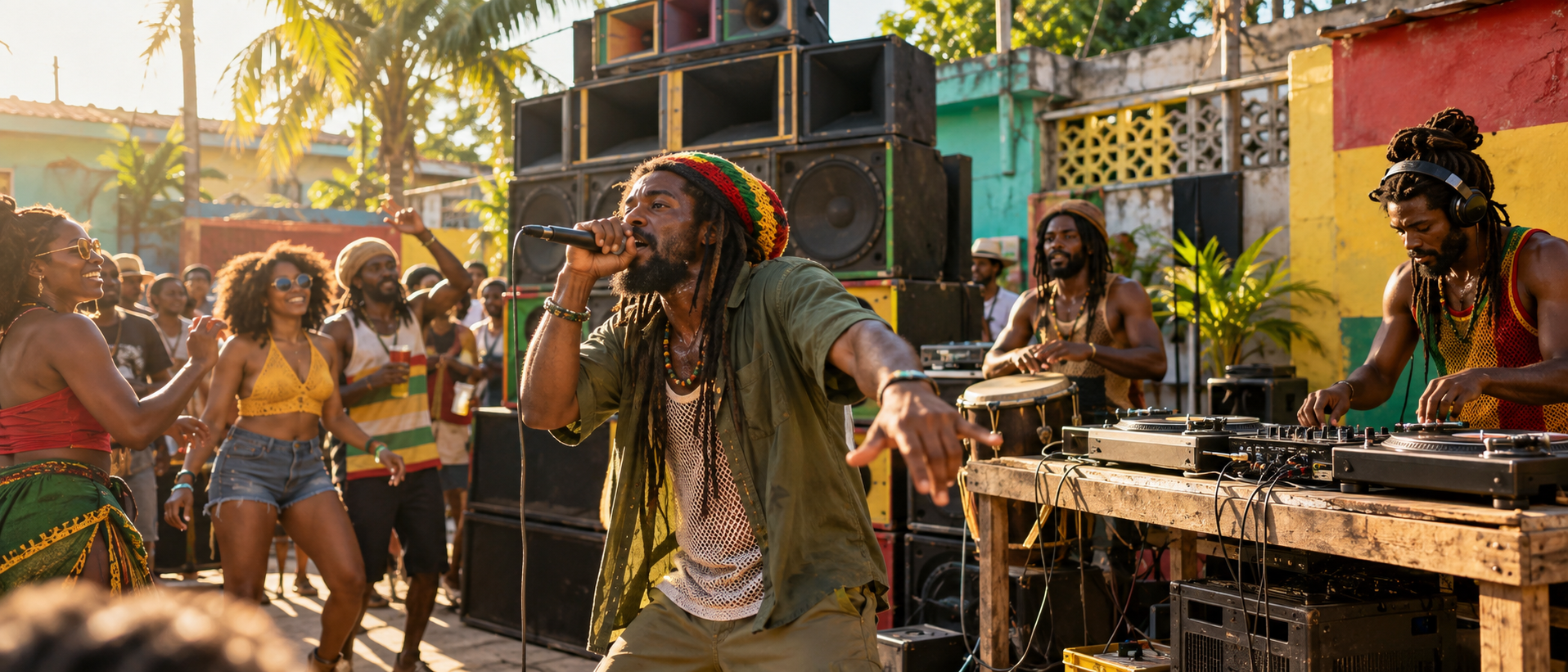
Ragga music has a distinctive energy that can capture your attention within seconds. A powerful rhythm, a confident vocal delivery, and a carefully placed phrase can turn a simple musical pattern into something instantly recognizable.
Rooted in Jamaica's reggae and dancehall traditions, ragga developed as digital production became increasingly important to Jamaican popular music during the 1980s.
The style is closely associated with electronic rhythms, bass-driven arrangements, and expressive deejay performances that interact directly with the beat.
Yet ragga is more than fast vocals or energetic dance music. Its musical identity reflects decades of Jamaican sound-system culture, rhythmic experimentation, and creative storytelling.
Whether you are discovering ragga for the first time or exploring its connections to reggae and dancehall, learning to recognize its defining elements can make every listening session more rewarding.
This relaxed ragga music guide explores the genre's origins, rhythmic foundations, vocal techniques, influential performers, and practical ways to appreciate its sound.
1. What Is Ragga Music?
Ragga, sometimes called raggamuffin music, is a style associated with Jamaican dancehall that places particular emphasis on digital rhythms and rhythmic vocal delivery.
The term became widely associated with developments in Jamaican music during the 1980s, when electronic instruments and programmed drum patterns transformed dancehall production.
Although ragga and dancehall are closely connected, ragga is often used to describe the more digitally oriented and deejay-driven side of the broader dancehall tradition.
The relationship between ragga and reggae
Reggae provides an important historical foundation for ragga.
Traditional reggae is frequently associated with prominent basslines, offbeat rhythmic accents, and socially conscious or spiritually influenced songwriting.
Ragga draws from these musical traditions while emphasizing different production and performance techniques.
Electronic drum machines, synthesizers, and digitally programmed arrangements became especially important to its development.
The result is a style that preserves elements of Jamaican rhythmic identity while introducing a different musical texture.
Why ragga sounds different
Several characteristics help distinguish ragga from other reggae-related styles:
- Digital or electronically programmed rhythms.
- Strong, repetitive bass patterns.
- Rhythmic deejay-style vocal delivery.
- Energetic interaction between voice and beat.
- Repeated instrumental patterns known as riddims.
- Vocal performances that emphasize cadence and timing.
These features combine to create music that often feels immediate, dynamic, and rhythmically engaging.
2. The Jamaican Roots of Ragga
Understanding ragga begins with Jamaica's rich musical history.
During the twentieth century, Jamaican musicians developed and transformed several influential styles, including ska, rocksteady, reggae, dub, and dancehall.
Each contributed ideas that helped shape later musical developments.
From reggae to dancehall
Dancehall emerged as a major force in Jamaican popular music around the late 1970s and early 1980s.
The style developed within a culture of sound systems, where selectors and deejays entertained audiences through recorded music, live vocal performances, and rhythmic experimentation.
Compared with some earlier reggae recordings, dancehall often emphasized direct rhythmic impact and performance energy.
This environment encouraged artists to develop distinctive vocal styles and producers to experiment with new musical technologies.
The digital dancehall revolution
One of the most important developments occurred in 1985 with the release of Wayne Smith's Under Mi Sleng Teng.
Produced by Prince Jammy, the recording became a landmark in the development of digital dancehall.
Its electronic rhythm demonstrated how digital instruments could reshape Jamaican music production.
The success of digital riddims helped establish a new direction for dancehall and contributed to the development of what became widely recognized as ragga.
The importance of sound-system culture
Sound systems have played a central role in Jamaican music for decades.
These mobile music setups typically feature powerful speakers, selectors, and performers who engage audiences through recorded tracks and live vocal interaction.
For ragga, sound-system culture provided an environment where performers could experiment with timing, lyrical delivery, and audience participation.
The relationship between performers and listeners remains an important part of the music's cultural identity.
3. Understanding Ragga Rhythms
Rhythm is one of ragga's defining characteristics.
Although individual recordings vary considerably, many share an emphasis on strong bass frequencies, repeated rhythmic patterns, and carefully positioned vocal phrases.
What is a riddim?
A riddim is an instrumental backing pattern used in Jamaican popular music.
Different artists may record separate songs over the same riddim, creating distinct performances from a shared musical foundation.
This practice is especially important in reggae and dancehall traditions.
A single riddim can support multiple interpretations, each shaped by the vocalist's melody, lyrics, timing, and personality.
For listeners, comparing songs built around the same riddim offers a fascinating way to understand musical creativity.
Basslines and percussion
Bass plays a central role in many ragga recordings.
Deep, repetitive bass patterns create a physical sense of movement and establish the foundation for the track.
Drums and programmed percussion provide additional rhythmic structure.
Listen for the interaction between:
- Kick drums that establish the main pulse.
- Snare or clap sounds that emphasize rhythmic accents.
- Hi-hats and percussion that introduce movement.
- Bass patterns that reinforce or contrast with the drums.
- Short instrumental breaks that create space for vocals.
These elements work together to produce the genre's characteristic rhythmic intensity.
Why repetition matters
Repetition is not simply a way to make a track easier to remember.
In ragga, repeated rhythmic patterns create a stable foundation that allows performers to experiment vocally.
When the instrumental arrangement remains relatively consistent, small changes in phrasing become more noticeable.
A performer can shift the placement of words, accelerate a phrase, or introduce a brief pause without losing the underlying groove.
4. The Art of Ragga Vocal Delivery
One of the most recognizable elements of ragga is its vocal style.
Rather than relying exclusively on conventional singing, many performers use rhythmic speech, chanting, melodic phrases, and deejay techniques.
What is Jamaican deejay-style performance?
In Jamaican musical culture, a deejay traditionally refers to a vocal performer who speaks, chants, or delivers rhythmic lyrics over recorded music.
This differs from the common international use of DJ to describe someone who selects and mixes records.
Jamaican deejay techniques helped influence the development of several musical forms, including aspects of hip-hop.
In ragga, the deejay's voice becomes an active rhythmic instrument.
Cadence and timing
Cadence refers to the rhythmic movement of a vocal phrase.
A ragga performer may deliver several quick syllables before leaving a brief space in the rhythm.
Another performer might use a slower, more deliberate pattern.
These choices create personality and help distinguish one artist from another.
When listening, notice whether the voice:
- Follows the beat closely.
- Moves slightly ahead of the rhythm.
- Uses unexpected pauses.
- Changes speed between phrases.
- Alternates between chanting and melody.
The relationship between voice and instrumental rhythm is often where ragga becomes most interesting.
The expressive role of Jamaican Patois
Jamaican Patois, also known as Jamaican Creole, is important to many ragga performances.
Its vocabulary, pronunciation, and rhythmic possibilities contribute to the character of the music.
For international listeners, unfamiliar expressions may initially make the lyrics difficult to follow.
However, vocal tone, repetition, and musical context can still communicate energy and emotion.
Learning about the cultural background of the language can deepen appreciation of the performances.
5. Influential Artists in Ragga and Digital Dancehall
Several Jamaican performers helped popularize the musical approaches associated with ragga.
Their recordings illustrate how different personalities can transform similar rhythmic foundations into distinctive songs.
Shabba Ranks
Shabba Ranks became one of the most internationally recognized dancehall performers during the late 1980s and early 1990s.
His powerful vocal delivery and distinctive rhythmic style helped introduce dancehall to wider audiences.
His recordings demonstrate the importance of vocal presence and rhythmic confidence.
Super Cat
Super Cat is known for his energetic performances and recognizable vocal style.
His work reflects the close relationship between Jamaican dancehall traditions and the international expansion of reggae-influenced music.
Listening to his recordings provides insight into the expressive possibilities of deejay performance.
Cutty Ranks
Cutty Ranks developed a distinctive approach characterized by strong rhythmic delivery and commanding vocal presence.
His recordings offer examples of how a performer can create intensity through timing and phrasing.
Chaka Demus & Pliers
The duo Chaka Demus & Pliers became internationally successful by combining deejay-style delivery with melodic singing.
Their music illustrates how ragga-related styles can incorporate contrasting vocal approaches within a single recording.
Buju Banton
Buju Banton emerged as an important dancehall artist during the early 1990s.
His career demonstrates the stylistic range of Jamaican popular music, moving across dancehall and reggae-related traditions.
These artists represent different aspects of a broad musical landscape rather than a single, uniform ragga sound.
6. Ragga, Dancehall, and Reggae: Understanding the Differences
The terms reggae, dancehall, and ragga are sometimes used interchangeably.
However, understanding their relationships can help listeners recognize important musical distinctions.
Reggae
Reggae is a broad Jamaican musical genre that developed during the late 1960s.
It is often associated with offbeat rhythmic accents, prominent basslines, and a wide range of lyrical themes.
Reggae includes many substyles and has influenced music around the world.
Dancehall
Dancehall developed as a Jamaican popular music style and cultural movement, becoming especially prominent from the late 1970s onward.
It places considerable emphasis on sound-system culture, riddims, and vocal performance.
Both digitally produced and instrumentally recorded dancehall music exist.
Ragga
Ragga is closely associated with the digital transformation of dancehall.
Its recognizable features often include electronic rhythms and prominent deejay-style vocal delivery.
The boundaries between these categories are not always fixed.
Many artists move between styles, and individual recordings may contain elements associated with several traditions.
For a broader listening experience, explore the different musical styles featured on 1LiveRadio.
7. How Ragga Influenced Music Beyond Jamaica
Ragga's influence extends far beyond its Jamaican origins.
Its rhythmic ideas, vocal techniques, and production approaches have contributed to musical developments in several countries.
Connections with hip-hop
Jamaican sound-system culture and deejay performance traditions have historical connections to the development of hip-hop.
Although the genres evolved in different environments, both place importance on rhythmic vocal delivery and the interaction between performers and recorded beats.
Ragga and hip-hop have also influenced each other through collaborations and shared production approaches.
Ragga jungle and drum and bass
During the 1990s, producers in the United Kingdom incorporated Jamaican reggae and dancehall influences into emerging electronic dance music styles.
Ragga jungle became associated with fast breakbeats, deep bass, and sampled or newly recorded dancehall-style vocals.
This fusion helped demonstrate how Jamaican musical ideas could interact with electronic production techniques.
Global dancehall influences
Dancehall and ragga-related rhythms have influenced popular music across the Caribbean, Europe, Africa, and the Americas.
Their impact can be heard in various forms of electronic music, pop, and urban music.
These connections reflect the international reach of Jamaican musical creativity.
8. How to Enjoy Ragga Radio
Listening to ragga through online radio can be an accessible way to explore the genre.
A varied selection of tracks allows you to hear different vocal approaches, production styles, and rhythmic patterns.
Start with the rhythm
During your first listen, focus on the bass and drums.
Try to identify the main rhythmic pattern before concentrating on the vocals.
This provides a foundation for understanding how the performer interacts with the beat.
Follow the vocal phrasing
On your next listen, pay attention to the voice.
Notice where phrases begin and end.
Observe how the performer changes speed, intensity, or pitch.
You may discover that the most memorable moments occur when the vocalist briefly moves away from the expected rhythmic pattern.
Compare different riddims
If you encounter multiple songs using the same instrumental backing, listen to them consecutively.
Notice how different artists approach the shared rhythm.
One may emphasize melody, while another focuses on rapid rhythmic delivery.
This comparison reveals how much creative variation is possible within a repeated musical structure.
Explore related genres
Ragga becomes easier to understand when heard alongside related musical traditions.
Try listening to classic reggae, dub, dancehall, and ragga jungle.
Each offers a different perspective on the relationship between rhythm, bass, and vocal expression.
You can also explore additional listening guides through the 1LiveRadio Blog.
9. The Cultural Importance of Ragga
Ragga is not only a collection of musical techniques.
It also reflects the social and cultural environment in which it developed.
Jamaican popular music has long provided space for storytelling, entertainment, social commentary, and expressions of local identity.
Music as cultural expression
Ragga performances can address everyday experiences, relationships, celebrations, competition, and social issues.
The themes vary widely between artists and recordings.
Understanding the cultural context helps listeners appreciate the music beyond its rhythmic energy.
The role of musical innovation
The emergence of digital dancehall demonstrated how new technologies could transform established musical traditions.
Producers adapted electronic instruments to Jamaican rhythmic approaches rather than simply reproducing existing international styles.
This combination of local creativity and technological experimentation helped shape ragga's identity.
For additional information about the history and international influence of reggae, consult UNESCO's overview of reggae music of Jamaica.
UNESCO recognized reggae music of Jamaica as part of the Representative List of the Intangible Cultural Heritage of Humanity in 2018.
Although this recognition concerns reggae more broadly, it provides useful cultural context for understanding the musical traditions from which ragga developed.
10. Why Ragga Remains Worth Exploring
Ragga offers listeners an engaging combination of rhythmic structure and vocal creativity.
Its digital production techniques helped reshape Jamaican popular music, while its performance traditions continue to influence artists across genres.
One of the most rewarding aspects of ragga is the relationship between repetition and variation.
A familiar riddim may sound completely different when interpreted by another performer.
A simple rhythmic pattern can become exciting through an unexpected pause or change in vocal cadence.
These details reward repeated listening.
For newcomers, the best approach is to remain curious.
Explore recordings from different decades, compare artists, and listen for the musical choices that give each track its personality.
Frequently Asked Questions About Ragga Music
What is ragga music?
Ragga is a style associated with Jamaican dancehall music, particularly its digitally produced rhythms and deejay-style vocal performances. It became prominent during the 1980s as electronic production transformed Jamaican popular music.
Is ragga the same as reggae?
No. Ragga developed from Jamaican musical traditions that include reggae and dancehall, but it is particularly associated with digital rhythms and rhythmic vocal delivery. The styles are closely related and sometimes overlap.
What is the difference between ragga and dancehall?
Dancehall is a broader Jamaican musical and cultural tradition. Ragga commonly refers to digitally oriented dancehall styles, especially those emphasizing electronic riddims and deejay performances.
Who are some well-known ragga artists?
Artists associated with ragga and digital dancehall include Shabba Ranks, Super Cat, Cutty Ranks, Chaka Demus & Pliers, and Buju Banton.
What is a riddim in ragga music?
A riddim is an instrumental backing pattern that can be used by multiple performers. Different artists may create separate songs over the same riddim, using their own lyrics, melodies, and vocal styles.
When did ragga music become popular?
Ragga became particularly prominent during the mid-to-late 1980s and early 1990s, following the growing popularity of digitally produced Jamaican dancehall.
Can I listen to ragga music online?
Yes. Online radio platforms, streaming services, and music archives provide opportunities to discover ragga recordings and explore related genres.
Final Thoughts: Discovering the Energy of Ragga
Ragga music rewards listeners who pay attention to rhythm, vocal timing, and musical personality.
Its energetic sound reflects a rich history of Jamaican innovation, from reggae and sound-system culture to digital dancehall production.
The most memorable moments often come from subtle changes in delivery: a phrase that lands unexpectedly, a rhythmic pause, or a performer who transforms a familiar riddim through a distinctive vocal approach.
Whether you prefer classic Jamaican recordings or modern interpretations, ragga offers an exciting musical tradition to explore.
Start with the rhythm, follow the voice, and allow the details to reveal themselves.
The more closely you listen, the more you may discover.
Reader comments
No comments yet. Start the conversation.
Leave a comment
Your email stays private. Comments appear after approval.