
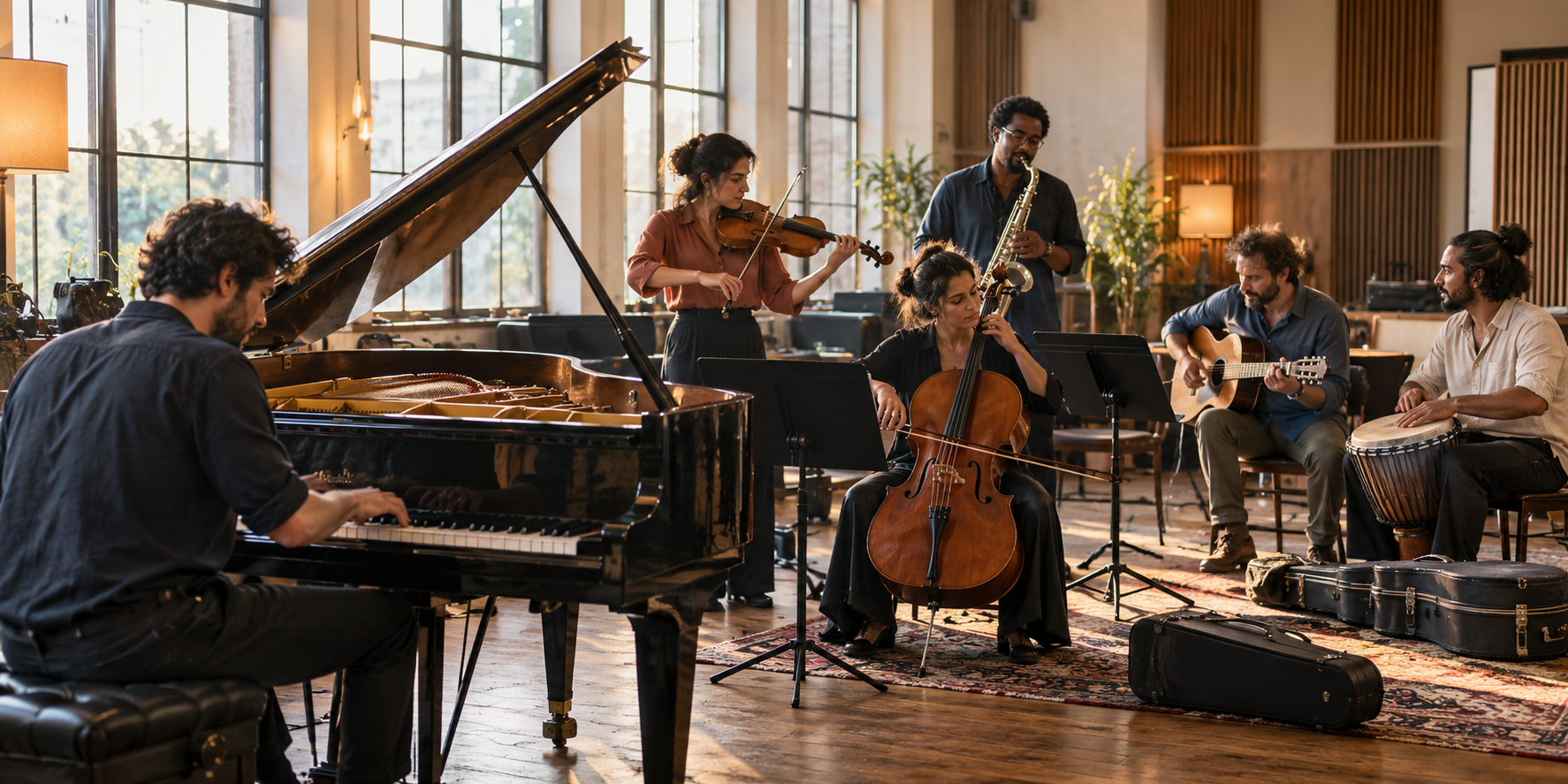
Sometimes, a melody can communicate everything a song needs to say without a single lyric.
A piano introduces a quiet musical phrase. A violin answers with a slightly different version. A guitar adds warmth, while a gentle rhythm gives the arrangement movement.
Nothing needs to be explained through words.
The instruments carry the musical conversation.
That is one of the most appealing qualities of instrumental music.
Instrumental recordings allow melody, rhythm, harmony, and texture to become the main focus. Without a lead lyric guiding the listener toward a particular story, the music leaves room for individual interpretation.
However, instrumental music is not one narrowly defined genre.
It can include classical compositions, jazz improvisation, acoustic guitar performances, electronic soundscapes, film scores, piano solos, and many other styles.
Some recordings are quiet and reflective. Others are energetic, complex, dramatic, or rhythmically adventurous.
This variety makes instrumental radio an interesting way to discover music.
You can enjoy a familiar orchestral composition, encounter an unfamiliar jazz performance, or discover a contemporary instrumental artist without selecting every track yourself.
In this guide, we'll explore what instrumental music means, how different instruments shape a recording, which styles are worth discovering, and how to listen more attentively.
We'll also create a practical one-hour listening journey and explain how to find instrumental radio stations on 1LiveRadio.
Whether you're looking for relaxing background music or recordings that reward close attention, instrumental music offers many possibilities.
1. What Is Instrumental Music?
Instrumental music is music performed primarily through instruments rather than lead vocal lyrics.
Its musical ideas are communicated through melody, harmony, rhythm, timbre, and arrangement.
The category includes an enormous range of musical traditions.
Classical instrumental music
Orchestral works, chamber music, and solo compositions.
Piano music
Solo piano performances and arrangements built around the instrument.
Instrumental jazz
Jazz recordings that emphasize instrumental performance and improvisation.
Guitar instrumentals
Music featuring acoustic, classical, electric, or other guitars.
Electronic instrumental music
Synthesizer-based compositions, ambient music, and electronic arrangements without lead lyrics.
Film and television scores
Instrumental compositions created to support visual storytelling.
Instrumental rock
Rock music in which guitars, bass, drums, and other instruments carry the musical ideas without a conventional lead singer.
Important distinction
Instrumental does not necessarily mean completely free of human voices.
Some instrumental recordings contain wordless vocal textures, sampled voices, or occasional spoken elements.
The defining characteristic is that the primary musical content is carried by instruments rather than a lead lyrical performance.
For historical background, explore Encyclopaedia Britannica's overview of instrumental music.
2. Why Instrumental Music Feels Different
When a recording has a lead singer, the voice often becomes the listener's main point of attention.
Lyrics can establish a story, describe an emotion, or communicate a specific message.
Instrumental music works differently.
Melody becomes more prominent
An instrument may carry the main musical idea.
Harmony shapes the atmosphere
Chord changes can influence how a passage feels.
Rhythm creates movement
Percussion, bass, and repeating patterns establish energy and momentum.
Timbre becomes expressive
The distinctive sound of a piano, trumpet, violin, or synthesizer can influence the recording's character.
Arrangement creates contrast
Different instruments may enter, disappear, or exchange musical ideas.
Interpretation becomes more open
Without lead lyrics, listeners may form different personal associations with the same recording.
Why this matters
Instrumental music encourages attention to musical details that can be less noticeable in lyric-focused songs.
A small change in tone, timing, or orchestration can become the most memorable moment.
3. Follow the Instrument Carrying the Melody
One of the easiest ways to understand an instrumental recording is to identify its main melody.
The melody is the recognizable sequence of musical notes that often forms the central musical idea.
Different instruments can carry this role.
Piano
A piano may introduce a theme through a simple sequence of notes.
Violin
A violin can sustain and shape melodic phrases with expressive changes in tone.
Guitar
A guitar can present a melody through plucked notes, chords, or sustained electric tones.
Saxophone
A saxophone can carry a melodic line with distinctive phrasing and articulation.
Flute
A flute may create a light, flowing melodic character.
Synthesizer
An electronic instrument can produce melodies with a wide variety of timbres.
Listening exercise
Choose an instrumental recording and ask:
-
Which instrument introduces the main melody?
-
Does that instrument remain in the foreground?
-
Does another instrument repeat the melody?
-
Does the melody return later?
-
Is it played differently when it returns?
Following the main melody provides a useful starting point, even when the arrangement becomes complex.
4. Understanding Instrumentation and Arrangement
Instrumentation refers to the selection and use of instruments in a musical work.
Arrangement concerns how musical material is organized for the performers or instruments involved.
These choices strongly influence how instrumental music sounds.
A simple piano melody
A short melody played alone may feel intimate.
The same melody with strings
Adding violins, violas, and cellos can create a richer texture.
The same melody with percussion
Rhythmic accompaniment may introduce movement and energy.
The same melody with electronic sounds
Synthesizers and processing can create a completely different atmosphere.
Why instrumentation matters
A musical idea can change character depending on which instruments perform it.
Listening tip
When a melody returns, notice whether its instrumentation has changed.
A phrase first introduced by a piano might later appear in the strings or woodwinds.
For more detail about instrumental roles and musical arrangements, read Britannica's guide to instrumentation.
5. Piano Instrumental Music: Simplicity and Expression
Piano music is one of the most accessible starting points for instrumental listening.
The instrument can perform melody, harmony, and rhythmic accompaniment simultaneously.
A solo pianist can therefore create a complete musical arrangement without additional performers.
Classical piano
Classical piano repertoire includes compositions from different historical periods.
Contemporary piano
Modern composers may use repeating patterns, minimal arrangements, and atmospheric production.
Jazz piano
Jazz pianists frequently explore improvisation, rhythmic variation, and harmonic complexity.
Film-score piano
Piano can establish memorable themes in cinematic music.
What should you listen for?
Pay attention to the relationship between the left and right hands.
One may carry the melody while the other provides accompaniment.
Notice how the pianist changes the volume, timing, and articulation.
Artists and composers to explore
-
Frédéric Chopin.
-
Claude Debussy.
-
Bill Evans.
-
Ludovico Einaudi.
-
Hania Rani.
These musicians represent different musical traditions rather than one uniform piano style.
Explore piano radio
The RadioArt: Piano station page provides a starting point for piano-focused radio discovery.
6. Classical Instrumental Music: A World of Musical Detail
Classical music offers an enormous instrumental repertoire.
It includes solo works, chamber music, concertos, symphonies, and many other forms.
Solo compositions
A single performer carries the musical material.
Chamber music
Small groups of instruments interact closely.
Orchestral music
Larger ensembles combine different instrumental families.
Concertos
A soloist or group of soloists performs with an orchestra.
Why classical music rewards attention
Composers often develop musical ideas through repetition, contrast, variation, and changes in instrumentation.
What should beginners notice?
Start with one recognizable theme.
Listen for its return.
Notice whether the theme becomes louder, softer, faster, slower, or more elaborate.
Composers to explore
-
Johann Sebastian Bach.
-
Wolfgang Amadeus Mozart.
-
Ludwig van Beethoven.
-
Claude Debussy.
-
Maurice Ravel.
Related listening guide
For a broader introduction, read What makes Classical radio worth a listen.
7. Understanding the Instruments of an Orchestra
An orchestra brings together instruments with different sounds and musical roles.
Learning to recognize these families makes orchestral music easier to follow.
Strings
The string family includes violins, violas, cellos, and double basses.
Strings can provide melodies, harmonies, rhythmic patterns, and sustained textures.
Woodwinds
Common orchestral woodwinds include flutes, oboes, clarinets, and bassoons.
They offer contrasting tones and expressive possibilities.
Brass
Trumpets, horns, trombones, and tubas can provide powerful musical statements or softer supporting lines.
Percussion
Percussion instruments contribute rhythm, accents, and distinctive sound colors.
Keyboards and other instruments
Piano, harp, and additional instruments may appear depending on the composition.
Why orchestration matters
The composer or arranger determines how these sounds interact.
A melody played by a solo flute feels different from the same melody performed by a full string section.
For a more detailed explanation, explore Berklee Online's introduction to orchestration.
8. Instrumental Jazz: Melody and Improvisation
Instrumental jazz offers another rewarding listening experience.
Jazz musicians frequently develop musical ideas through improvisation, rhythmic interaction, and harmonic exploration.
Common instruments
Instrumental jazz may feature:
-
Piano.
-
Saxophone.
-
Trumpet.
-
Double bass.
-
Drums.
-
Guitar.
-
Trombone.
The role of improvisation
A musician may create new melodic ideas during a performance.
Rhythmic interaction
The drummer and bassist often establish a foundation while responding to other performers.
Musical conversation
A saxophone solo may be followed by a piano solo.
The rhythm section can react to changes in intensity and phrasing.
What should beginners listen for?
Follow the main theme before the improvisation begins.
Then notice how the soloist develops new ideas.
Artists to explore
-
Miles Davis.
-
John Coltrane.
-
Bill Evans.
-
Thelonious Monk.
-
Dave Brubeck.
Related guide
Discover more through The small details that make Jazz memorable.
9. Guitar Instrumentals: From Acoustic to Electric
The guitar is capable of a remarkable variety of instrumental sounds.
Classical guitar
Classical guitar performances often emphasize fingerstyle technique and expressive phrasing.
Acoustic fingerstyle
A guitarist may perform melody, bass, and accompaniment simultaneously.
Electric guitar
Electric guitar instrumentals can feature sustained notes, distortion, effects, and elaborate melodic passages.
Jazz guitar
Jazz guitarists explore chord voicings, improvisation, and rhythmic variation.
Ambient guitar
Reverb, delay, and looping can transform guitar sounds into atmospheric textures.
Artists to explore
-
Andrés Segovia.
-
Paco de Lucía.
-
Joe Satriani.
-
Steve Vai.
-
Pat Metheny.
These artists work in different musical traditions.
Listening tip
Notice how the guitarist produces the notes.
Are they plucked gently, struck with a pick, sustained through effects, or combined with chords?
The playing technique can be as important as the melody.
10. Instrumental Electronic Music
Electronic music offers many possibilities for instrumental composition.
Some recordings use clear melodies and dance rhythms.
Others emphasize atmosphere, texture, and gradual development.
Ambient music
Ambient compositions often focus on atmosphere and sustained sound.
Synthesizer music
Synthesizers can create melodies, basslines, and complex textures.
Instrumental electronica
Electronic arrangements may combine programmed rhythms with melodic elements.
Downtempo
Some downtempo recordings feature relaxed rhythms and atmospheric production.
Minimal electronic music
A small number of repeating elements can develop gradually.
What should listeners notice?
Pay attention to how sounds change over time.
A synthesizer tone may slowly become brighter.
A repeated pattern may gain additional layers.
A rhythm may disappear, leaving only an atmospheric texture.
Artists to explore
-
Brian Eno.
-
Jean-Michel Jarre.
-
Vangelis.
-
Tycho.
These artists illustrate different approaches to electronic instrumental music.
11. Ambient Music vs. Instrumental Music
Ambient and instrumental music overlap, but they are not identical.
Instrumental music
Instrumental music is defined primarily by the absence of a lead lyrical vocal performance.
Ambient music
Ambient music is generally associated with atmosphere, texture, and particular approaches to musical attention.
Where they overlap
Many ambient recordings are instrumental.
Where they differ
Not every instrumental recording is ambient.
A fast jazz solo or energetic guitar instrumental may have little in common with a quiet ambient soundscape.
Likewise, ambient music can sometimes include voices or vocal textures.
Why the distinction matters
Understanding the difference helps listeners choose music based on mood and musical characteristics rather than broad labels.
12. Instrumental Film Music: Telling Stories Without Words
Film scores demonstrate how instrumental music can support storytelling.
A composer may create a theme associated with a character, place, or dramatic idea.
Recurring themes
A melody may return at different moments in a film.
Orchestral arrangements
Strings, brass, woodwinds, and percussion can establish dramatic contrast.
Electronic sound design
Synthesizers and processed sounds may create unusual atmospheres.
Rhythmic intensity
Percussion can support scenes involving movement or suspense.
Quiet passages
Sparse instrumental arrangements may emphasize reflection or emotional intimacy.
Composers to explore
-
John Williams.
-
Ennio Morricone.
-
Hans Zimmer.
-
Ryuichi Sakamoto.
-
Hildur Guðnadóttir.
Listening exercise
Choose a recognizable instrumental film theme.
Listen without watching the associated scene.
Notice which musical elements communicate the atmosphere.
Then consider how the music might function differently when heard independently.
13. How Rhythm Shapes Instrumental Music
Rhythm plays an important role in many instrumental recordings.
However, its function changes across styles.
Classical music
Rhythm may contribute to the development of a musical phrase or larger composition.
Jazz
Rhythmic interaction and improvisation can become central features.
Electronic music
A repeating beat may provide a consistent foundation.
Acoustic guitar
Rhythm may emerge from the interaction between bass notes and melody.
Ambient music
Some recordings use little or no obvious percussion.
What should listeners notice?
Ask whether the rhythm is:
-
Steady.
-
Flexible.
-
Syncopated.
-
Repetitive.
-
Gradually changing.
-
Almost absent.
Why rhythm matters
Even when a recording has no lyrics, rhythm can establish movement and shape the listener's experience.
14. The Importance of Timbre
Timbre is the quality that allows listeners to distinguish between different sounds.
For example, a piano and a violin can play the same note at the same pitch but sound noticeably different.
Instrument construction
The physical characteristics of an instrument influence its sound.
Playing technique
A musician can change timbre through articulation and performance.
Recording environment
The acoustics of a room can affect the recorded sound.
Electronic processing
Effects can alter an instrument's tonal character.
Instrument combinations
Several instruments can blend into a new overall texture.
Listening exercise
Choose a recording with at least two melodic instruments.
Notice how their sounds differ.
Does one sound bright and clear?
Does another sound warm, soft, metallic, or breathy?
These differences help give the arrangement its identity.
15. Dynamics: How Volume Creates Expression
Dynamics describe changes in musical loudness and intensity.
In instrumental music, dynamic contrast can communicate emotion without lyrics.
Quiet passages
Soft playing can create intimacy or anticipation.
Loud passages
Greater intensity can produce excitement or dramatic emphasis.
Crescendo
A gradual increase in volume can build tension.
Decrescendo
A gradual decrease in volume can create a sense of release.
Sudden contrast
A loud section followed by silence can be especially striking.
Why dynamics matter
An instrumental theme may become more expressive when its intensity changes.
Listening tip
Follow the overall volume of a recording.
Notice whether the music builds gradually or changes suddenly.
16. Why Repetition Can Make Instrumental Music Memorable
Repetition is an important compositional tool.
A melody may return several times with small changes.
Repeated themes
A recognizable musical idea helps create structure.
Variations
A theme may change in rhythm, harmony, instrumentation, or register.
Ostinato
An ostinato is a repeating musical figure or pattern.
Layering
Additional instruments may enter over a repeated idea.
Gradual development
Small changes can transform the emotional character of a passage.
Listening exercise
Choose a piece built around a repeating pattern.
Listen for the first version.
Then compare it with later repetitions.
Ask:
What changed, and what remained familiar?
This simple question can reveal much about how instrumental compositions develop.
17. Instrumental Music for Studying and Concentration
Many listeners choose instrumental music while studying, reading, or working.
Without lead lyrics, some recordings may feel less distracting during language-heavy tasks.
However, the effect depends on the individual, the activity, and the music.
Music with steady dynamics
Recordings without dramatic volume changes may be easier to keep in the background.
Familiar instrumental music
Some listeners find familiar music less distracting than unfamiliar recordings.
Minimal arrangements
Sparse music may leave more room for concentration.
Ambient recordings
Slowly changing textures can provide a consistent atmosphere.
Solo piano
Gentle piano pieces may appeal to listeners who prefer recognizable melodies.
Important consideration
Instrumental music does not automatically improve concentration.
Complex or emotionally engaging recordings can still demand attention.
Practical listening tip
Try a short session with instrumental music at a comfortable volume.
Compare it with working in silence.
Choose the option that supports your task rather than assuming one approach works for everyone.
18. Instrumental Music for Relaxation
Instrumental music can also provide an enjoyable setting for quiet moments.
Gentle piano
Soft piano melodies may create a reflective atmosphere.
Acoustic guitar
Warm acoustic arrangements can suit relaxed listening.
Ambient electronic music
Sustained textures may provide a spacious background.
Light orchestral music
Some orchestral compositions feature gentle melodies and restrained dynamics.
Instrumental jazz
Quieter jazz recordings may appeal to listeners who enjoy subtle rhythmic movement.
Why personal preference matters
One listener may find solo piano relaxing.
Another may prefer ambient electronics or acoustic guitar.
The best choice depends on the particular recording and the listener's preferences.
Related listening guide
Explore The small details that make Easy Listening memorable for more ideas about relaxed musical programming.
19. Instrumental Music for Creative Activities
Instrumental music can accompany writing, drawing, design, and other creative activities.
Different styles may support different moods.
Atmospheric electronic music
Can provide a spacious background.
Classical music
Offers a wide range of structures and expressive ideas.
Instrumental jazz
May interest listeners who enjoy improvisation and rhythmic movement.
Acoustic guitar
Can create an intimate musical environment.
Film scores
May evoke a particular atmosphere or sense of drama.
Choosing the right music
Consider whether you want music that stays in the background or invites closer attention.
For some creative tasks, an engaging instrumental performance may be inspiring.
For others, it may become distracting.
Experiment with different styles and volumes.
20. Instrumental Music vs. Easy Listening
Instrumental and easy listening are related categories, but they describe different characteristics.
Instrumental
The term primarily describes music without lead lyrical vocals.
Easy Listening
Easy Listening generally describes programming or arrangements intended to provide an accessible, often relaxed listening experience.
Where they overlap
Some easy listening recordings are instrumental.
Where they differ
Not every instrumental piece is relaxing.
Instrumental music can be dramatic, aggressive, rhythmically complex, or experimental.
Likewise, easy listening can include vocal performances.
Why this matters
If you're looking for quiet background music, an instrumental label alone may not be enough.
Check the station's musical focus.
21. Influential Instrumental Artists and Composers
Instrumental music has developed across many musical traditions.
The following artists and composers provide varied starting points.
Ludwig van Beethoven
Known for influential piano, chamber, and orchestral compositions.
Listen for: The development and transformation of musical themes.
Claude Debussy
An important composer whose music often explores distinctive harmonies and instrumental colors.
Listen for: Atmosphere and subtle changes in texture.
Bill Evans
An influential jazz pianist.
Listen for: Harmonic detail and melodic phrasing.
Miles Davis
A major jazz trumpeter and bandleader.
Listen for: Improvisation, space, and interaction between musicians.
Joe Satriani
Known for instrumental electric guitar music.
Listen for: Expressive guitar melodies and technical performance.
Brian Eno
An influential figure in ambient and experimental electronic music.
Listen for: Slowly changing textures and atmosphere.
Vangelis
Known for electronic compositions and film music.
Listen for: Synthesizer melodies and expansive arrangements.
Ludovico Einaudi
Known for contemporary piano compositions.
Listen for: Repetition and gradual melodic development.
Ryuichi Sakamoto
A composer and musician whose work spans electronic music, piano, and film scores.
Listen for: The relationship between melody, harmony, and texture.
Pat Metheny
An influential jazz guitarist.
Listen for: Guitar tone, improvisation, and melodic development.
These artists represent different styles rather than one unified instrumental genre.
22. Ten Instrumental Recordings Worth Exploring
A varied selection of recordings can help demonstrate the breadth of instrumental music.
1. Ludwig van Beethoven – Für Elise
A familiar solo piano composition.
Listen for: The recognizable melody and contrasting sections.
2. Claude Debussy – Clair de lune
A piano composition known for its expressive atmosphere.
Listen for: Dynamic changes and flowing melodic phrases.
3. Dave Brubeck Quartet – Take Five
An influential instrumental jazz recording.
Listen for: Its five-beat meter and saxophone melody.
4. Miles Davis – So What
A well-known jazz recording.
Listen for: Improvisation and the interaction between instruments.
5. Joe Satriani – Always with Me, Always with You
An instrumental electric guitar recording.
Listen for: Melodic guitar phrasing.
6. Brian Eno – 1/1
An ambient composition from Ambient 1: Music for Airports.
Listen for: Repetition and slowly developing textures.
7. Vangelis – Chariots of Fire
A recognizable electronic film theme.
Listen for: Synthesizer melody and rhythmic development.
8. Ludovico Einaudi – Nuvole Bianche
A contemporary piano composition.
Listen for: Repeated patterns and changes in intensity.
9. Ryuichi Sakamoto – Merry Christmas Mr. Lawrence
A well-known instrumental theme associated with the film of the same name.
Listen for: The melody and its emotional character.
10. Booker T. & the M.G.'s – Green Onions
A classic instrumental recording built around an organ riff.
Listen for: Groove, repetition, and ensemble interaction.
These recordings are starting points rather than a definitive list.
Together, they demonstrate how different instrumental styles use melody, rhythm, and arrangement.
23. How to Listen to Instrumental Music More Closely
Instrumental recordings often become more rewarding when you focus on one element at a time.
First listen: Identify the mood
Notice the overall atmosphere without analyzing every detail.
Second listen: Follow the melody
Identify the instrument carrying the main theme.
Third listen: Explore the accompaniment
Listen to what the supporting instruments contribute.
Fourth listen: Notice the rhythm
Pay attention to the beat, pulse, or rhythmic flexibility.
Fifth listen: Follow the arrangement
Notice when instruments enter or disappear.
Sixth listen: Focus on timbre
Compare the sounds of different instruments.
Seventh listen: Recognize development
Listen for themes that return in altered forms.
A useful question
What gives this recording its particular identity?
The answer might involve the melody, instrument choice, rhythm, harmony, or production.
24. A One-Hour Instrumental Music Listening Journey
A one-hour listening session can introduce several different instrumental styles.
The following plan is flexible.
Choose recordings that fit the suggested time blocks, or listen to excerpts from longer works.
Minutes 0–10: Begin With Solo Piano
Suggested composers and artists:
-
Claude Debussy.
-
Ludovico Einaudi.
What to notice:
Follow the melody and listen for changes in dynamics.
Listening goal: Understand how one instrument can carry a complete musical idea.
Minutes 10–20: Explore Classical Orchestral Music
Suggested composers:
-
Ludwig van Beethoven.
-
Maurice Ravel.
What to notice:
Listen for different instrumental families.
Pay attention to how themes move between instruments.
Listening goal: Recognize the importance of orchestration.
Minutes 20–30: Discover Instrumental Jazz
Suggested artists:
-
Miles Davis.
-
Dave Brubeck Quartet.
What to notice:
Focus on rhythm, improvisation, and ensemble interaction.
Listening goal: Understand how musicians develop musical ideas during a performance.
Minutes 30–40: Explore Guitar Instrumentals
Suggested artists:
-
Joe Satriani.
-
Pat Metheny.
What to notice:
Listen for differences in tone, technique, and phrasing.
Listening goal: Discover the expressive possibilities of the guitar.
Minutes 40–50: Experience Electronic Instrumental Music
Suggested artists:
-
Brian Eno.
-
Vangelis.
What to notice:
Focus on synthesizer sounds, repetition, and atmosphere.
Listening goal: Understand how electronic production can shape instrumental compositions.
Minutes 50–60: Discover Instrumental Radio
Finish by exploring the Instrumental radio category on 1LiveRadio.
Choose a station that interests you.
Listen to several tracks without selecting individual recordings.
Listening goal: Discover an unfamiliar instrumental style or artist.
Reflect on your listening session
Ask yourself:
-
Which instrument interested you most?
-
Did you prefer solo or ensemble performances?
-
Which recording had the most memorable melody?
-
Did you enjoy acoustic or electronic sounds?
-
Which style would you like to explore further?
Your answers can guide future listening.
25. How to Choose an Instrumental Radio Station
Instrumental radio stations may specialize in very different styles.
Choosing the right station begins with understanding your preferences.
Piano radio
Suitable for listeners who enjoy piano-focused programming.
Classical instrumental radio
May feature orchestral, chamber, and solo compositions.
Jazz instrumental radio
Can introduce improvisation and ensemble performances.
Guitar instrumental radio
May emphasize acoustic, classical, jazz, or electric guitar.
Relaxing instrumental radio
Often focuses on gentler arrangements and accessible melodies.
Mixed instrumental radio
May combine several musical traditions.
How to choose
Read the station description.
Look for information about instruments, genres, and programming.
Then listen to several recordings before deciding whether the station suits your preferences.
Browse available stations
Visit the Instrumental radio directory on 1LiveRadio.
26. Instrumental Radio Stations on 1LiveRadio
1LiveRadio includes several station listings associated with instrumental music.
These pages provide useful starting points for exploring different programming approaches.
Instrumental Hits Radio
The Instrumental Hits Radio station page is one option to investigate when looking for instrumental programming.
The station name suggests a focus on recognizable instrumental selections, although its current playlist should be checked through the player.
Instrumental
The Instrumental station listing offers another starting point for exploring the category.
RadioArt: Piano
The RadioArt: Piano page may interest listeners seeking piano-focused programming.
RadioArt: Solo Instruments
The RadioArt: Solo Instruments page provides another option for exploring music centered on individual instruments.
Compare station descriptions
Station names are useful clues, but they do not guarantee a particular playlist.
Read the available information and check the player when visiting a station.
Discover more
Browse the complete Instrumental category for additional station listings.
27. Building Your Own Instrumental Music Playlist
A personal playlist can help you explore instrumental music more deliberately.
Start with one familiar melody
Choose a recording you already enjoy.
Add a solo performance
Include piano, guitar, or another solo instrument.
Explore orchestral music
Choose a composition featuring several instrumental families.
Include instrumental jazz
Add a recording that emphasizes improvisation.
Discover electronic music
Explore synthesizer-based or ambient compositions.
Compare moods
Include both quiet and energetic recordings.
Pay attention to transitions
Notice how one track's ending connects with the next track's beginning.
Revisit favorites
Repeated listening can reveal new details.
Expand gradually
Follow artists, instruments, and musical traditions that interest you.
A thoughtful playlist can become a personal guide to instrumental music.
28. Common Mistakes When Exploring Instrumental Music
Instrumental music is broad, but several assumptions can limit discovery.
Mistake 1: Assuming instrumental music is always relaxing
Some instrumental recordings are intense, dramatic, or rhythmically complex.
Mistake 2: Treating instrumental music as one genre
Instrumental recordings exist across many musical traditions.
Mistake 3: Focusing only on the main melody
Supporting instruments often contribute important musical details.
Mistake 4: Ignoring rhythm
Rhythm can be central even when no singer is present.
Mistake 5: Assuming music without lyrics is automatically suitable for concentration
The effect depends on the recording, the task, and the listener.
Mistake 6: Expecting every instrumental track to feature piano
Instrumental music includes countless instruments and combinations.
Mistake 7: Ignoring arrangement
Changes in instrumentation can transform a familiar melody.
Mistake 8: Judging a radio station after one track
Several recordings provide a better understanding of its programming.
A better approach
Listen for melody, rhythm, timbre, dynamics, and arrangement.
These elements can help explain the character of almost any instrumental recording.
29. Why Instrumental Radio Is Useful for Music Discovery
Instrumental radio provides a convenient way to explore different musical styles.
Continuous listening
You can enjoy a sequence of recordings without selecting every track.
Unexpected discoveries
A station may introduce an unfamiliar composer, performer, or instrument.
Musical variety
Mixed programming can connect different instrumental traditions.
Mood-based listening
Some stations emphasize relaxed music, while others offer more energetic selections.
Instrument discovery
Radio can introduce sounds you may not have encountered before.
Artist exploration
An interesting recording can encourage you to learn more about the performer.
Why it matters
Instrumental music is a large category.
Radio can help you discover which styles deserve closer attention.
30. Explore Instrumental and Related Music on 1LiveRadio
Instrumental music connects naturally with classical, jazz, electronic, and easy listening traditions.
If you enjoy orchestral arrangements, classical music may be a rewarding direction.
If you prefer improvisation, instrumental jazz offers a different experience.
Listeners seeking gentler programming may enjoy some easy listening recordings.
Explore Instrumental radio
Browse the Instrumental radio stations on 1LiveRadio.
Discover piano-focused programming
Visit RadioArt: Piano.
Explore solo instruments
Check RadioArt: Solo Instruments.
Learn about classical music
Read What makes Classical radio worth a listen.
Explore jazz
Discover The small details that make Jazz memorable.
Find relaxed listening ideas
Explore The small details that make Easy Listening memorable.
These guides provide different starting points for exploring instrumental sounds.
Frequently Asked Questions About Instrumental Music
What is instrumental music?
Instrumental music is music performed primarily through instruments rather than lead lyrical vocals.
Does instrumental music have lyrics?
Instrumental music generally does not feature lead lyrics, although some recordings may include wordless voices or occasional vocal samples.
Is instrumental music a genre?
Instrumental is a broad musical category rather than one narrowly defined genre.
What instruments are used in instrumental music?
Instrumental recordings can feature piano, guitar, violin, saxophone, trumpet, synthesizers, percussion, and many other instruments.
Is classical music instrumental?
Much classical music is instrumental, but classical music also includes important vocal traditions.
Is jazz instrumental music?
Many jazz recordings are instrumental, although jazz also includes vocal music.
What is instrumental rock?
Instrumental rock is rock music in which instruments carry the main musical ideas without a conventional lead singer.
What is instrumental electronic music?
It is electronic music that emphasizes instrumental or synthesized sounds rather than lead lyrical vocals.
Is ambient music instrumental?
Many ambient recordings are instrumental, but ambient music can also include vocal elements.
What is a solo instrumental performance?
A solo instrumental performance features one musician or instrument carrying the musical material.
What is orchestral instrumental music?
Orchestral instrumental music is performed by an orchestra without lead lyrical singing.
What is the difference between instrumental and acoustic music?
Instrumental describes music without lead lyrical vocals. Acoustic describes music made with acoustic instruments or a particular approach to their sound.
Is instrumental music always relaxing?
No. Instrumental music can be gentle, energetic, dramatic, experimental, or intense.
Is instrumental music good for studying?
Some listeners find certain instrumental recordings helpful while studying, but the effect depends on the task, the music, and individual preferences.
Can instrumental music improve concentration?
There is no universal guarantee. Some people prefer instrumental background music, while others concentrate better in silence.
What is the best instrumental music for relaxation?
The best choice depends on personal preference. Gentle piano, acoustic guitar, and some ambient recordings are common starting points.
What is a melody in instrumental music?
A melody is a recognizable sequence of musical notes that often forms the main musical idea.
What is instrumentation?
Instrumentation refers to the selection and use of instruments in a musical work.
What is orchestration?
Orchestration concerns how musical material is assigned and arranged for orchestral instruments.
What is timbre?
Timbre is the sound quality that helps distinguish one instrument or voice from another.
What is instrumental radio?
Instrumental radio refers to stations or programs that focus on music performed primarily through instruments.
Can I listen to instrumental radio online?
Yes. Online radio directories include stations featuring instrumental music.
Where can I find instrumental radio stations?
You can browse the Instrumental radio category on 1LiveRadio.
Final Thoughts: A More Natural Way Into Instrumental Radio
Instrumental music offers an enormous range of listening experiences.
A piano can express a memorable musical idea through only a few notes.
A violin can transform that idea through expressive phrasing.
A jazz ensemble can develop it through improvisation.
An orchestra can expand it through different instrumental colors.
A guitarist can reshape it through tone and technique.
An electronic producer can turn it into an atmospheric soundscape.
These recordings may have very little in common stylistically, yet each demonstrates how music can communicate without relying on lead lyrics.
The most rewarding approach is to begin with one simple question:
Which instrument is carrying the central musical idea?
Follow that instrument.
Notice how the supporting parts shape its movement.
Listen for changes in rhythm, harmony, and texture.
Pay attention when the melody returns.
Consider whether another instrument takes over.
Then decide how closely you want to listen.
Some instrumental recordings work well as gentle background music.
Others deserve your full attention.
A quiet piano piece may provide a reflective atmosphere, while an energetic jazz performance can invite you to follow every musical interaction.
Neither experience is more valuable than the other.
The important thing is to choose music that suits your interests and the moment.
Instrumental music becomes more rewarding when you listen beyond the absence of lyrics and begin noticing everything the instruments have to say.
To continue exploring, browse the Instrumental radio stations on 1LiveRadio, discover the RadioArt: Solo Instruments listing, or explore related musical traditions through the Classical and Jazz listening guides.
Your next favorite melody may not need words at all.
Reader comments
No comments yet. Start the conversation.
Leave a comment
Your email stays private. Comments appear after approval.