
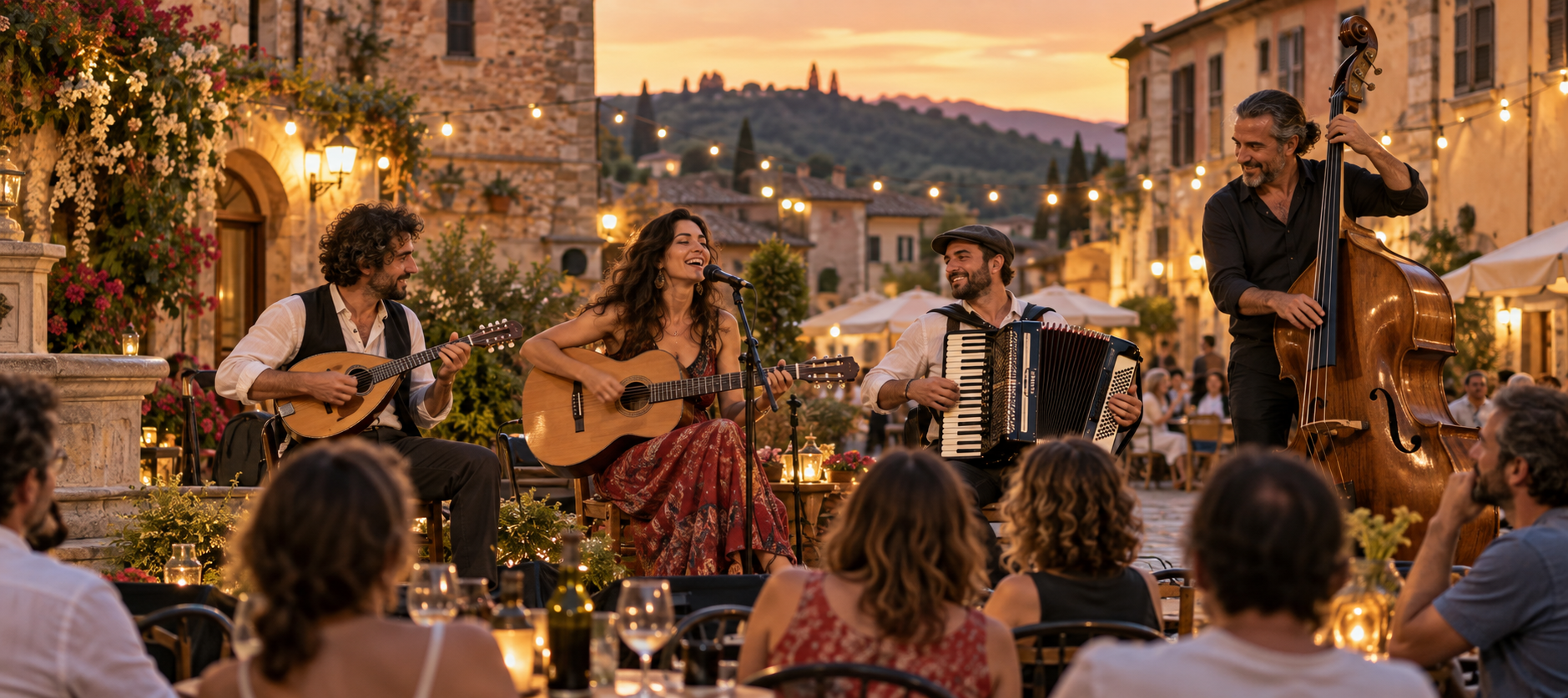
A familiar Italian melody begins with a gentle piano introduction. A singer enters, stretching the final syllable of a phrase before the strings rise behind the voice.
Another recording opens with an energetic electronic beat, a repeating synthesizer line, and a chorus designed for the dance floor.
A third features an acoustic guitar and a conversational vocal performance, with lyrics that tell a personal story.
All three recordings can belong to the broad world of Italian music, yet they offer completely different listening experiences.
That variety is what makes Italian music radio worth exploring.
Italian music is not one genre. It includes traditional songs, opera, singer-songwriters, popular music, rock, electronic dance music, regional folk traditions, and contemporary recordings.
Some listeners are drawn to expressive Italian-language vocals. Others enjoy the theatrical intensity of opera, the storytelling of classic singer-songwriters, or the electronic energy of Italo disco.
Modern Italian music also includes hip-hop, indie pop, alternative rock, and experimental electronic production.
Understanding these differences can make it easier to find radio stations that match your interests.
In this guide, we'll explore the history of Italian popular music, its major styles, influential artists, memorable recordings, and practical listening techniques.
We'll also explain how to discover Italian music radio stations on 1LiveRadio.
Whether you're learning Italian, exploring European music, or simply looking for something new to hear, Italian radio offers many possibilities.
1. What Is Italian Music?
Italian music is a broad category describing music associated with Italy, its languages, and its musical traditions.
It is not limited to songs performed in Italian.
The category can include several distinct forms.
Traditional Italian music
Regional folk songs, dances, and local performance traditions.
Italian opera
A dramatic art form combining music, singing, theater, and orchestral accompaniment.
Canzone italiana
Italian song traditions, including popular songs associated with different historical periods.
Cantautori
Singer-songwriters who write and perform their own material, often emphasizing lyrics and personal expression.
Italian pop
Contemporary and historical popular music produced by Italian artists.
Italian rock
Rock music associated with Italian performers and bands.
Italo disco
An electronic dance music style associated with Italy, particularly during the 1980s.
Contemporary Italian music
Modern recordings incorporating pop, hip-hop, electronic, indie, and other influences.
Why the distinction matters
A song performed in Italian is not automatically traditional Italian music.
Likewise, an Italian artist may create music in English or another language.
The language, musical style, cultural context, and artist's background all contribute to how a recording is understood.
2. Why Italian Music Is So Diverse
Italy has a long and varied musical history.
Different regions have developed distinctive cultural traditions, while Italian musicians have also contributed to international musical movements.
Regional identities
Local languages, dialects, instruments, and customs influence traditional music.
Classical traditions
Italy played an important role in the historical development of opera and Western classical music.
Popular songwriting
Italian popular music developed recognizable traditions of melody, vocal expression, and lyrical storytelling.
International influences
Jazz, rock, electronic music, hip-hop, and other styles have influenced Italian artists.
Modern production
Contemporary musicians combine local influences with global recording techniques.
Why this matters for listeners
The label Italian music provides a geographical or cultural starting point, not a promise of one particular sound.
A useful listening approach is to identify the specific style of each recording.
3. The Importance of Melody in Italian Songs
Melody plays an important role in many well-known Italian popular songs.
However, Italian music includes a wide range of melodic approaches.
Expressive phrasing
A singer may extend certain notes or vary the timing of a phrase.
Memorable choruses
Some Italian pop songs emphasize strong melodic hooks.
Melodic contrast
A quiet verse may lead into a more expansive chorus.
Ornamentation
A vocalist may add expressive details to individual notes.
Repetition
Returning melodic phrases can make a song recognizable.
What should listeners notice?
Choose an Italian-language song and follow the main melody.
Ask:
-
Does the melody rise or fall?
-
Are certain notes sustained?
-
Does the singer change the rhythm of a phrase?
-
How does the chorus differ from the verse?
-
Does the melody return in a new arrangement?
These details can make a recording memorable even when you do not understand every word.
4. The Italian Language and Vocal Expression
Italian-language singing is often associated with flowing vowels and expressive melodic phrasing.
However, vocal approaches differ considerably across genres.
Opera
Classical singers use specialized vocal techniques developed for theatrical performance.
Traditional songs
Regional styles may feature distinctive pronunciation and vocal delivery.
Classic pop
Some singers emphasize clear melodies and sustained notes.
Cantautori
Singer-songwriters may use conversational phrasing to highlight lyrics.
Contemporary pop
Modern singers may combine Italian-language lyrics with international pop production.
Italian rap
Rappers often emphasize rhythmic delivery, wordplay, and regional linguistic influences.
Why language matters
The rhythm and sound of a language can influence musical phrasing.
However, language alone does not determine the genre.
Listening tip
Focus on how the singer places words within the rhythm.
A phrase may begin slightly before the beat or extend beyond the expected ending.
5. Italian Opera: A Major Musical Tradition
Opera is one of Italy's most internationally influential artistic traditions.
It combines music, theater, singing, and dramatic storytelling.
Opera emerged in Italy around the end of the sixteenth century and developed through several historical periods.
Important characteristics
Opera may include:
-
Solo vocal performances.
-
Ensembles.
-
Orchestral accompaniment.
-
Dramatic scenes.
-
Recitative.
-
Arias.
-
Large-scale musical structures.
What is an aria?
An aria is a vocal piece within an opera that often provides an opportunity for expressive singing.
What is recitative?
Recitative is a style of vocal delivery that follows speech-like rhythms and helps advance dramatic action.
Why opera matters
Italian composers and performers played central roles in opera's historical development.
Important composers
-
Claudio Monteverdi.
-
Gioachino Rossini.
-
Giuseppe Verdi.
-
Giacomo Puccini.
Listening tip
Begin with a recognizable aria.
Notice how the singer's phrasing interacts with the orchestra.
For historical context, explore Encyclopaedia Britannica's overview of opera.
6. How to Listen to Italian Opera
Opera can seem unfamiliar to listeners who primarily enjoy popular music.
However, a few simple listening techniques can make it more accessible.
Begin with the vocal line
Follow the singer's melody.
Notice the orchestra
Listen to how the instruments support the voice.
Pay attention to dynamics
Observe changes in volume and intensity.
Identify repeated themes
Some musical ideas return during a dramatic work.
Learn the dramatic context
A short explanation of the scene can make an aria easier to understand.
Use translations
When available, a reliable translation can clarify the text.
Listen more than once
Repeated listening often reveals details that are difficult to notice initially.
Related guide
Read The small details that make Opera memorable.
For an accessible introduction to opera's history and development, see the Victoria and Albert Museum's guide to opera.
7. Canzone Italiana: The Italian Song Tradition
Canzone italiana is a broad term associated with Italian song.
It includes popular songwriting traditions that developed across different periods.
Melodic emphasis
Many classic Italian songs feature recognizable vocal melodies.
Expressive singing
Vocal phrasing can play an important role in communicating emotion.
Lyrical storytelling
Songs may explore relationships, everyday experiences, nostalgia, or social themes.
Orchestral arrangements
Some classic recordings feature strings, brass, or other ensemble instruments.
Changing production styles
Later recordings incorporate rock, electronic, and contemporary pop influences.
Why it matters
Canzone italiana provides a useful starting point for understanding Italian popular music.
However, it should not be treated as one fixed musical formula.
8. The Sanremo Music Festival
The Festival di Sanremo, officially known as the Festival della Canzone Italiana, is an important event in Italian popular music.
It began in 1951 and has played a significant role in presenting Italian songs and performers.
What makes Sanremo distinctive?
The festival is associated with the presentation and performance of songs.
Musical variety
Different editions have featured artists and recordings representing changing popular music trends.
Cultural influence
Sanremo has contributed to public discussions about Italian songwriting, performers, and popular culture.
Connection with Italian music history
Many well-known Italian artists have participated in the festival.
Why radio listeners should know about it
Songs associated with Sanremo can provide a useful introduction to different periods of Italian popular music.
Listening tip
Compare performances from different decades.
Notice changes in vocal style, instrumentation, production, and songwriting.
The differences can reveal how Italian popular music has evolved.
9. Cantautori: Italy's Singer-Songwriter Tradition
The term cantautore refers to a singer-songwriter.
The plural is cantautori.
Italian cantautori have played an important role in popular music, particularly through recordings emphasizing lyrics and personal artistic expression.
Common characteristics
Cantautori recordings may feature:
-
Narrative lyrics.
-
Personal observations.
-
Social commentary.
-
Acoustic instruments.
-
Distinctive vocal phrasing.
-
Varied arrangements.
Important artists
Examples include:
-
Fabrizio De André.
-
Lucio Dalla.
-
Francesco De Gregori.
-
Giorgio Gaber.
-
Paolo Conte.
These performers represent different songwriting approaches.
Why the lyrics matter
In many cantautori recordings, the words are central to the musical experience.
Listening tip
Choose a song and find a reliable translation.
Then listen again.
Notice how the singer's delivery supports the text.
10. Fabrizio De André and Italian Songwriting
Fabrizio De André is widely recognized as an influential Italian singer-songwriter.
His work is associated with poetic lyrics, storytelling, and varied musical influences.
What makes his recordings interesting?
Listeners may notice:
-
Narrative songwriting.
-
Carefully chosen language.
-
Acoustic arrangements.
-
Distinctive vocal delivery.
-
Musical influences from different traditions.
Why context matters
Understanding the lyrics can significantly change how a recording is experienced.
Listening exercise
Choose one of his songs.
Listen first for melody and arrangement.
Then read a reliable translation.
Listen again and consider how the words influence the musical atmosphere.
This approach can be useful for exploring other Italian cantautori as well.
11. Classic Italian Pop Music
Italian pop has produced many recordings recognized by audiences both inside and outside Italy.
Different decades introduced changing production styles and musical influences.
Romantic ballads
Some songs emphasize expressive vocals and lyrical themes.
Orchestral pop
Certain recordings combine popular songwriting with rich instrumental arrangements.
Dance-oriented pop
Other tracks feature stronger rhythms and electronic production.
Acoustic pop
Guitar and piano arrangements can create a more intimate sound.
Contemporary pop
Modern recordings may incorporate international pop influences.
Artists to explore
Examples include:
-
Mina.
-
Adriano Celentano.
-
Gianni Morandi.
-
Eros Ramazzotti.
-
Laura Pausini.
These artists represent different periods and approaches.
Listening tip
Compare a classic recording with a modern Italian pop song.
Notice differences in vocal production, instrumentation, and rhythm.
12. Mina: A Distinctive Voice in Italian Popular Music
Mina is one of the most influential singers in Italian popular music.
Her recordings cover a wide range of styles.
Vocal expression
Her performances demonstrate expressive phrasing and technical control.
Musical versatility
Her repertoire includes different popular music approaches.
Arrangement
Some recordings feature elaborate instrumental backing.
Interpretation
Vocal delivery can give a song a distinctive emotional character.
What should listeners notice?
Focus on changes in vocal intensity.
Pay attention to how individual phrases are shaped.
Notice the interaction between the voice and the arrangement.
Why Mina matters
Her recordings provide a useful starting point for exploring Italian vocal performance across different musical styles.
13. Italian Rock Music
Italian rock developed through the influence of international rock traditions and local musical approaches.
The category includes several styles.
Classic rock
Guitar-driven arrangements and recognizable song structures.
Progressive rock
Longer compositions, complex arrangements, and experimentation.
Alternative rock
Different approaches to songwriting and production.
Pop rock
A combination of rock instrumentation and accessible melodies.
Contemporary rock
Modern recordings may incorporate electronic or alternative influences.
Artists to explore
Examples include:
-
PFM (Premiata Forneria Marconi).
-
Banco del Mutuo Soccorso.
-
Litfiba.
-
Vasco Rossi.
-
Måneskin.
These artists represent different periods and musical identities.
Listening tip
Pay attention to the relationship between guitars, rhythm, and vocals.
Italian rock is not defined by one arrangement style.
14. Italian Progressive Rock
Italy developed an influential progressive rock scene during the 1970s.
Italian progressive rock is often associated with ambitious compositions and detailed arrangements.
Common characteristics
Recordings may feature:
-
Extended instrumental passages.
-
Keyboards.
-
Electric guitars.
-
Complex rhythms.
-
Changing musical sections.
-
Classical influences.
Important artists
Examples include:
-
Premiata Forneria Marconi.
-
Banco del Mutuo Soccorso.
-
Le Orme.
Why this style is interesting
Progressive rock often rewards close attention.
A composition may move through several contrasting sections rather than following a simple verse-and-chorus structure.
Listening tip
Follow the keyboard and guitar parts.
Notice how themes develop and return.
15. Italo Disco: Italy's Electronic Dance Legacy
Italo disco is an electronic dance music style associated with Italy, particularly during the 1980s.
It developed through a combination of electronic production, disco influences, and European dance music.
Common characteristics
Italo disco recordings often feature:
-
Synthesizer melodies.
-
Electronic basslines.
-
Drum machines.
-
Repetitive dance rhythms.
-
Memorable vocal hooks.
-
Studio effects.
Why it became recognizable
Its electronic production and melodic approach helped create a distinctive sound.
Important artists and recordings
Examples include:
-
Gazebo – I Like Chopin.
-
Ryan Paris – Dolce Vita.
-
P. Lion – Happy Children.
-
Righeira – Vamos a la playa.
Important distinction
Not every Italo disco song is performed in Italian.
Some well-known recordings use English or other languages.
Listening tip
Focus on the synthesizer bassline.
Notice how it interacts with the drum machine and vocal melody.
For additional background, explore Wired Italia's article about the history and sound of Italo disco.
16. Italian Music and Disco
Italian producers and performers contributed to European dance music during the disco and post-disco periods.
However, disco and Italo disco are not identical.
Disco
Disco developed through several international musical communities and became especially influential during the 1970s.
Italo disco
Italo disco is associated with a later electronic dance music style that developed in Italy and the wider European market.
Shared characteristics
Both may feature:
-
Dance-oriented rhythms.
-
Repetitive basslines.
-
Memorable melodies.
-
Studio production.
-
Electronic elements.
Important differences
Italo disco is particularly associated with synthesizers and electronic production approaches of the 1980s.
Related listening
Explore A more natural way into Disco radio for a broader introduction to disco music.
17. Italian Folk Music and Regional Traditions
Italy's regional musical traditions are diverse.
They reflect local languages, cultural histories, instruments, and performance practices.
Northern Italy
Different northern regions maintain distinctive traditional music and dance practices.
Central Italy
Local song and dance traditions vary across communities.
Southern Italy
Southern regions are associated with several well-known folk traditions.
Sicily
Sicilian music includes distinctive regional song and performance practices.
Sardinia
Sardinia has important vocal and instrumental traditions, including forms of polyphonic singing.
Why regional differences matter
Traditional Italian music should not be reduced to one national sound.
A recording from Sardinia may differ considerably from one associated with Naples or Sicily.
Listening tip
Identify the region before drawing conclusions about the musical tradition.
18. Tarantella and Southern Italian Dance Traditions
Tarantella is a term associated with several lively Italian dance traditions.
Its forms and historical contexts vary by region.
Rhythmic movement
Tarantella-associated music often features energetic rhythmic patterns.
Dance context
The music is connected with particular social and cultural practices.
Instrumentation
Traditional arrangements may use instruments such as tambourines, accordions, or other regional instruments.
Regional variation
Different communities maintain different forms.
Why the distinction matters
Tarantella is not one single recording style that represents all Italian folk music.
Listening exercise
Choose a clearly identified regional tarantella performance.
Focus on the rhythm.
Notice how the instruments support the dance structure.
Then compare it with another regional performance.
19. Neapolitan Songs
Neapolitan song is an important tradition associated with Naples.
It has contributed several internationally recognizable melodies.
Language
Many traditional Neapolitan songs use the Neapolitan language.
Melodic expression
Some recordings emphasize lyrical melodies and expressive vocal delivery.
Performance history
The repertoire has been interpreted by different singers across generations.
Well-known examples
Songs associated with the tradition include:
-
'O sole mio.
-
Funiculì, Funiculà.
-
Torna a Surriento.
Important distinction
Neapolitan is not simply a different accent of standard Italian.
The language and cultural tradition deserve their own context.
Listening tip
Compare performances of the same song by different singers.
Notice changes in tempo, vocal phrasing, and instrumentation.
20. Contemporary Italian Pop
Modern Italian pop combines local songwriting traditions with international production influences.
Electronic production
Synthesizers and programmed rhythms appear in many recordings.
Acoustic songwriting
Some artists continue to emphasize piano and guitar.
Pop rock
Rock instrumentation remains important in certain styles.
R&B influences
Some contemporary recordings incorporate rhythm-and-blues-related production approaches.
International collaboration
Italian artists increasingly work across language and musical boundaries.
Artists to explore
Examples include:
-
Elisa.
-
Marco Mengoni.
-
Annalisa.
-
Mahmood.
-
Elodie.
These artists represent different approaches to contemporary Italian popular music.
Listening tip
Compare the relationship between the vocal melody and electronic production.
Does the arrangement emphasize the singer, the beat, or both?
21. Italian Hip-Hop and Rap
Italian hip-hop has developed into an important part of contemporary popular music.
It includes different lyrical, rhythmic, and production approaches.
Language
Italian rap frequently uses Italian, while some performers incorporate regional expressions or multiple languages.
Rhythm
Vocal delivery often emphasizes rhythmic phrasing.
Production
Recordings may draw on hip-hop, trap, electronic, and other influences.
Lyrics
Artists may explore personal experiences, social themes, or everyday life.
Artists to explore
Examples include:
-
Fabri Fibra.
-
Marracash.
-
Salmo.
-
Ghali.
Why context matters
Italian hip-hop is not one uniform style.
Artists differ in their lyrical approaches and production choices.
Listening tip
Follow the relationship between the vocal rhythm and the beat.
Even when you do not understand every word, rhythmic phrasing can reveal important musical details.
22. Italian Indie and Alternative Music
Italy also has active indie and alternative music scenes.
These styles may combine Italian-language songwriting with rock, electronic, folk, and pop influences.
Indie pop
Often emphasizes melodic songwriting and distinctive production.
Alternative rock
May feature experimental arrangements or less conventional guitar sounds.
Electronic indie
Combines songwriting with synthesizers and electronic rhythms.
Acoustic indie
May focus on intimate vocals and restrained arrangements.
Artists to explore
Examples include:
-
Calcutta.
-
Thegiornalisti.
-
Baustelle.
-
I Cani.
Listening tip
Pay attention to lyrical delivery and production choices.
Some indie recordings emphasize a conversational vocal style rather than dramatic singing.
23. Ten Italian Songs Worth Exploring
A varied selection of recordings can introduce different periods and styles of Italian music.
1. Domenico Modugno – Nel blu, dipinto di blu (Volare)
A famous Italian popular song.
Listen for: Its memorable melody and expressive vocal delivery.
2. Mina – Se telefonando
A classic Italian pop recording.
Listen for: Vocal phrasing and melodic development.
3. Lucio Dalla – Caruso
A well-known Italian song associated with expressive storytelling.
Listen for: The relationship between the melody and vocal intensity.
4. Fabrizio De André – La canzone di Marinella
A recording associated with Italian singer-songwriter traditions.
Listen for: Narrative lyrics and restrained musical expression.
5. Franco Battiato – Centro di gravità permanente
A distinctive Italian pop recording.
Listen for: Rhythm, melody, and unusual lyrical imagery.
6. Gazebo – I Like Chopin
A recognizable Italo disco recording.
Listen for: Synthesizer textures and electronic rhythm.
7. Eros Ramazzotti – Più bella cosa
A well-known Italian pop song.
Listen for: Melodic phrasing and arrangement.
8. Laura Pausini – La solitudine
A popular Italian ballad.
Listen for: Vocal expression and melodic structure.
9. Måneskin – Zitti e buoni
A contemporary Italian rock recording.
Listen for: Guitar energy and rhythmic vocal delivery.
10. Mahmood – Soldi
A modern Italian pop recording incorporating contemporary rhythmic influences.
Listen for: Vocal phrasing, percussion, and production.
Why this selection is varied
These recordings represent different musical periods and approaches.
They are not intended to define one uniform Italian sound.
24. How to Listen to Italian Music More Closely
Italian music becomes more rewarding when you pay attention to individual musical choices.
First listen: Identify the style
Is the recording pop, opera, folk, rock, electronic, or something else?
Second listen: Follow the melody
Notice how the main musical phrase develops.
Third listen: Focus on the voice
Pay attention to pronunciation, phrasing, and changes in intensity.
Fourth listen: Explore the arrangement
Identify the instruments supporting the melody.
Fifth listen: Follow the rhythm
Notice whether the recording emphasizes a steady beat or flexible timing.
Sixth listen: Consider the language
If possible, find a reliable translation.
Seventh listen: Identify one memorable detail
Ask yourself:
What gives this recording its individual character?
The answer may involve a vocal phrase, instrumental response, rhythm, or production choice.
25. Italian Music for Different Listening Moods
Italian music includes styles suitable for many listening situations.
Relaxed evenings
Gentle Italian pop or acoustic songwriting may appeal to listeners seeking quieter music.
Romantic listening
Some classic Italian ballads emphasize expressive melodies and intimate themes.
Energetic activities
Italian rock and dance music can provide stronger rhythms.
Focused listening
Opera and progressive rock may reward close attention.
Cultural discovery
Regional folk traditions can introduce unfamiliar instruments and performance styles.
Language learning
Italian-language songs can provide additional exposure to pronunciation and vocabulary.
Music discovery
Mixed Italian radio stations may introduce artists from different periods.
Why mood matters
A station's genre label does not fully describe its atmosphere.
Choose music based on the recordings and your preferences.
26. A One-Hour Italian Music Listening Journey
A structured listening session can introduce several important Italian musical traditions.
The following plan takes approximately sixty minutes.
Minutes 0–10: Begin With Classic Italian Songs
Suggested artists:
-
Domenico Modugno.
-
Mina.
What to notice:
Focus on melody and expressive vocal phrasing.
Listening goal: Recognize characteristics of classic Italian popular music.
Minutes 10–20: Explore the Cantautori Tradition
Suggested artists:
-
Fabrizio De André.
-
Lucio Dalla.
What to notice:
Pay attention to lyrical storytelling and the relationship between words and melody.
Listening goal: Understand the importance of songwriting in Italian popular music.
Minutes 20–30: Discover Italian Opera
Suggested composers:
-
Giuseppe Verdi.
-
Giacomo Puccini.
What to notice:
Listen to the interaction between voice and orchestra.
Listening goal: Appreciate opera as a distinct musical and theatrical tradition.
Minutes 30–40: Explore Italian Dance Music
Suggested artists:
-
Gazebo.
-
Ryan Paris.
What to notice:
Focus on synthesizer melodies, basslines, and drum-machine rhythms.
Listening goal: Recognize the electronic character of Italo disco.
Minutes 40–50: Discover Contemporary Italian Music
Suggested artists:
-
Mahmood.
-
Annalisa.
What to notice:
Listen for modern production and different approaches to vocal phrasing.
Listening goal: Understand how Italian popular music continues to evolve.
Minutes 50–60: Explore Italian Radio
Finish by browsing the Italian Music category on 1LiveRadio.
Choose a station whose description interests you.
Listen to several recordings without selecting individual songs.
Listening goal: Discover an unfamiliar Italian artist or musical style.
Reflect on your listening session
Ask yourself:
-
Which vocal style interested you most?
-
Did you prefer classic or contemporary recordings?
-
Which song had the most memorable melody?
-
Did you enjoy acoustic or electronic arrangements?
-
Which Italian musical tradition would you like to explore further?
Your answers can help guide future listening.
27. How to Choose an Italian Music Radio Station
Italian radio stations may specialize in different styles and periods.
Understanding their programming can help you find the right listening experience.
Classic Italian music stations
May emphasize well-known recordings from earlier decades.
Romantic Italian music stations
May focus on ballads and love songs.
Contemporary Italian pop stations
May feature current popular music.
Italian rock stations
May emphasize guitar-driven recordings.
Mixed Italian music stations
May combine several periods and styles.
Regional programming
Some stations may feature local traditions or regional music.
How to choose
Read the station description.
Look for information about genre, language, and musical period.
Then listen to several tracks before deciding whether the programming suits you.
Browse Italian stations
Visit the Italian Music category on 1LiveRadio.
28. Italian Music Radio Stations on 1LiveRadio
1LiveRadio includes several station listings associated with Italian music.
These pages provide starting points for exploring different programming approaches.
ITALIAN RADIO – Only (romantic) Italian Music
The ITALIAN RADIO – Only (romantic) Italian Music station page is listed in the directory.
Its name suggests a focus on romantic Italian music.
Listeners interested in ballads and expressive vocals may wish to investigate its programming.
Radio Italy 60
The Radio Italy 60 station page provides another option for exploring Italian-associated programming.
Check its description and current playlist for details.
RADIO POWER ITALIA
The RADIO POWER ITALIA station page is another listing available in the directory.
Its current musical focus should be checked through the station details.
ItaliaRadio (MRG.fm)
The ItaliaRadio (MRG.fm) listing offers another starting point for discovering Italian music.
Radio Obozrevatel Italian Music
The Radio Obozrevatel Italian Music page provides an additional Italian music station listing.
Compare station programming
Station names can suggest a musical focus, but they do not guarantee a particular playlist.
Programming and stream availability may change.
Discover more
Browse the Italian Music radio directory for additional station listings.
29. Italian Music for Language Learners
Italian-language songs can provide enjoyable exposure to the sounds of the language.
However, listening to music is not a substitute for structured language learning.
Pronunciation
Songs can introduce different vowel sounds and patterns of speech.
Vocabulary
Lyrics may contain useful everyday words and expressions.
Repetition
Repeated choruses can make certain phrases easier to remember.
Cultural context
Songs may introduce references to Italian places, traditions, and social experiences.
Different registers
Lyrics can range from formal poetic language to informal expressions.
Regional variation
Some recordings use dialects or regional languages rather than standard Italian.
Practical exercise
Choose a song with clear vocals.
Listen once without reading the lyrics.
Then read an accurate transcription.
Look up unfamiliar words.
Listen again while following the text.
Important consideration
Singers may stretch syllables or change natural word stress for musical reasons.
For pronunciation practice, combine music with spoken Italian resources.
30. Building Your Own Italian Music Playlist
A personal playlist can help you explore Italian music across different periods and styles.
Start with familiar recordings
Choose a few Italian songs you already enjoy.
Add classic Italian pop
Include recordings by artists such as Mina or Domenico Modugno.
Explore singer-songwriters
Add a song by a cantautore.
Include opera
Choose an aria or instrumental passage.
Discover regional traditions
Add a clearly identified folk recording.
Explore Italo disco
Include an electronic dance track from the 1980s.
Add contemporary music
Choose modern pop, rock, or hip-hop.
Compare arrangements
Notice differences between orchestral, acoustic, electronic, and guitar-driven recordings.
Revisit favorites
Repeated listening can reveal details you initially missed.
Expand gradually
Follow artists, musical periods, and regional traditions that interest you.
A varied playlist can become a useful introduction to Italy's musical diversity.
31. Common Mistakes When Exploring Italian Music
Italian music is a broad category, and several assumptions can limit discovery.
Mistake 1: Assuming all Italian music sounds romantic
Italian music includes energetic rock, electronic dance music, experimental recordings, and many other styles.
Mistake 2: Treating opera as the only important Italian tradition
Italy has contributed to many musical forms.
Mistake 3: Assuming every Italian artist sings in Italian
Some Italian performers record in English or other languages.
Mistake 4: Ignoring regional traditions
Traditional music differs considerably across Italy.
Mistake 5: Confusing Italo disco with all Italian dance music
Italo disco is one historically specific style.
Mistake 6: Treating Sanremo as a musical genre
Sanremo is a music festival, not one fixed genre.
Mistake 7: Assuming all Italian songs use the same vocal style
Vocal approaches differ across opera, pop, rap, rock, and folk traditions.
Mistake 8: Ignoring lyrics
Words can be central to understanding singer-songwriter recordings.
Mistake 9: Judging a radio station after one track
Several songs provide a better understanding of its programming.
Mistake 10: Treating Italian music as one uniform national sound
Italy's musical culture includes significant regional and stylistic diversity.
A better approach
Identify the recording's specific tradition, musical style, and historical context.
Then listen for the details that give it an individual identity.
32. Why Italian Radio Is Useful for Music Discovery
Italian radio can introduce listeners to artists and recordings they might not discover through familiar playlists.
Musical variety
Mixed stations may feature different decades and genres.
Language exposure
Italian-language songs can provide opportunities to hear different vocal approaches.
Cultural discovery
Programming may introduce regional and historical traditions.
Artist exploration
An unfamiliar song can lead to further listening.
Continuous programming
Radio allows listeners to enjoy music without selecting every track.
Comparing styles
Different stations can reveal the contrast between classic pop, contemporary music, and traditional recordings.
Why it matters
Italian music is too varied to understand through one famous song or performer.
Radio can provide an accessible starting point for broader exploration.
33. Why Italian Music Continues to Matter
Italian music has made important contributions to several areas of musical culture.
Opera
Italian composers and performers played central roles in opera's development.
Classical music
Italian musical traditions influenced composition, performance, and instrumental development.
Popular songwriting
Italian artists created influential song traditions emphasizing melody and lyrics.
Singer-songwriters
The cantautori tradition helped establish distinctive approaches to popular songwriting.
Electronic dance music
Italo disco contributed to the development of European electronic dance music.
Contemporary pop
Modern Italian artists continue to experiment with international influences.
Regional traditions
Local musical practices preserve distinctive cultural histories.
Why the variety matters
Italian music is not simply a historical tradition.
It continues to develop through new artists, technologies, and cultural influences.
34. Explore Italian Music on 1LiveRadio
Italian music connects with opera, disco, rock, pop, and many other styles.
Exploring related categories can help listeners understand those connections.
Browse Italian Music radio
Visit the Italian Music category on 1LiveRadio.
Discover romantic Italian songs
Explore ITALIAN RADIO – Only (romantic) Italian Music.
Explore another Italian station
Visit Radio Italy 60.
Learn about opera
Read The small details that make Opera memorable.
Discover disco
Explore A more natural way into Disco radio.
Compare programming
Different stations may emphasize different musical periods and styles.
Read their descriptions and explore the available selections.
Frequently Asked Questions About Italian Music
What is Italian music?
Italian music is a broad category covering music associated with Italy, its languages, artists, and musical traditions.
Is Italian music one genre?
No. It includes opera, pop, rock, folk, electronic music, hip-hop, and many other styles.
What is canzone italiana?
Canzone italiana is a broad term associated with Italian song traditions.
What is a cantautore?
A cantautore is an Italian singer-songwriter.
What is the Sanremo Music Festival?
Sanremo is a major Italian song festival that began in 1951.
Is Sanremo a music genre?
No. It is a music festival featuring songs and performers.
What is Italian opera?
Italian opera is a theatrical musical tradition combining singing, instrumental music, and dramatic storytelling.
Who are famous Italian opera composers?
Examples include Giuseppe Verdi, Giacomo Puccini, Gioachino Rossini, and Claudio Monteverdi.
What is an aria?
An aria is a vocal piece within an opera or another larger musical work.
What is Italo disco?
Italo disco is an electronic dance music style associated with Italy, particularly during the 1980s.
Is Italo disco always sung in Italian?
No. Many well-known Italo disco recordings use English or other languages.
What is Italian progressive rock?
Italian progressive rock is a musical tradition associated with complex arrangements, extended compositions, and experimentation.
What is tarantella?
Tarantella refers to several Italian dance traditions, particularly associated with southern Italy.
What is Neapolitan song?
Neapolitan song is a musical tradition associated with Naples and the Neapolitan language.
Is Neapolitan the same as standard Italian?
No. Neapolitan is a distinct regional language with its own cultural and linguistic history.
Who are some famous Italian singers?
Examples include Mina, Adriano Celentano, Laura Pausini, Eros Ramazzotti, and many others.
Who are some Italian singer-songwriters?
Examples include Fabrizio De André, Lucio Dalla, Francesco De Gregori, and Paolo Conte.
Who are some contemporary Italian artists?
Examples include Mahmood, Annalisa, Elodie, Marco Mengoni, and Måneskin.
Is Italian music good for learning Italian?
Italian-language songs can provide useful exposure to pronunciation and vocabulary, but they work best alongside structured language learning.
Does all Italian music feature expressive singing?
No. Vocal approaches differ across musical styles, and many Italian recordings are instrumental.
What is Italian music radio?
Italian music radio refers to stations or programs featuring music associated with Italy.
Can I listen to Italian music radio online?
Yes. Online radio directories include stations featuring Italian music.
Where can I find Italian music radio stations?
You can browse the Italian Music radio category on 1LiveRadio.
Final Thoughts: Finding Your Place in Italian Music Radio
Italian music offers far more variety than any single song or genre can represent.
A classic Italian ballad may emphasize expressive vocal phrasing.
An opera performance may combine dramatic singing with orchestral intensity.
A cantautore may use simple instrumentation to support detailed storytelling.
A regional folk recording may reflect a particular community's cultural history.
An Italo disco track may feature electronic rhythms and memorable synthesizer melodies.
A contemporary Italian artist may combine international pop production with distinctive Italian-language songwriting.
These recordings belong to different traditions, yet each offers a way to explore Italy's musical culture.
The most rewarding approach is to listen beyond the broad category label.
Start with the voice and the arrangement.
Notice how the singer shapes a phrase.
Follow the melody.
Pay attention to the instruments.
Listen for changes in rhythm and intensity.
Consider whether the recording feels intimate, orchestral, electronic, or dance-oriented.
Then explore the context behind the music.
You do not need to understand every Italian lyric immediately.
A clear melody can make a recording enjoyable even when the words are unfamiliar.
However, learning about the language and cultural background can make the listening experience richer.
Some listeners will prefer classic Italian songs.
Others may enjoy opera, progressive rock, Italo disco, or contemporary pop.
There is no single correct starting point.
Finding your place in Italian music means discovering the artists, traditions, and musical details that connect with your own listening preferences.
To continue exploring, browse the Italian Music radio stations on 1LiveRadio, visit the ITALIAN RADIO – Only (romantic) Italian Music listing, or discover related traditions through the Opera and Disco listening guides.
Your next favorite Italian song may come from a musical tradition you have never explored before.
Reader comments
No comments yet. Start the conversation.
Leave a comment
Your email stays private. Comments appear after approval.