
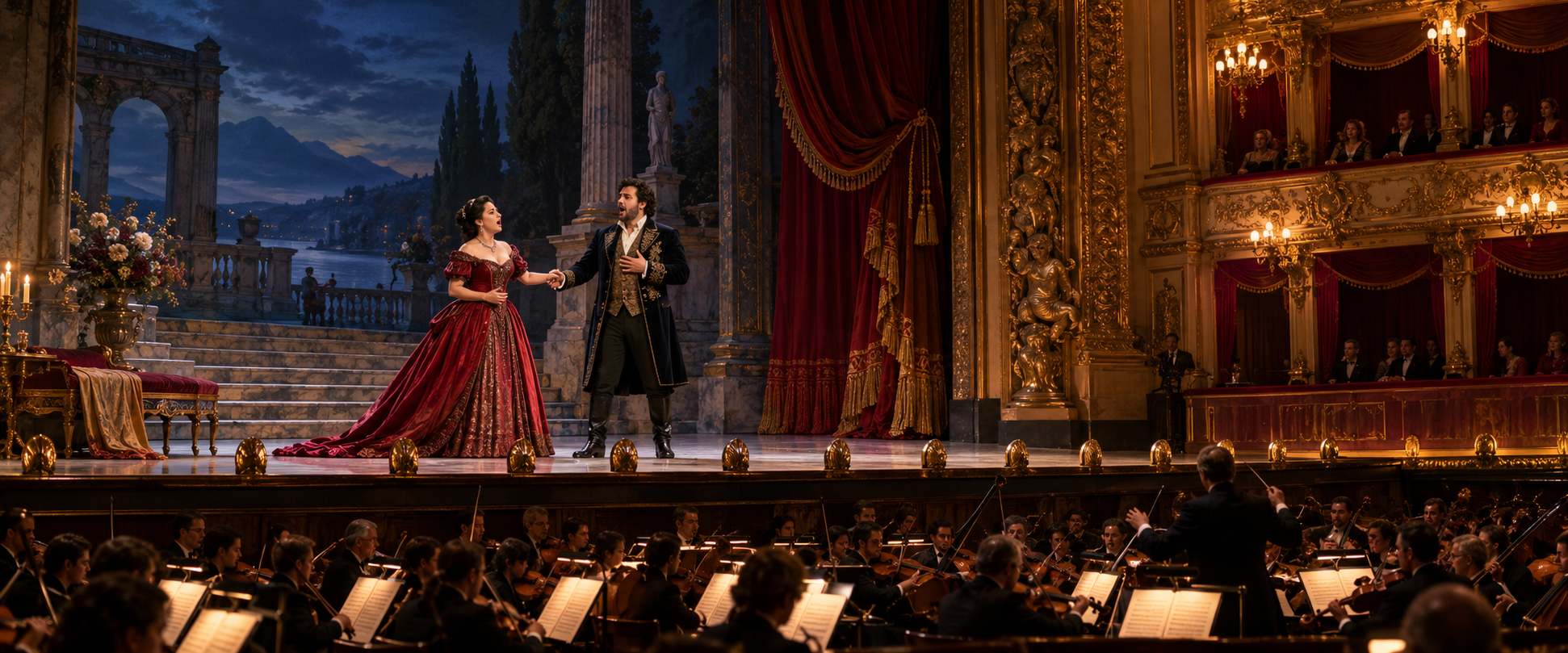
A singer steps onto the stage. The orchestra begins quietly, creating an atmosphere of anticipation. Then a voice rises above the instruments, expressing an emotion that words alone might struggle to communicate.
This is one of the defining experiences of opera music.
Opera brings together singing, orchestral composition, drama, poetry, and theatrical performance. A story unfolds through music, with singers portraying characters whose relationships, decisions, and emotions shape the action.
Some moments are intimate. Others involve powerful choruses, dramatic confrontations, or elaborate orchestral passages.
Although opera has a history stretching back more than four centuries, its music remains accessible to anyone willing to listen with curiosity.
You don't need to understand Italian, recognize every composer, or know an entire plot before enjoying an opera aria.
A beautiful melody, an expressive voice, or an unexpected orchestral change can provide an immediate connection.
From the elegance of Mozart to the emotional intensity of Verdi and Puccini, opera offers an extraordinary variety of musical experiences.
In this guide, we'll explore what opera is, how it developed, its most famous composers and singers, essential arias, and how to start listening to opera radio online.
You'll also find a practical one-hour listening plan designed for beginners.
If you're ready to discover the genre, start with the Opera radio category on 1LiveRadio.
1. What Is Opera Music?
Opera is a form of musical theatre in which singing plays a central role in telling a dramatic story.
Unlike a conventional play, where most dialogue is spoken, opera generally uses music to communicate characters' thoughts, emotions, and actions.
A complete production may combine:
-
Solo singing.
-
Duets and ensembles.
-
Choruses.
-
Orchestral accompaniment.
-
Acting and stage movement.
-
Costumes and scenery.
-
Dramatic storytelling.
The relationship between these elements is essential.
A singer may express grief through a long melodic phrase while the orchestra creates tension underneath. A duet may reveal conflicting emotions, and a chorus may represent a crowd or community.
Opera is therefore more than a collection of beautiful songs.
It is a dramatic experience in which music helps tell the story.
For additional historical context, explore Britannica's overview of opera.
2. The Origins of Opera: From Italy to the World
Opera emerged in Italy around the end of the sixteenth century.
Its development was influenced by attempts to combine music, poetry, and drama in ways inspired by ideas about ancient Greek theatre.
Early composers experimented with musical forms that could make dramatic text understandable while allowing singers to express emotion.
The first operas
Jacopo Peri's Dafne, composed in the late 1590s, is often identified as one of the earliest operas, although its music is largely lost.
His Euridice, first performed in 1600, is among the earliest surviving operas.
Claudio Monteverdi
Monteverdi helped establish opera as a powerful dramatic form.
His L'Orfeo, first performed in 1607, remains an important landmark in opera history.
Opera spreads across Europe
During the seventeenth and eighteenth centuries, opera developed in several European countries.
Different traditions emerged, reflecting local languages, theatrical practices, and musical preferences.
The nineteenth century
Opera became increasingly important in public musical culture.
Composers such as Rossini, Donizetti, Bellini, Verdi, and Wagner developed distinctive approaches to vocal writing and drama.
The twentieth century and beyond
Composers continued experimenting with harmony, orchestration, dramatic subjects, and theatrical presentation.
Opera remains a living art form, with contemporary works performed alongside historical masterpieces.
For a useful introduction, read Opera North's brief history of opera.
3. How Opera Tells a Story Through Music
One of opera's most interesting characteristics is the relationship between dramatic action and musical expression.
A character may communicate an emotion through a melody that lasts several minutes.
The orchestra may reveal tension even when the singer's words appear calm.
The role of the voice
Singers communicate character and emotion through phrasing, tone, dynamics, and vocal technique.
The role of the orchestra
The orchestra establishes atmosphere, supports the singers, and sometimes introduces musical ideas associated with characters or situations.
The role of the chorus
A chorus can represent groups of people, communities, or collective reactions.
The role of musical contrast
A quiet passage may lead into a dramatic climax.
A joyful melody may appear in a scene with troubling implications.
Why this matters
Opera rewards attentive listening because its meaning is communicated through several musical layers at once.
Listening tip: Choose an aria and pay attention to how the orchestra changes as the singer's emotions become more intense.
4. Opera Arias: The Most Memorable Musical Moments
An aria is a solo vocal piece, or a solo-dominated passage, that allows a character to express an emotion, thought, or situation.
Arias are among the most recognizable parts of opera.
They can often be appreciated independently of the complete production.
What makes an aria memorable?
A strong aria may feature:
-
An expressive melody.
-
Distinctive vocal writing.
-
Emotional development.
-
Orchestral support.
-
A dramatic climax.
Famous opera arias
“Nessun dorma” — Giacomo Puccini
From Turandot.
A powerful tenor aria associated with determination and hope.
“La donna è mobile” — Giuseppe Verdi
From Rigoletto.
A lively and immediately recognizable melody.
“Habanera” — Georges Bizet
From Carmen.
A famous mezzo-soprano aria built around a distinctive rhythm.
“O mio babbino caro” — Giacomo Puccini
From Gianni Schicchi.
A lyrical soprano aria expressing a young woman's appeal to her father.
“Der Hölle Rache” — Wolfgang Amadeus Mozart
From The Magic Flute.
An exceptionally demanding soprano aria commonly known as the Queen of the Night aria.
Where to begin
Start with “O mio babbino caro” if you prefer lyrical melodies.
Choose “Nessun dorma” if you enjoy dramatic vocal climaxes.
Try the Queen of the Night aria if you want to hear extraordinary vocal agility.
5. Arias, Recitatives, Duets, and Choruses
Opera uses several musical forms to develop its story.
Understanding a few basic terms makes listening easier.
Musical form Main purpose What to listen for Aria Express a character's emotions or thoughts Melody and vocal expression Recitative Move the dramatic action forward Speech-like musical phrasing Duet Bring two singers together Interaction between voices Ensemble Combine several characters Contrasting musical lines Chorus Represent a group or collective voice Harmony and dramatic scale Overture Introduce an opera instrumentally Orchestral themes and atmosphere Interlude Connect scenes or provide musical transition Changes in mood and orchestrationThese forms do not appear in exactly the same way in every opera.
Some works use clearly separated arias and recitatives, while others develop a more continuous musical structure.
A useful listening exercise
Compare an aria with a recitative.
Notice how the aria may emphasize a sustained emotional moment while the recitative often communicates information more directly.
6. The Main Opera Voice Types
Opera singers are commonly categorized according to vocal range and other characteristics.
These categories help composers and performers match voices to particular roles.
Soprano
The highest common female voice category.
Soprano roles may require lyrical expression, dramatic power, or exceptional agility.
Mezzo-soprano
Generally lower than soprano.
Mezzo-soprano roles can include a wide variety of characters and musical styles.
Contralto
A comparatively low female voice category.
True contralto voices are relatively uncommon.
Countertenor
A high male voice category, often associated with particular historical and contemporary repertories.
Tenor
A high male voice category frequently associated with leading roles.
Baritone
A male voice category generally positioned between tenor and bass.
Bass
The lowest common male voice category.
Bass roles may require vocal depth, authority, or dramatic intensity.
An important detail
Vocal classification involves more than the highest and lowest notes a singer can produce.
Timbre, comfortable range, vocal weight, and technical characteristics also matter.
Listening tip
Compare a soprano aria with a baritone aria.
Notice differences in tone, vocal color, and dramatic expression.
7. Mozart: Elegance, Character, and Musical Drama
Wolfgang Amadeus Mozart is one of opera's most influential composers.
His works combine sophisticated musical writing with vivid dramatic characterization.
Mozart's operas often explore relationships, misunderstandings, social expectations, and human emotions.
Famous Mozart operas
The Marriage of Figaro
A comedy involving relationships, social tensions, and complicated personal situations.
Don Giovanni
A dramatic work centered on the legendary character of Don Juan.
The Magic Flute
A work combining fantasy, symbolism, comedy, and serious themes.
Essential listening
-
“Voi che sapete” — The Marriage of Figaro.
-
“Là ci darem la mano” — Don Giovanni.
-
“Der Hölle Rache” — The Magic Flute.
What to listen for
Mozart frequently reveals character through subtle musical details.
Notice how the melody, accompaniment, and rhythm reflect a character's emotional state.
8. Verdi: Powerful Voices and Human Conflict
Giuseppe Verdi became one of the defining composers of nineteenth-century Italian opera.
His works are known for memorable melodies, powerful dramatic situations, and expressive vocal writing.
Famous Verdi operas
La Traviata
A tragic story centered on love, social expectations, and personal sacrifice.
Rigoletto
A drama involving deception, power, and tragedy.
Aida
A large-scale work exploring love, loyalty, and political conflict.
Essential listening
-
“Libiamo ne' lieti calici” — La Traviata.
-
“La donna è mobile” — Rigoletto.
-
“Celeste Aida” — Aida.
What makes Verdi distinctive?
Verdi often creates direct emotional impact through clear melodic writing and dramatic contrasts.
His music can move quickly between intimacy and intensity.
Listening tip
Play “Libiamo ne' lieti calici.”
Notice how the duet and surrounding voices contribute to the atmosphere of celebration.
9. Puccini: Emotion and Orchestral Color
Giacomo Puccini is especially admired for his ability to combine expressive melodies with dramatic orchestral writing.
His operas frequently explore love, loss, jealousy, and difficult personal choices.
Famous Puccini operas
La Bohème
A story of young artists, friendship, love, and hardship.
Tosca
A dramatic work involving love, political conflict, and betrayal.
Madama Butterfly
A tragedy centered on love, cultural misunderstanding, and abandonment.
Turandot
A work combining spectacle, mystery, and dramatic vocal writing.
Essential listening
-
“Che gelida manina” — La Bohème.
-
“Vissi d'arte” — Tosca.
-
“Un bel dì vedremo” — Madama Butterfly.
-
“Nessun dorma” — Turandot.
What to listen for
Puccini's orchestration often intensifies the emotional meaning of a vocal phrase.
Notice how the instruments support the singer without merely repeating the melody.
10. Wagner: Musical Drama on a Grand Scale
Richard Wagner developed an influential approach to opera and music drama.
His works often involve mythology, philosophical themes, and large orchestral forces.
Important Wagner works
The Flying Dutchman
A supernatural story involving a cursed sailor.
Tristan und Isolde
A drama exploring love, desire, and longing.
The Ring of the Nibelung
A cycle of four music dramas involving gods, heroes, power, and conflict.
Leitmotifs
Wagner is particularly associated with the use of recurring musical ideas, often called leitmotifs.
These may be connected with characters, objects, situations, or dramatic concepts.
Why leitmotifs matter
A recurring theme can remind the listener of something important even when it is not explicitly mentioned.
Listening tip
Choose an orchestral excerpt from Wagner.
Listen for a melody that returns in a different musical setting.
Notice how changes in instrumentation or harmony affect its meaning.
11. Bizet and the Popularity of Carmen
Georges Bizet's Carmen is one of the world's best-known operas.
Its music combines memorable melodies, strong rhythmic character, and dramatic tension.
The story
Carmen follows a complex relationship involving desire, jealousy, and personal freedom.
Famous musical moments
“Habanera”
A distinctive aria sung by Carmen.
“Toreador Song”
A memorable number associated with Escamillo.
Why Carmen is accessible
Many listeners recognize its melodies even if they have never attended an opera.
The music is rhythmically distinctive and dramatically direct.
Listening tip
Compare the “Habanera” with the “Toreador Song.”
Notice how Bizet creates contrasting personalities through melody and rhythm.
12. Famous Opera Singers Worth Discovering
A singer's interpretation can transform the experience of an opera.
Two performers may sing the same aria with different phrasing, timing, vocal color, and emotional emphasis.
Maria Callas
Callas became celebrated for her dramatic interpretations and expressive vocal performances.
Luciano Pavarotti
Pavarotti was known for his powerful tenor voice and became one of the most internationally recognized opera singers.
Plácido Domingo
Domingo developed a long international career across a wide operatic repertoire.
José Carreras
Carreras became widely admired for his lyrical tenor singing.
Leontyne Price
Price was celebrated for her rich soprano voice and performances in major operatic roles.
Joan Sutherland
Sutherland became especially associated with technically demanding coloratura and bel canto repertoire.
Renée Fleming
Fleming is known for her expressive soprano singing across opera and other vocal music.
Cecilia Bartoli
Bartoli is admired for her interpretations of Baroque and bel canto repertoire.
Listening exercise
Find two performances of the same aria by different singers.
Compare their tempo, phrasing, dynamics, and emotional interpretation.
This is one of the most rewarding ways to develop an appreciation of opera singing.
13. Italian Opera vs. German and French Opera
Opera developed through several national and linguistic traditions.
These traditions overlap, and individual composers often worked across stylistic boundaries.
Italian opera
Italian opera is strongly associated with lyrical vocal writing and composers such as Rossini, Verdi, and Puccini.
German-language opera
German-language traditions include works by Mozart, Weber, Wagner, and Richard Strauss.
Some emphasize complex orchestration and dramatic continuity.
French opera
French opera includes works by composers such as Bizet, Gounod, and Massenet.
Different periods developed distinctive approaches to melody, drama, and theatrical spectacle.
Does language matter?
Language affects rhythm, pronunciation, and vocal phrasing.
However, listeners can appreciate the music without understanding every word.
A practical approach
Read a short plot summary before listening.
If available, follow a translation of the text.
Then focus on how the music expresses the characters' emotions.
14. Opera vs. Classical Music
Opera is closely connected with classical music, but the two terms are not interchangeable.
Classical music is a broad category encompassing many traditions of composed music.
It includes symphonies, chamber music, concertos, solo instrumental works, choral music, and opera.
Opera is a dramatic art form in which music and singing play central roles.
What they share
Opera and orchestral classical music often use similar instruments and compositional techniques.
What makes opera different?
Opera combines musical composition with dramatic characters and theatrical storytelling.
Can opera be enjoyed without seeing the stage?
Yes.
Although the theatrical elements are important to a complete production, individual arias, overtures, and orchestral passages can be rewarding as audio experiences.
Related listening
Explore the Classical radio category on 1LiveRadio.
You can also read our Classical Music Guide.
15. Opera vs. Musical Theatre
Opera and musical theatre both combine music with dramatic performance.
However, their conventions often differ.
Opera
Singing usually carries a substantial part of the dramatic action.
Operatic vocal technique is traditionally designed to project over an orchestra without electronic amplification, although performance practices vary.
Musical theatre
Musicals commonly combine songs with spoken dialogue and may draw on pop, jazz, rock, and other musical styles.
Microphone amplification is widely used in contemporary musical theatre.
Important overlap
The distinction is not absolute.
Some operas include spoken dialogue, while certain musicals use extensive continuous singing.
Listening comparison
Compare a traditional opera aria with a musical-theatre solo.
Notice differences in vocal technique, orchestration, and dramatic presentation.
Explore the Musical genre on 1LiveRadio or read our Musical Theatre Listening Guide.
16. How to Start Listening to Opera as a Beginner
Opera can seem unfamiliar at first, particularly when a performance uses a language you do not speak.
A gradual approach makes the experience more enjoyable.
Start with one aria
Choose a short, memorable piece rather than an entire opera.
Learn the dramatic situation
Read two or three sentences explaining what the character is experiencing.
Follow the melody
Listen to the shape of the vocal line.
Notice the orchestra
Pay attention to changes in dynamics and instrumentation.
Explore different voices
Compare soprano, tenor, baritone, and other vocal types.
Listen more than once
Familiarity often reveals musical details that were not obvious initially.
Avoid trying to understand everything
You do not need to identify every musical technique.
A useful question
How does the music communicate the character's emotion?
This question provides a simple and rewarding starting point.
17. A One-Hour Opera Listening Journey
The following listening plan introduces several important aspects of opera.
The suggested pieces can be heard as individual recordings or excerpts. Use the remaining time in each section to replay passages and compare performances.
Minutes 0–10: Discover a Lyrical Aria
Suggested piece: “O mio babbino caro” — Puccini.
Listen for: Smooth melodic lines and emotional expression.
Goal: Experience opera's lyrical side.
Minutes 10–20: Hear Dramatic Tenor Singing
Suggested piece: “Nessun dorma” — Puccini.
Listen for: The gradual development toward a powerful climax.
Goal: Understand how vocal intensity creates dramatic impact.
Minutes 20–30: Explore Vocal Agility
Suggested piece: “Der Hölle Rache” — Mozart.
Listen for: Rapid vocal passages and demanding high notes.
Goal: Discover the technical possibilities of operatic singing.
Minutes 30–40: Experience an Ensemble
Suggested piece: “Libiamo ne' lieti calici” — Verdi.
Listen for: Interaction between solo voices and chorus.
Goal: Understand how opera combines several performers.
Minutes 40–50: Discover Opera's Rhythmic Character
Suggested piece: “Habanera” — Bizet.
Listen for: Distinctive rhythm and expressive vocal phrasing.
Goal: Explore a contrasting musical style.
Minutes 50–60: Explore Opera Radio
Visit the Opera radio category on 1LiveRadio.
Choose an available station and listen to its programming.
Listen for: Differences between vocal and instrumental passages.
Goal: Discover a composer, singer, or aria you have not heard before.
After your listening session
Ask yourself:
-
Which voice interested me most?
-
Did I prefer lyrical or dramatic music?
-
Which orchestral passage stood out?
-
Would I enjoy hearing the complete opera?
-
Which composer should I explore next?
Your answers can help guide future listening.
18. How to Choose an Opera Radio Station
Opera-oriented radio programming can vary significantly.
Some stations emphasize complete performances.
Others include arias, overtures, and selections from well-known works.
For beginners
Look for programming featuring familiar arias and accessible selections.
For vocal enthusiasts
Choose stations or programs emphasizing famous singers and historical recordings.
For orchestral music lovers
Explore broadcasts featuring overtures and instrumental excerpts.
For experienced listeners
Look for complete opera performances and specialist programming.
For broader classical listening
Consider classical stations that include opera alongside symphonies and chamber music.
A practical tip
Listen for several minutes before judging a station.
One instrumental excerpt may not represent the rest of its programming.
19. Opera Radio on 1LiveRadio
1LiveRadio provides a dedicated category for discovering stations associated with opera.
Explore Opera Radio
Browse the Opera category on 1LiveRadio.
This is the most direct starting point for opera-related station listings.
Explore Classical Radio
Visit the Classical category for broader programming that may include opera.
WOSU Classical 101 FM
Explore WOSU Classical 101 FM.
This classical station listing offers another starting point for listeners interested in the wider classical repertoire.
Its inclusion here does not mean that it broadcasts opera continuously.
Discover Related Music
Explore the Italian Music Guide to learn more about musical traditions connected with opera's history.
Note: The linked station and category pages were accessible when checked. Live audio availability and current programming schedules were not independently verified.
20. Common Mistakes Beginners Make With Opera
Opera becomes more approachable when listeners avoid a few common assumptions.
Mistake 1: Thinking opera is only for experts
You can appreciate a beautiful aria without formal musical training.
Mistake 2: Believing you must understand every word
A translation helps, but melody and vocal expression communicate important emotions.
Mistake 3: Starting with the longest work
A short aria or overture can provide a better introduction.
Mistake 4: Assuming all opera sounds alike
Mozart, Verdi, Wagner, and Puccini developed very different musical approaches.
Mistake 5: Focusing only on vocal power
Subtle phrasing and expressive restraint can be just as important.
Mistake 6: Ignoring the orchestra
Instrumental writing contributes to the drama.
Mistake 7: Treating every aria as an isolated song
Knowing the dramatic situation can deepen your appreciation.
Mistake 8: Assuming historical performances are the only valid interpretations
Opera continues to evolve through new productions and artistic interpretations.
A better approach
Begin with curiosity rather than expectations.
Listen for what interests you, then gradually explore the surrounding work.
21. Why Opera Still Matters Today
Opera remains important because it combines several forms of artistic expression.
Its music can communicate complex emotions through melody, harmony, rhythm, and orchestration.
Its stories explore themes that continue to interest audiences, including love, ambition, loyalty, jealousy, sacrifice, and conflict.
Musical influence
Opera has contributed to the development of vocal technique, orchestral composition, and theatrical music.
Dramatic storytelling
Composers use musical structure to develop characters and situations.
Performance traditions
Opera offers opportunities to compare interpretations across generations.
Cultural significance
Opera has played an important role in the artistic histories of several countries.
Contemporary creativity
New operas continue to be composed and performed.
Accessibility through recordings
Radio, streaming, and recorded performances allow listeners to explore works beyond the opera house.
An enduring experience
Opera can be enjoyed as theatre, musical composition, vocal performance, or a combination of all three.
For an additional beginner-friendly introduction, explore the English National Opera's guide to opera.
Frequently Asked Questions About Opera Music
What is opera music?
Opera is a dramatic musical art form that combines singing, instrumental accompaniment, and theatrical storytelling.
When was opera invented?
Opera emerged in Italy around the end of the sixteenth century.
Who are the most famous opera composers?
Mozart, Verdi, Puccini, Wagner, Rossini, and Bizet are among the most widely recognized opera composers.
What is an opera aria?
An aria is a solo vocal piece or passage that typically allows a character to express an emotion, thought, or dramatic situation.
What is the most famous opera aria?
There is no universally agreed answer, but “Nessun dorma,” “La donna è mobile,” and the Queen of the Night aria are among the most recognizable.
What are the main opera voice types?
Common categories include soprano, mezzo-soprano, contralto, countertenor, tenor, baritone, and bass.
Do opera singers use microphones?
Traditional operatic singing is generally designed for acoustic projection without individual amplification, although practices vary by venue and production.
Is opera the same as classical music?
Opera is part of the broader classical music tradition, but classical music includes many other forms.
Is opera the same as musical theatre?
No. The traditions overlap, but they often differ in vocal technique, dramatic structure, and performance practices.
Do I need to understand Italian to enjoy opera?
No. Understanding the language can deepen your appreciation, but music and vocal expression can communicate emotion independently.
What is the best opera for beginners?
Popular starting points include Mozart's The Magic Flute, Verdi's La Traviata, Puccini's La Bohème, and Bizet's Carmen.
Can I listen to opera radio online?
Yes. You can explore the Opera radio category on 1LiveRadio to find relevant station listings.
Final Thoughts: Discover the Power of Opera Music
Opera is one of the most expressive forms of musical storytelling.
It combines the human voice with orchestral composition and theatrical drama, creating experiences that can be intimate, joyful, mysterious, or overwhelming.
A single aria may communicate longing.
A duet may reveal a complicated relationship.
A chorus may transform a private conflict into a public event.
And an orchestral passage may express emotions that the characters cannot put into words.
The greatest reward comes from listening to how these elements work together.
You do not need to understand an entire opera to appreciate one remarkable musical moment.
Begin with a familiar aria.
Follow the melody.
Notice the singer's phrasing.
Listen to the orchestra.
Then explore the dramatic situation behind the music.
As your familiarity grows, you may discover a preference for Mozart's elegance, Verdi's dramatic intensity, Puccini's emotional melodies, or Wagner's expansive orchestral writing.
There is no single correct way to begin.
Whether you prefer famous arias, complete performances, or historical recordings, opera offers a remarkable range of musical experiences.
Start with the Opera radio category on 1LiveRadio, explore the Classical music guide, and discover the voices and compositions that interest you most.
Sometimes, the best introduction to opera is simply one unforgettable voice and the story it begins to tell.
Reader comments
No comments yet. Start the conversation.
Leave a comment
Your email stays private. Comments appear after approval.