
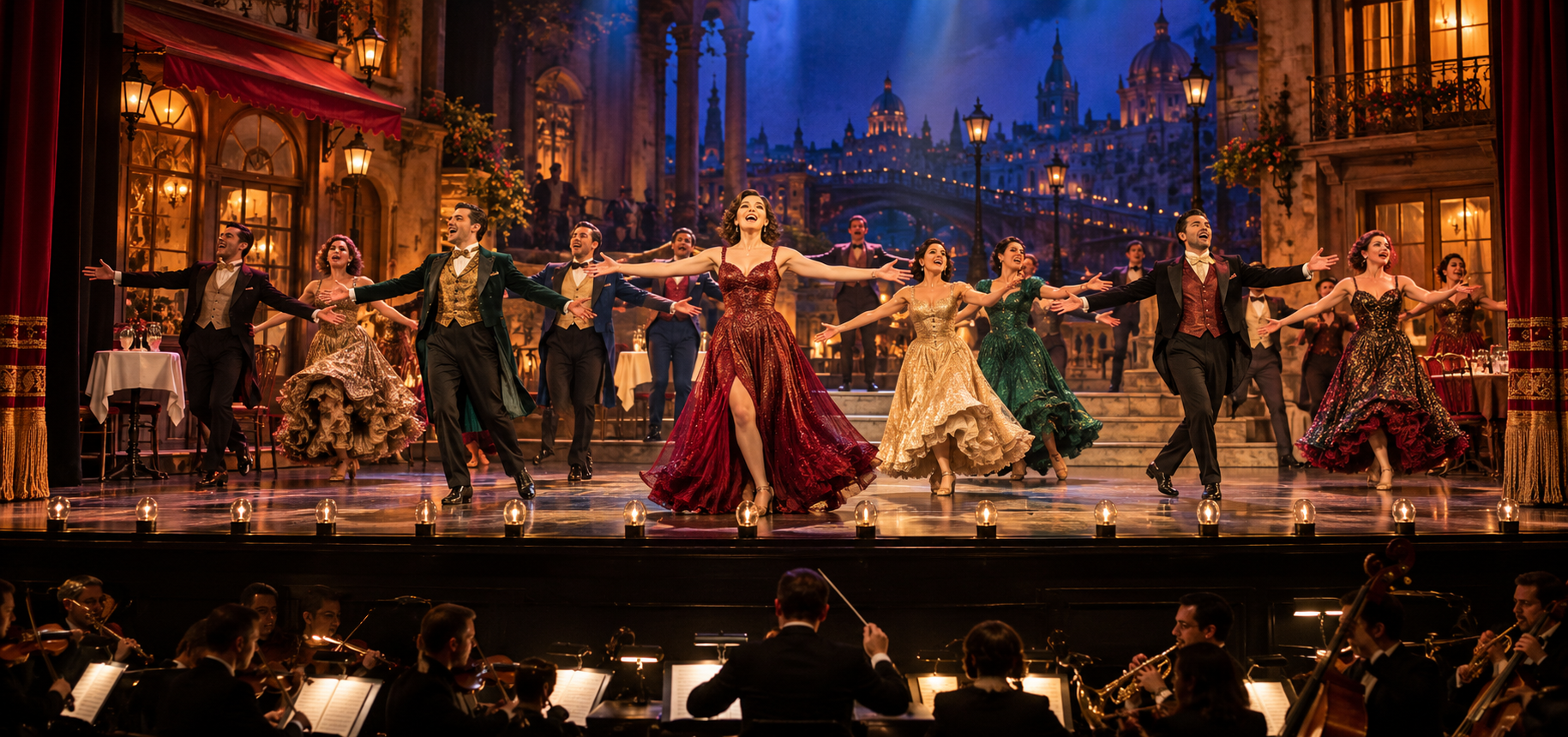
A spotlight illuminates an empty stage. An orchestra begins playing, and a performer steps forward to sing.
Within moments, the audience learns something important about the character: what they want, what they fear, or what they are struggling to express.
The song is entertaining, but it also serves a dramatic purpose.
This is what makes musical theatre songs different from many other forms of popular music.
In musical theatre, songs are often essential parts of the storytelling. They can reveal emotions, introduce characters, develop relationships, create conflict, or bring a dramatic scene to its conclusion.
A memorable musical theatre song works on two levels. It contributes to the production's story, but it can also remain compelling when heard independently.
Think of the emotional power of Les Misérables, the unforgettable melodies of The Phantom of the Opera, the storytelling of Hamilton, or the uplifting songs of The Sound of Music.
Each production approaches music differently, yet all demonstrate how singing can transform a theatrical moment.
For radio listeners, musical theatre offers an unusually varied experience. A playlist might move from an intimate solo to a dramatic duet, a comic number, or a powerful ensemble finale.
In this guide, we'll explore the history of musical theatre, the differences between Broadway and West End productions, influential composers, famous musicals, essential songs, and practical listening techniques.
You'll also find a one-hour listening plan and ways to explore Musical radio on 1LiveRadio.
Whether you're discovering Broadway classics or exploring modern musical soundtracks, the best starting point is simple: listen to the story behind the song.
1. What Is Musical Theatre Music?
Musical theatre combines music, spoken dialogue, acting, and often dance to tell a story.
Songs may serve several dramatic purposes. Some introduce characters, while others reveal emotions that would be difficult to communicate through dialogue alone.
Unlike a conventional pop album, where individual songs may be independent, a musical's score is often designed around an overarching narrative.
Common characteristics of musical theatre songs
Storytelling: Lyrics communicate events, emotions, or character motivations.
Character development: Songs reveal personalities, ambitions, and conflicts.
Expressive vocals: Performers use phrasing and dynamics to communicate dramatic meaning.
Orchestration: Instrumental arrangements support the scene's emotional atmosphere.
Musical themes: Melodies may return at different moments in the production.
Ensemble singing: Multiple performers can represent different characters or viewpoints.
Varied musical styles: Productions may incorporate classical, jazz, pop, rock, hip-hop, folk, or electronic influences.
Musical theatre is not defined by a single instrumental sound.
Its distinguishing feature is the relationship between music and dramatic storytelling.
2. A Brief History of Musical Theatre
Modern musical theatre developed through several theatrical and musical traditions.
Its history includes influences from operetta, musical comedy, vaudeville, revue, and other forms of popular entertainment.
Early theatrical traditions
Nineteenth-century operetta and musical entertainment helped establish approaches that later influenced stage musicals.
These productions combined music, theatrical performance, and dramatic or comic storytelling.
The early twentieth century
Musical comedy became increasingly prominent in American theatre.
Broadway developed into an important center for theatrical productions featuring music and dance.
Show Boat and dramatic integration
The 1927 musical Show Boat, with music by Jerome Kern and lyrics and book by Oscar Hammerstein II, became an important landmark.
Its approach to dramatic themes and musical storytelling helped influence later developments.
Read more in Britannica's history of Show Boat.
Oklahoma! and the integrated musical
Rodgers and Hammerstein's Oklahoma!, which premiered in 1943, became another major milestone.
The production demonstrated how songs, dance, and dramatic action could work together within a unified theatrical structure.
Later developments
During the second half of the twentieth century, musicals explored increasingly diverse themes and musical styles.
Rock musicals, concept musicals, large-scale international productions, and contemporary works expanded the possibilities of the form.
Musical theatre today
Modern musicals continue to combine established theatrical techniques with contemporary musical influences.
For a broader introduction, explore Britannica's guide to musical theatre.
3. Broadway vs. West End Musicals
Two of the most recognizable centers of English-language musical theatre are Broadway and London's West End.
Both are associated with internationally successful productions.
Broadway
Broadway refers to a major professional theatre district in New York City.
It has played an important role in the development of American musical theatre.
West End
London's West End is another major center for professional theatre.
It features both British productions and international musicals.
Shared productions
Many successful musicals have appeared in both locations.
Examples include:
-
The Phantom of the Opera
-
Les Misérables
-
Wicked
-
The Lion King
-
Hamilton
Are Broadway and West End musicals musically different?
Not necessarily.
The distinction is primarily geographical and theatrical rather than a strict musical classification.
A Broadway production and a West End production of the same show may use substantially similar songs and orchestrations.
However, performances, casts, and staging can differ.
Listening tip
Compare recordings from different productions of the same musical.
Notice how vocal interpretation changes the emotional character of familiar songs.
4. Why Musical Theatre Songs Tell Stories
One of musical theatre's defining characteristics is the dramatic purpose of its songs.
A number may express something the character cannot easily say in ordinary conversation.
Introducing a character
An early song may reveal a character's personality or ambitions.
Expressing desire
A character may sing about a dream or goal.
Developing conflict
A song can reveal disagreement or emotional tension.
Changing a relationship
A duet may show how two characters influence one another.
Creating comedy
Musical timing and lyrics can support humorous scenes.
Building dramatic intensity
An ensemble number can bring several storylines together.
Reaching a resolution
A final song may reflect the story's emotional conclusion.
Listening exercise
Choose a musical theatre song and ask:
What does the character want at this moment?
Then consider how the melody, lyrics, and arrangement communicate that desire.
5. The Different Types of Musical Theatre Songs
Musical theatre includes several recognizable song functions.
These categories are useful, although individual songs may serve more than one purpose.
Song type Dramatic purpose Example Opening number Establishes the world or atmosphere “Circle of Life” — The Lion King Character introduction Reveals personality or circumstances “Alexander Hamilton” — Hamilton Desire song Expresses an ambition or longing “Part of Your World” — The Little Mermaid Love song Explores a romantic relationship “Tonight” — West Side Story Comic number Creates humor through music “Popular” — Wicked Dramatic solo Expresses intense personal emotion “I Dreamed a Dream” — Les Misérables Ensemble number Combines several voices or perspectives “One Day More” — Les Misérables Finale Concludes or reflects on the story “Finale” — In the HeightsThese functions help explain why musical theatre playlists can contain such contrasting moods.
A humorous song may be followed by an emotional ballad or a dramatic ensemble.
The variety reflects the needs of different stories.
6. The Importance of Lyrics in Musical Theatre
Lyrics are particularly important in musical theatre because they frequently communicate essential information.
A song's words may reveal the character's emotional state, introduce a new idea, or change the direction of the story.
Clear storytelling
Lyrics help listeners understand the dramatic situation.
Character perspective
The words reveal how a character interprets events.
Emotional development
A song may begin with uncertainty and end with determination.
Repetition
Repeated phrases can emphasize important ideas.
Wordplay
Some musicals use humor, rhyme, and linguistic complexity.
Musical phrasing
The rhythm of the words influences how they are performed.
Listening tip
Choose a song from a musical you have never seen.
Listen carefully to the lyrics.
Try to identify the character's situation without knowing the full plot.
Then read a short synopsis of the production.
Notice which details become clearer.
7. How Orchestration Supports the Story
Orchestration refers to the way musical material is arranged for instruments.
In musical theatre, orchestration can strongly influence the emotional meaning of a scene.
Strings
String instruments may create warmth, tension, or dramatic intensity.
Brass
Brass instruments can introduce excitement, grandeur, or rhythmic emphasis.
Woodwinds
Woodwinds contribute distinctive colors and melodic details.
Piano and keyboards
Keyboard instruments often support harmony and rhythm.
Percussion
Percussion can create momentum or emphasize dramatic transitions.
Guitars and bass
Rock- and pop-influenced musicals frequently use electric instruments.
Electronic sounds
Some contemporary productions incorporate synthesizers and electronic production.
Listening exercise
Choose an emotional musical theatre song.
Listen to its introduction before the vocalist enters.
What mood does the instrumentation establish?
Then notice how the arrangement changes as the song develops.
8. The Role of the Musical Theatre Performer
Musical theatre singing combines vocal technique with dramatic interpretation.
A performer must communicate the character's emotional state while maintaining musical accuracy.
Vocal clarity
Listeners need to understand the lyrics.
Emotional expression
Tone and phrasing communicate dramatic meaning.
Dynamic range
Changes in volume can emphasize important moments.
Character interpretation
The same song may sound different when performed by another actor.
Rhythmic precision
Performers coordinate with the orchestra and other singers.
Ensemble awareness
Group numbers require careful interaction.
Listening tip
Compare two recordings of the same musical theatre song.
Notice differences in tempo, phrasing, emotional emphasis, and vocal delivery.
Neither performance needs to be identical to communicate the song effectively.
9. Rodgers and Hammerstein: A Major Musical Theatre Partnership
Richard Rodgers and Oscar Hammerstein II became one of the most influential songwriting partnerships in musical theatre.
Their productions helped establish approaches to integrating songs with dramatic storytelling.
Important musicals
Oklahoma! (1943)
A landmark in the development of the integrated musical.
Carousel (1945)
Known for emotionally expressive songs and dramatic themes.
South Pacific (1949)
Combines memorable music with a story addressing social prejudice.
The King and I (1951)
Features songs that develop relationships and character perspectives.
The Sound of Music (1959)
Includes some of the most recognizable songs in musical theatre.
Essential songs
-
“Oh, What a Beautiful Mornin'”
-
“You'll Never Walk Alone”
-
“Some Enchanted Evening”
-
“Getting to Know You”
-
“My Favorite Things”
What to listen for
Notice how the songs express the characters' circumstances rather than functioning only as musical entertainment.
10. Stephen Sondheim and Complex Musical Storytelling
Stephen Sondheim was one of the most influential figures in modern musical theatre.
His work is particularly associated with sophisticated lyrics, character psychology, and inventive musical structures.
Important productions
Company
Explores relationships and modern adult life.
Follies
Examines memory, ambition, and disappointment.
A Little Night Music
Combines romantic complexity with distinctive musical writing.
Sweeney Todd
Uses music to support a dark and dramatic story.
Into the Woods
Reinterprets familiar fairy tales while exploring their consequences.
Sunday in the Park with George
Explores artistic creation and personal relationships.
Essential songs
-
“Being Alive”
-
“Send in the Clowns”
-
“Not While I'm Around”
-
“Finishing the Hat”
-
“No One Is Alone”
Listening tip
Pay attention to how the lyrics reveal conflicting emotions.
Sondheim's songs often become more meaningful when heard in their dramatic context.
11. Andrew Lloyd Webber and the Modern Musical
Andrew Lloyd Webber became one of the most commercially successful composers in musical theatre.
His productions include rock-influenced scores, dramatic ballads, and large-scale theatrical works.
Important musicals
Jesus Christ Superstar
A rock opera centered on the final days of Jesus.
Evita
A musical exploring the life and public image of Eva Perón.
Cats
A theatrical work inspired by T. S. Eliot's poetry.
The Phantom of the Opera
A romantic and dramatic musical featuring a large-scale score.
Sunset Boulevard
A musical adaptation of the classic film.
Essential songs
-
“Don't Cry for Me Argentina”
-
“Memory”
-
“The Music of the Night”
-
“All I Ask of You”
-
“As If We Never Said Goodbye”
Listening tip
Focus on the way orchestration supports emotional intensity.
Notice how melodies return in different dramatic situations.
12. Claude-Michel Schönberg and Les Misérables
Les Misérables is one of the most internationally recognized stage musicals.
Its music was composed by Claude-Michel Schönberg, with original French lyrics by Alain Boublil and Jean-Marc Natel. Herbert Kretzmer wrote the English-language lyrics.
The production is based on Victor Hugo's novel.
Why its music is distinctive
The score combines intimate solos with powerful ensemble numbers.
Melodies and musical ideas return throughout the production.
These recurring themes help connect different characters and dramatic moments.
Essential songs
“I Dreamed a Dream”
An emotional solo expressing disappointment and loss.
“On My Own”
A song exploring unrequited love.
“Bring Him Home”
A reflective prayer-like solo.
“One Day More”
A large ensemble number bringing together several dramatic perspectives.
“Do You Hear the People Sing?”
An anthem associated with collective action.
Listening tip
Listen to “One Day More.”
Try identifying the different characters' musical lines.
Notice how the arrangement combines them into a unified ensemble.
13. Lin-Manuel Miranda and Contemporary Musical Theatre
Lin-Manuel Miranda is a composer, lyricist, actor, and creator associated with contemporary musical theatre.
His work demonstrates how Broadway can incorporate musical influences from outside traditional show-tune styles.
In the Heights
This musical explores community, identity, and personal aspirations.
Its score incorporates Latin musical influences, hip-hop, and other contemporary styles.
Hamilton
Hamilton uses hip-hop, R&B, and musical theatre traditions to tell a story inspired by the life of Alexander Hamilton.
Musical storytelling
Miranda's work often uses intricate lyrics and rhythmic phrasing.
Essential songs
-
“In the Heights”
-
“96,000”
-
“Alexander Hamilton”
-
“My Shot”
-
“Wait for It”
-
“The Room Where It Happens”
Listening tip
Focus on the relationship between rhythmic delivery and storytelling.
Notice how different characters express their perspectives through distinct musical approaches.
14. Famous Broadway and West End Musicals
Musical theatre includes a wide range of productions.
The following selection provides useful starting points.
Musical First major stage premiere Musical characteristics Oklahoma! 1943 Integrated storytelling and memorable melodies West Side Story 1957 Dramatic orchestration, dance rhythms and vocal ensembles The Sound of Music 1959 Accessible melodies and expressive songs Les Misérables 1980 Recurring themes, emotional solos and large ensembles Cats 1981 Varied musical styles and theatrical atmosphere The Phantom of the Opera 1986 Dramatic melodies and rich orchestration Rent 1996 Rock-influenced music and contemporary themes Wicked 2003 Powerful vocal numbers and character-driven storytelling The Book of Mormon 2011 Musical comedy and theatrical satire Hamilton 2015 Hip-hop influences and complex lyrical storytelling Hadestown 2016 Folk, jazz and blues influencesThe dates refer to significant original stage premieres, not necessarily Broadway debuts.
How to explore these shows
Choose one production that interests you.
Listen to its opening number, a major solo, and an ensemble piece.
This provides a useful introduction to the musical's overall style.
15. The Difference Between a Cast Recording and a Soundtrack
Listeners often use the words cast recording and soundtrack interchangeably.
However, they describe different types of recordings.
Cast recording
A cast recording documents songs from a stage production.
It may feature performers from the original Broadway or West End cast.
Original Broadway cast recording
This generally features the original Broadway cast of a particular production.
Revival cast recording
A revival recording features performers from a later production.
Film soundtrack
A film soundtrack contains music associated with a motion picture.
Studio cast recording
A studio cast recording is produced separately from a particular stage cast.
Why the distinction matters
The same musical may have several recordings featuring different performers, orchestrations, and interpretations.
Listening tip
Compare a stage cast recording with a film adaptation.
Notice differences in vocal style, arrangement, and pacing.
For additional information, explore Broadway.org's guide to Broadway cast recordings.
16. Musical Theatre vs. Opera
Musical theatre and opera share important characteristics.
Both combine music and dramatic performance.
However, their traditions and performance conventions often differ.
Musical theatre
Frequently combines singing, spoken dialogue, acting, and dance.
Opera
Traditionally places a strong emphasis on sung drama and classical vocal techniques.
Vocal approaches
Musical theatre includes several vocal styles, from classical-influenced singing to contemporary pop and rock techniques.
Instrumentation
Both forms can use orchestras, although musical theatre productions may incorporate a wider range of popular music instrumentation.
Dramatic structure
Both use music to communicate character and emotion.
Important distinction
The boundaries are not absolute.
Some stage works incorporate characteristics of both opera and musical theatre.
Related reading
Explore The small details that make Opera memorable.
17. Musical Theatre vs. Film Musicals
Stage musicals and film musicals share many storytelling techniques.
However, their presentation differs.
Stage musicals
Performances unfold before a live audience.
Film musicals
Music is presented through cinematic techniques, including editing, camera movement, and location changes.
Adaptations
Some successful stage musicals become films.
Others begin as films and are later adapted for the stage.
Examples
-
The Sound of Music
-
West Side Story
-
Chicago
-
Les Misérables
-
The Lion King
Listening differences
A film soundtrack may feature different arrangements from a stage cast recording.
Related reading
Explore How to spend an hour with Film & Musical music.
18. Musical Theatre and Popular Music
Musical theatre has long interacted with popular music.
Different productions incorporate styles that reflect their historical periods and dramatic settings.
Jazz
Jazz-influenced rhythms and harmonies appear in numerous musicals.
Rock
Rock musicals use electric guitars, drums, and rock vocal techniques.
Pop
Contemporary pop influences shape many modern scores.
Hip-hop
Some productions use rap and rhythmically complex lyrics.
Folk
Folk influences can contribute to storytelling and atmosphere.
Classical music
Orchestral techniques remain important in many productions.
Listening tip
Compare a song from Oklahoma! with one from Hamilton.
Notice how different musical languages support dramatic storytelling.
Related reading
Discover What makes Pop radio worth a listen.
19. Essential Musical Theatre Songs for Beginners
The following songs provide an introduction to different aspects of musical theatre.
Musical Song What to listen for Oklahoma! “Oh, What a Beautiful Mornin'” Character introduction and melodic storytelling The Sound of Music “My Favorite Things” Memorable melody and lyrical expression West Side Story “Tonight” Romantic melody and dramatic atmosphere Les Misérables “I Dreamed a Dream” Emotional interpretation The Phantom of the Opera “The Music of the Night” Dramatic orchestration Cats “Memory” Vocal expression and melodic development Wicked “Defying Gravity” Character transformation and vocal intensity Rent “Seasons of Love” Ensemble singing Hamilton “Wait for It” Rhythmic storytelling and character perspective Hadestown “Wait for Me” Atmosphere and dramatic progressionThese selections represent different musical traditions and periods.
How to use this list
Choose three songs with contrasting styles.
Listen to the lyrics first.
Then focus on the vocal performance and instrumental arrangement.
Finally, consider what dramatic moment each song represents.
20. How to Listen to Musical Theatre Songs More Closely
Musical theatre rewards attention to both music and narrative.
First listen: Follow the lyrics
Identify what the performer is communicating.
Second listen: Consider the character
Ask why the character needs to sing.
Third listen: Focus on the melody
Notice how the melody supports the emotion.
Fourth listen: Hear the orchestration
Pay attention to the instruments.
Fifth listen: Identify dramatic changes
Notice when the musical intensity increases or decreases.
Sixth listen: Follow the backing voices
Observe how ensembles contribute to the scene.
Seventh listen: Consider the ending
Ask what has changed by the time the song finishes.
A useful question
Does the character feel the same at the end of the song as at the beginning?
In many effective musical theatre numbers, the answer is no.
21. A One-Hour Musical Theatre Listening Journey
A structured listening session can introduce several sides of musical theatre.
The following plan takes approximately sixty minutes.
Choose recordings or excerpts that fit each time block.
Minutes 0–10: Discover Classic Broadway
Suggested songs:
-
“Oh, What a Beautiful Mornin'” — Oklahoma!
-
“My Favorite Things” — The Sound of Music
Listen for: Memorable melodies and clear storytelling.
Goal: Understand the foundations of classic musical theatre.
Minutes 10–20: Explore Romantic and Dramatic Songs
Suggested songs:
-
“Tonight” — West Side Story
-
“The Music of the Night” — The Phantom of the Opera
Listen for: Orchestration and emotional expression.
Goal: Recognize how music supports dramatic atmosphere.
Minutes 20–30: Experience Emotional Solos
Suggested songs:
-
“I Dreamed a Dream” — Les Misérables
-
“Memory” — Cats
Listen for: Vocal phrasing and emotional intensity.
Goal: Understand the relationship between character and performance.
Minutes 30–40: Discover Ensemble Numbers
Suggested songs:
-
“One Day More” — Les Misérables
-
“Seasons of Love” — Rent
Listen for: Group harmonies and multiple vocal perspectives.
Goal: Recognize how ensembles contribute to storytelling.
Minutes 40–50: Explore Modern Musicals
Suggested songs:
-
“Defying Gravity” — Wicked
-
“Wait for It” — Hamilton
Listen for: Contemporary musical influences and character development.
Goal: Discover different approaches to modern musical theatre.
Minutes 50–60: Explore Musical Radio
Browse the Musical category on 1LiveRadio.
Choose a station that interests you.
Listen to several tracks without selecting each song individually.
Goal: Discover an unfamiliar musical or performer.
Reflect on your session
Which song communicated the strongest emotion?
Did you prefer a solo, duet, or ensemble?
Which musical style interested you most?
Which production would you like to explore further?
Your answers can guide your next listening session.
22. How to Choose a Musical Theatre Radio Station
Musical theatre radio programming can vary considerably.
Some stations focus on classic Broadway recordings.
Others include modern West End productions, film musicals, or broader soundtrack selections.
Classic Broadway
Look for programming featuring Rodgers and Hammerstein, Sondheim, and other influential composers.
Modern musicals
Choose stations featuring contemporary productions such as Wicked and Hamilton.
West End musicals
Explore programming featuring major London productions.
Film musicals
Some stations combine theatrical recordings with film soundtracks.
Mixed musical theatre
Broader stations may include songs from different periods and productions.
Choosing a station
Read the station description and listen to several tracks.
A single recording may not represent the station's overall programming.
Start with the Musical category on 1LiveRadio.
23. Finding Musical Theatre Radio on 1LiveRadio
1LiveRadio provides a dedicated category for discovering radio stations associated with musical theatre.
Browse the Musical category
Explore Musical radio on 1LiveRadio.
The category provides a starting point for exploring available station listings.
Check station descriptions
Look for information about Broadway, West End, cast recordings, or musical soundtracks.
Compare programming
Different stations may emphasize different periods and styles.
Discover new productions
Radio can introduce songs from musicals you have never heard.
Return to familiar favorites
A continuous playlist can also provide a convenient way to revisit classic songs.
Note: Individual musical theatre station links have not been independently confirmed for this article, so no specific station is presented as verified. Station availability and programming may change.
24. Musical Theatre for Different Listening Preferences
Musical theatre offers several approaches for different listeners.
For listeners who enjoy emotional ballads
Explore Les Misérables and The Phantom of the Opera.
For listeners who enjoy comedy
Try selected songs from The Book of Mormon or Avenue Q.
For listeners who enjoy complex lyrics
Explore Stephen Sondheim's work.
For listeners who enjoy contemporary music
Discover Hamilton, In the Heights, or Rent.
For listeners who enjoy orchestral arrangements
Explore West Side Story and classic Broadway productions.
For listeners who enjoy ensemble singing
Try Les Misérables and Rent.
Why this matters
Musical theatre is not one musical genre in the narrow sense.
It is a storytelling tradition that can incorporate many musical styles.
25. Building Your Own Musical Theatre Playlist
A personal playlist can introduce different approaches to theatrical songwriting.
Begin with a classic Broadway song.
Add a dramatic solo.
Choose a romantic duet.
Include a comic number.
Then add an ensemble piece.
Finish with a contemporary musical theatre recording.
Suggested playlist
-
“Oh, What a Beautiful Mornin'” — Oklahoma!
-
“My Favorite Things” — The Sound of Music
-
“Tonight” — West Side Story
-
“I Dreamed a Dream” — Les Misérables
-
“Popular” — Wicked
-
“One Day More” — Les Misérables
-
“Wait for It” — Hamilton
-
“Wait for Me” — Hadestown
What to compare
Notice how each song communicates a different dramatic situation.
Pay attention to lyrics, melody, instrumentation, and vocal delivery.
This approach can reveal the variety within musical theatre.
26. Common Mistakes When Exploring Musical Theatre
Several assumptions can make musical theatre harder to appreciate.
Assuming every musical sounds the same
Different productions incorporate very different musical styles.
Ignoring the lyrics
The words often contain essential dramatic information.
Listening only for vocal power
Subtle interpretation can be just as important.
Confusing cast recordings with film soundtracks
Different versions may feature different performers and arrangements.
Judging a musical by one song
A single recording may not represent the production's overall musical identity.
Ignoring ensemble numbers
Group songs can reveal important relationships and conflicts.
Expecting every song to work like a pop single
Some numbers depend heavily on dramatic context.
Overlooking orchestration
Instrumental arrangements contribute significantly to storytelling.
Assuming Broadway and West End describe different musical genres
They primarily refer to different theatrical locations.
A better approach
Listen to several songs from one production and consider how they contribute to the story.
27. Why Musical Theatre Radio Is Worth Exploring
Musical theatre radio offers a convenient way to discover songs from different productions.
Familiar classics
Many stations feature recognizable theatrical songs.
New discoveries
Radio may introduce unfamiliar musicals.
Vocal variety
Different performers bring distinct interpretations.
Musical diversity
Playlists can include classical-influenced songs, jazz, rock, pop, and hip-hop.
Historical exploration
Listeners can compare recordings from different decades.
Cast comparisons
Different productions may offer contrasting interpretations.
Storytelling
Songs can communicate powerful emotions even outside their original theatrical setting.
Why it matters
Musical theatre includes a vast collection of recordings.
Radio can help listeners explore beyond the most famous productions.
28. Explore Musical Theatre and Related Music on 1LiveRadio
Musical theatre connects with several musical traditions worth exploring.
Discover Musical radio
Browse the Musical category on 1LiveRadio.
Explore Film & Musical
Read How to spend an hour with Film & Musical music.
Discover Opera
Read The small details that make Opera memorable.
Explore Classical Music
Discover Classical Music Radio: Composers & Masterpieces.
Discover Pop Music
Read What makes Pop radio worth a listen.
Learn about musical theatre history
Explore Britannica's overview of musical theatre.
Research stage and screen musicals
Visit the Library of Congress guide to musicals.
Discover cast recordings
Explore Broadway.org's cast recording resources.
These resources provide different starting points for exploring theatrical music and its history.
Frequently Asked Questions About Musical Theatre Songs
What are musical theatre songs?
Musical theatre songs are compositions written for stage productions that combine music with dramatic storytelling.
What makes musical theatre music different from pop music?
Musical theatre songs frequently serve a specific dramatic purpose within a larger story.
What is Broadway?
Broadway is a major professional theatre district in New York City.
What is the West End?
The West End is a major theatre district in London.
Are Broadway and West End musicals different genres?
No. The terms primarily describe theatrical locations rather than separate musical genres.
What is a show tune?
A show tune is a song associated with a musical theatre production.
What is a cast recording?
A cast recording documents songs performed by a particular theatrical cast.
What is an original Broadway cast recording?
It generally features the original Broadway cast of a production.
What is the difference between a cast recording and a soundtrack?
Cast recordings document stage productions, while soundtracks are associated with films or other screen productions.
Who were Rodgers and Hammerstein?
Richard Rodgers and Oscar Hammerstein II were an influential musical theatre songwriting partnership.
Who was Stephen Sondheim?
Stephen Sondheim was a composer and lyricist known for sophisticated musical storytelling.
Who is Andrew Lloyd Webber?
Andrew Lloyd Webber is a composer associated with internationally successful musicals.
Who created Hamilton?
Lin-Manuel Miranda wrote the music, lyrics, and book for Hamilton.
What are some famous Broadway musicals?
Examples include Oklahoma!, West Side Story, Wicked, Hamilton, and The Lion King.
What are some famous West End musicals?
Examples include Les Misérables, The Phantom of the Opera, and Cats.
What are some famous musical theatre songs?
Examples include “Memory,” “Defying Gravity,” “I Dreamed a Dream,” and “The Music of the Night.”
What is an ensemble number?
An ensemble number is a musical passage performed by multiple characters or singers.
What is an opening number?
An opening number introduces the production's world, characters, or atmosphere.
What is a musical theatre ballad?
A ballad is generally a slower, emotionally expressive song.
Are all musicals performed live?
Stage musicals are performed live, but musical storytelling also appears in film and television.
Is musical theatre related to opera?
Yes. Both combine music and drama, although their traditions and performance conventions differ.
Can musical theatre include hip-hop?
Yes. Productions such as Hamilton incorporate hip-hop influences.
Can I listen to musical theatre songs on the radio?
Yes. Some radio stations feature Broadway, West End, and related theatrical recordings.
Where can I find Musical radio stations?
Browse the Musical category on 1LiveRadio.
Final Thoughts: Discover the Stories Behind Musical Theatre Songs
Musical theatre offers a listening experience built around the relationship between music and storytelling.
A melody introduces a character.
A lyric reveals an ambition.
An instrumental passage creates tension.
A duet develops a relationship.
An ensemble brings different perspectives together.
Each musical element contributes to the dramatic experience.
What makes musical theatre songs memorable is not simply their melodies, but the stories those melodies help communicate.
Classic Broadway productions established influential approaches to theatrical songwriting.
Later composers expanded the form through new musical styles and dramatic ideas.
Contemporary productions continue to combine established theatrical traditions with popular music influences.
For listeners, the most rewarding approach is to follow the narrative.
Pay attention to the lyrics.
Consider the character's motivation.
Notice how the orchestration changes.
Listen to the emotional development.
Ask what has changed by the end of the song.
Some listeners will prefer the melodies of Rodgers and Hammerstein.
Others may enjoy Stephen Sondheim's complex lyrics, Andrew Lloyd Webber's dramatic scores, or Lin-Manuel Miranda's contemporary storytelling.
There is no single correct starting point.
The beauty of musical theatre lies in discovering how music can transform a dramatic moment into an unforgettable listening experience.
To continue exploring, browse the Musical category on 1LiveRadio and discover related traditions through the Film & Musical, Opera, and Classical Music listening guides.
Your next favorite musical theatre song may be the one that tells a story you recognize in your own life.
Reader comments
No comments yet. Start the conversation.
Leave a comment
Your email stays private. Comments appear after approval.