
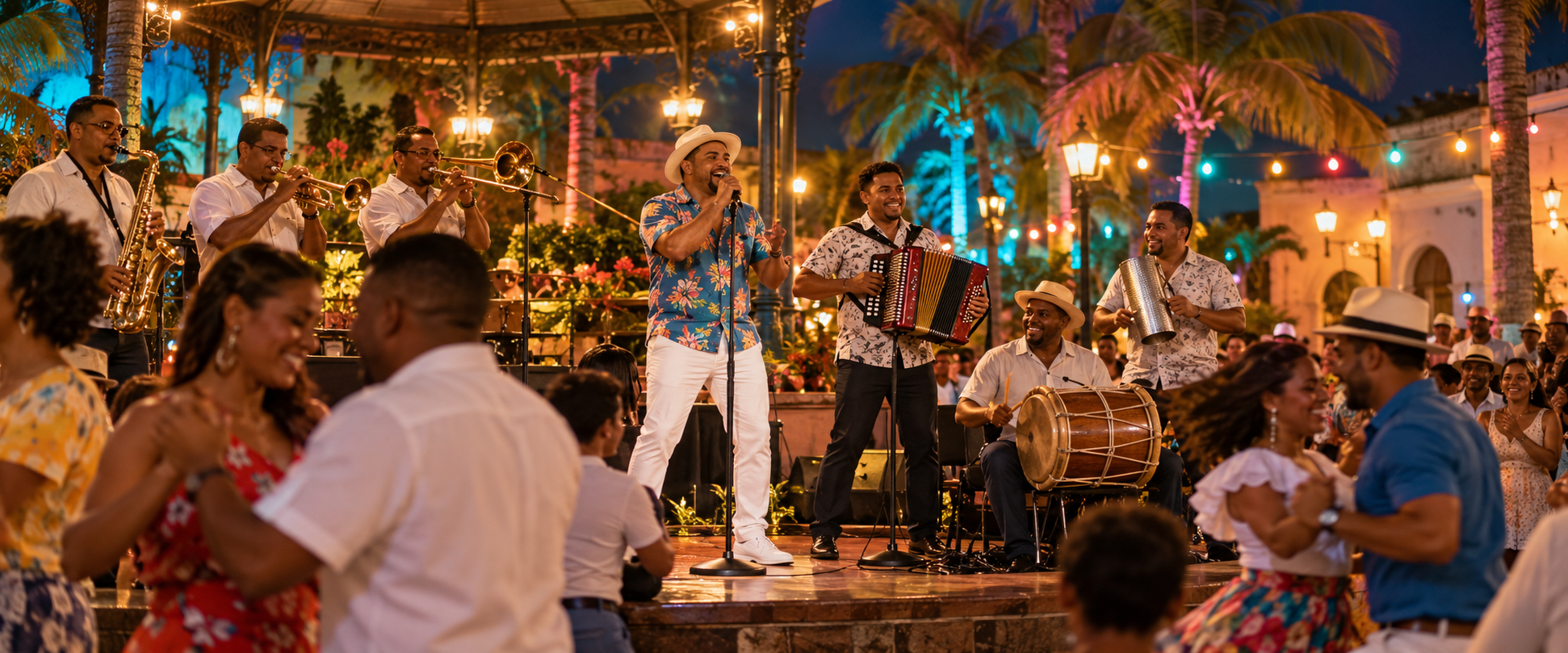
A bright accordion melody begins, followed by the unmistakable sound of scraping percussion. A drum establishes the rhythm, the bass joins in, and the entire arrangement seems to move forward.
Then the singer enters.
The melody is lively, the rhythm remains clear, and the instruments respond to one another with energetic phrases.
Even before you recognize the song, you can feel the music's momentum.
This is one of the defining pleasures of merengue music.
Closely associated with the Dominican Republic, merengue is both a musical tradition and a social dance. Its distinctive rhythmic character has helped it become one of the most recognizable styles of Caribbean dance music.
Traditional performances often feature accordion, tambora drum, and güira percussion. Larger orchestral arrangements may introduce brass sections, piano, bass, and other instruments.
Contemporary recordings can incorporate synthesizers, electronic percussion, and influences from modern popular music.
Yet the essential appeal often remains the same: a clear rhythmic pulse that encourages movement.
Merengue is more than fast dance music. Its history, instrumentation, melodic traditions, and cultural importance make it a rewarding style for close listening.
In this guide, we'll explore merengue's Dominican roots, musical characteristics, major styles, influential artists, essential recordings, and practical listening techniques.
We'll also create a one-hour listening journey and explain how to explore Merengue radio on 1LiveRadio.
Whether you're preparing for a dance, discovering Caribbean music, or simply looking for something energetic, merengue offers an inviting place to begin.
1. What Is Merengue Music?
Merengue is a musical and dance tradition strongly associated with the Dominican Republic.
It is known for rhythmic movement, expressive melodies, and arrangements that can range from small traditional ensembles to large orchestras.
A dance-oriented pulse
Many merengue recordings feature a regular beat that supports continuous movement.
Percussion
Tambora and güira are especially important in traditional merengue.
Accordion
Accordion is central to many merengue típico performances.
Brass instruments
Trumpets, saxophones, and other horns feature in many orchestral arrangements.
Vocals
Singers contribute memorable melodies, rhythmic phrasing, and expressive performances.
Modern production
Some contemporary recordings use keyboards, synthesizers, and programmed drums.
Musical variety
Merengue includes several styles with different instrumentation and performance traditions.
Why the definition matters
Merengue is not simply a fast rhythm.
It is a musical tradition with a distinctive cultural history.
In 2016, UNESCO inscribed the music and dance of merengue in the Dominican Republic on its Representative List of the Intangible Cultural Heritage of Humanity.
Learn more through UNESCO's official merengue heritage page.
2. Where Did Merengue Originate?
Merengue developed in the Dominican Republic during the nineteenth century, although its precise early history includes competing interpretations.
Its development reflects interactions among different musical and cultural traditions.
Dominican roots
Merengue became an important part of Dominican musical identity.
African musical contributions
African-derived rhythmic traditions contributed to the wider musical environment in which merengue developed.
European musical influences
European dance and instrumental traditions also formed part of the historical context.
Rural performance
Merengue developed through regional and community performance practices.
Urban development
The music later became prominent in urban entertainment.
Recording and radio
Broadcasting helped bring merengue to wider audiences.
International recognition
Performers introduced the style to listeners beyond the Dominican Republic.
Why history matters
Merengue's development involved musical exchange and changing social environments.
Its history should not be reduced to one instrument, rhythm, or cultural influence.
3. Why Merengue Matters in Dominican Culture
Merengue has an important place in Dominican cultural life.
National identity
The genre is closely associated with the Dominican Republic.
Social dancing
Merengue is performed at celebrations and community gatherings.
Family events
The music frequently accompanies social occasions.
Public performances
Bands and orchestras contribute to the genre's performance traditions.
Cultural transmission
Musical knowledge passes between generations.
International communities
Dominican communities have carried merengue to other countries.
UNESCO recognition
Its cultural importance was recognized through UNESCO's 2016 inscription.
Why this matters
Merengue is more than entertainment.
It is a living musical and dance tradition.
4. What Makes Merengue Sound Distinctive?
Several musical elements contribute to merengue's recognizable character.
Rhythmic drive
The rhythm creates continuous movement.
Clear pulse
Many recordings emphasize a regular beat.
Percussion interaction
Tambora and güira provide complementary rhythmic patterns.
Accordion melodies
Traditional ensembles often feature energetic accordion phrases.
Brass arrangements
Orchestral merengue may emphasize powerful horn sections.
Vocal hooks
Singers contribute memorable melodies.
Instrumental variation
Different ensembles create different textures.
Listening tip
Choose a merengue recording.
Focus first on the percussion.
Then notice how the melody moves around the rhythmic foundation.
5. Understanding Merengue Rhythm
Rhythm is central to merengue's musical identity.
Many recordings are organized around a clear duple-meter pulse.
Regular beat
The pulse supports dancing.
Tambora patterns
The drum contributes rhythmic accents.
Güira
The scraping instrument adds continuous rhythmic texture.
Bass
Basslines reinforce the groove.
Rhythmic variation
Performers may introduce accents and changes.
Tempo
Merengue is frequently energetic, although tempos vary.
Ensemble interaction
Different instruments contribute to the overall rhythmic movement.
Listening exercise
Tap your foot to the main beat.
Then listen to the güira.
Notice how its continuous pattern interacts with the drum.
6. The Tambora Drum
The tambora is an important percussion instrument in Dominican merengue.
Construction
The instrument is a double-headed drum.
Performance
Players use different striking techniques to create contrasting sounds.
Rhythmic foundation
Tambora patterns contribute to merengue's characteristic groove.
Instrument interaction
The drum works closely with güira and other instruments.
Musical accents
Different strokes create rhythmic variation.
Traditional importance
Tambora is central to many traditional ensembles.
Listening tip
Focus on the drum.
Notice how its accents interact with the steady pulse.
7. The Güira: Merengue's Rhythmic Texture
The güira is a metal scraping percussion instrument.
It contributes a distinctive sound to many merengue performances.
Metallic texture
The instrument produces a bright scraping sound.
Repeated patterns
Continuous rhythmic figures help maintain movement.
Interaction with tambora
The two instruments create complementary patterns.
Traditional ensembles
Güira is a key component of merengue típico.
Orchestral arrangements
The instrument may also appear in larger ensembles.
Rhythmic clarity
Its sound helps define the groove.
Listening tip
Choose a traditional merengue recording.
Follow the güira throughout the track.
Notice how it creates continuity even when the melody changes.
8. The Accordion in Merengue
Accordion is strongly associated with merengue típico, also known in some contexts as perico ripiao.
Melodic lead
The accordion frequently carries the main melody.
Rhythmic phrasing
Accordion passages interact with the percussion.
Ornamentation
Players may introduce decorative melodic figures.
Repetition
Recurring phrases help establish the song's identity.
Improvisation
Some performers introduce variations during instrumental passages.
Regional identity
Accordion-led merengue remains important in Dominican musical culture.
Listening tip
Follow the accordion melody.
Notice how it changes while the percussion maintains the groove.
For a recording-based introduction, explore Smithsonian Folkways' Merengue Típico from the Dominican Republic.
9. Merengue Típico: Traditional Dominican Merengue
Merengue típico is a traditional style associated particularly with the Dominican Republic's Cibao region.
Accordion
The accordion often provides the melodic lead.
Tambora
The drum contributes rhythmic movement.
Güira
The scraping instrument provides a characteristic rhythmic texture.
Bass
Bass instruments support the groove.
Performance energy
The music often emphasizes lively interaction.
Musical variation
Performers may extend or vary instrumental passages.
Cultural continuity
Merengue típico remains an important living tradition.
Artists to explore
-
Fefita la Grande.
-
El Prodigio.
-
La India Canela.
-
Francisco Ulloa.
Listening tip
Compare two típico performances.
Notice differences in accordion phrasing and ensemble interaction.
10. What Is Perico Ripiao?
Perico ripiao is a term commonly associated with traditional accordion-led merengue.
Its usage can vary by context.
Small ensembles
Traditional performances often feature compact instrumental groups.
Accordion
The instrument carries many melodic passages.
Tambora
The drum provides rhythmic accents.
Güira
The instrument contributes continuous scraping patterns.
Dance rhythm
The music emphasizes movement.
Performance traditions
Musicians may introduce melodic variations.
Important distinction
Merengue típico and perico ripiao are closely related terms, but historical and regional usage can vary.
Listening tip
Focus on the interaction among accordion, tambora, and güira.
11. Merengue de Orquesta
Merengue de orquesta refers to orchestral approaches to merengue.
These arrangements often differ from smaller típico ensembles.
Brass sections
Trumpets and saxophones may feature prominently.
Piano
Piano contributes harmony and rhythmic patterns.
Bass
Basslines support the groove.
Percussion
Tambora, güira, and other instruments provide rhythmic movement.
Vocals
Lead singers and backing voices may interact.
Arrangements
Larger ensembles allow more complex instrumental sections.
Artists to explore
-
Johnny Ventura.
-
Wilfrido Vargas.
-
Fernando Villalona.
-
Sergio Vargas.
Listening tip
Compare an orchestral merengue recording with a típico performance.
Notice how the instrumentation changes the sound.
12. Merengue and Brass Instruments
Brass and reed instruments are prominent in many orchestral merengue arrangements.
Trumpets
Trumpets may introduce bright melodic phrases.
Saxophones
Saxophones can contribute rhythmic and melodic passages.
Instrumental responses
Horn sections may answer vocal lines.
Repeated riffs
Short recurring phrases add energy.
Ensemble coordination
Different instruments perform complementary parts.
Dynamic changes
Brass sections can create dramatic accents.
Listening tip
Follow the horn section through one complete recording.
Notice how it interacts with the singer and percussion.
13. Merengue Vocals
Vocals contribute strongly to the character of many merengue recordings.
Melodic hooks
Singers often introduce memorable phrases.
Rhythmic delivery
Vocal phrasing interacts with the beat.
Call and response
Lead singers and backing voices may exchange phrases.
Expressive performance
Singers can vary intensity and articulation.
Group vocals
Some arrangements feature ensemble singing.
Lyrical variety
Songs address different subjects and moods.
Listening tip
Focus on the chorus.
Notice how the vocal melody fits within the rhythm.
14. Merengue Lyrics and Themes
Merengue recordings explore a range of lyrical subjects.
Celebration
Some songs emphasize festive experiences.
Love
Romantic relationships are common themes.
Humor
Certain recordings use playful storytelling.
Social commentary
Some songs address everyday experiences and social issues.
Community
Music can reflect shared cultural experiences.
Personal stories
Lyrics may describe individual circumstances.
Important distinction
No single lyrical theme defines every merengue recording.
Listening tip
Find an accurate translation of a song you enjoy.
Notice how its meaning changes your interpretation.
15. Merengue and Social Dancing
Merengue is closely associated with social partner dancing.
Clear pulse
The rhythm provides a recognizable foundation.
Continuous movement
Dancers can maintain a regular step.
Partner interaction
Social dancing emphasizes coordination.
Musical phrasing
Changes in melody can influence movement.
Tempo variation
Different recordings create different levels of energy.
Cultural context
Merengue dancing is connected with Dominican social traditions.
Beginner tip
Begin by identifying the main beat.
Practice moving comfortably in time before adding more elaborate steps.
16. Merengue vs. Bachata
Merengue and bachata are both important Dominican musical traditions.
However, they have different histories and musical characteristics.
Merengue
Often emphasizes a lively rhythmic pulse.
Bachata
Frequently features guitar-based arrangements and expressive vocals.
Instrumentation
Traditional merengue may feature accordion, tambora, and güira.
Bachata commonly emphasizes guitar, bass, bongos, and güira.
Dance
Both are associated with social partner dancing.
Musical mood
Both genres include different moods, although their rhythmic approaches differ.
Cultural identity
Each has a distinct place in Dominican music.
Listening tip
Compare one merengue recording with one bachata track.
Focus on the rhythm and instrumentation.
For more, read The small details that make Bachata memorable.
17. Merengue vs. Salsa
Merengue and salsa are both associated with Latin dance music.
However, their rhythmic structures and histories differ.
Merengue
Many recordings emphasize a clear duple-meter pulse.
Salsa
Many arrangements involve Afro-Cuban rhythmic structures and layered percussion.
Instrumentation
Orchestral versions of both genres may feature brass sections.
Piano
Piano is prominent in many salsa arrangements and some merengue arrangements.
Percussion
The instruments and rhythmic patterns differ.
Dance
Both genres have established social dance traditions.
Listening tip
Compare the rhythmic foundation of one merengue track with one salsa recording.
Notice how the accents differ.
Explore What makes Salsa radio worth a listen.
18. Merengue vs. Cumbia
Merengue and cumbia developed through different musical histories.
Merengue
Strongly associated with the Dominican Republic.
Cumbia
Has important roots in Colombia.
Rhythm
The styles use different rhythmic approaches.
Instrumentation
Traditional merengue frequently emphasizes tambora, güira, and accordion.
Cumbia instrumentation varies considerably by region.
Dance traditions
Both are associated with social dancing.
Regional development
Cumbia developed numerous regional forms across Latin America.
Listening tip
Compare the percussion and bass patterns.
Notice how each genre organizes movement.
For more, explore How to spend an hour with Cumbia music.
19. Merengue and Latin Music
Merengue is one of many musical traditions included in the broad Latin music category.
Caribbean roots
The genre developed in the Dominican Republic.
Dance culture
Merengue is closely connected with social dancing.
Musical exchange
Performers have incorporated different influences.
International audiences
The style reached listeners beyond the Dominican Republic.
Contemporary recordings
Modern production continues to shape the genre.
Cultural identity
Merengue remains strongly connected with Dominican musical heritage.
Important distinction
Latin music is a broad category, not one musical genre.
Related guide
Explore Finding your place in Latin radio.
20. Influential Merengue Artists
Several performers helped shape merengue's development and international recognition.
Johnny Ventura
A Dominican singer and bandleader who played an important role in modernizing merengue performance.
Listen for: Energetic vocals, rhythmic arrangements, and ensemble interaction.
Wilfrido Vargas
A Dominican musician and bandleader associated with influential orchestral merengue.
Listen for: Brass arrangements and lively rhythmic production.
Juan Luis Guerra
A Dominican singer-songwriter whose work incorporates merengue, bachata, and other musical influences.
Listen for: Melodic songwriting and carefully developed arrangements.
Milly Quezada
A Dominican singer closely associated with merengue.
Listen for: Expressive vocals and dance-oriented arrangements.
Sergio Vargas
A Dominican performer known for merengue and related popular music.
Listen for: Vocal phrasing and rhythmic energy.
Fernando Villalona
A Dominican singer associated with merengue and other popular styles.
Listen for: Melody and performance character.
Fefita la Grande
An influential Dominican accordionist associated with merengue típico.
Listen for: Accordion melodies and traditional ensemble interaction.
El Prodigio
A Dominican accordionist associated with contemporary merengue típico.
Listen for: Instrumental technique and energetic arrangements.
La India Canela
A Dominican accordionist associated with merengue típico.
Listen for: Accordion phrasing and traditional rhythmic textures.
Why this selection matters
These performers represent different approaches to merengue.
Their recordings reveal how the genre developed through traditional and modern arrangements.
21. Essential Merengue Songs to Explore
The following recordings provide useful starting points for discovering merengue.
They are listening suggestions rather than a definitive ranking.
1. Johnny Ventura – Patacón Pisao
A recognizable recording associated with Johnny Ventura.
Listen for: Rhythmic energy and vocal delivery.
2. Wilfrido Vargas – El Africano
A well-known merengue recording.
Listen for: Brass arrangements and energetic percussion.
3. Juan Luis Guerra – La Bilirrubina
A famous merengue recording.
Listen for: Melodic hooks and rhythmic movement.
4. Milly Quezada – Volvió Juanita
A well-known song associated with Dominican merengue performance.
Listen for: Vocal expression and festive energy.
5. Los Hermanos Rosario – La Dueña del Swing
An energetic merengue recording.
Listen for: Rhythmic drive and ensemble arrangement.
6. Sergio Vargas – La Ventanita
A recognizable recording associated with merengue.
Listen for: Vocal melody and rhythmic accompaniment.
7. Juan Luis Guerra – El Niágara en Bicicleta
A popular merengue recording.
Listen for: Storytelling and rhythmic arrangement.
8. Fefita la Grande – Traditional merengue típico performances
Explore recordings from her extensive catalog.
Listen for: Accordion technique and percussion interaction.
Why this selection works
These recordings illustrate different aspects of merengue.
They also provide starting points for exploring influential performers.
22. Women in Merengue
Women have made important contributions to merengue performance and development.
Milly Quezada
A prominent singer associated with merengue.
Fefita la Grande
An influential accordionist associated with merengue típico.
La India Canela
A Dominican accordionist recognized for her work in traditional merengue.
Performance traditions
Women have contributed as singers, instrumentalists, and bandleaders.
Musical innovation
Different performers have introduced distinctive approaches.
Cultural representation
Their work forms an important part of merengue history.
Why this matters
A complete introduction to merengue should recognize contributions from performers across different generations.
For more, explore Smithsonian Folkways' profile of La India Canela.
23. How Merengue Creates Energy
Merengue often creates excitement through rhythmic continuity and instrumental interaction.
Regular pulse
The beat provides a stable foundation.
Percussion layers
Tambora and güira contribute movement.
Basslines
Bass reinforces the groove.
Melodic hooks
Recognizable phrases maintain interest.
Brass accents
Orchestral arrangements may introduce powerful instrumental passages.
Vocal interaction
Singers and backing voices contribute energy.
Dynamic variation
Changes in instrumentation create contrast.
Listening tip
Follow one merengue recording from beginning to end.
Identify three moments when the arrangement changes while the main pulse remains recognizable.
24. How to Listen to Merengue More Closely
A structured listening method can help beginners recognize the genre's characteristics.
First listen: Find the pulse
Tap along to the main beat.
Second listen: Focus on the güira
Notice the continuous scraping pattern.
Third listen: Follow the tambora
Identify the drum accents.
Fourth listen: Explore the melody
Follow the accordion, brass, or vocal line.
Fifth listen: Notice the bass
Listen to how it supports the groove.
Sixth listen: Compare sections
Notice changes between verses, choruses, and instrumental passages.
Seventh listen: Consider the atmosphere
Ask how the instruments work together to create movement.
A useful question
What keeps the music moving even when the melody changes?
Often, the answer lies in the rhythmic foundation.
25. A One-Hour Merengue Listening Journey
A structured listening session can introduce several aspects of merengue.
The following plan takes approximately sixty minutes.
Choose recordings or excerpts that fit each time block.
Minutes 0–10: Begin With Merengue Típico
Suggested artists:
-
Fefita la Grande.
-
La India Canela.
What to notice:
Focus on accordion, tambora, and güira.
Listening goal: Recognize the traditional instrumental foundation.
Minutes 10–20: Explore Classic Orchestral Merengue
Suggested artists:
-
Johnny Ventura.
-
Wilfrido Vargas.
What to notice:
Listen for brass arrangements and energetic vocals.
Listening goal: Understand the orchestral approach.
Minutes 20–30: Discover Melodic Merengue
Suggested artist:
-
Juan Luis Guerra.
What to notice:
Focus on songwriting, melody, and arrangement.
Listening goal: Appreciate melodic development within the rhythmic groove.
Minutes 30–40: Explore Vocal Performance
Suggested artists:
-
Milly Quezada.
-
Sergio Vargas.
What to notice:
Follow vocal phrasing and ensemble interaction.
Listening goal: Recognize different performance approaches.
Minutes 40–50: Compare Merengue and Bachata
Choose one merengue recording and one bachata track.
What to notice:
Compare rhythm, instrumentation, and vocal delivery.
Listening goal: Understand the differences between two Dominican musical traditions.
Minutes 50–60: Explore Merengue Radio
Finish by browsing the Merengue category on 1LiveRadio.
Choose a station that interests you.
Listen to several recordings without selecting individual tracks.
Listening goal: Discover an unfamiliar performer or musical approach.
Reflect on your listening session
Ask yourself:
-
Which rhythm interested you most?
-
Did you prefer accordion-led or orchestral arrangements?
-
Which singer stood out?
-
Did the güira or tambora catch your attention?
-
Which artist would you like to explore further?
Your answers can guide future listening.
26. How to Choose a Merengue Radio Station
Merengue radio stations may feature different musical approaches.
Traditional merengue
Some programming may emphasize accordion-led recordings.
Merengue típico
Certain stations may focus on traditional Dominican ensembles.
Orchestral merengue
Other programming may feature brass-heavy arrangements.
Classic merengue
Some stations may emphasize recordings from earlier decades.
Contemporary merengue
Others may include recent productions.
Mixed Latin dance music
Some stations combine merengue with salsa, bachata, and other styles.
How to choose
Read the station description.
Look for information about its musical focus.
Then listen to several tracks before deciding whether the programming suits your preferences.
Browse Merengue radio
Visit the Merengue category on 1LiveRadio.
27. Merengue Radio on 1LiveRadio
The Merengue category on 1LiveRadio provides a starting point for exploring stations associated with the genre.
Explore the category
Open the Merengue category page.
Review station descriptions
Look for information about programming.
Identify musical preferences
Some listeners prefer traditional accordion-led recordings.
Others enjoy orchestral arrangements.
Compare performers
Different artists use different vocal and instrumental approaches.
Listen to several tracks
One recording may not represent a station's overall programming.
Discover related music
Explore salsa, bachata, cumbia, and other Latin styles.
Important consideration
Station programming and stream availability may change.
Check individual station descriptions and players when listening.
28. Merengue for Different Listening Moods
Merengue includes recordings suited to different listening experiences.
Celebrations
Energetic tracks can contribute to a festive atmosphere.
Social dancing
The regular pulse supports movement.
Family gatherings
Merengue can accompany social occasions.
Focused listening
Traditional ensembles reward attention to instrumental interaction.
Cultural discovery
The genre provides an introduction to Dominican musical traditions.
Artist exploration
Different performers offer different musical approaches.
Why mood matters
Merengue is often associated with energy, but individual recordings vary.
Choose songs according to their musical characteristics.
29. Building Your Own Merengue Playlist
A personal playlist can help you explore the genre systematically.
Start with merengue típico
Choose an accordion-led recording.
Add orchestral merengue
Include a track featuring brass arrangements.
Explore classic performers
Choose recordings associated with Johnny Ventura or Wilfrido Vargas.
Include melodic songwriting
Add a merengue recording by Juan Luis Guerra.
Discover female performers
Explore Milly Quezada, Fefita la Grande, or La India Canela.
Compare traditional and modern production
Notice how instrumentation changes.
Revisit favorites
Repeated listening can reveal subtle details.
Expand gradually
Follow the artists and styles that interest you most.
30. Common Mistakes When Exploring Merengue
Merengue has a rich musical history, and several assumptions can limit discovery.
Mistake 1: Assuming merengue is only fast music
Tempo is important, but the genre includes different approaches.
Mistake 2: Ignoring its Dominican roots
Merengue is strongly associated with the Dominican Republic.
Mistake 3: Treating merengue and bachata as identical
They have different histories and musical characteristics.
Mistake 4: Confusing merengue with salsa
Their rhythmic structures and traditions differ.
Mistake 5: Overlooking traditional ensembles
Merengue típico is an important part of the genre.
Mistake 6: Ignoring the güira
The instrument contributes significantly to the rhythmic texture.
Mistake 7: Focusing only on percussion
Melody and arrangement are also important.
Mistake 8: Assuming every recording uses accordion
Orchestral and modern arrangements may emphasize different instruments.
Mistake 9: Ignoring cultural context
Merengue is connected with Dominican social and musical traditions.
Mistake 10: Judging a radio station after one track
Several recordings provide a better understanding of its programming.
A better approach
Listen to the rhythm, explore different ensembles, and learn about the music's history.
31. Why Merengue Radio Is Useful for Music Discovery
Merengue radio provides a convenient way to explore the genre.
Continuous listening
You can hear several recordings without selecting every track.
Artist discovery
Radio may introduce unfamiliar performers.
Musical variety
Stations may feature traditional and modern styles.
Rhythmic comparison
Listeners can compare different arrangements.
Cultural exploration
Merengue can lead toward broader Dominican musical traditions.
Unexpected discoveries
A new recording may introduce a different instrumental approach.
Why it matters
Merengue includes more variety than one playlist can represent.
Radio can help listeners explore beyond familiar songs.
32. Merengue as a Living Musical Tradition
Merengue continues to develop through performers, communities, and changing musical technology.
Traditional ensembles
Accordion-led performances remain important.
Contemporary artists
New recordings reflect changing influences.
Digital platforms
Online services make music easier to discover.
Production technology
Electronic instruments contribute to new arrangements.
Performance culture
Live events remain important.
International audiences
Merengue continues to reach listeners beyond the Dominican Republic.
Cultural heritage
UNESCO recognition highlights its significance.
Why this matters
Merengue is not simply a historical musical style.
It remains a living tradition.
33. Explore Merengue and Related Music on 1LiveRadio
Merengue connects with a wider musical landscape worth exploring.
Discover Merengue radio
Browse the Merengue category on 1LiveRadio.
Explore Latin music
Read Finding your place in Latin radio.
Discover Bachata
Read The small details that make Bachata memorable.
Explore Salsa
Read What makes Salsa radio worth a listen.
Discover Cumbia
Read How to spend an hour with Cumbia music.
Learn about Dominican cultural heritage
Explore UNESCO's official merengue heritage page.
Discover traditional merengue recordings
Visit Smithsonian Folkways' Merengue Típico from the Dominican Republic.
Explore merengue history
Read A History of Merengue from iASO Records.
These resources provide different starting points for discovering the music.
Frequently Asked Questions About Merengue Music
What is merengue music?
Merengue is a musical and dance tradition strongly associated with the Dominican Republic.
Where did merengue originate?
Merengue developed in the Dominican Republic during the nineteenth century.
Is merengue Dominican music?
Yes. Merengue is closely associated with Dominican musical heritage.
Is merengue a Latin music genre?
Yes. Merengue is one of many musical traditions included within the broad Latin music category.
What does merengue sound like?
Many recordings feature lively rhythms, percussion, melodic instruments, and expressive vocals.
What instruments are common in merengue?
Tambora, güira, accordion, bass, brass instruments, piano, and keyboards may appear.
What is a tambora?
Tambora is a double-headed drum important in Dominican merengue.
What is a güira?
Güira is a metal scraping percussion instrument used in merengue.
Why is accordion important in merengue?
Accordion is central to many merengue típico performances.
What is merengue típico?
Merengue típico is a traditional Dominican style associated with accordion-led ensembles.
What is perico ripiao?
Perico ripiao is a term commonly associated with traditional accordion-led merengue.
What is merengue de orquesta?
Merengue de orquesta refers to orchestral arrangements that often feature brass sections and larger ensembles.
Is merengue always fast?
No. Tempos vary, although the genre is often associated with energetic movement.
Is merengue dance music?
Yes. Merengue is closely connected with social dancing.
Is merengue the same as bachata?
No. They are distinct Dominican musical traditions.
Is merengue the same as salsa?
No. They have different rhythmic structures and musical histories.
Is merengue the same as cumbia?
No. Merengue and cumbia developed through different cultural traditions.
Who are some famous merengue artists?
Examples include Johnny Ventura, Wilfrido Vargas, Juan Luis Guerra, Milly Quezada, Sergio Vargas, and Fefita la Grande.
Who was Johnny Ventura?
Johnny Ventura was an influential Dominican singer and bandleader associated with modern merengue.
Who is Wilfrido Vargas?
Wilfrido Vargas is a Dominican musician and bandleader associated with influential orchestral merengue recordings.
Who is Juan Luis Guerra?
Juan Luis Guerra is a Dominican singer-songwriter whose work incorporates merengue, bachata, and other musical influences.
Who is Milly Quezada?
Milly Quezada is a prominent Dominican singer associated with merengue.
Why is merengue culturally important?
Merengue is an important part of Dominican musical and dance heritage.
Is merengue recognized by UNESCO?
Yes. UNESCO inscribed the music and dance of merengue in the Dominican Republic on its Representative List of the Intangible Cultural Heritage of Humanity in 2016.
What is merengue radio?
Merengue radio refers to stations or programs featuring merengue recordings.
Can I listen to merengue radio online?
Yes. Online radio directories include categories associated with merengue.
Where can I find merengue radio stations?
You can browse the Merengue radio category on 1LiveRadio.
Final Thoughts: A More Natural Way Into Merengue Radio
Merengue offers a musical experience built around rhythm, melody, and shared movement.
A güira may establish a continuous rhythmic texture.
A tambora may introduce distinctive accents.
An accordion may carry a bright melodic phrase.
A brass section may add energy.
A singer may introduce a memorable chorus.
The bassline supports the groove while the arrangement changes around it.
These details help explain why merengue remains such a recognizable part of Caribbean dance music.
The most useful starting point is to follow the rhythm.
Listen to the main pulse.
Notice how the güira and tambora interact.
Follow the bassline.
Pay attention to the accordion or brass.
Listen to the singer's phrasing.
Notice how the arrangement changes without losing its rhythmic foundation.
If you're dancing, begin with a comfortable step that follows the beat.
If you're listening closely, focus on the relationship between percussion and melody.
Some listeners will prefer traditional merengue típico.
Others may enjoy orchestral arrangements, classic recordings, or contemporary production.
There is no single correct starting point.
A natural introduction to merengue begins with its steady movement and grows through an appreciation of its instruments, performers, and Dominican cultural heritage.
To continue exploring, browse the Merengue radio category on 1LiveRadio, discover traditional performances through Smithsonian Folkways, or explore related Caribbean styles through the Bachata and Salsa listening guides.
Your next favorite merengue recording may be the one that makes a familiar rhythm feel entirely new.
Reader comments
No comments yet. Start the conversation.
Leave a comment
Your email stays private. Comments appear after approval.